


Detox is a solid gray-box framework for React Native. However, React Native teams increasingly run into its walls: deep JavaScript expertise requirements, no self-healing when UI changes, and persistent flaky tests caused by async synchronization issues. If you’re looking for a Detox alternative for React Native testing, you’re not alone.
This guide reviews 12 tools built to replace or complement Detox: covering React Native, Flutter, native iOS/Android, and hybrid apps. Each tool is evaluated on what React Native QA teams actually care about: flakiness reduction, no-code options, self-healing, cloud device access, and CI/CD compatibility.
Why React Native Teams Specifically Look for Detox Alternatives
Detox was built for React Native, but that specificity is also its biggest constraint. Here’s what drives React Native QA teams to look for alternatives:
- JavaScript-only limitation: Detox requires test authors to work in JavaScript. Teams with mixed codebases or non-JS QA engineers face a steep learning curve.
- Flaky async tests: Even with Detox’s JS thread synchronization, async operations in complex React Native apps still produce intermittent failures; one of the most common complaints in Detox QA workflows.
- No self-healing: When a UI element changes its identifier or position, Detox tests break and require manual updates. Modern alternatives auto-repair locators.
- iOS and Android parity gaps: Detox’s behavior sometimes differs across platforms, creating inconsistencies that are hard to debug.
- No cross-framework support: If your app evolves to include Flutter components or native views, Detox can’t follow. Alternatives like Appium or Panto AI handle mixed stacks.
- Heavy setup overhead: Configuring Detox with simulators, build configurations, and CI pipelines takes significant time before a single test runs.
These Detox alternatives below address each of these gaps, with different trade-offs depending on your team’s size, stack, and tolerance for configuration.
Top 12 Detox Alternatives for React Native Testing
1. Panto AI
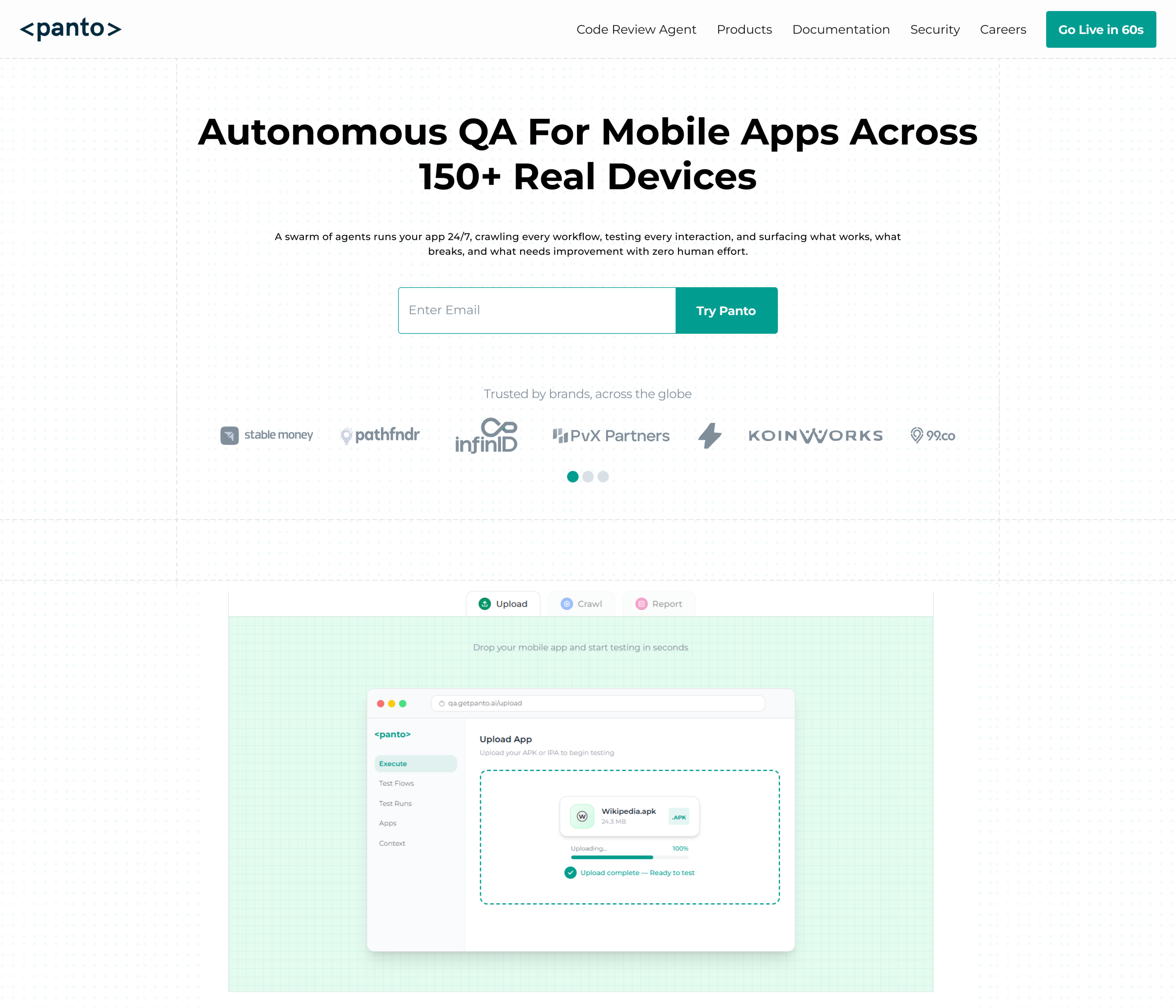
Panto AI is the most direct Detox alternative for React Native testing. It eliminates the two biggest Detox pain points — flaky async tests and manual locator maintenance, through AI-powered self-healing and natural language test generation. No JavaScript expertise required from your QA team.
Tests run on real iOS and Android devices, with detailed Slack reports that include videos, screenshots, and step-by-step logs. CI/CD integration means tests trigger automatically on every push, with zero maintenance overhead when your UI changes.
Panto AI also goes beyond test execution, it ships code with 30,000+ SAST security checks and dynamic code review, making it a full QA layer rather than just a test runner.
Key Features
- Natural language test case generation
- Automatic self-healing for UI changes
- Real device execution on iOS and Android
- CI/CD pipeline integration with instant triggers
- Slack and dashboard reports with video playback
How it facilitates React Native testing Panto AI handles React Native’s async patterns natively, without the JS thread synchronization complexity that causes Detox flakiness. It works across mixed stacks too, so if your app includes native views alongside RN components, tests don’t break.
Limitations
- Proprietary platform with no open-source option
- Requires onboarding to get context memory calibrated
- Less suitable for teams that want full script-level control
Best For: React Native teams who want a no-code, self-healing Detox replacement with minimal setup and zero ongoing maintenance.
2. Appium
Appium is the most widely adopted open-source framework for mobile test automation, and the most natural migration path for teams leaving Detox. It uses the WebDriver protocol to test native, hybrid, and web apps across iOS and Android without requiring app recompilation.
Unlike Detox’s JavaScript-only constraint, Appium supports multiple languages: JavaScript, Python, Java, Ruby, and more — making it accessible to QA engineers across different stacks. Its plugin ecosystem and Selenium Grid compatibility make it a strong fit for teams already running web automation.
The trade-off is setup complexity. Appium requires driver configuration, explicit wait management, and more initial CI/CD wiring than Detox, but the flexibility it offers in return is unmatched in the open-source space.
Key Features
- Multi-language binding support (JS, Python, Java, Ruby)
- WebDriver protocol for native, hybrid, and web apps
- Selenium Grid integration for parallel execution
- Built-in element inspector
- Large plugin ecosystem and community
How it facilitates React Native testing Appium tests React Native apps through the same interfaces as any native app, no special bridge required. It handles both iOS and Android in a single test suite, unlike Detox which can behave inconsistently across platforms.
Limitations
- No automatic JS thread synchronization — explicit waits required
- Higher setup and maintenance overhead than Detox
- No self-healing; locator changes break tests
Best For: Teams with multi-language QA engineers who need full cross-platform flexibility and are comfortable managing driver configuration.
3. Testsigma
Testsigma brings codeless test creation to React Native testing through plain English NLP, letting non-technical QA authors write, run, and maintain tests without touching a line of code. Its AI copilot records user flows and converts them into executable test cases automatically.
The platform runs on a real device cloud of 3,000+ devices, eliminating the need for local simulator management. NLP-powered self-healing keeps locators stable when UI elements change, reducing the maintenance burden that makes Detox costly at scale.
Jenkins and GitHub Actions integrations make it straightforward to slot into existing CI/CD pipelines, and unified web and mobile coverage means teams don’t need separate tooling for different surfaces.
Key Features
- Natural language test authoring
- 3,000+ real device cloud access
- AI-powered record and playback
- Self-healing locators
- CI/CD integration with Jenkins and GitHub Actions
How it facilitates React Native testing Testsigma’s NLP engine abstracts away React Native’s underlying complexity — testers describe what they want to test in plain English, and the platform handles execution across both iOS and Android. No knowledge of React Native’s async model needed.
Limitations
- Paid platform with limited free tier
- Less granular control than code-based frameworks
- Custom logic still requires developer involvement
Best For: Teams where QA is owned by non-engineers who need a scalable, low-maintenance alternative to Detox with real device coverage.
4. TestGrid

TestGrid combines manual, automated, and low-code testing in one platform, with access to real Samsung and Apple devices through a secure cloud. Its turbo mode delivers lag-free remote control, and precise gesture replication, including multi-touch and complex swipes, makes it well-suited for testing interaction-heavy React Native UIs.
AI script generation converts natural language descriptions into automated test scripts, reducing the time from test idea to execution. Device locking ensures your team always has access to specific devices during critical release windows.
Flakiness analytics dashboards surface patterns proactively, making it easier to identify which test steps are unreliable and why, a significant improvement over Detox’s debugging experience.
Key Features
- Real device access with turbo remote control
- AI-generated scripts from natural language
- Device locking for release-critical testing
- Flakiness analytics dashboard
- Cross-browser mobile web support
How it facilitates React Native testing TestGrid’s gesture replication handles the touch-based interactions common in React Native apps accurately. The no-code path lets QA teams build smoke test suites for RN apps without JavaScript knowledge.
Limitations
- Self-healing is partial, not fully automatic
- Less mature ecosystem than Appium or Espresso
- Some advanced features locked behind higher-tier plans
Best For: QA teams that blend manual exploratory testing with automation, and need real device access with strong gesture support.
5. Perfecto
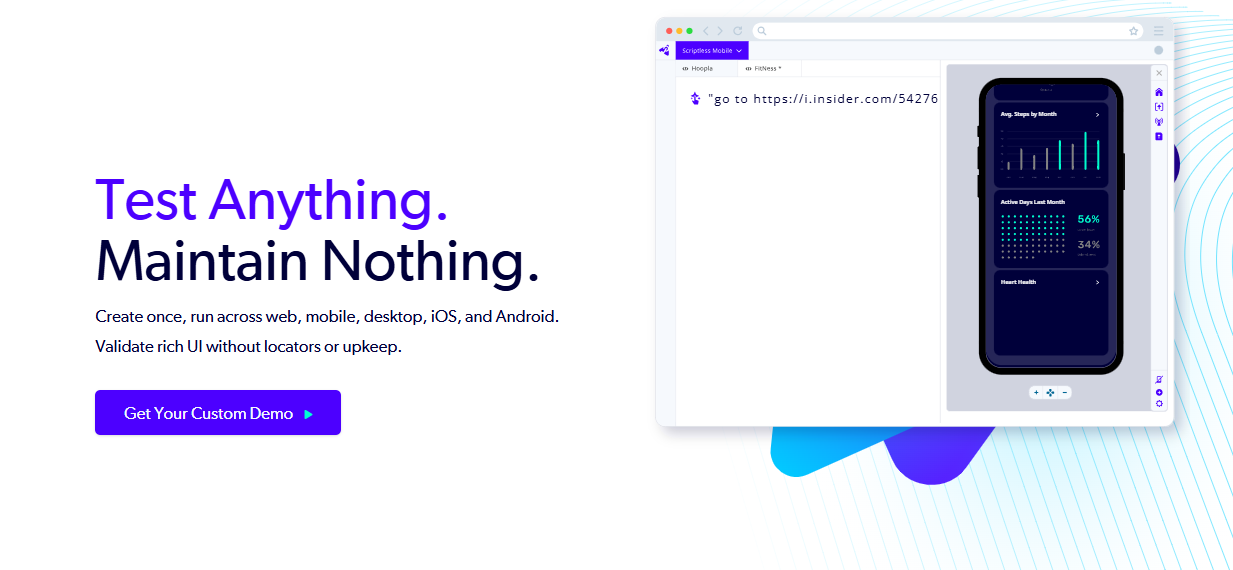
Perfecto provides enterprise-grade real device cloud testing with native support for Appium, Espresso, and XCUITest, making it framework-agnostic and easy to migrate to from Detox. Its continuous testing triggers directly from CI/CD pipelines, and global device fleets cover every OS version and carrier network.
Intelligent wait mechanisms reduce flakiness significantly, while 5G network virtualization lets teams test how React Native apps behave under edge connectivity conditions. The unified environment for functional, security and visual testing reduces the number of separate tools teams need to manage.
Advanced analytics surface performance regressions early, and granular SSO role-based access makes it a practical choice for large distributed engineering teams.
Key Features
- Global real device fleet with carrier network simulation
- Native Appium, Espresso, and XCUITest support
- 5G network virtualization
- Unified functional, visual, and security testing
- Granular SSO and role-based access control
How it facilitates React Native testing Perfecto’s framework-agnostic design means your existing Detox-era test logic can be migrated to Appium and run on Perfecto’s infrastructure with minimal rewriting. Carrier simulation is particularly useful for testing React Native apps in markets with variable network conditions.
Limitations
- No self-healing — locator changes still require manual updates
- Premium pricing, designed for enterprise budgets
- Steeper learning curve for smaller teams
Best For: Enterprise teams that need global device coverage, compliance-grade reporting, and CI/CD-integrated testing at scale.
6. Testim Mobile

Testim Mobile uses machine learning to detect and stabilize UI elements, making it one of the more flake-resistant Detox alternatives available. Codeless recording captures interactions across React Native, Flutter, and native apps, and smart locators dynamically select the most stable identifier available, reducing test breakage when UIs change.
Cloud execution removes the need for local simulator setup, and AI automatically repairs failing locators during maintenance cycles. Shared test libraries enable cross-team collaboration, which is useful when QA and development operate independently.
The overall maintenance burden drops significantly compared to Detox scripting, which matters most for teams shipping frequent React Native updates.
Key Features
- ML-powered locator stability
- Codeless recording across RN, Flutter, and native
- Cloud parallel execution
- Automatic locator repair
- Shared test libraries for team collaboration
How it facilitates React Native testing Testim Mobile’s ML engine handles the element instability that causes most Detox flakiness in React Native apps. It identifies elements by behavior and visual context, not just static identifiers, so tests survive UI refactors.
Limitations
- Less control than code-first frameworks
- Pricing scales with usage, which can get expensive
- Fewer integrations than Appium in enterprise pipelines
Best For: React Native teams that want ML-powered stability without writing test code, especially those with frequent UI iteration cycles.
7. Espresso
Espresso is Google’s native Android UI testing framework and the gold standard for Android-only test automation. Its automatic synchronization with the Android UI thread eliminates most of the timing-related flakiness that affects Detox without requiring explicit waits or custom synchronization logic.
Deep Android Studio integration means it fits directly into developer workflows, and Gradle-based parallel execution via Orchestrator makes it fast at scale. Built-in retry mechanisms handle transient failures gracefully, and its Kotlin and Java APIs are idiomatic for Android developers.
The trade-off is platform scope: Espresso is Android-only, so it can’t replace Detox for teams testing on both iOS and Android.
Key Features
- Automatic UI thread synchronization
- Kotlin and Java fluent APIs
- Advanced scroll and adapter matching
- Async idling resource support
- Android Studio and Gradle integration
How it facilitates React Native testing Espresso can test the Android side of React Native apps at the native layer. For teams where Android coverage is the priority and iOS is handled separately, it provides faster and more reliable execution than Detox on Android.
Limitations
- Android-only — no iOS support
- Requires Java or Kotlin, not JavaScript
- No cloud device farm built-in
Best For: Android-first React Native teams who want the most reliable native test framework for the Android side of their stack.
8. XCUITest

XCUITest is Apple’s native iOS UI automation framework and the most performant option for iOS-only testing. It queries elements through the accessibility tree, provides comprehensive gesture APIs including 3D Touch, and integrates fully with Xcode’s debugging and profiling tools.
Batch parallel execution optimizes CI/CD throughput, and execution speed on simulators and real devices surpasses cross-platform alternatives significantly. Accessibility-focused testing also ensures inclusive app experiences as a byproduct of the test suite.
Like Espresso on Android, XCUITest is platform-specific, it doesn’t extend to Android, making it a partial replacement for Detox rather than a full one.
Key Features
- Native predicate-based element querying
- Complete iOS gesture API including 3D Touch
- Simulator batch execution
- Automatic screenshot diffing
- Full Xcode integration
How it facilitates React Native testing XCUITest tests React Native apps through iOS’s native accessibility layer. It’s the most reliable way to validate the iOS side of a React Native app, which is more stable than Detox on iOS for complex animations and transitions.
Limitations
- iOS-only, no Android coverage
- Requires Swift or Objective-C knowledge
- No self-healing or AI assistance
Best For: iOS-first React Native teams who want the fastest, most reliable native framework for Apple platform testing.
9. Robot Framework
Robot Framework is a keyword-driven test automation framework with a tabular syntax designed to be readable by non-developers as well as engineers. Its Appium library extension brings comprehensive mobile coverage, and its Python foundation ensures OS independence and easy extensibility across different CI/CD environments.
Modular keyword design maximizes test reuse across projects, and rich HTML and PDF reporting makes results accessible to stakeholders outside the QA team. The layered architecture also makes it possible to complement existing Detox investments rather than replacing everything at once.
It’s a practical choice for teams that want structured, maintainable tests without locking into a proprietary platform.
Key Features
- Keyword-driven tabular test format
- Appium library for mobile automation
- Custom listener hooks and variable scoping
- HTML and PDF report generation
- Extensible library ecosystem
How it facilitates React Native testing Robot Framework tests React Native apps through its Appium integration, inheriting Appium’s full iOS and Android compatibility. The keyword abstraction layer makes test logic readable to QA engineers who aren’t familiar with React Native internals.
Limitations
- No self-healing — depends on Appium’s locator stability
- Setup complexity similar to raw Appium
- Not ideal for teams wanting rapid no-code authoring
Best For: Teams that want structured, readable, maintainable tests with Python-based extensibility and don’t want to be tied to a commercial platform.
10. EarlGrey

EarlGrey brings Espresso-style automatic synchronization to iOS testing, handling UI, network, and animation sync natively, without the manual wait logic that makes other iOS frameworks flaky. Auto-retry mechanisms and expressive matchers make tests resilient to transient failures.
It has React Native bridge compatibility, which extends its coverage to hybrid iOS apps alongside fully native ones. Network stubbing isolates API dependencies effectively, making tests more deterministic and faster to run in CI/CD environments.
For teams running iOS-heavy React Native apps who find Detox unstable on iOS specifically, EarlGrey is a targeted fix.
Key Features
- Automatic UI, animation, and network synchronization
- Fluent action chain builders
- Robust accessibility matching
- Intelligent conditional polling
- React Native bridge compatibility
How it facilitates React Native testing EarlGrey’s automatic synchronization handles the animation and async rendering issues that cause Detox flakiness on iOS. Its React Native bridge support means it can interact with RN components directly, not just native views.
Limitations
- iOS-only — no Android support
- Less active community compared to Espresso or XCUITest
- Requires Objective-C or Swift knowledge
Best For: React Native teams where iOS flakiness is the specific problem, and who want Espresso-level synchronization on the Apple side of their stack.
11. Selendroid

Selendroid is a lightweight WebDriver-based framework specializing in Android automation, with built-in support for hybrid app testing and multi-session management. Its integrated UI hierarchy inspector makes element targeting straightforward, and Selenium Grid compatibility supports distributed execution across multiple devices.
It handles legacy Android versions gracefully, a niche but important capability for apps that still need to support older device ecosystems. The lightweight Java architecture has a smaller resource footprint than a full Appium server, which matters in resource-constrained CI environments.
For most React Native teams, Selendroid is a legacy or niche choice, but it fills specific gaps that larger frameworks don’t always address cleanly.
Key Features
- Multi-app concurrent session support
- Integrated UI hierarchy viewer
- Selenium Grid compatibility
- Comprehensive gesture APIs
- Open plugin architecture
How it facilitates React Native testing Selendroid can test the Android layer of React Native apps through WebDriver, making it useful for teams that need hybrid app coverage or legacy Android version support that Detox doesn’t provide.
Limitations
- Android-only, no iOS support
- Less actively maintained than Appium or Espresso
- No self-healing or AI-assisted features
Best For: Teams with legacy Android version requirements or hybrid app testing needs that larger frameworks handle poorly.
12. LambdaTest
LambdaTest provides cloud infrastructure across 3,000+ real devices with deep Appium integration for cross-OS mobile testing. HyperExecute slashes execution times through intelligent parallelization, and live video console enables real-time collaborative debugging, useful when QA and dev are working remotely.
Geolocation and viewport emulation test how React Native apps behave for users in different regions, and SSO team integrations streamline access management for larger organizations. Infrastructure costs are eliminated through the scalable cloud model, no device lab to maintain.
It functions less as a test framework and more as a cloud execution layer, meaning it works alongside Appium, Espresso, or XCUITest rather than replacing your framework choice.
Key Features
- 3,000+ real device cloud with sub-30-second startup
- HyperExecute for parallel test acceleration
- Live video console for real-time debugging
- Geolocation and viewport emulation
- Bi-directional Git sync and secure local tunnel
How it facilitates React Native testing LambdaTest runs your Appium-based React Native tests across a wide range of real devices and OS versions, covering the device fragmentation that’s one of the hardest parts of React Native QA. Remote execution matches local Detox performance while adding scale.
Limitations
- Not a standalone framework, it needs Appium or similar underneath
- No self-healing
- Costs scale with device hours and parallelization
Best For: Teams that already use Appium or another framework and need a scalable real device cloud to replace local simulators and expand OS/device coverage.
Comparison Table of Detox Alternatives for React Native Testing
| Tool | React Native Support | Platform | Coding Required | Self-Healing | Cloud Devices | Pricing |
|---|---|---|---|---|---|---|
| Panto AI | ✓ Full | iOS/Android | No | Yes | Yes | Paid |
| Appium | ✓ Full | iOS/Android/Web | Yes | No | Integrations | Free |
| Testsigma | ✓ Full | iOS/Android/Web | No | Yes | Yes | Paid |
| TestGrid | ~ Partial | iOS/Android | Optional | Partial | Yes | Free/Paid |
| Perfecto | ✓ Full | iOS/Android | Yes | No | Yes | Paid |
| Testim Mobile | ✓ Full | iOS/Android | No | Yes | Yes | Paid |
| Espresso | ✗ No | Android only | Yes | No | Local | Free |
| XCUITest | ✗ No | iOS only | Yes | No | Local | Free |
| Robot Framework | ~ Via Appium | iOS/Android | Optional | No | Integrations | Free |
| EarlGrey | ~ Partial | iOS only | Yes | Partial | Local | Free |
| Selendroid | ✗ No | Android only | Yes | No | Local | Free |
| LambdaTest | ✓ Full | iOS/Android/Web | Yes | No | Yes | Paid |
Choosing Amongst Detox React Native Testing Alternatives
Most searches for a Detox alternative for React Native come from teams hitting the same 3 walls: flaky tests, high maintenance when UI changes, and slow CI feedback loops. Here’s where to start:
- Zero coding, self-healing: Choose Panto AI or Testim Mobile. Both handle React Native’s async patterns without Detox’s setup overhead, and automatically repair tests when UI changes.
- Full control, multi-language: Choose Appium. It’s the most mature React Native-compatible framework, supports any language your team uses, and plugs into any CI/CD system.
- Non-technical QA authoring: Choose Testsigma. Plain English test creation with a real device cloud — no JavaScript required.
- Enterprise scale: Choose Perfecto or LambdaTest. Global device farms, carrier simulation, and compliance-grade reporting.
- Panto AI:
- You want AI-powered self-healing to eliminate maintenance.
- Prefer natural language, no-code test creation for iOS/Android.
- Need integrated code review plus Slack reports with videos.
- Appium:
- Your team uses multiple languages and frameworks.
- You need broad cross-platform support (native, hybrid, web).
- Comfortable managing setup and driver complexities.
- Testsigma:
- Non-technical users require plain English, codeless testing.
- Access to a large real-device cloud is essential.
- NLP-powered self-healing and CI/CD integration needed.
- TestGrid:
- Manual and no-code debugging must blend with automation.
- Need real Samsung/Apple devices with lag-free remote access.
- Require AI-generated scripts and device locking features.
- Perfecto:
- Enterprise requires global device farm and carrier network simulation.
- CI/CD continuous testing with flakiness reduction is vital.
- Security and performance testing unified in one platform.
- Testim Mobile:
- Reinforcement Learning based stable element detection is important.
- Apps use React Native, Flutter or native frameworks.
- Codeless recording and cloud parallel runs preferred.
- Espresso:
- You focus solely on native Android apps.
- Automatic UI synchronization to reduce flakes is required.
- Android Studio integration and fast execution needed.
- XCUITest:
- Developing for native iOS exclusively.
- Need deep Xcode integration and predicate queries.
- Require fast, reliable simulator and real-device debugging.
- Robot Framework:
- Desire keyword-driven, readable tests for all team members.
- Need modular Python-based extensibility and reporting.
- Want integration with Appium and CI/CD pipelines.
- EarlGrey:
- You want Espresso-like synchronization on iOS.
- Need expressive UI matchers with auto-retries.
- React Native apps form part of your portfolio.
- Selendroid:
- Legacy Android version support is necessary.
- Prefer lightweight Java-based WebDriver framework.
- Visual element inspector and selenium grid support needed.
- LambdaTest:
- Require access to thousands of cloud real devices.
- Need fast Appium cross-OS execution with video debugging.
- Geolocation emulation and scalable cloud infrastructure wanted.
This list helps align your testing needs with the best Detox alternatives for your team dynamics, app type, and release velocity.