What is AI Test Case Generation?

AI test case generation represents a fundamental shift in how organizations approach software quality assurance.

At its core, this technology leverages artificial intelligence powered test analytics, machine learning algorithms, and natural language processing to automatically create, maintain, and optimize test cases without extensive manual effort.

Traditional test case creation requires QA engineers to manually analyze requirements, design scenarios, and write test steps—a process that’s time-consuming, error-prone, and struggles to scale in modern CI/CD environments.

AI-driven QA platforms eliminate this bottleneck by automatically translating requirements, user stories, and code specifications into executable test cases within hours instead of days.

How AI Test Case Generation Works

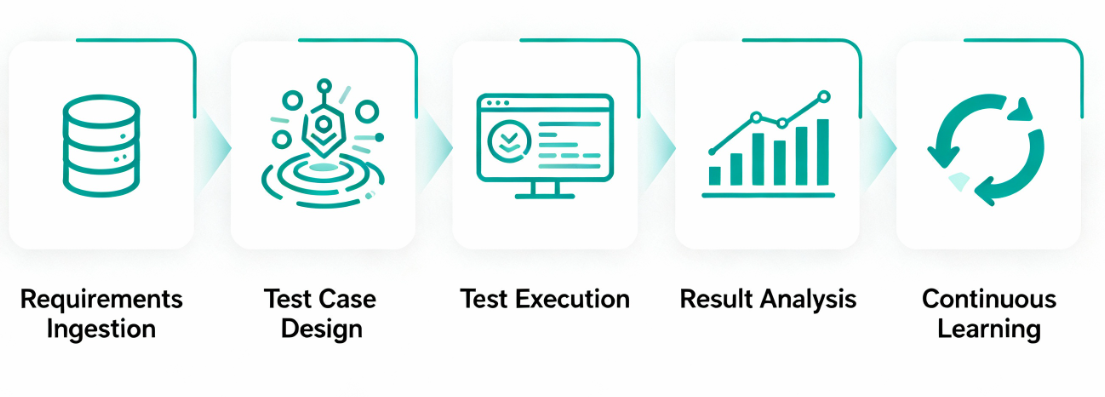
Process of AI Test Case Generation

The mechanics of AI based testing involve a sophisticated multi-stage pipeline that combines NLP, AI models, and automation frameworks. Understanding this process reveals why AI-powered testing approaches deliver superior results.

Stage 1: Requirements Ingestion and Analysis

The first step involves feeding AI systems various input sources—requirement documents, user stories, acceptance criteria, API specifications, or even production usage data.

NLP models, often transformer-based architectures like BERT or GPT, break down requirement documents into key components. They identify entities (users, actions, inputs), conditions (when actions occur), and expected outcomes (what should happen).

For example, when analyzing a requirement like “users should receive an error message when entering an invalid email format,” the AI extracts the trigger condition, the test action, and the expected result automatically.

Stage 2: Vector Embeddings and Semantic Understanding

Once requirements are parsed, they’re converted into vector embeddings—high-dimensional mathematical representations capturing semantic meaning. This transformation enables the AI to understand not just the literal text, but the underlying context and relationships between different scenarios.

Vector embeddings allow the AI system to identify similar requirements across documents, infer missing steps, and recognize equivalent test conditions described using different language.

If one requirement says “validate password strength” and another says “check that weak passwords are rejected,” the system recognizes these describe the same test scenario despite different wording.

Stage 3: Scenario Formulation and Path Prediction

With semantic understanding in place, AI-powered test automation systems predict logical user journeys based on patterns learned from historical testing data. Reinforcement learning models trained on thousands of test scenarios and software documentation help map these flows across specific application features or components.

This stage generates positive scenarios (valid inputs, expected happy paths), negative scenarios (invalid inputs, error conditions), and edge cases (boundary conditions, extreme inputs, unusual combinations).

A single requirement like “user login” might generate 20+ test scenarios automatically—including valid credentials, invalid credentials, SQL injection attempts, network timeouts, and session expiration scenarios.

Stage 4: Test Case Construction and Formatting

The AI transforms identified scenarios into structured test cases with predefined steps, inputs, preconditions, and expected outcomes. These test cases are formatted for compatibility with specific automation frameworks.

Each generated test case contains detailed action sequences: “Open application → Enter username → Enter password → Click login button → Verify dashboard appears.” The AI automatically includes necessary data setup, preconditions, and cleanup steps required for each test.

Stage 5: Continuous Learning and Adaptive Maintenance

Modern AI testing platforms learn and improve through reinforcement learning. After each test, the system observes which test cases successfully identified bugs, which provided redundant coverage, and which failed due to environment or application changes.

This ongoing learning process optimizes the test suite over time. The AI identifies which test cases delivered the most value, suggests consolidations for redundant coverage, and automatically updates tests when application changes occur.

Self-Healing Automation: The Game-Changer

One of the most revolutionary aspects of AI powered test automation is self-healing capabilities. Traditional automation fails catastrophically when UI elements change—if a button’s ID shifts from “confirmButton” to “purchaseConfirmButton,” all tests referencing that element break immediately.

Self-healing automation addresses this through continuous AI monitoring and intelligent adaptation:

  • Detection → The AI-powered system immediately recognizes that the expected element no longer exists. Rather than failing the test, it analyzes the application’s current structure searching for the missing element using alternative matching techniques.
  • Analysis → The system examines visual properties, semantic meaning, and contextual location. It recognizes that “purchaseConfirmButton” serves the same functional purpose—despite the ID change, it’s still the confirmation button users interact with to complete their purchase.
  • Adaptation → The framework automatically updates the test script, replacing the outdated locator with the new element identifier. Subsequent test executions proceed without manual intervention.
  • Learning → The system records this change pattern, improving its ability to handle similar transformations in the future.

This self-healing capability dramatically reduces test maintenance—organizations report 70-85% maintenance cost reductions compared to traditional debugging frameworks.

Edge Case Discovery Through AI

Traditional QA teams struggle to identify edge cases—those rare, boundary-condition scenarios that rarely occur in normal usage but often cause catastrophic failures in production. AI edge case testing systematically discovers these hidden vulnerabilities through machine learning pattern analysis.

AI systems analyze historical failure data, production logs, and user behavior patterns to identify which scenarios are most likely to expose defects. If 85% of production failures occur when users input strings longer than 1,000 characters, the AI prioritizes generating test cases with extremely long inputs, discovering boundary violations humans might overlook.

The AI identifies data-driven edge cases (inputs violating format constraints, numeric overflows, special characters), environmental edge cases (network latency spikes, memory constraints, concurrent user loads), and temporal edge cases (timeout scenarios, delayed API responses, race conditions).

How AI Identifies and Generates Diverse Test Scenarios

AI-powered test analytics platforms excel at generating comprehensive test coverage by analyzing multiple dimensions simultaneously. A single user requirement generates dozens of test scenarios through this multi-dimensional analysis:

  • Positive Testing → Valid inputs following expected workflows (the happy path).
  • Negative Testing → Invalid inputs, incorrect data types, missing required fields.
  • Boundary Testing → Values at limits (minimum, maximum, just beyond limits) and transitions between states.
  • Error Condition Testing → Network failures, timeouts, permission errors, database constraints.
  • Integration Testing → Multi-step workflows, dependencies between features, data propagation across systems.
  • Performance Testing → Load conditions, concurrent user scenarios, resource exhaustion scenarios.

This systematic approach catches an average of 30-45% more defects than manual QAs. AI doesn’t just generate tests—it generates comprehensive, systematic, multi-angle coverage.

Benefits of AI Test Case Generation

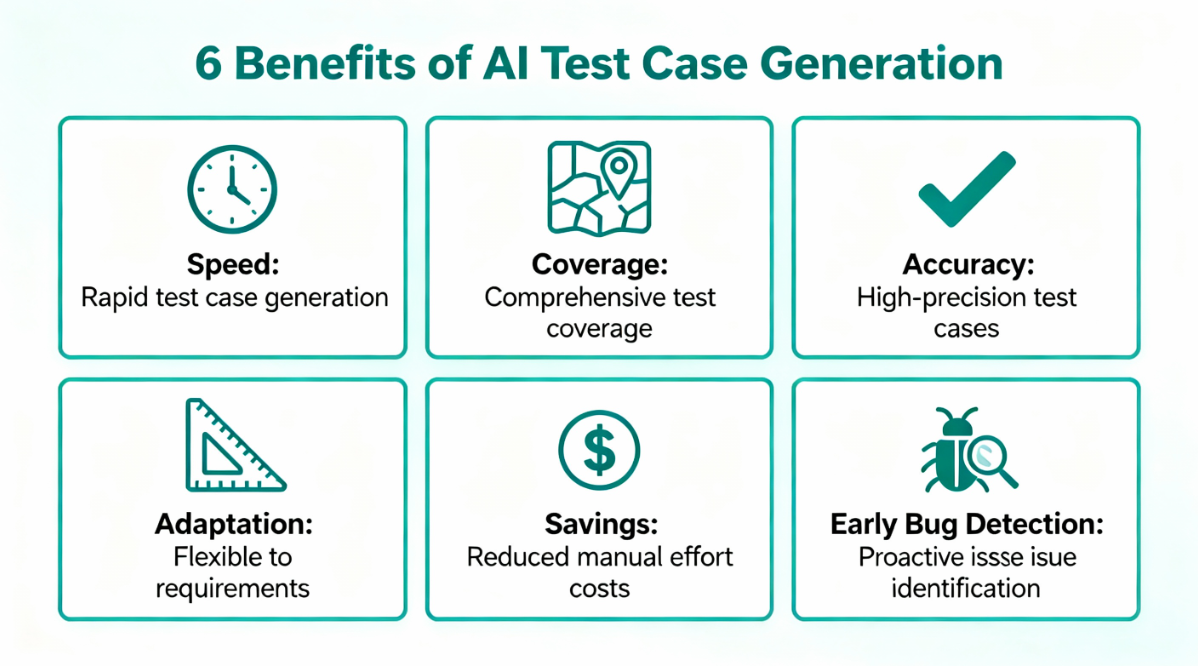
Benefits of AI Test Case Generation

Accelerated Test Creation

Organizations implementing AI-driven QA solutions report 40-60% reduction in test creation time. Developers can describe use cases in natural language, and the AI transforms them into fully executable test automation within minutes.

Enhanced Coverage Without Coverage Gaps

AI-powered debugging identifies scenarios that human testers frequently overlook. By systematically generating positive, negative, boundary, and edge case scenarios, AI achieves comprehensive coverage that escape traditional approaches.

Reduced Human Error

Manual test case creation is inherently prone to errors—missing steps, incorrect preconditions, overlooked scenarios. AI-generated tests follow consistent patterns and structures, eliminating human oversight.

Continuous Adaptation

Software changes constantly—UI redesigns, API refactors, feature modifications. AI-powered QA tools automatically detect these changes, adapt test cases accordingly, and notify teams of modifications.

Cost Optimization

By automating test creations, organizations redirect QA resources toward strategic activities like exploratory debugging, test strategy refinement, and so on. Most teams reduce total testing costs by 40-50% within six months of implementation.

Earlier Defect Detection

AI-powered test monitoring enables continuous testing throughout development. Defects discovered earlier cost significantly less to fix—studies show fixing issues in development costs 10x less than fixing production bugs.

Leading AI Test Case Generation Tools

1. Panto AI
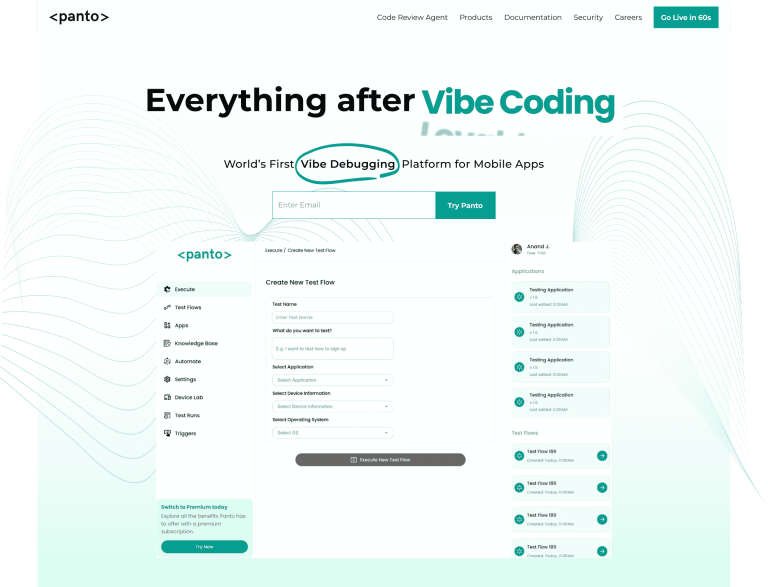
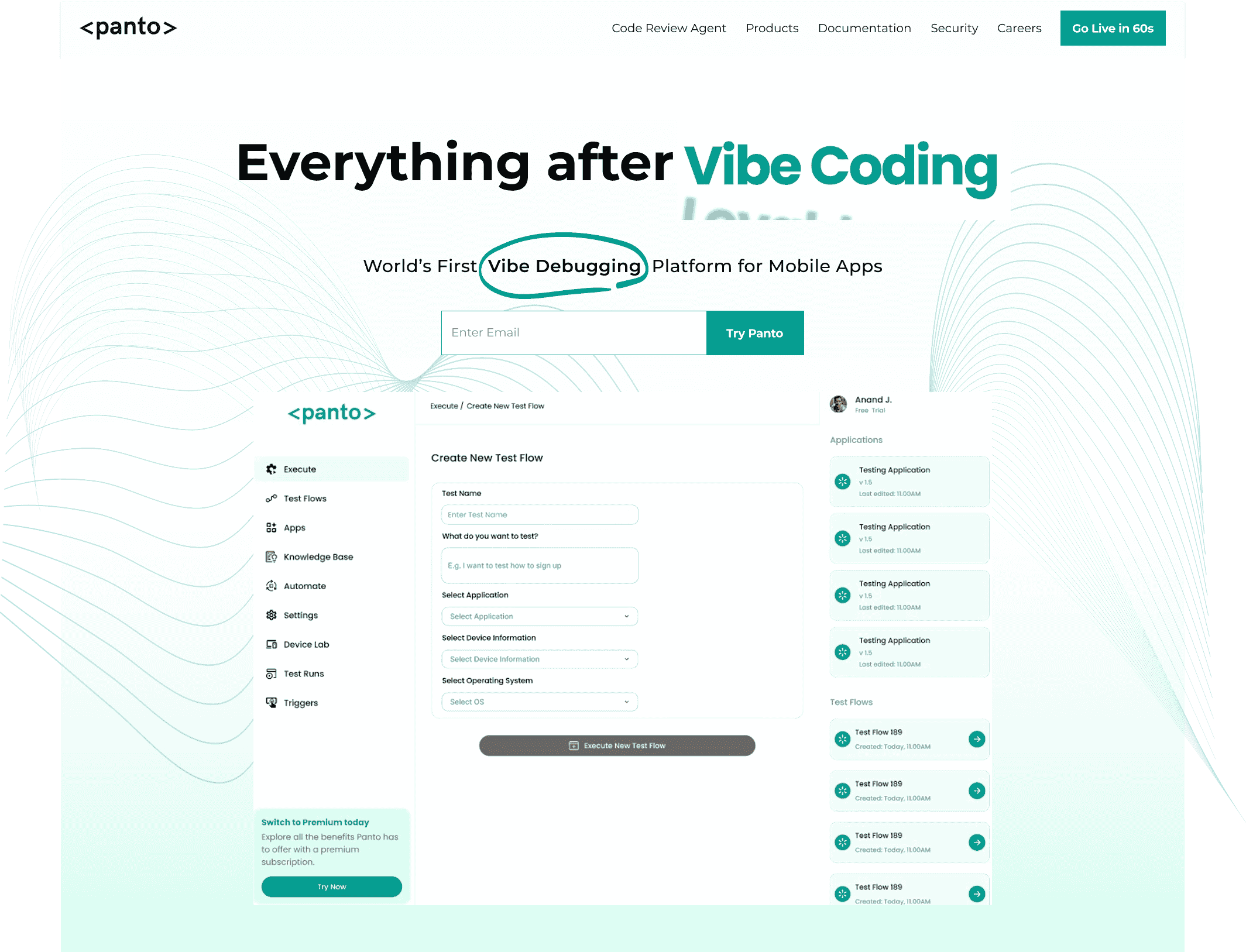
Panto AI AI Test Case Generation

Panto AI stands as a Vibe Debugging platform designed specifically for mobile app QA. This innovative solution combines dynamic code reviews with automated AI powered test automation capabilities, creating an end-to-end platform.

The platform’s strength lies in understanding behavioral patterns rather than just surface-level outputs. Panto AI uses natural language processing to understand requirements and automatically generates test cases tailored to your organization’s context.

It executes tests on real devices or emulators, runs automated tests across multiple devices simultaneously, and automatically self-heals when UI changes occur: remapping journeys, adapting to updates, and providing real-time feedback.

Best For: Mobile app QA teams, organizations requiring comprehensive code review alongside testing, enterprises seeking behavioral-level debugging insights.

2. TestSprite

TestSprite

TestSprite represents a revolutionary approach to AI powered test automation with autonomous testing capabilities covering the entire test lifecycle from planning through execution and debugging.

The platform’s standout feature is MCP Server integration, enabling natural-language test orchestration directly within AI coding assistants like Cursor, Windsurf, and Copilot.

This IDE-native approach brings testing directly into developers’ workflows. TestSprite handles both UI and backend API testing autonomously, automatically generating executable test code without manual intervention.

Best For: Development teams seeking closed-loop feedback, organizations wanting fully autonomous E2E testing, teams already invested in IDE-based AI assistants like GitHub Copilot.

3. Testomat.io

Testomat.io AI Test Case Generation

Testomat.io brings pragmatic intelligence to QA, unifying traditional and automated testing workflows within a single platform that learns from historical data and application behavior patterns.

The platform blends generative AI for test creation with powerful AI powered test analytics that identify flaky tests and maintain quality metrics at scale.

Deep CI/CD integrations enable continuous feedback, while the platform’s analytics engine identifies patterns in test failures, helping teams prioritize maintenance efforts effectively.

Best For: QA organizations scaling from manual to automated testing, teams implementing collaborative BDD practices, organizations needing intelligent test failure analysis and optimization.

4. Katalon Studio

Katalon Studio has evolved into a comprehensive AI-powered QA platform empowering teams across the entire testing lifecycle with intelligent automation capabilities.

StudioAssist provides context-aware test generation using project-specific knowledge, while TrueTest analyzes real user behavior directly from production to generate automated tests automatically.

The platform’s self-healing engine automatically adapts when UI elements change, updating test cases intelligently. Visual testing uses AI-driven comparisons distinguishing meaningful layout changes from insignificant pixel variations, eliminating false positives.

Best For: Enterprise agile teams, organizations requiring comprehensive platform integration.

5. Mabl

Mabl AI Test Case Generation

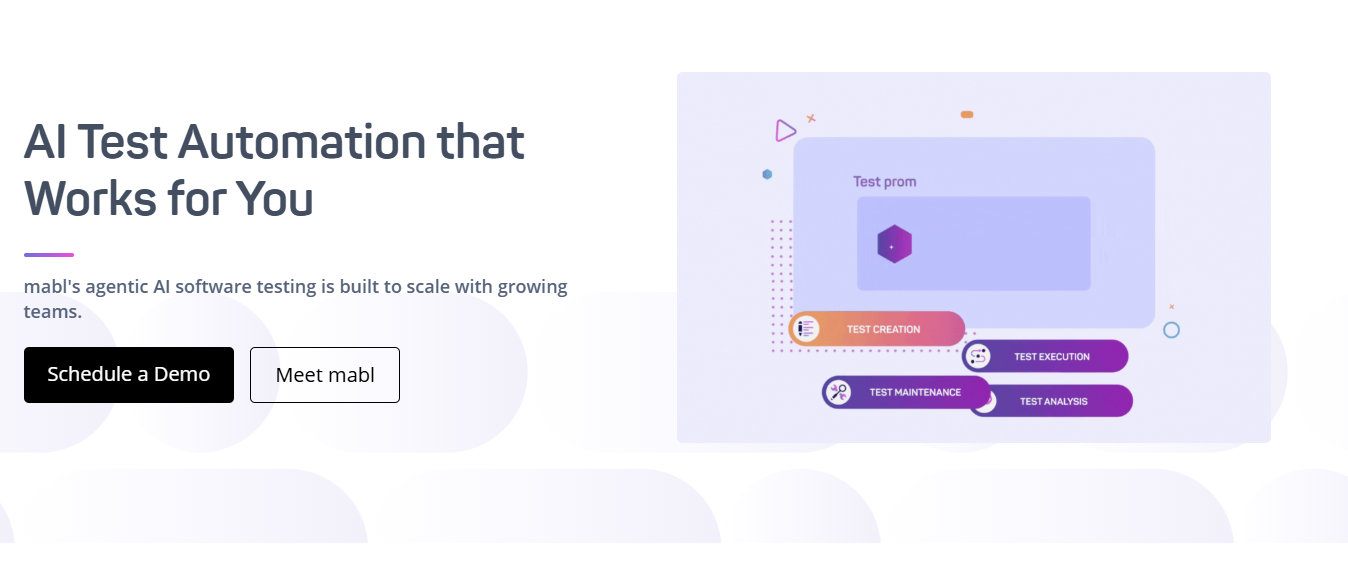
Mabl has established itself as the quintessential AI native test automation platform, with artificial intelligence embedded throughout the entire architecture.

Mabl’s agentic test creation generates tests 10x faster than traditional debugging, with intelligent assertions handling complex scenarios like image recognition and AI chatbots.

The platform’s AI Vectorization creates semantic embeddings across all test assets, enabling intelligent discovery and test reuse while providing context understanding for faster coverage gap identification.

Best For: Organizations requiring fast CI/CD adoption, teams wanting dramatically reduced test maintenance, enterprises standardizing testing infrastructure.

6. TestRigor

TestRigor

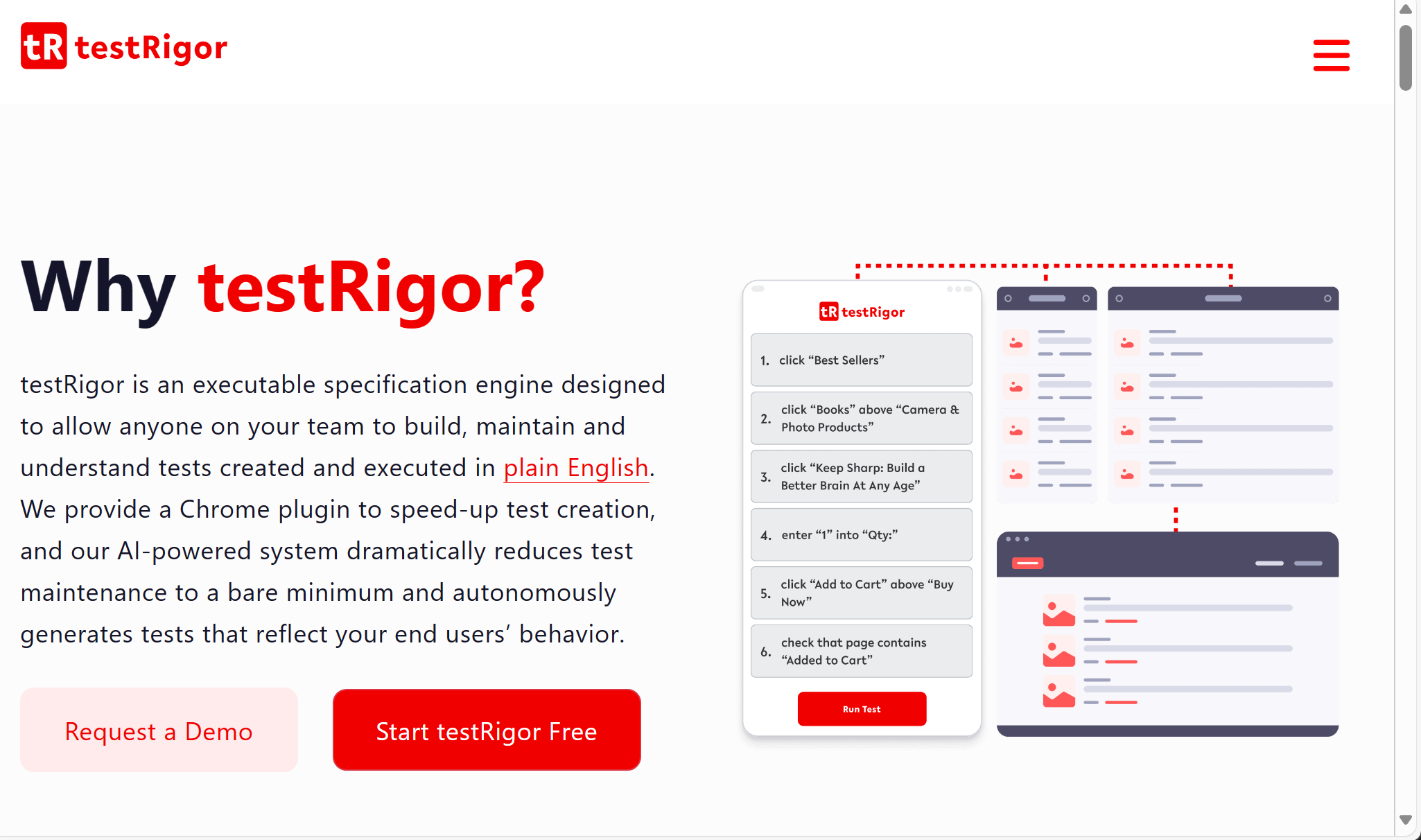
TestRigor delivers the most accessible AI-powered QA automation experience available, enabling teams to build tests 15x faster using generative AI and plain English commands.

Unlike traditional automation requiring XPath or CSS selector expertise, TestRigor allows teams to reference UI elements as users see them on screen. The platform’s ML-based image classification and OCR capabilities enable robust testing even for complex visual elements.

Test maintenance represents TestRigor’s standout advantage. Customers report spending 200 times less time on maintenance than Selenium users.

Best For: Non-technical testers, organizations lacking SDET expertise, teams prioritizing rapid automation establishment with minimal maintenance overhead.

7. Tricentis Tosca

Tricentis Tosca AI Test Case Generation

Tricentis Tosca represents enterprise-grade AI powered test automation, leveraging Vision AI to handle debugging complexity that traditional approaches cannot manage.

Tosca’s Vision AI uses image-based recognition in order to application components without requiring source code access. This approach creates resilient tests, reducing maintenance by up to 85% compared to script-based alternatives.

Predictive defect analysis examines historical patterns and risks, recommending testing focus areas. The platform’s model-based test case generation automatically creates coverage using business models, accelerating development without extensive scripting.

Best For: Enterprise organizations, teams managing complex heterogeneous applications, organizations valuing quality insights and testing strategies.

8. ACCELQ

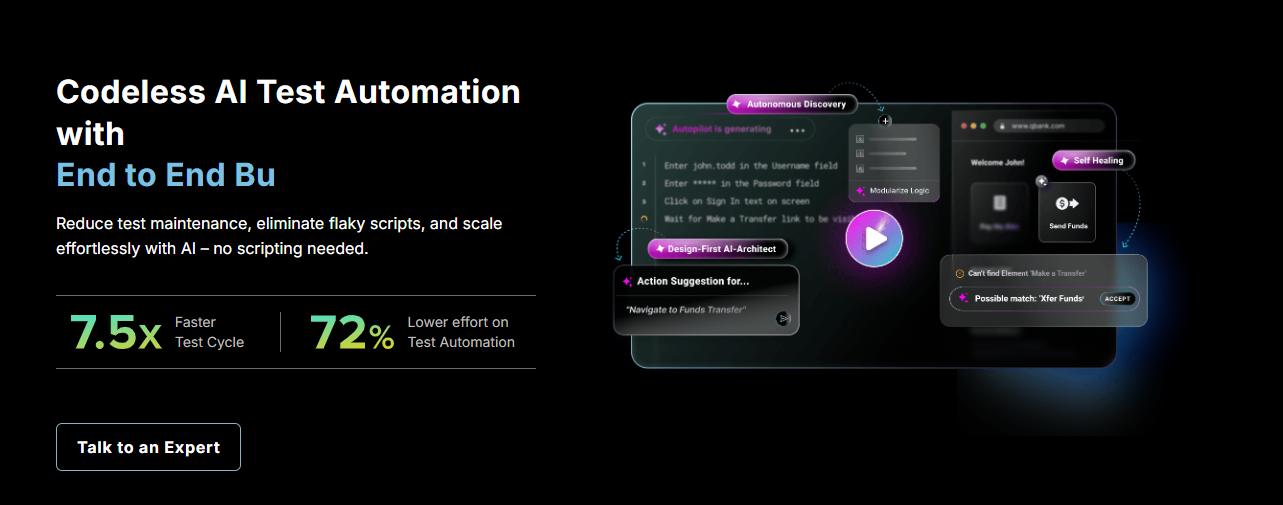
ACCELQ brings cloud-native AI powered test analytics to teams seeking complete testing automation in a codeless manner.

NLP enables functional and API automation for web, mobile, API, database, and desktop applications through a browser-based interface. The platform automates test design, planning, generation, and execution through AI-driven capabilities.

ACCELQ customers report 3x faster automation development with 70% maintenance reduction, translating to 50% cost savings while enabling continuous delivery alignment.

Best For: Organizations embracing codeless automation, teams supporting multiple application types, enterprises needing browser-based testing.

9. Testim

Testim AI Test Case Generation

Testim specializes in AI-powered performance testing and stable test automation, leveraging smart locators technology to eliminate maintenance nightmares.

Testim’s Smart Locators evaluate hundreds of element attributes, creating the industry’s most stable low-maintenance tests. When UI elements change, locators improve through AI learning, comparing confidence scores across runs.

The platform’s auto-grouping feature identifies code duplication across all tests, automatically consolidating them into reusable components.

Best For: Web and mobile app teams, organizations requiring rapid test authoring, QA departments seeking measurable testing time savings per sprint.

10. BrowserStack

Browserstack

BrowserStack introduced its unified AI test platform in 2026, consolidating testing infrastructure with AI-powered test monitoring and intelligent analysis capabilities.

Processing over one billion tests yearly, BrowserStack offers 20,000+ devices and 3,500 browser-desktop combinations. AI agents guide testing throughout the lifecycle.

BrowserStack’s AI-driven test analysis identifies flaky tests, performs unique error analysis, categorizes failures, and provides root cause analysis automatically.

Best For: Large-scale testing operations, organizations requiring comprehensive infrastructure, teams needing unified debugging and reporting across thousands of devices.

Comprehensive AI Test Case Generation Tools Comparison

ToolBest ForKey StrengthTest MaintenancePlatform SupportUnique FeatureLearning CurveScalability
Panto AIMobile app QA + Code reviewVibe debugging + self-healingSelf-healing, auto-remappingiOS, Android, iPadDynamic Code Review integrationEasyHigh (mobile)
TestSpriteAutonomous E2E testingMCP IDE integrationAutonomous adaptationWeb, Mobile, APIMCP Server for IDEEasyVery High
Testomat.ioScaling QA workflowsPragmatic AI blendAnalytics-drivenWeb, Mobile, API, DesktopHistorical data learningModerateVery High
Katalon StudioEnterprise agile teamsComprehensive platformAI suggestionsWeb, Mobile, API, DesktopTrueTest from productionModerateVery High
MablFast CI/CD adoptionAI-native architecture85% reductionWeb, Mobile, API, PerformanceAgentic test creationEasyVery High
TestRigorNon-technical testersPlain English automation200x vs SeleniumWeb, Mobile, Desktop, APINLP-based plain EnglishVery EasyHigh
Tricentis ToscaEnterprise complexityVision AI intelligence85% reductionWeb, Mobile, API, EnterpriseVision AI for complex UIHardVery High
ACCELQCodeless automation3x faster automation70% reductionWeb, Mobile, API, DB, DesktopNatural language NLPVery EasyVery High
TestimWeb & Mobile appsSmart Locators80% savingsWeb, Mobile, Cross-browserSmart Locators 2.0ModerateHigh
BrowserStackLarge-scale testingUnified ecosystemAI-drivenWeb, Mobile, Cross-browser, APIFlaky test detectionHardVery High

The AI test case generation landscape continues evolving rapidly. Autonomous testing systems are emerging that can understand business requirements, design comprehensive test strategies, and execute end-to-end testing with minimal human intervention.

Most critically, AI test case generation fundamentally changes how organizations approach quality assurance—from reactive bug-finding to proactive quality engineering, enabling faster, more reliable software delivery at unprecedented scale.

The future of QA is about empowering QA teams with intelligent tools that handle repetitive tasks automatically, freeing human expertise for complex problems and strategic testing innovation.