



Kobiton has been a trusted mobile testing platform for enterprises seeking real-device automation and cloud testing solutions. However, the QA ecosystem has matured, with new contenders offering features that address Kobiton’s limitations.
2026 brings a competitive landscape where AI-driven automation, self-healing capabilities, and AI test generation have become table stakes. Teams increasingly demand intelligent automation, without constant human intervention.
This blog explores the best Kobiton alternatives for you and your team to help you future-proof your debugging strategy and accelerate delivery.
Why Explore Kobiton Alternatives?
Kobiton excels at real-device testing and enterprise-grade deployment flexibility, supporting both cloud and on-premise infrastructure. However, several limitations emerge when teams demand faster QA velocity and AI-powered testing.
Drawbacks of Kobiton:
- Kobiton’s constraints include higher per-device licensing costs, lengthy test script setup requirements, and limited NLP- based test generation capabilities.
- Teams frequently encounter extended implementation timelines and steep learning curves for complex automation frameworks.
- Enterprise customers report that maintaining test scripts across frequent UI changes demands significant engineering resources.
Modern Kobiton alternatives offer:
- AI-powered test generation from plain English requirements
- Self-healing automation that adapts to UI changes automatically
- Reduced test maintenance overhead by 60-80%
- Faster setup with intuitive, codeless interfaces
- Multi-framework support (Appium, Maestro, Espresso, XCUITest)
- Superior analytics and AI-driven root cause analysis
Organizations evaluating mobile testing platforms report that 78% of enterprises require testing across 15+ device combinations, while 71% of QA teams assess multiple platforms annually.
This signals a market demanding flexibility, cost efficiency, and intelligent automation beyond traditional QA means.
Key Metrics & Statistics for 2026
Mobile QA automation significantly impacts team productivity and time-to-market. Leading organizations leveraging AI-powered mobile testing platforms report measurable improvements.
Test execution velocity gains:
- 35% faster test execution cycles with AI-optimized test paths
- 45% reduction in test maintenance overhead through self-healing automation
- 60-80% reduction in manual script updates when UI changes occur
Device coverage requirements:
- Enterprises test on an average of 18 device configurations per release cycle
- Real-device testing represents 62% of QA budgets in 2026
- Cross-browser and cross-device testing eliminates 40% of production defects earlier
Cost and efficiency metrics:
- Organizations save $75,000-$250,000 annually switching from traditional device farms to AI-powered platforms
- Test creation velocity increases by 200-300% with codeless automation approaches
- CI/CD feedback loops compress from 4-6 hours to 30-45 minutes with parallel execution
Top 10 Kobiton Alternatives in 2026
1. Panto AI: Vibe Debugging for Mobile Apps
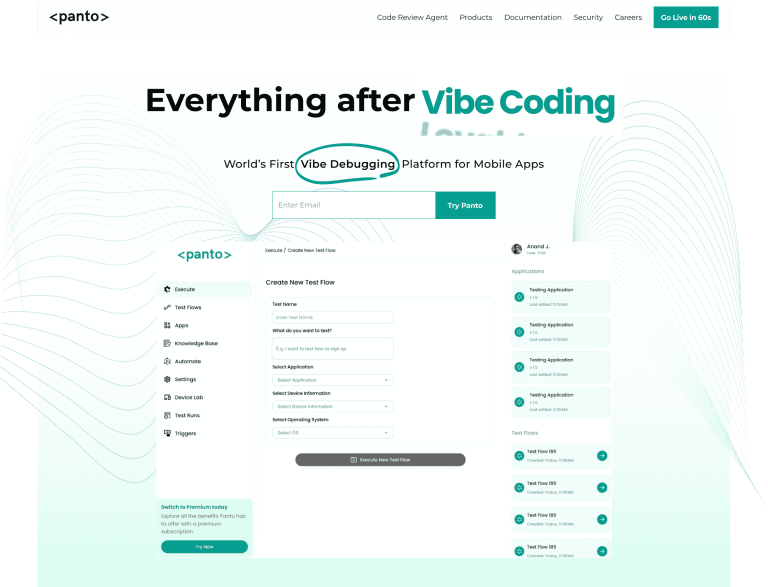
Panto AI redefines mobile app testing through its Vibe Debugging Platform, combining dynamic code reviews, security scanning, and AI-powered QA automation. This platform represents next-generation intelligent testing tailored for enterprises demanding speed, reliability, and reduced maintenance.
Panto AI excels at NLP-based test case generation. Teams describe use cases in plain English, and the platform automatically navigates apps, executing tests step-by-step. Its self-healing automation detects UI changes, adapts test flows, and notifies teams automatically—eliminating manual script maintenance that consumes 60-80% of traditional QA effort.
A standout feature of Panto AI is its ability to generate reusable Appium/Maestro code that executes seamlessly across multiple devices. Teams write once and execute everywhere, dramatically reducing test creation time and maintenance overhead.
Panto’s Key Capabilities:
- Automated test case creation from natural language requirements
- Multi-device execution on real devices and emulators
- Slack and CI/CD pipeline integration
- Instant debug reports with videos, logs, and screenshots
- Visual recognition and contextual understanding
- Self-healing automation that adapts to UI changes
- Support for iOS, Android, and iPad applications
- Achieves 100% test coverage in two weeks
Teams report 60-80% reduction in test maintenance compared to traditional frameworks, freeing engineers for higher-value debugging activities.
2. BrowserStack: The Enterprise Real-Device Cloud

BrowserStack dominates mobile testing through its massive real-device inventory and enterprise-grade infrastructure. With access to 30,000+ real devices, it provides unparalleled coverage for organizations requiring comprehensive device compatibility testing.
BrowserStack’s App Automate product supports multiple automation frameworks—Appium, Espresso, XCUITest, and Maestro—enabling teams to leverage existing expertise without tool switching. Self-healing agents automatically detect UI changes and suggest smart locators, reducing flaky test maintenance significantly.
BrowserStack excels at day-zero OS version support, delivering new iOS and Android releases immediately. This eliminates delays when testing on cutting-edge devices and operating systems, critical for mobile-first enterprises.
BrowserStack’s Advanced Features:
- 30,000+ real devices with instant access
- Support for Appium, Espresso, XCUITest, Maestro frameworks
- Self-healing agents and smart locator suggestions
- Real-world device workflows (biometrics, SIM authentication, Apple Pay)
- 150+ CI/CD integrations (Jenkins, GitHub, GitLab, Azure DevOps)
- CPU/memory usage monitoring and advanced debugging
- Parallel execution across multiple device types
Enterprise customers report achieving 34% faster regression cycles and reducing device procurement costs by maintaining zero physical device inventory.
3. Sauce Labs: AI-Driven Enterprise Testing
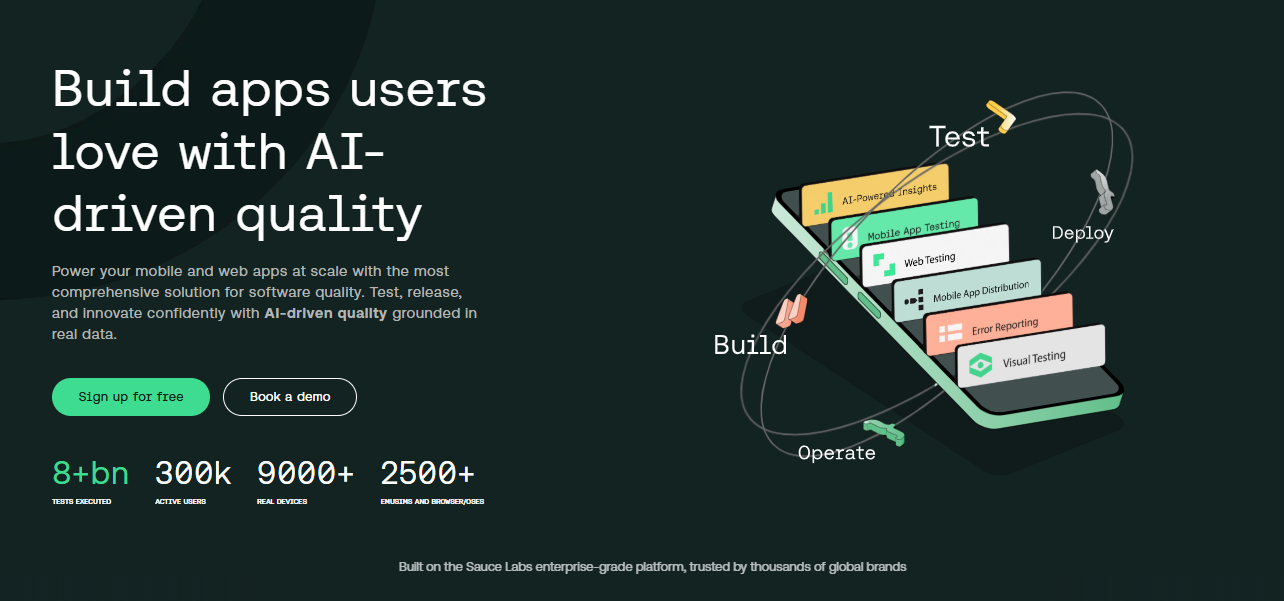
Sauce Labs provides enterprise-grade mobile testing focused on continuous quality across the entire software development lifecycle. Its new Sauce AI agents deliver actionable test intelligence that cuts debugging time and accelerates release cycles.
Sauce Labs differentiates through cross-platform automation—single tests execute identically across web, mobile, desktop, iOS, and Android. This eliminates test duplication and reduces maintenance complexity for organizations with multi-platform applications.
Its AI-driven visual validation automatically assesses complex UI elements like dashboards, carousels, dynamic maps, and data-driven components without manual test specification. This accelerates test creation and improves detection of visual regressions invisible to traditional automation.
Sauce Labs Key Features:
- AI-driven validation for complex UI elements
- Cross-platform test execution (web, mobile, iOS, Android, desktop)
- Real & virtual device coverage
- Low-code & scriptless options with natural language
- Diagnostic insights and AI-powered failure triage
- Deep debugging with historical replay capability
- Compliance-friendly tooling for regulated industries
Organizations using Sauce Labs report 50% reduction in test debugging time and improved regulatory compliance through audit-ready test reporting.
4. Maestro: Lightweight YAML-Based Testing
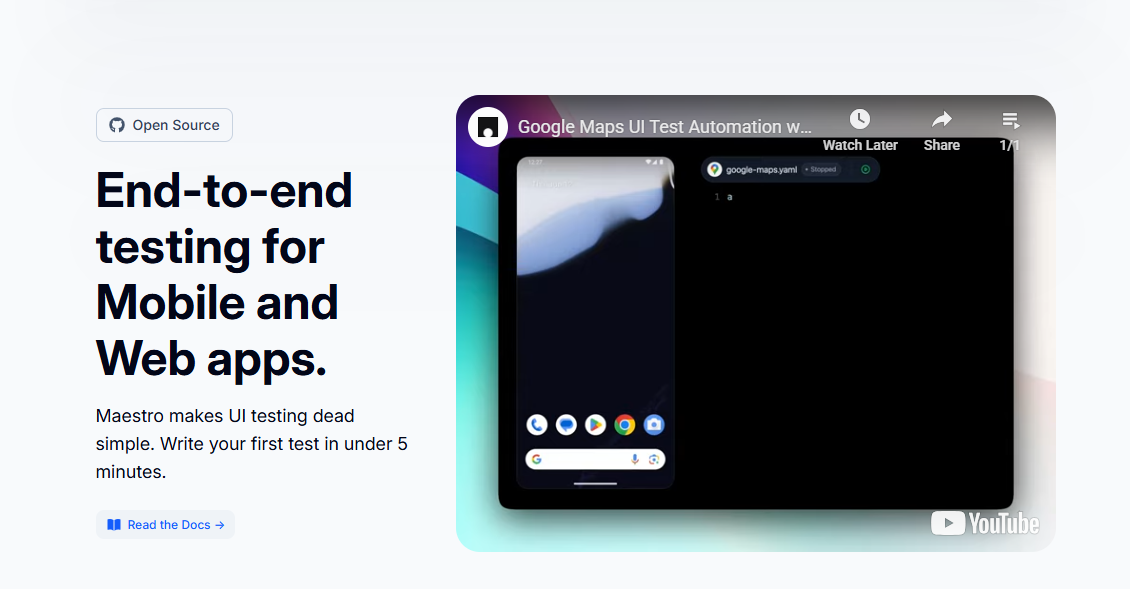
Maestro emphasizes simplicity and developer experience through YAML-based test syntax. This approach democratizes automation for teams without extensive scripting expertise while maintaining powerful cross-platform capabilities.
Maestro’s lightweight YAML format makes tests readable to non-technical stakeholders, improving collaboration across QA, product, and development teams. Tests express user journeys clearly, reducing ambiguity and maintenance overhead when requirements evolve.
The platform supports Android, iOS, and Web testing through a unified framework. Teams define test flows once in YAML and execute across all platforms, achieving write-once, run-everywhere efficiency without framework switching.
Maestro’s Standout Capabilities:
- YAML-based syntax for readability and maintainability
- Android, iOS, and Web support in single framework
- Cloud integration for real-device execution
- CI/CD pipeline integration (Jenkins, GitHub Actions, GitLab)
- Lightweight approach reducing infrastructure overhead
- Fast test execution with minimal resource consumption
- Growing adoption among mobile-first startups and enterprises
Teams using Maestro report 40% faster test development and improved test maintainability through clear, human-readable syntax.
5. Appium: Open-Source Cross-Platform Flexibility
Appium dominates mobile automation through open-source flexibility and support for multiple programming languages. Supporting Java, Python, Ruby, and JavaScript, it enables organizations to leverage existing expertise without retraining entire teams.
Appium’s write-once, run-everywhere capability enables identical tests to execute on iOS and Android without modification. This eliminates test duplication and reduces maintenance burden for teams managing multi-platform applications.
The Appium ecosystem includes AI-powered locator engines that improve element detection accuracy and reduce flaky tests. Dynamic test prioritization analyzes code commits and executes relevant tests automatically, compressing feedback loops significantly.
Appium’s Key Strengths:
- Support for Java, Python, Ruby, JavaScript, and multiple languages
- Write-once, run-everywhere for iOS and Android
- No app modification or instrumentation required
- Massive community with extensive plugin ecosystem
- CI/CD pipeline integration for reliability
- Element-level intelligence understanding user actions
- Dynamic test prioritization analyzing code commits
- Support for native, hybrid, and web applications
The trade-off involves steeper learning curves and extended setup times (30+ minutes), requiring dedicated automation engineering expertise.
6. Testim: AI-Powered Element Recognition

Testim simplifies mobile automation through cloud-based recording and stable AI-driven element detection. This approach accelerates test creation for teams lacking extensive programming experience while maintaining automation reliability.
Testim’s virtual mobile grid eliminates the need for physical device management, reducing infrastructure overhead and cost. Organizations leverage virtual environments for rapid testing while optional real-device integration supports quality validation on target devices.
The platform excels at low-maintenance automation through intelligent element detection that adapts to UI changes automatically. Teams spend less time debugging flaky tests and more time expanding test coverage.
Testim’s Advanced Features:
- Cloud-based recording with instant test generation
- Stable AI-driven element detection and adaptation
- Virtual mobile grid for scalable testing
- Low-maintenance automation reducing script updates
- Support for native, hybrid, and cross-platform apps
- Visual regression testing capabilities
- Integration with popular CI/CD platforms
Organizations report achieving 50% reduction in test maintenance effort and 3x faster test creation compared to traditional Appium-based approaches.
7. TestGrid: AI-Powered Cloud Testing Platform

TestGrid provides comprehensive cloud end-to-end testing supporting mobile, web, and API applications. Its focus on real-device testing and intuitive interface simplifies test management for teams across all technical skill levels.
TestGrid’s AI-powered analytics identify potential issues and optimize testing strategies automatically. Teams gain actionable insights into test health, failure root causes, and performance metrics without manual analysis.
The platform supports thousands of real devices enabling cross-platform testing at scale. Integration with popular CI/CD tools (Jenkins, GitLab, GitHub Actions) ensures seamless testing within existing development pipelines.
TestGrid’s Key Capabilities:
- Real-device cloud with thousands of devices
- AI-powered analytics and insights
- Support for mobile, web, and API testing
- Automated and manual testing workflows
- Easy CI/CD integration (Jenkins, GitLab, GitHub)
- User-friendly interface for non-technical users
- Cross-platform compatibility testing
- Performance monitoring and optimization
Teams leveraging TestGrid report 40% improvement in test execution efficiency and better cross-platform compatibility assurance.
8. Perfecto: Mobile-First Test Orchestration
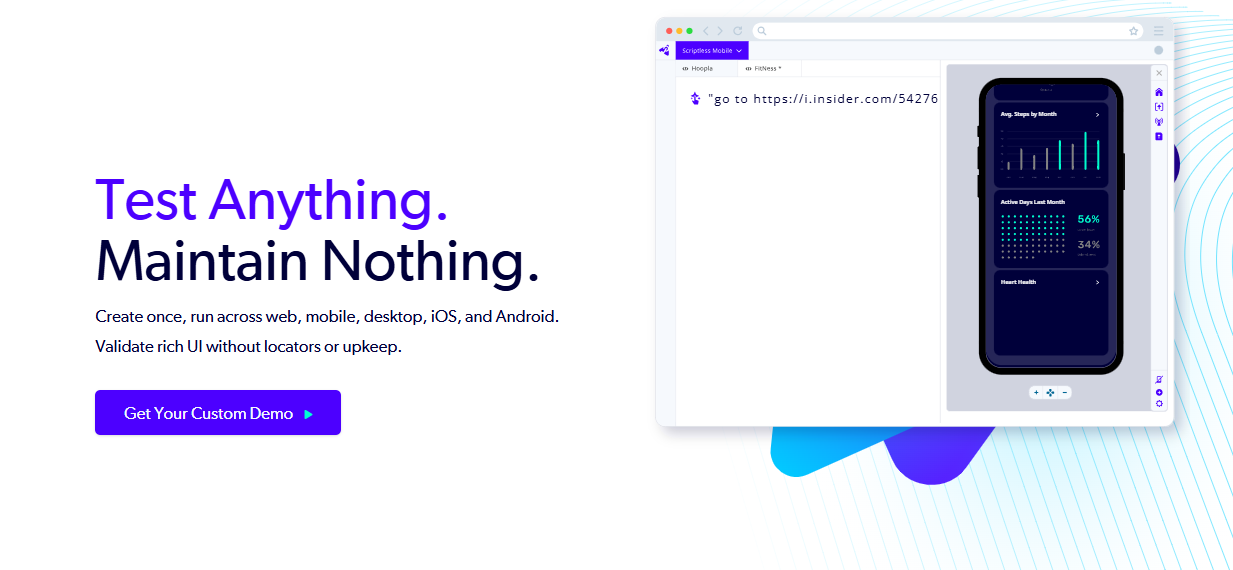
Perfecto specializes in mobile-first test orchestration with emphasis on real-device testing at enterprise scale. Its robust monitoring and reliability features ensure consistent debugging across complex device ecosystems.
Perfecto’s advanced mobile monitoring capabilities provide visibility into network conditions, device performance, and application behavior. This enables teams to identify performance regressions and user experience issues invisible to traditional testing approaches.
The platform excels at managing complex testing infrastructure for large enterprises with diverse device requirements. Organizations maintain centralized control over device allocation, test scheduling, and resource optimization.
Perfecto’s Strengths:
- Real-device testing at enterprise scale
- Advanced monitoring and reliability features
- Mobile-heavy focus with comprehensive device coverage
- Network condition simulation (4G, 5G, WiFi)
- Device-level performance monitoring
- Centralized infrastructure management
- Enterprise-grade security and compliance
- Support for continuous testing and DevOps workflows
Enterprise customers report 50% improvement in test infrastructure efficiency and better visibility into real-world device performance.
9. AWS Device Farm: Scalable AWS-Native Testing
AWS Device Farm provides scalable mobile and web testing leveraging AWS cloud infrastructure. For organizations already invested in AWS, it offers seamless integration with existing development pipelines and deployment workflows.
AWS Device Farm manages 2,500+ real devices enabling comprehensive device compatibility testing without maintaining physical device labs. Teams access devices on-demand, reducing capital expenditure and infrastructure overhead significantly.
The platform supports manual and automated testing with deep debugging capabilities powered by AWS’s cloud scale. Integration with AWS services (CodeBuild, CodePipeline, Lambda) enables sophisticated testing workflows within AWS ecosystems.
AWS Device Farm Key Features:
- 2,500+ real devices for comprehensive coverage
- Cloud and on-premise deployment options
- Manual and automated testing workflows
- Deep debugging support and test report analytics
- AWS CodeBuild and CodePipeline integration
- Parallel test execution across multiple devices
- Device allocation management
- Performance profiling and diagnostics
Organizations using AWS Device Farm report 35% reduction in testing infrastructure costs and improved CI/CD pipeline integration efficiency.
10. Cerberus Testing: Open-Source Low-Code Automation
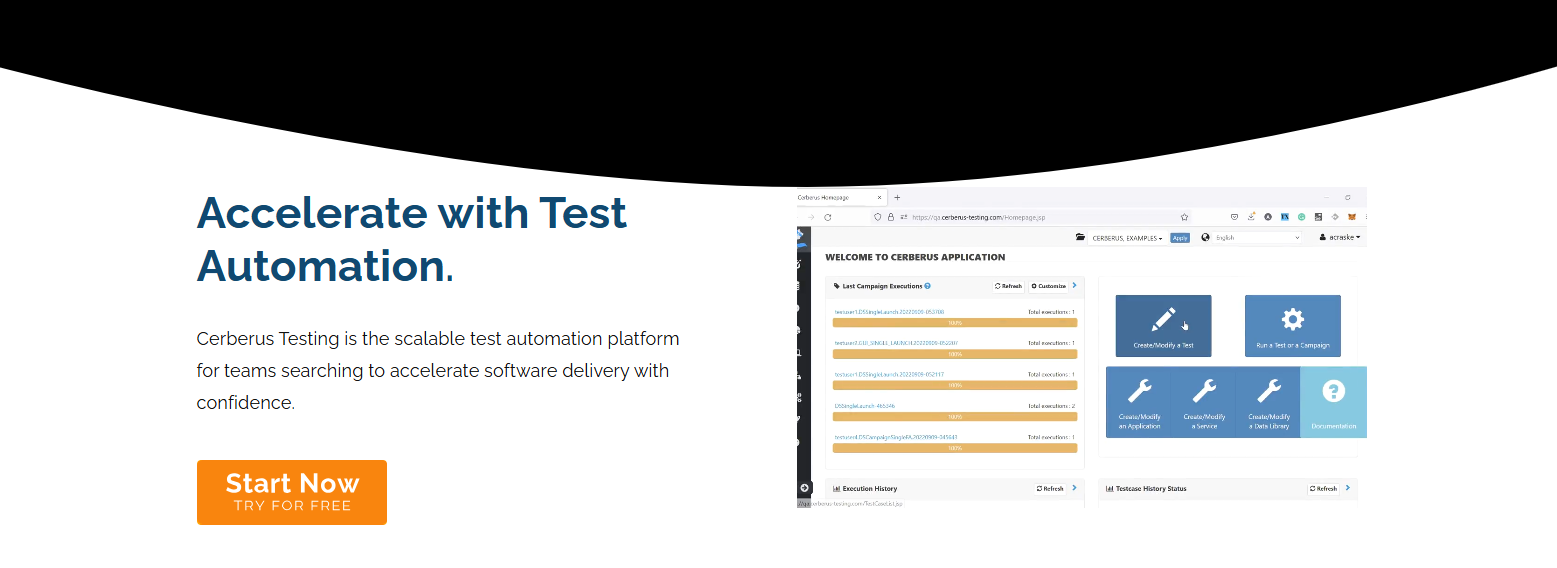
Cerberus Testing stands out as a fully open-source, low-code automation platform supporting web, mobile, API, desktop, and database testing. This approach appeals to organizations prioritizing cost efficiency, flexibility, and vendor independence.
Cerberus Testing emphasizes collaboration and ease of authoring through intuitive interfaces requiring minimal coding expertise. Teams create reusable test components and workflows accelerating test development without heavy scripting overhead.
The platform’s built-in monitoring includes visual test monitoring, performance checks, and data validation. Organizations gain visibility into application quality beyond traditional functional testing.
Cerberus Testing Capabilities:
- Low-code automation with reusable components
- Unified platform for web, mobile, API, desktop, and database testing
- Parallel execution across environments
- Built-in UX monitoring and performance validation
- Direct CI/CD pipeline integration
- Open-source with active community support
- No vendor lock-in with full source code access
- Flexible deployment options (cloud and on-premise)
Teams using Cerberus Testing report 60% reduction in automation platform costs and improved agility through community-driven feature development.
Kobiton Alternatives Comparison Table
| Kobiton Alternatives | Best For | Platforms | Learning Curve | Setup Time | Self-Healing | AI Generation | Price Model |
|---|---|---|---|---|---|---|---|
| Panto AI | Mobile testing with vibe debugging | iOS, Android, iPad | Very Low | < 5 mins | ✅ Yes | ✅ Advanced | Freemium |
| BrowserStack | Enterprise multi-device coverage | iOS, Android, Web | Low | 5-10 mins | ✅ Yes | ✅ Yes | Freemium/Paid |
| Sauce Labs | Cross-platform with AI insights | Web, Mobile, Desktop, iOS, Android | Medium | 10 mins | ✅ Yes | ✅ Advanced | Paid |
| Maestro | Lightweight YAML testing | Android, iOS, Web | Very Low | < 5 mins | ✅ Yes | ❌ No | Open Source |
| Appium | Open-source multi-language support | iOS, Android | High | 30 mins | ❌ No | ✅ 2026 | Open Source |
| Testim | AI-powered element detection | iOS, Android, Hybrid | Low | 10 mins | ✅ Yes | ✅ Yes | Freemium/Paid |
| TestGrid | AI analytics and cloud testing | Mobile, Web, API | Low | 10 mins | ✅ Yes | ✅ Yes | Freemium/Paid |
| Perfecto | Enterprise mobile orchestration | iOS, Android | Medium | 15 mins | ✅ Yes | ✅ Yes | Paid |
| AWS Device Farm | AWS ecosystem integration | iOS, Android, Web | Medium | 10 mins | ❌ No | ❌ No | Paid |
| Cerberus Testing | Open-source cost efficiency | Web, Mobile, API, Desktop | Low | 10 mins | ❌ No | ❌ No | Open Source |
Key insights from comparison:
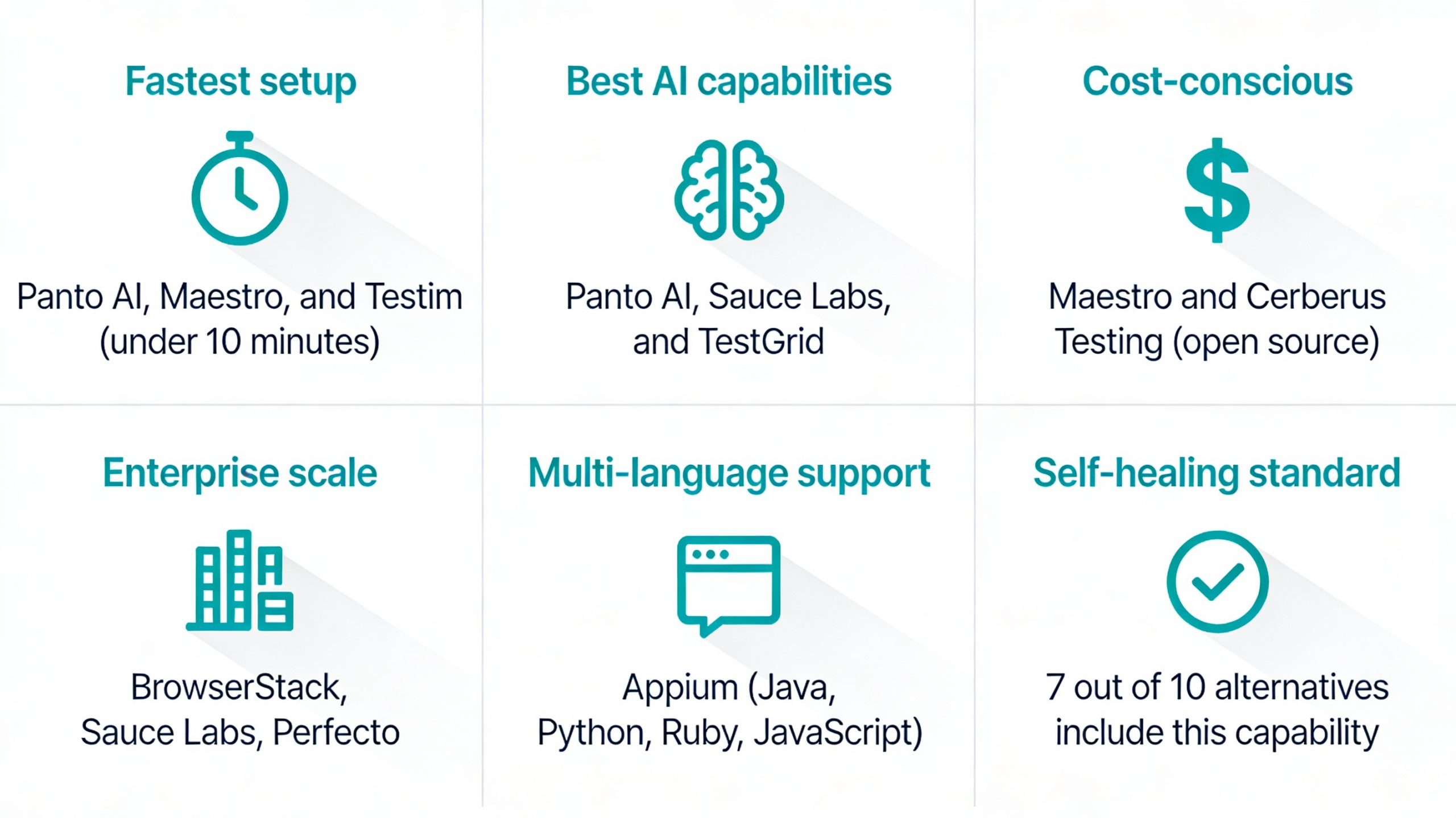
- Fastest setup: Panto AI, Maestro, and Testim (under 10 minutes)
- Best AI capabilities: Panto AI, Sauce Labs, and TestGrid
- Cost-conscious: Maestro and Cerberus Testing (open source)
- Enterprise scale: BrowserStack, Sauce Labs, Perfecto
- Multi-language support: Appium (Java, Python, Ruby, JavaScript)
- Self-healing standard: 7 out of 10 alternatives include this capability
Making Your Selection Decision
Choose Panto AI when mobile app testing is your primary focus and you want AI-powered intelligence with minimal setup. Self-healing capabilities eliminate maintenance burden, freeing teams for higher-value testing.
Choose BrowserStack for enterprises requiring massive real-device coverage and multi-framework support. Its mature ecosystem and day-zero OS access ensure comprehensive device compatibility validation.
Choose Sauce Labs when cross-platform testing (web, mobile, desktop) and AI-driven diagnostics are critical. Its compliance-friendly reporting suits regulated industries.
Choose Maestro for teams prioritizing developer experience and lightweight infrastructure. YAML-based syntax improves collaboration and reduces learning curves.
Choose Appium when open-source flexibility and multi-language support align with existing team expertise. The mature ecosystem and community support justify the setup complexity.
Building a Competitive Mobile Testing Strategy in 2026
QA in 2026 provides multiple Kobiton alternatives addressing specific organizational needs comprehensively. Each tool excels in different scenarios, enabling teams to select platforms matching their requirements and constraints.
So how do you select the perfect tool from this list of Kobiton alternatives?
- Future-proof your testing strategy by evaluating specific organizational constraints.
- Assess team expertise levels, current application architecture, and projected growth trajectories.
- Compare total cost of ownership across candidate solutions, including licensing, infrastructure, and engineering time.
The QA landscape continues evolving with QA automation and cloud-native architectures becoming standard. Teams investing in modern testing Kobiton alternatives like Panto AI, Testim and Maestro today, position themselves competitively for sustained success ahead.
Evaluate these Kobiton alternatives systematically, considering your organization’s technical stack, team capabilities, and long-term testing vision. The right platform accelerates delivery while reducing QA friction across development lifecycles.