


Mobile quality directly impacts revenue, retention, and brand perception.
For organizations investing in digital products, selecting the right mobile testing framework is a strategic decision, not just a technical one.
Two dominant native automation tools lead this space: XCUITest for iOS testing and Espresso for Android automation. Both frameworks promise speed, stability, and deep platform integration, yet their differences shape long-term QA success.
Explore how each framework works, where it excels, and how to choose the right solution for scalable mobile quality.
Understanding Native Mobile Testing Frameworks: XCUITest and Espresso
What Is XCUITest in the iOS Testing Ecosystem

XCUITest is Apple’s native UI automation framework built into Xcode.
It enables teams to create automated UI tests for iPhone and iPad applications using Swift or Objective-C.
Because it runs directly within Apple’s development environment, XCUITest delivers fast execution and reliable synchronization with UI elements.
This deep integration makes it a preferred choice for organizations focused on premium iOS user experience.
XCUITest operates by launching the application, interacting with visible UI components, and validating expected behavior. Tests simulate real user actions such as taps, gestures, and navigation across screens.
This approach ensures that functional workflows, accessibility flows, and UI stability are validated before release. For leadership teams, that translates into reduced production risk and stronger customer satisfaction.
Core Advantages of XCUITest for Enterprise iOS QA
Native app performance is the biggest strength of XCUITest. Tests execute quickly because no external automation bridge is required.
Stability is another major advantage. Automatic synchronization with animations and UI rendering reduces flaky failures.
Integration within Xcode simplifies developer adoption. Engineering teams can manage unit tests, UI tests, and performance tests in one ecosystem.
Key benefits include:
- Fast execution on real devices and simulators
- Strong reliability with minimal flaky behavior
- Seamless CI/CD integration within Apple toolchains
- Built-in UI recording for rapid test creation
- Tight alignment with Swift development workflows
For executives, these strengths support predictable release cycles and lower QA maintenance costs. That predictability becomes critical as mobile apps scale.
Limitations of XCUITest That Leaders Must Consider
Despite its strengths, XCUITest is restricted to the Apple ecosystem. It cannot test Android applications or support cross-platform reuse.
Language flexibility is limited to Swift and Objective-C. Organizations using diverse programming stacks may face collaboration friction.
UI-level automation can still be slower than unit-level validation. Large regression suites require smart prioritization to maintain fast pipelines.
Mac infrastructure is also required for execution. This can increase CI environment complexity for global engineering teams.
These constraints matter most for companies pursuing cross-platform scalability and unified QA strategy. Understanding them early prevents long-term tooling lock-in.
What Is Espresso in Android Automation Testing
Espresso is Google’s native UI debugging framework for Android applications. It is included within Android Studio and supports Java and Kotlin test development.
The framework synchronizes automatically with the Android UI thread. This ensures actions occur only when the interface is stable and ready.
Such synchronization dramatically improves test speed, determinism, and reliability. For fast-moving product teams, this reduces debugging time and accelerates releases.
Espresso tests interact with UI components just like real users. They validate navigation, inputs, and screen transitions across real Android devices.
This makes Espresso essential for maintaining consistent Android user experience at scale. Organizations shipping frequent updates benefit the most.
Key Strengths of Espresso for Android Quality Engineering
Espresso is designed specifically for Android performance. Its lightweight architecture enables extremely fast execution.
Automatic waiting mechanisms remove the need for manual delays. This significantly reduces flaky automation failures.
Native integration inside Android Studio simplifies onboarding. Developers and QA engineers can collaborate using familiar tooling.
Major advantages include:
- High execution speed across emulators and real devices
- Stable synchronization with background processes
- Minimal setup with built-in SDK support
- Clear debugging and failure reporting
- Strong compatibility with CI/CD pipelines and device farms
For decision-makers, these benefits translate into lower testing overhead and faster product iteration. Speed becomes a competitive advantage.
Constraints of Espresso in Enterprise Mobile Testing
Espresso is limited strictly to Android platforms. Organizations must maintain separate tooling for iOS automation.
Test creation requires knowledge of Android architecture. Pure manual QA teams may need additional technical training.
System-level interactions outside the application are restricted. Complex cross-app workflows can require supplementary tools.
Source code access is typically necessary for instrumentation. Black-box debugging scenarios become harder to implement.
These limitations highlight an important leadership insight. Native excellence does not equal cross-platform coverage.
Feature Comparison Table: XCUITest vs Espresso
| Capability | XCUITest (iOS Testing Tool) | Espresso (Android Automation Tool) |
|---|---|---|
| Platform Support | iOS and Apple devices | Android devices and emulators |
| Programming Languages | Swift, Objective-C | Java, Kotlin |
| Execution Speed | Very fast native execution | Very fast synchronized execution |
| Test Stability | High stability with UI sync | High stability with thread sync |
| IDE Integration | Built into Xcode | Built into Android Studio |
| CI/CD Compatibility | macOS-based pipelines | Cross-OS Android pipelines |
| Recorder Availability | Built-in UI recorder | Built-in test recorder |
| Cross-Platform Reuse | Not supported | Not supported |
| Best Use Case | Premium iOS applications | Scalable Android applications |
Strategic Comparison: Performance, Scalability, and Business Impact
Performance and Execution Speed in Real-World Pipelines
Both frameworks deliver exceptional speed compared to cross-platform tools.
Native execution removes middleware latency.
Fast feedback loops improve developer productivity and release confidence.
This directly influences engineering velocity.
Shorter regression cycles enable more frequent deployments. For leadership, that means faster innovation without sacrificing quality.
Scalability Across Teams, Devices, and Releases
Scalability depends less on tooling and more on ecosystem alignment. XCUITest scales best within Apple-focused organizations.
Espresso scales efficiently for Android-first product strategies. Each framework thrives in its native environment.
Running both frameworks in parallel is common for global apps. However, this doubles maintenance unless automation strategy is optimized.
True scalability often requires layered testing strategy and smart CI orchestration. Framework choice is only one piece of the puzzle.
Cross-Platform Testing Considerations for Executives
Neither XCUITest nor Espresso supports unified cross-platform automation. Separate codebases are unavoidable with purely native tools.
This increases QA investment but improves platform-specific reliability. Organizations must balance cost against user experience quality.
Some enterprises adopt hybrid strategies. Native frameworks handle deep validation while cross-platform tools cover shared flows.
The optimal decision depends on:
- Product complexity
- Release frequency
- Platform revenue distribution
- Engineering team structure
- Long-term scalability goals
Strategic alignment matters more than tool popularity. Technology leaders should evaluate business impact first, tooling second.
Use Case Comparison Table: When to Choose Each Framework
| Scenario | Recommended Framework | Reason |
|---|---|---|
| iOS-only consumer application | XCUITest | Deep Apple ecosystem integration |
| Android-only global product | Espresso | Fast and stable Android execution |
| Dual-platform enterprise app | Both | Maximum platform reliability |
| Rapid CI/CD mobile startup | Native per platform | Fast feedback and release speed |
| Long-term scalable QA architecture | Hybrid strategy | Balance of coverage and cost |
Why Panto’s QA Platform Can Outperform Traditional Native Frameworks
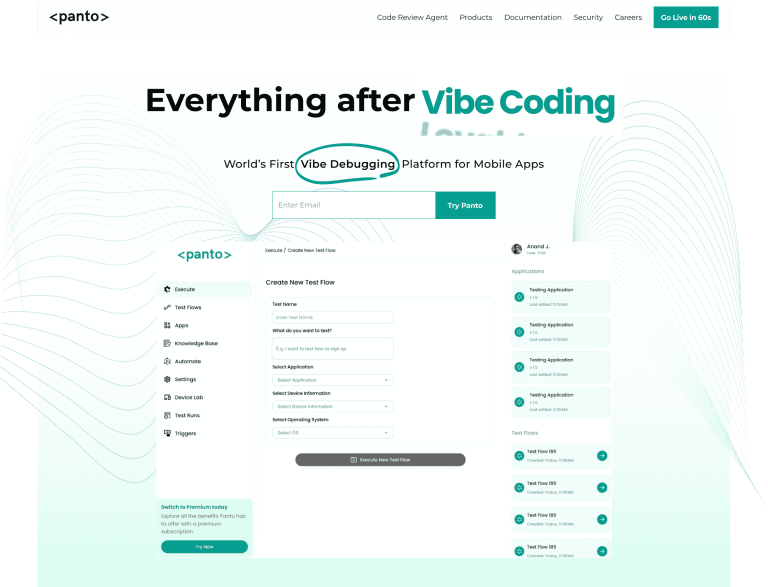
While XCUITest and Espresso deliver strong native automation, modern enterprises often need faster scalability, broader coverage, and lower maintenance overhead.
This is where Panto’s AI-driven QA approach creates measurable advantages.
Native frameworks focus on platform-specific execution. Panto focuses on end-to-end quality intelligence across the entire product lifecycle.
For CTOs and QA leaders, the difference is strategic rather than technical. It shifts testing from execution to continuous quality assurance at scale.
Unified Cross-Platform Testing Without Duplicate Effort
XCUITest and Espresso require separate automation suites for iOS and Android.
This doubles maintenance, infrastructure, and debugging effort.
Panto eliminates this fragmentation through single-flow cross-platform validation. Teams test user journeys once and validate everywhere.
This directly improves engineering velocity and release confidence.
AI-Powered Test Generation and Self-Healing Automation
Traditional frameworks depend heavily on manual script creation and upkeep.
UI changes frequently break test stability.
Panto introduces AI-assisted test generation and self-healing selectors. Automation adapts automatically as the product evolves.
This transforms QA from reactive maintenance to proactive intelligence.
End-to-End Quality Visibility for Engineering and Leadership
Native tools primarily report pass or fail results. They rarely provide deep insight into product risk or user impact.
Panto delivers real-time quality analytics tied to business metrics. Leaders gain visibility beyond technical execution.
Such insight is critical for enterprise-scale digital products.
Seamless CI/CD, Cloud, and Real-Device Intelligence
Both XCUITest and Espresso integrate with CI/CD pipelines. However, orchestration and scaling still require significant setup.
Panto provides cloud-native execution, real-device coverage, and intelligent prioritization out of the box. Testing becomes continuous rather than scheduled.
This accelerates time-to-market without compromising stability.
Business Impact: From Testing Tool to Quality Platform
The biggest difference is philosophical. XCUITest and Espresso are automation frameworks.
Panto is a full-stack QA intelligence platform. It connects no code testing, analytics, and release confidence into one system.
In competitive digital markets, quality speed becomes a growth lever. Platforms that unify intelligence and automation deliver the strongest advantage.
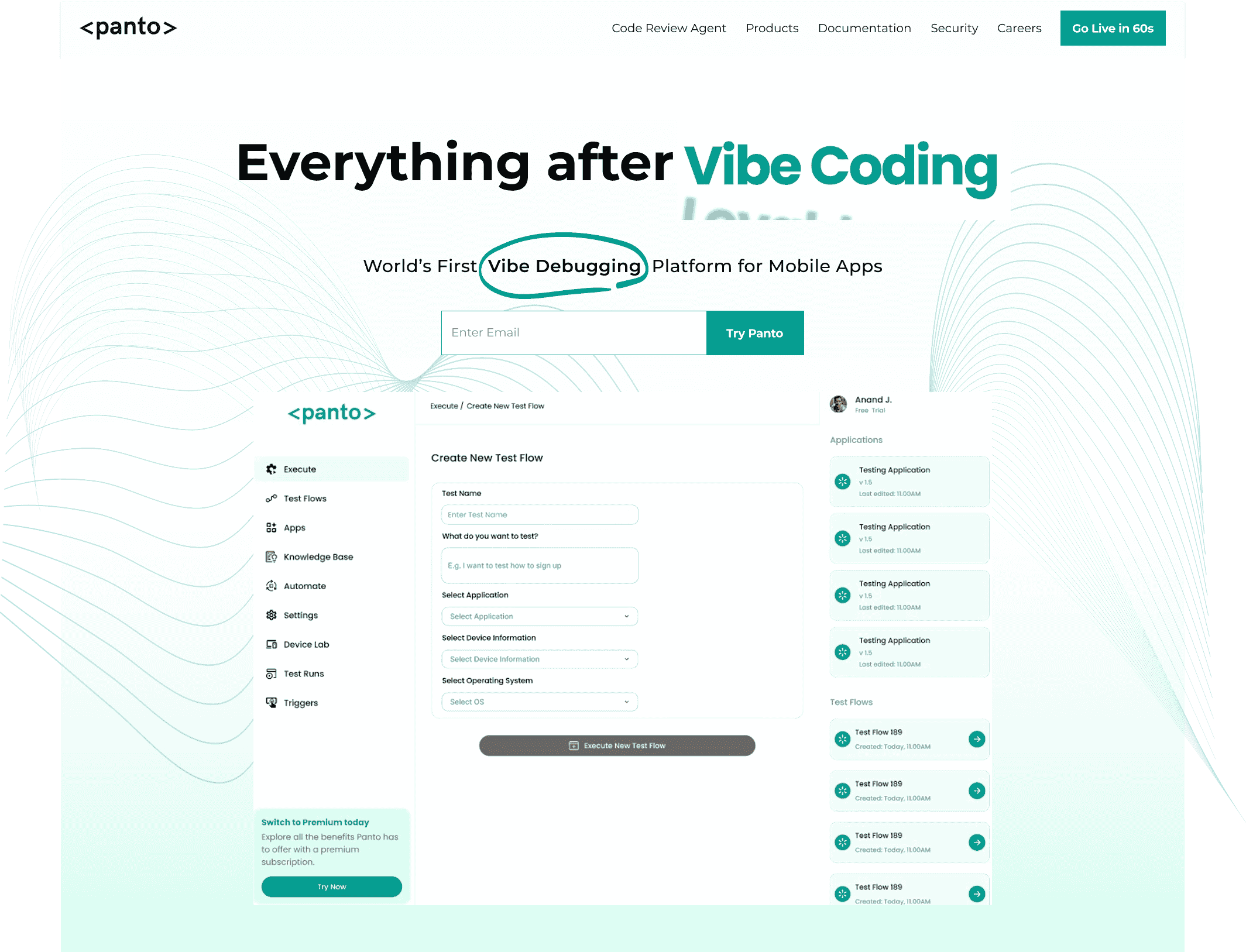
Everything After Vibe Coding
Panto AI helps developers find, explain, and fix bugs faster with AI-assisted QA—reducing downtime and preventing regressions.
- ✓ Explain bugs in natural language
- ✓ Create reproducible test scenarios in minutes
- ✓ Run scripts and track issues with zero AI hallucinations
Mobile QA Best Practices for Modern Engineering Leaders
Choosing a framework is only the beginning. Sustainable quality requires disciplined testing strategy.
High-performing teams typically:
- Combine unit, integration, and UI automation layers
- Run parallel tests across multiple devices
- Integrate automation into CI/CD from day one
- Track flaky tests and eliminate instability quickly
- Align QA metrics with business KPIs
These practices ensure automation investment delivers measurable ROI.
Without strategy, even the best framework underperforms.
Final Recommendation: Align Framework Choice With Business Strategy
XCUITest and Espresso are both industry-grade mobile testing frameworks. Each of these automation tools excels within its native ecosystem.
For iOS excellence, XCUITest remains the strongest choice. For Android scalability, Espresso leads in speed and stability.
Enterprises targeting both platforms should adopt parallel native automation supported by strong CI/CD orchestration. This approach maximizes quality while protecting long-term scalability.
Ultimately, the right decision is not about tools alone. It is about delivering consistent, high-quality mobile experiences that drive growth.
Technology leaders who align QA strategy with business vision will outperform competitors. And that journey begins with choosing the right testing foundation.