

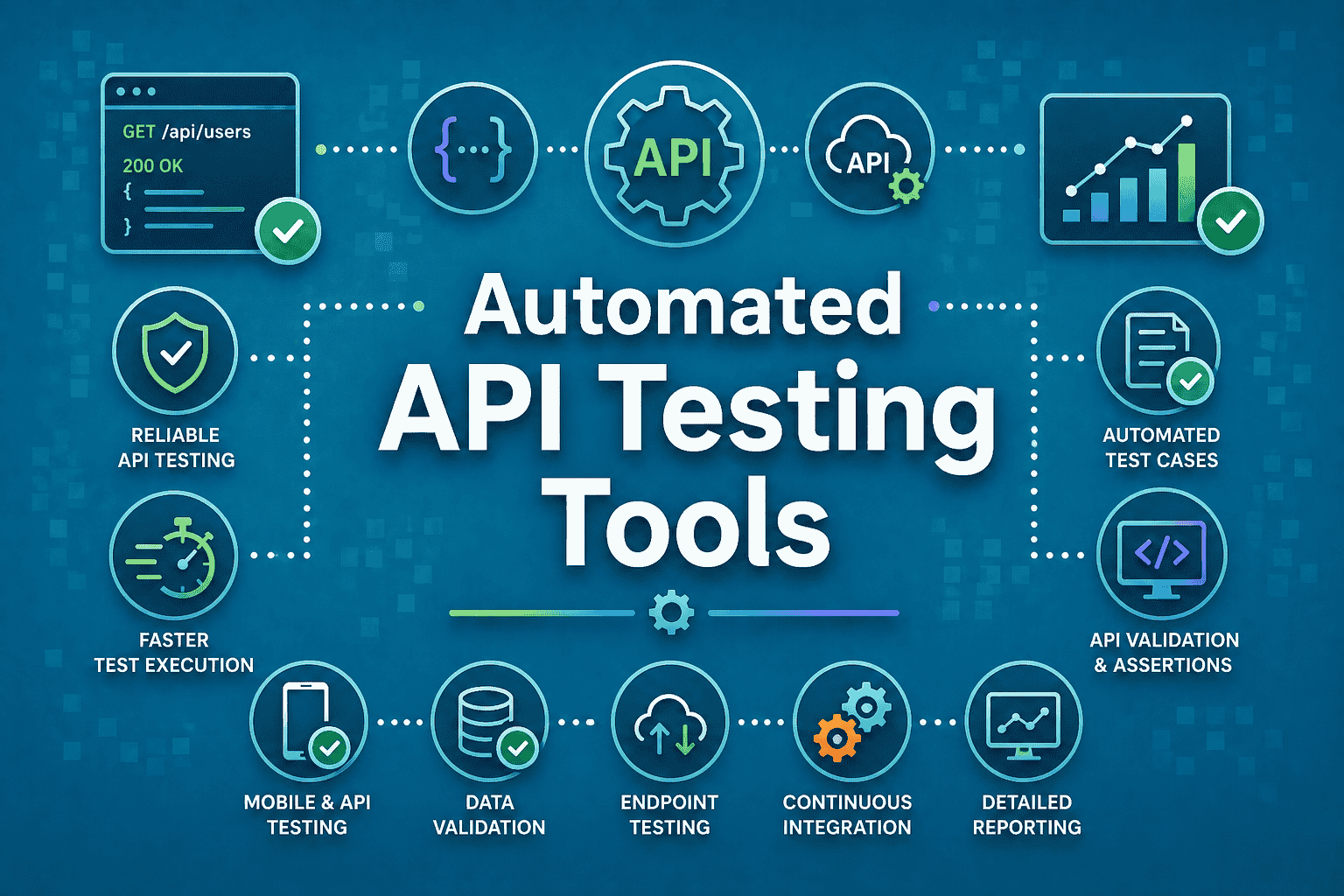

A breaking API change ships on Friday. Your frontend team finds out Monday morning from end users. No test caught it. No alert fired.
That one missed API test can cost three engineers a full day of incident triage, a support ticket storm, and a trust deficit with customers that’s hard to recover.
APIs are the backbone of modern apps, yet API testing remains one of the least automated layers in most QA stacks. That gap is exactly what the best automated API testing tools in 2026 are built to close.
This list focuses on what actually matters for shipping teams: how fast you can get value, how well the tool scales, and how much manual effort it removes.
Here are the 10 best automated API testing tools in 2026, ranked by what matters to forward-moving QA teams of 2026.
Key Tools
- Panto AI: AI-native automated API testing platform for teams that want self-healing coverage and fast functional validation.
- Postman: Industry-standard API testing tool for teams needing design, collaboration, and automated request validation in one place.
- REST Assured: Java-based API automation library for developers who want readable test code inside existing backend workflows.
- Katalon: Low-code automated API testing platform for QA teams managing API, mobile, and UI testing together.
- Karate DSL: BDD-style API testing framework for teams that want functional, mock, and performance testing in one tool.
- SoapUI / ReadyAPI: Enterprise API testing suite for complex SOAP and REST environments with compliance requirements.
- Insomnia: Lightweight API client and testing tool for developers who want quick, clean request validation.
- Hoppscotch: Open-source browser-based API testing tool for lean teams that value speed and self-hosting.
- Tricentis Tosca: Enterprise codeless API testing platform for large teams with governance, SAP, and risk-based needs.
- K6: Developer-friendly API load testing tool for performance validation in CI/CD pipelines.
The 10 best tools for Automated API Testing
1. Panto AI — AI-Native Testing Built for APIs and Functional Flows
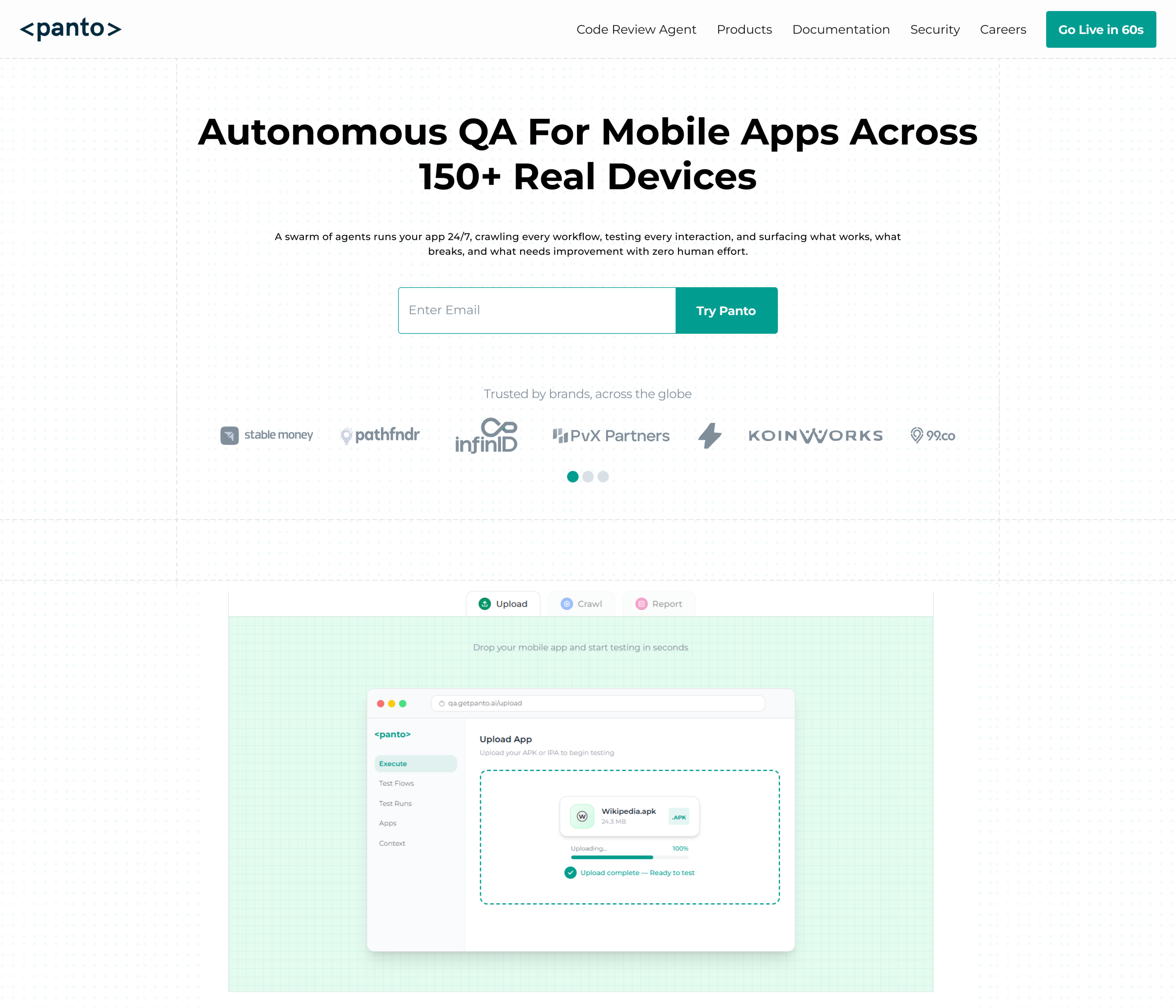
Panto AI is an AI-native test automation platform that brings self-healing tests and autonomous AI agents to both functional and API testing without requiring teams to write or maintain scripts.
It is built for fast-moving SaaS and mobile teams that need coverage across APIs and UI flows without the overhead of traditional frameworks.
The low-code approach means QA and developers can collaborate on the same test suite without a scripting bottleneck. For teams comparing AI-powered API testing tools, this is one of the most modern options on the market.
Best for: Agile SaaS teams and startups that want AI-driven API + functional testing without enterprise complexity
Key features:
- AI agent-driven test execution for REST APIs and functional flows
- Self-healing tests that auto-update when endpoints or payloads change
- No-code test creation — write tests in plain language, not scripts
- Native CI/CD integration with GitHub, GitLab, Bitbucket, Azure DevOps
- Covers API, UI, and regression testing in a single platform
AI capabilities: AI agents autonomously detect API changes, regenerate broken assertions, and flag regressions without manual intervention
Pricing: Freemium plan available; paid plans for team and enterprise use
Pros:
- Genuinely AI-native, not bolted-on AI features
- Covers API + UI testing in one tool, reducing stack complexity
- Fast onboarding — no framework setup or scripting required
Cons:
- Newer platform; ecosystem and integrations are still growing
- Best suited for REST APIs; advanced gRPC/SOAP support is still maturing
2. Postman — The Industry Standard for API Design and Testing
Postman is the most widely adopted API platform in the world, used for API design, documentation, mocking, and automated testing.
Its Postbot AI assistant can generate test scripts, summarize API behavior, and debug failures from natural language prompts.
If your team already uses Postman for API development, the testing layer is the path of least resistance. For many teams, it remains the default starting point for API testing in CI/CD pipelines.
With over 30 million developers on the platform, the ecosystem of community collections, integrations, and tutorials means most API testing questions already have an answer somewhere in the Postman docs.
Best for: Full-stack developer teams and API-first companies already using Postman for documentation and collaboration
Key features:
- Collections-based test runner with JavaScript assertions
- Postbot AI for test generation and debugging
- API mocking, monitoring, and contract testing
- Newman CLI for CI/CD pipeline integration
- Team collaboration with shared workspaces
AI capabilities: Postbot generates test cases, suggests fixes for failing tests, and explains API responses in plain English
Pricing: Free plan available; paid plans from $14/user/month
Pros:
- Massive ecosystem and community
- Covers the full API lifecycle from design to monitoring
- Newman CLI makes CI/CD integration straightforward
Cons:
- Can get expensive at scale
- Test scripting still requires JavaScript knowledge for complex scenarios
3. REST Assured — The Java Developer’s Go-To API Testing Library
REST Assured is an open-source Java library that lets developers write API tests as readable, expressive code using a BDD-style Given/When/Then syntax.
It is not a standalone tool; it integrates into existing Java test suites and works best in teams that are already Java-heavy.
There is no GUI and no dashboard. It is just code, which makes it a strong choice for teams that want automated API testing software embedded directly into their engineering workflow.
Best for: Java development teams that want API testing embedded directly in their existing test codebase
Key features:
- BDD-style syntax: Given/When/Then
- Full support for REST, JSON, XML validation
- Native integration with JUnit, TestNG, Maven, Gradle
- Authentication support — OAuth2, basic auth, JWT
- Request/response logging and schema validation
AI capabilities: None natively; relies on external AI tools for test generation
Pricing: Free and open source
Pros:
- Zero licensing cost
- Deep Java ecosystem integration
- Highly expressive syntax makes tests self-documenting
Cons:
- Java-only
- No built-in reporting or dashboard
4. Katalon — Low-Code API Testing with a Unified Platform Play
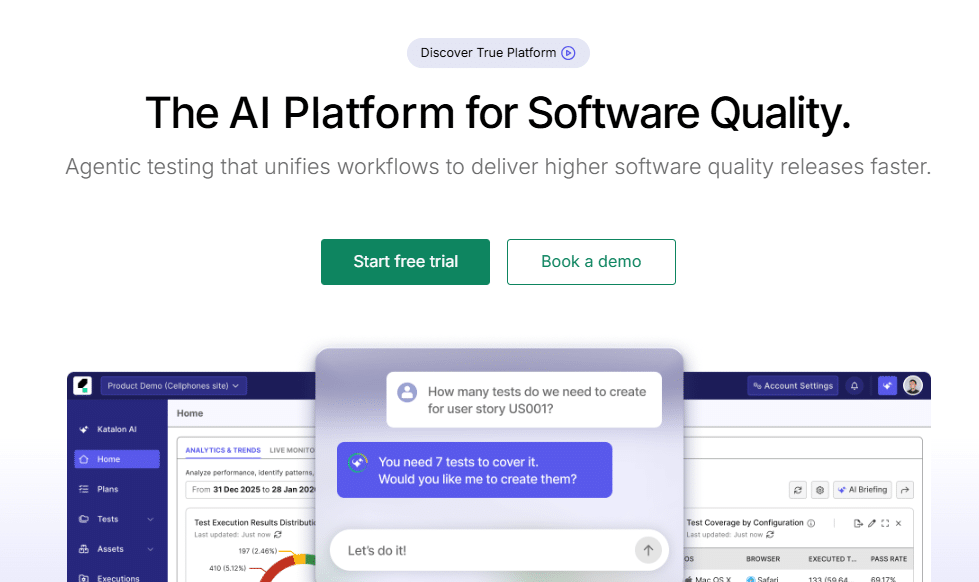
Katalon is a low-code test automation platform that covers web, mobile, API, and desktop testing in a single environment.
Its API testing module supports REST, SOAP, and GraphQL with a visual request builder and built-in assertion engine.
Self-healing locators and AI-assisted failure analysis reduce maintenance overhead considerably compared to purely script-based alternatives.
For QA teams managing web, mobile, and API testing across multiple products, consolidating into one platform cuts context-switching and reduces the cost of onboarding new team members.
It is one of the stronger all-in-one API test automation tools for mid-size teams that want coverage without managing four separate frameworks.
Best for: Mid-size QA teams that want one platform for API, UI, and mobile testing
Key features:
- Visual API request builder
- Supports REST, SOAP, GraphQL in one platform
- Self-healing test execution and AI failure analysis
- CI/CD integrations with Jenkins, GitHub Actions, Azure DevOps
- Built-in test reporting and analytics dashboard
AI capabilities: Self-healing locators, AI-assisted root cause analysis, smart wait handling
Pricing: Free plan available; paid plans from $175/month
Pros:
- Unified platform for API, UI, and mobile
- Accessible to non-developers
- Strong reporting out of the box
Cons:
- Heavy for teams that only need API testing
- Performance can slow on large test suites
5. Karate DSL — BDD API Testing with Built-In Performance Testing
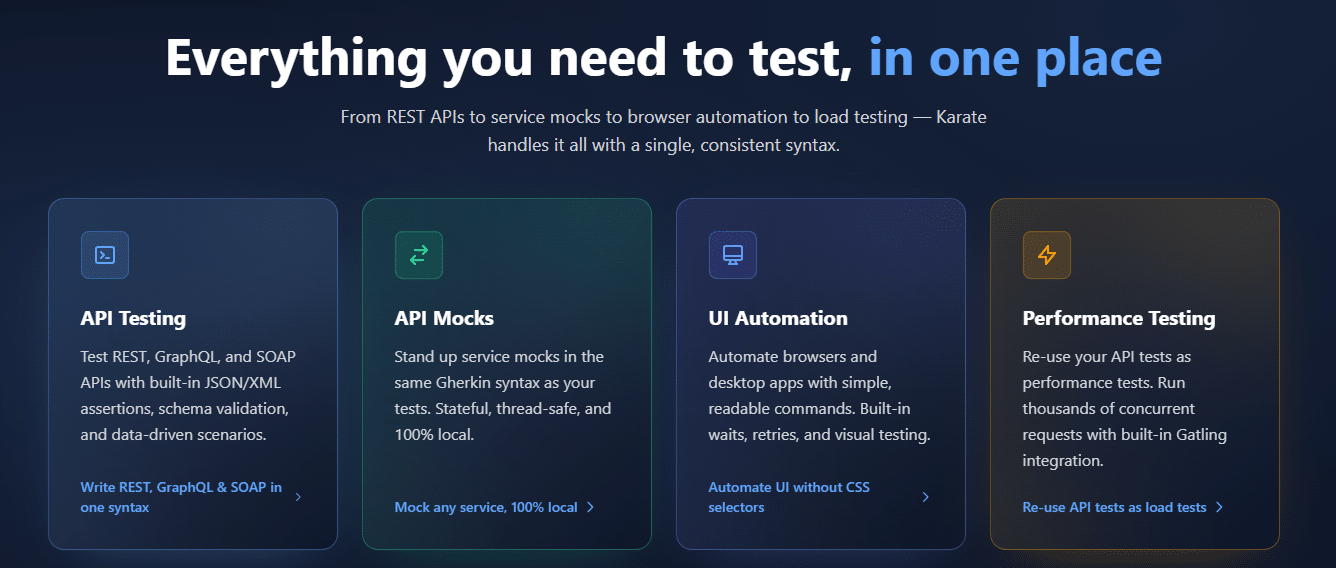
Karate DSL is an open-source framework that combines API test automation, mocking, performance testing, and UI automation in one tool. It uses a Gherkin-based syntax, so teams do not need to write Java for most tests.
It is one of the few tools where the same test script can support both functional API testing and load testing.
That makes it especially useful for teams that want automated API regression testing and performance coverage in one place.
Best for: Teams that want BDD-style API tests with built-in performance testing in a single open-source tool
Key features:
- Gherkin syntax
- Built-in parallel execution
- API mocking and contract testing support
- Performance testing via Gatling integration
- GraphQL, SOAP, and REST support
AI capabilities: None natively
Pricing: Free and open source
Pros:
- No Java or coding expertise needed for most tests
- Parallel execution out of the box
- Functional + performance testing in one framework
Cons:
- Less intuitive for teams unfamiliar with BDD syntax
- Smaller community than Postman or REST Assured
6. SoapUI / ReadyAPI — The Enterprise Veteran for Complex API Testing
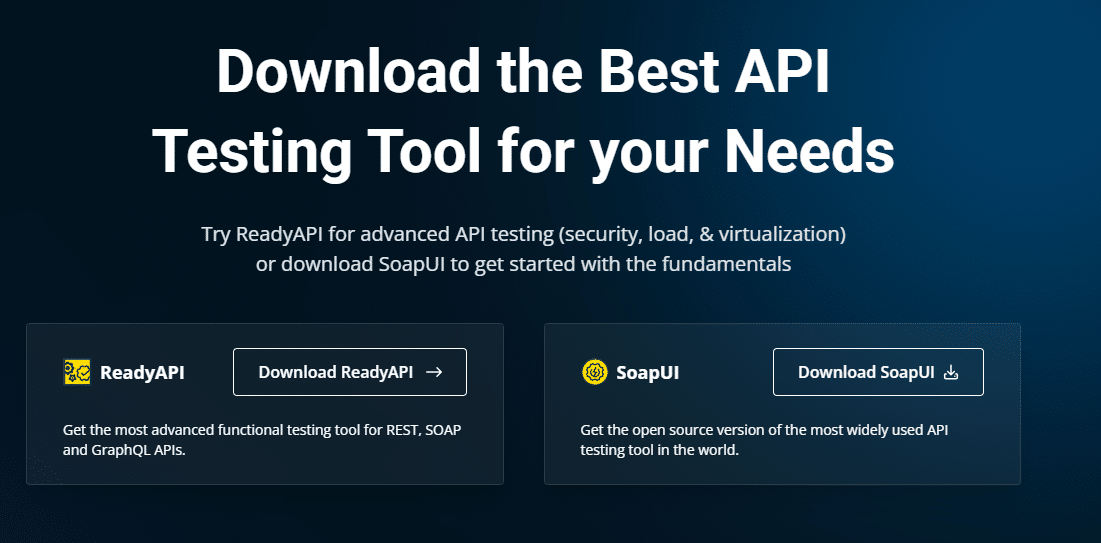
SoapUI and ReadyAPI by SmartBear have been enterprise standards for SOAP and REST API testing for years. ReadyAPI adds AI-assisted test generation, security scanning, and virtualization on top of SoapUI’s core capabilities.
This is still one of the strongest options for legacy environments, especially when SOAP is not optional.
For organizations with deep compliance needs, it remains a serious choice among best API testing tools for developers and QA teams.
Best for: Enterprise teams with complex SOAP/REST environments, compliance requirements, and legacy service dependencies
Key features:
- Deep SOAP and WSDL support
- ReadyAPI adds security testing and API virtualization
- Data-driven testing with CSV, Excel, database inputs
- CI/CD integration via command-line runner
- Built-in load testing
AI capabilities: ReadyAPI includes AI-assisted test generation and smart assertions
Pricing: SoapUI is free; ReadyAPI starts at $659/year
Pros:
- Best-in-class SOAP support
- Security testing in the commercial version
- Trusted by large enterprises
Cons:
- UI feels dated
- Overkill for teams working only with REST and GraphQL
7. Insomnia — Lightweight API Client with Testing Built In
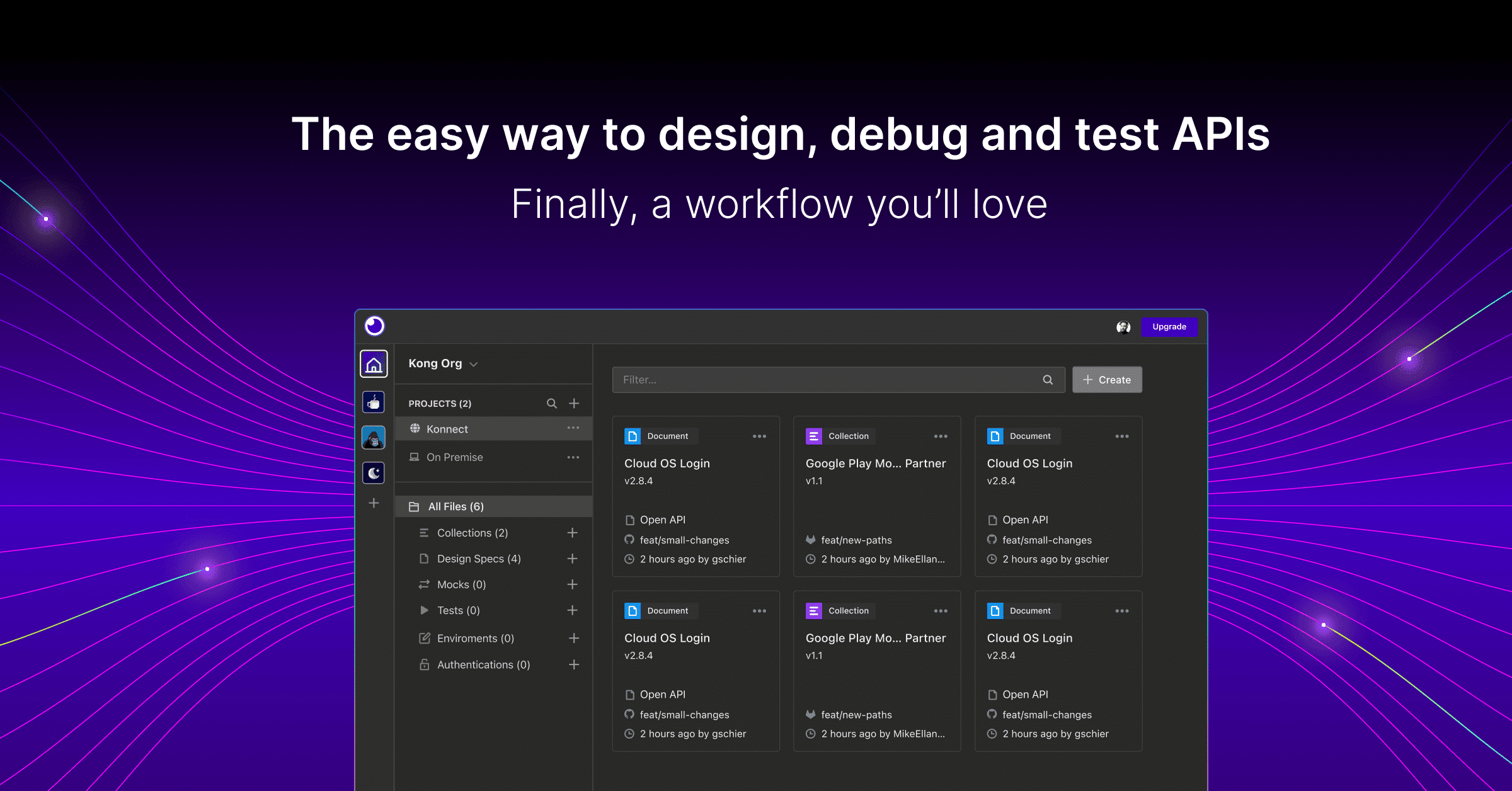
Insomnia by Kong is a developer-friendly REST and GraphQL API client with a built-in test runner for assertions against API responses.
It is lightweight, fast to set up, and supports environment variables, authentication flows, and response chaining.
It is not a full automation platform, but for teams that want quick API tests alongside development, it is a clean and efficient option.
Best for: Individual developers and small teams wanting a fast, lightweight API testing tool
Key features:
- Clean UI for API request building and testing
- JavaScript-based test assertions in the request editor
- Environment and variable management
- GraphQL explorer with schema introspection
- Git sync for team collaboration
AI capabilities: Limited; no autonomous test generation or self-healing
Pricing: Free plan available; paid plans from $16/user/month
Pros:
- Very fast to get started
- Clean, modern UI
- Excellent GraphQL support
Cons:
- Limited CI/CD automation capabilities
- Not designed for large regression suites
8. Hoppscotch — Open-Source API Testing for Lean Teams
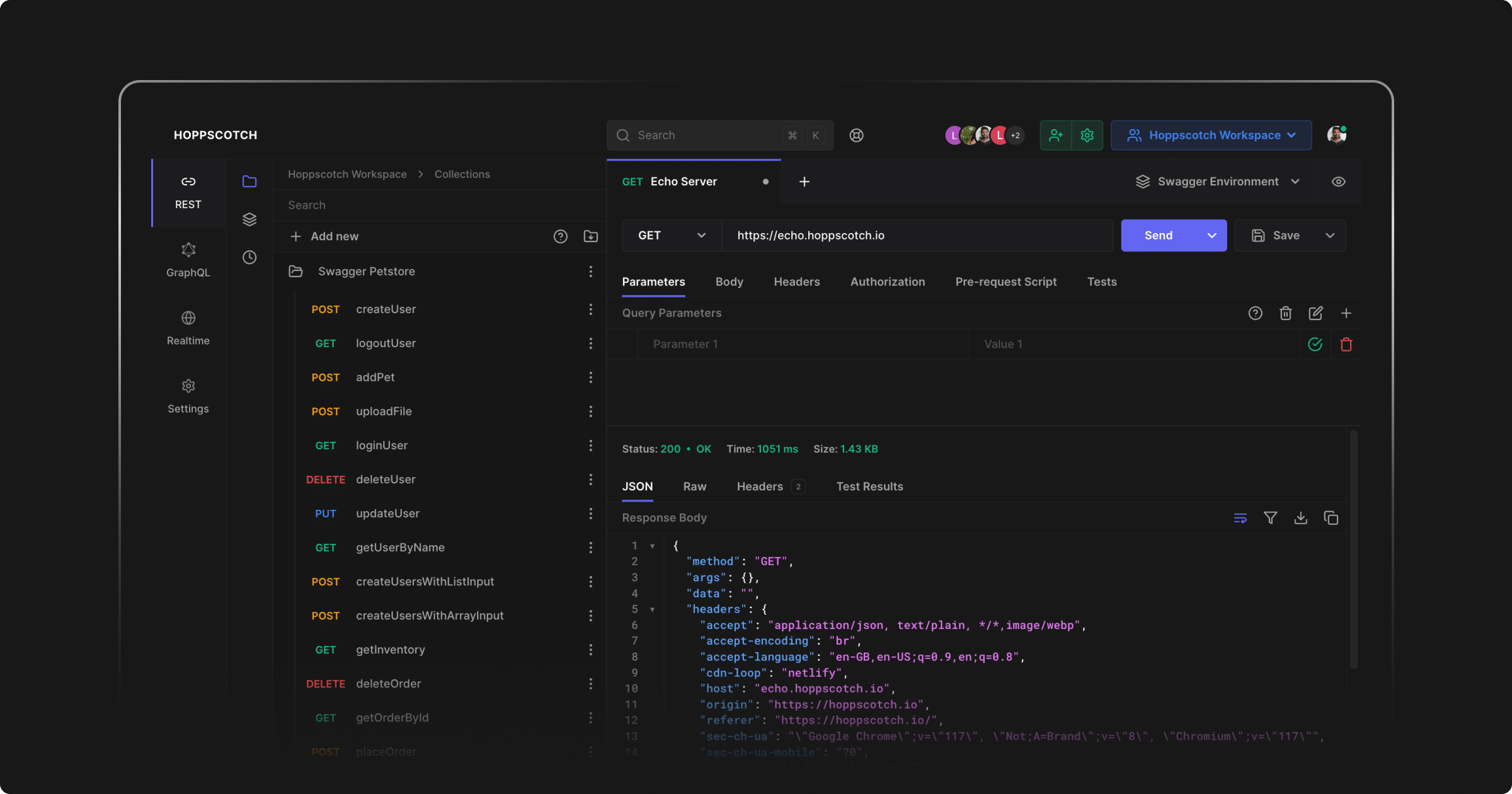
Hoppscotch is a lightweight, open-source API development and testing tool that runs entirely in the browser. It supports REST, GraphQL, WebSockets, MQTT, and SSE, giving it broad protocol coverage for a tool at this price point.
The self-hosted option makes it especially attractive for teams with privacy requirements or strict infrastructure policies.
A fintech or healthtech team that cannot send API payloads through a third-party cloud, for example, can run Hoppscotch entirely on their own infrastructure and still get a clean, modern testing experience at zero cost.
Best for: Lean engineering teams and open-source projects that want a browser-based API testing tool
Key features:
- Browser-based, no installation required
- REST, GraphQL, WebSockets, MQTT, SSE support
- Self-hosted option for privacy
- Team collaboration with shared collections
- Environment variables and pre-request scripts
AI capabilities: None currently
Pricing: Free open-source plan; cloud plans from $19/month
Pros:
- Zero install
- Broad protocol support
- Self-hosted option for privacy-sensitive teams
Cons:
- No CI/CD integration in the free tier
- Limited test automation depth
9. Tricentis Tosca — Enterprise Codeless API Testing at Scale
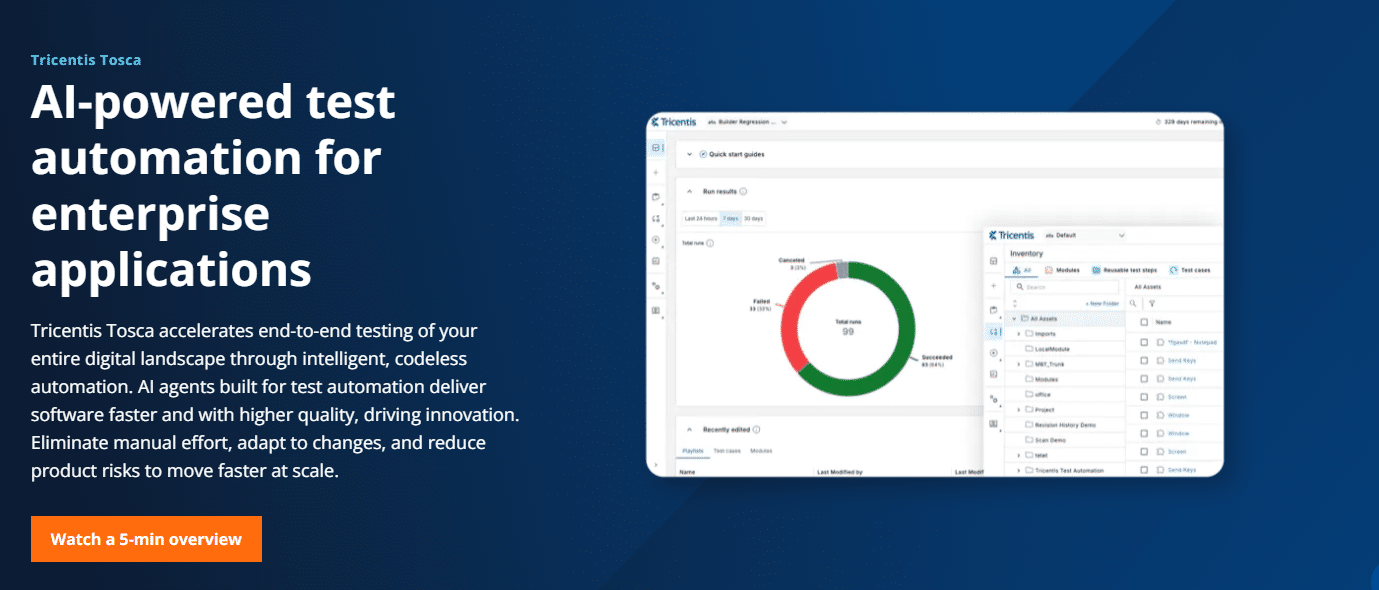
Tricentis Tosca is an enterprise-grade, model-based QA automation platform with strong API testing capabilities.
It uses a codeless, risk-based approach to test design and is widely used in SAP, banking, and insurance environments.
Its AI agents handle test maintenance, execution prioritization, and impact analysis for large suites. For large organizations, it is one of the most mature options in the market.
Best for: Large enterprise teams with complex, multi-system environments and compliance-driven testing requirements
Key features:
- Model-based test automation
- API, UI, mobile, and SAP testing
- AI-driven test impact analysis and prioritization
- Risk-based test optimization
- Enterprise integrations with ServiceNow, SAP, Salesforce
AI capabilities: AI agents for test maintenance, impact analysis, and autonomous execution
Pricing: Pricing varies; enterprise contracts only
Pros:
- Strong for SAP and complex enterprise environments
- Risk-based AI reduces unnecessary execution
- Excellent governance and compliance support
Cons:
- High cost
- Overkill for smaller API-first SaaS products
10. K6 — Developer-Centric Performance Testing for APIs
K6 by Grafana is a developer-first, open-source performance and load testing tool designed to stress test APIs under real-world traffic conditions.
Tests are written in JavaScript and run from the CLI or cloud, which makes it a natural fit for DevOps pipelines.
It is not a functional API testing tool, as in, it will not validate your business logic or check response payloads for correctness.
It is built specifically for performance, load, and stress scenarios: how does your API behave when 10,000 users hit it simultaneously, and where does it break first?
For DevOps teams running performance gates in CI/CD, it is the most developer-friendly option available.
Best for: DevOps and backend engineering teams that need load and performance testing for APIs in CI/CD pipelines
Key features:
- JavaScript-based test scripts
- CLI-first and cloud execution
- Threshold-based pass/fail in CI/CD pipelines
- Grafana integration for real-time metrics
- Browser testing extension for end-to-end performance
AI capabilities: None natively
Pricing: Open-source free; K6 Cloud from $49/month
Pros:
- Best-in-class for API performance and load testing
- JavaScript syntax is approachable for developers
- Grafana integration gives strong observability
Cons:
- Not a functional testing tool
- Requires scripting knowledge
Quick comparison table of Automated API Testing Tools
| Tool | Best For | AI Features | Contract Testing | Free Plan | Starting Price |
|---|---|---|---|---|---|
| Panto AI | AI-native functional + API testing | Yes — self-healing, AI agents | Yes | Yes | Freemium |
| Postman | API design + testing all-in-one | Yes — Postbot AI | Limited | Yes | $14/user/mo |
| REST Assured | Java-based API automation | No | No | Yes | Free |
| Katalon | Low-code unified testing | Yes — self-healing | Yes | Yes | $175/mo |
| Karate DSL | BDD-style API + perf testing | No | Yes | Yes | Free |
| SoapUI / ReadyAPI | Enterprise SOAP + REST | Limited | Yes | Yes (SoapUI) | $659/yr |
| Insomnia | Lightweight API client + testing | No | No | Yes | $16/user/mo |
| Hoppscotch | Open-source API testing | No | No | Yes | $19/mo |
| Tricentis Tosca | Enterprise codeless automation | Yes — AI agents | Yes | No | Pricing varies |
| K6 | Performance + load testing APIs | No | No | Yes | $49/mo |
How to choose the right API testing tool
Solo devs and startups
Hoppscotch is a strong free option if you want something browser-based and lightweight. AI-native API and functional testing is better if you want AI-native automation without spending time on script maintenance.
Java-heavy backend teams
REST Assured is the cleanest fit if your backend stack is already built around Java, JUnit, and Maven or Gradle. It keeps everything inside your existing test infrastructure.
Mid-size QA teams needing API + UI coverage
Katalon is a solid unified platform. Panto AI is the better choice if you want React Native automated testing with less maintenance overhead.
API-first teams already in Postman
Stick with Postman plus Newman for CI/CD. The ecosystem, team familiarity, and documentation workflow can outweigh the cost.
Enterprise, SAP, and SOAP environments
Tricentis Tosca and ReadyAPI are the strongest choices here. Their depth matters when legacy systems and compliance requirements dominate the stack.
DevOps teams focused on performance
K6 is the obvious choice for load and performance testing. Pair it with Panto AI or Postman for functional coverage.
API testing trends in 2026
- AI-generated test cases are replacing hand-written scripts. Tools like Panto AI and Postbot are making test authoring conversational, which reduces the cost of maintaining large suites.
- Self-healing API tests are becoming table stakes. Teams now expect tests to adapt when schemas, payloads, or endpoints change.
- Shift-left API testing is growing. More teams are validating contracts and API designs before code ships, using consumer-driven contract testing.
- GraphQL testing demand is rising. As more teams move beyond REST, testing tools need to catch up quickly.
- Performance testing is moving into CI/CD pipelines. K6 and similar tools are shifting load testing and debugging from quarterly reviews to every merge request, making API performance a continuous signal rather than a pre-release checkbox.
- API observability is complementing testing. Teams are pairing test suites with runtime monitoring to catch issues that tests miss.
Final verdict
The best automated API testing tools 2026 are not just about request sending anymore. They are about speed, resilience, collaboration, and how much manual upkeep they remove from your QA process.
For teams trying to simplify their stack, cut maintenance, and scale automated API regression testing without adding more framework overhead, the best choice is usually the one that gets you from idea to stable coverage the fastest.
In 2026, the teams winning on API quality are not the ones with the most tests, they are the ones with the most resilient tests. Build for maintenance from day one.
FAQ’s
Q: What is automated API testing?
Automated API testing validates that APIs return correct responses, handle errors properly, and perform within acceptable limits without manual execution. These tests run automatically on every code push within CI/CD pipelines.
Q: What is the difference between API testing and UI testing?
API testing validates backend logic and data layers directly, independent of the frontend. It is faster, more stable, and helps catch bugs earlier. UI testing, on the other hand, validates the end-user experience but tends to be slower and more brittle.
Q: Do I need a separate tool for API testing and functional testing?
Not necessarily. Modern platforms like Panto AI and Katalon support both API and UI functional testing within a single environment, reducing tool sprawl and simplifying maintenance across the QA stack.
Q: Is Postman good enough for automated API testing in CI/CD?
Postman, combined with the Newman CLI, works well for small to medium test suites. At larger scale, teams may face limitations in test organization, parallel execution, and maintainability, where dedicated platforms like Panto AI or Katalon provide stronger capabilities.
Q: Can AI replace writing API tests manually?
For standard CRUD and REST endpoints, largely yes. AI-driven tools like Panto AI can generate, execute, and maintain API tests autonomously. However, for complex business logic, edge cases, and security scenarios, human-driven test strategy remains essential.
Want to see how Panto AI handles API and functional testing in a single platform without scripts or setup overhead? Start for free — no credit card required.
You can also explore related reads on self-healing test automation, cross-browser testing tools, and automated regression testing tools.