


AccelQ has dominated the codeless test automation landscape for enterprise teams since its introduction, offering an intuitive cloud-based platform and powerful AI-driven self-healing capabilities.
However, 2026 presents a diverse testing ecosystem catering to different needs, team sizes, and tech stacks.
This guide explores 10 AccelQ alternatives and their advanced testing features, while highlighting AccelQ’s own limitations.
Whether you need mobile-first automation, no-code test generation, or AI-powered quality assurance, several AccelQ alternatives deserve your attention.
Why Explore AccelQ Alternatives?
AccelQ excels at multi-platform codeless automation and enterprise scalability, with its cloud-native architecture providing seamless CI/CD integration. But now, the QA market has matured, with new contenders offering superior features.
Limitations emerge in AccelQ when handling complex mobile app testing workflows, managing expensive cloud infrastructure, or seeking alternatives with more flexible pricing models.
Teams often discover that AccelQ’s premium pricing, setup complexity, and vendor lock-in create friction during scaling.
New AccelQ alternatives offer:
- AI-powered natural language test creation across web and mobile
- Self-healing automation that adapts to UI changes
- Real-device testing capabilities without emulator limitations
- Codeless and low-code testing options for diverse teams
- More cost-effective pricing for startup and mid-market organizations
Organizations report that 71% of testing teams evaluate multiple frameworks annually, recognizing that no single tool solves all problems perfectly.
Key Metrics & Statistics for 2026
QA automation tool selection impacts team productivity significantly. Organizations using AI-powered automation platforms report:
- 35% faster test execution cycles
- 45% reduction in test maintenance overhead
- 78% of enterprises require testing across 5+ browser combinations
- 60-70% reduction in maintenance effort with self-healing automation
Cloud-based parallel execution capabilities:
- Reduce feedback loops from hours to minutes
- Enable true continuous integration pipelines
- Save organizations $50,000-$200,000 annually through optimized solutions
Mobile app testing trends:
- Mobile-first testing strategies represent 62% of QA budgets
- Self-healing automation reduces maintenance by 60-70%
- Frees engineers for higher-value testing activities
Top 10 AccelQ Alternatives in 2026
1. Panto AI: Vibe Debugging for Mobile Apps
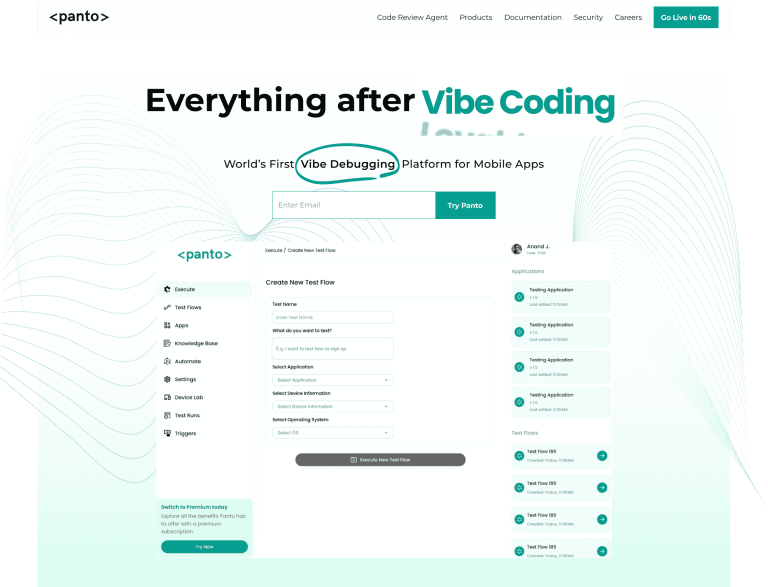
Panto AI redefines mobile app testing through its Vibe Debugging Platform, combining dynamic code reviews, security scanning, and AI-powered QA automation. This represents the future of intelligent mobile testing.
Panto AI excels at NLP-based test case generation across iOS and Android. Teams describe use cases in plain English, and the platform automatically navigates apps, executing tests step-by-step.
Its self-healing automation detects UI changes, adapts test flows, and notifies teams automatically without manual updates.
A standout feature of Panto AI is its ability to generate reusable test code that executes seamlessly across multiple devices. Teams write once and execute everywhere, reducing test creation time and maintenance overhead dramatically.
Panto’s Key capabilities:
- Automated test case creation from natural language requirements
- Multi-device execution on real devices and emulators
- Slack and CI/CD pipeline integration
- Instant debug reports with videos, logs, and screenshots
- Visual recognition and contextual understanding
- Self-healing automation that adapts to UI changes
- Support for iOS, Android, and iPad applications
Panto AI’s comprehensive support ensures seamless coverage across all major platforms. Teams achieve 100% test coverage in two weeks, with test maintenance dropping 60-80% compared to traditional approaches.
2. Testsigma: AI-Powered Codeless Automation
Testsigma eliminates coding through agentic AI capabilities, accepting plain English descriptions and auto-generating tests. This democratizes automation across teams without programming expertise.
Testsigma’s NLP engine understands requirements in natural language and converts them into executable test cases automatically. The platform supports web, mobile, API, Salesforce, and SAP testing—all unified in one environment.
Testsigma’s features:
- AI-powered test case generation and maintenance
- Auto-detection and remapping of UI elements
- Support for web, mobile, API, Salesforce, and SAP testing
- Real-time analytics and test health monitoring
- Native Slack and CI/CD integrations
- Create test cases 5-10x faster than traditional approaches
- Smart maintenance replacing manual script updates
Smart debugging maintenance automatically updates tests when applications change. Teams report 50%+ reduction in automation effort and improvements in regression execution speed.
3. Playwright: The Enterprise Choice
Playwright has emerged as the primary competitor for enterprise testing across platforms. Built with modern architecture, it offers true multi-browser support across Chromium, Firefox, and WebKit with unified APIs. This eliminates environment-specific workarounds and test rewrites.
Playwright’s advanced capabilities include multi-page and multi-domain automation, true parallel execution, network interception, and advanced debugging with DOM snapshots. Unlike codeless tools, Playwright provides developers with full control over test automation scripts.
Playwright’s advanced capabilities:
- Multi-page and multi-domain automation
- True parallel execution across browser contexts
- Network interception and response mocking at protocol level
- Screenshots, videos, and detailed trace recordings
- Desktop app testing through experimental features
- Advanced debugging with DOM snapshots
Enterprise adoption reached 34% among Fortune 500 companies in 2025. Playwright requires additional reporting tools and carries a steeper learning curve than codeless alternatives. However, it excels for teams with strong development practices.
4. Selenium WebDriver: The Industry Standard
Selenium WebDriver remains the most mature and widely-adopted framework, supporting virtually every programming language and browser combination. Its W3C WebDriver protocol compliance ensures longevity and standardization.
Selenium Grid enables distributed parallel testing across machines, making it ideal for large-scale enterprise debugging. The massive community provides extensive resources, established patterns, and deep ecosystem integration.
Selenium strengths:
- Selenium Grid enables distributed parallel testing across machines
- Legacy system support with massive community resources
- Deep ecosystem integration and established patterns
- Multi-language support: Java, Python, Ruby, C#, JavaScript
- Browser compatibility across all major and niche browsers
However, Selenium demands rigorous setup, driver management, and advanced coding knowledge. Synchronization issues can plague test stability without explicit waits and careful handling.
5. Katalon Studio: All-In-One Testing Platform
Katalon Studio provides comprehensive end-to-end testing for web, mobile, API, and desktop applications—all unified in a single platform. Designed for teams seeking codeless automation with optional scripting, it bridges the gap between non-technical testers and developers.
Katalon’s capture-and-replay recorder generates test scripts automatically, while the built-in IDE allows developers to enhance tests with custom code when needed. Integration with Jira, Jenkins, and other tools creates seamless CI/CD pipelines.
Katalon capabilities:
- All-in-one platform for web, mobile, API, and desktop testing
- Codeless test automation with optional scripting
- Built-in test analytics and reporting
- Integration with Jira, Jenkins, and popular DevOps tools
- Support for both cloud and on-premises deployment
- AI-driven self-healing capabilities
- Pre-built test objects for popular applications
Katalon‘s strength lies in its versatility and ease of adoption. Teams report rapid test creation with minimal learning curves. However, advanced customization requires deeper technical knowledge.
6. LambdaTest: Cloud-Based Cross-Browser Testing
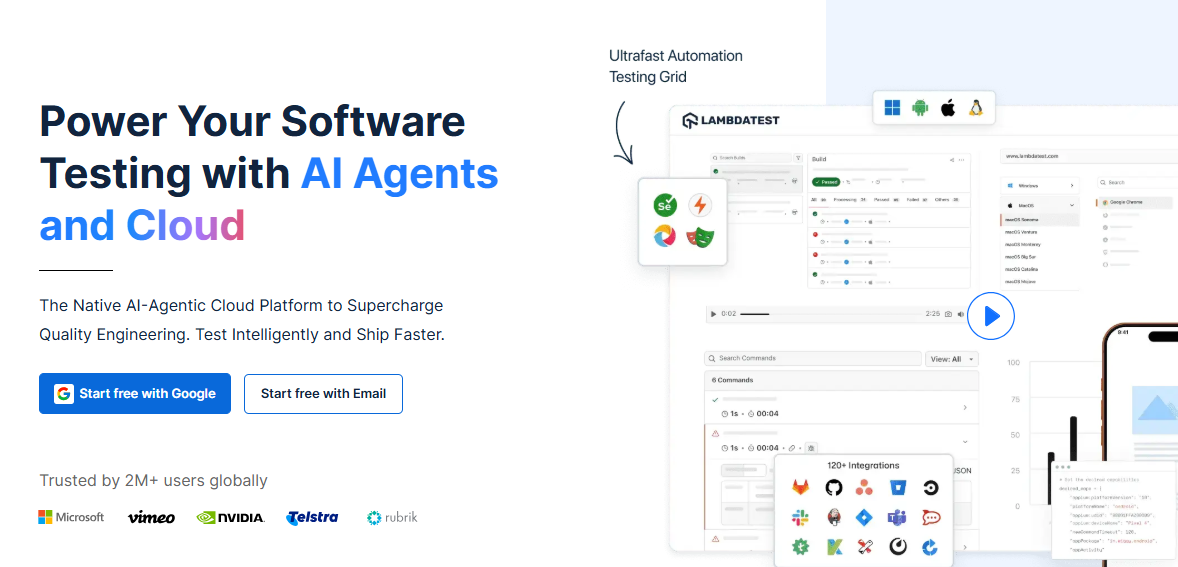
LambdaTest provides unified web and mobile testing on a cloud infrastructure supporting 10,000+ browser and OS combinations. Real device testing on thousands of mobile devices ensures accurate, real-world compatibility validation.
LambdaTest supports Selenium, Playwright, Cypress, and Appium—accommodating diverse team preferences. Parallel execution reduces feedback cycles from hours to minutes, enabling rapid CI/CD integration.
LambdaTest strengths:
- Cloud-based cross-browser testing on 10,000+ configurations
- Real-device mobile testing on Android and iOS
- Support for multiple frameworks (Selenium, Playwright, Cypress, Appium)
- Visual regression testing capabilities
- Unlimited parallel test execution
- Real-time browser session recording and debugging
- Built-in test analytics and insights
Teams report 50%+ reduction in testing time through parallel execution capabilities. LambdaTest excels for teams needing comprehensive cross-browser coverage without infrastructure management overhead.
7. Kobiton: Mobile-First Real-Device Testing
Kobiton specializes in enterprise-scale mobile app testing on real devices, eliminating emulator and simulator limitations. With AI-augmented automation and no-code testing workflows, Kobiton accelerates mobile QA delivery.
Kobiton’s device lab offers 1000+ real devices across iOS and Android versions, providing device-in-hand experiences virtually. AI-powered automation generates Appium scripts automatically, reducing script development time significantly.
Kobiton capabilities:
- Real-device testing on 1000+ mobile devices
- AI-powered automation with self-healing scripts
- Scriptless testing workflows for non-technical teams
- One-hour continuous testing and integration cycles
- Multiple parallel testing sessions
- Desktop-based collaboration for distributed teams
- CI/CD integration with Jenkins, JIRA, and others
Nike’s QA team reduced test execution time from 160 hours to 12 hours using Kobiton’s automation. Pricing starts at $83/month, making it accessible for growing teams.
8. Mabl: Intelligent AI-Native Testing
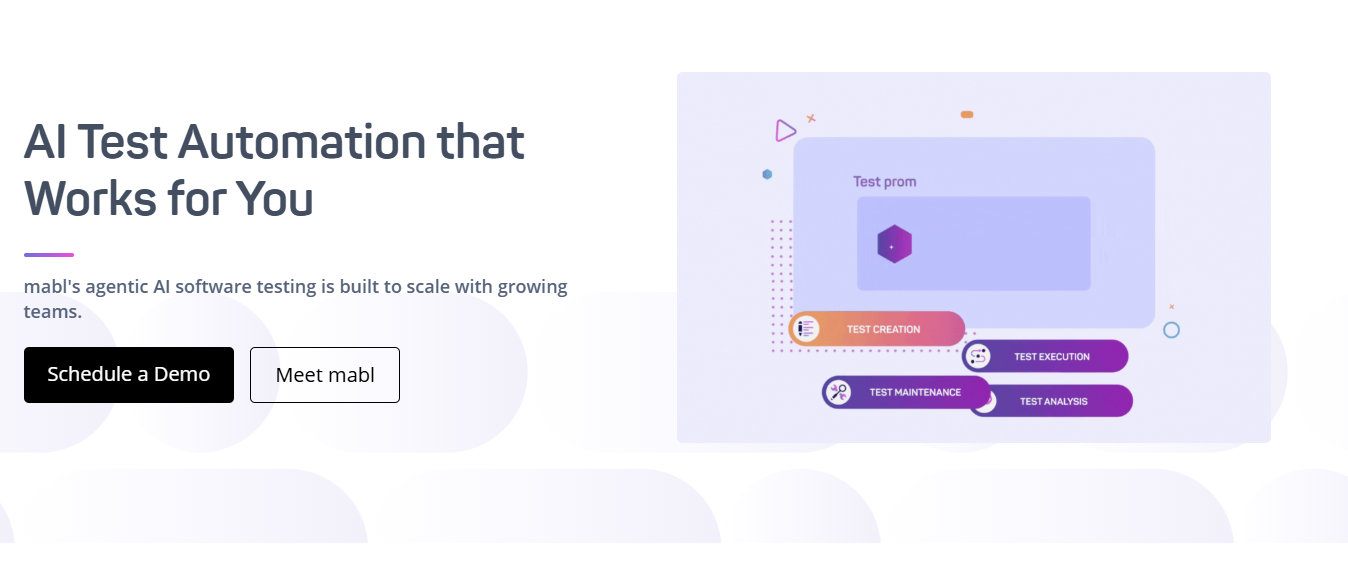
Mabl combines machine learning with agentic test automation, observing user interactions and generating tests automatically. Its analysis pipeline learns from every test run, improving accuracy and reducing false positives.
Mabl’s unique strength lies in its adaptive testing engine. Reinforcement learning models understand normal application behavior, predicting expected performance ranges. When actual execution deviates significantly, Mabl generates intelligent insights pointing to root causes.
Mabl features:
- AI-powered agentic test creation and execution
- Machine learning-based test maintenance and healing
- Visual regression testing with pixel-perfect accuracy
- Cross-browser and cross-device testing
- CI/CD pipeline integration
- Unlimited test execution agents
- Performance and accessibility checks built-in
Mabl enables teams to create tests 10x faster with agentic capabilities. AI-driven maintenance reduces overhead by 85%, freeing engineering resources for strategic debugging activities.
9. Ranorex Studio: Enterprise-Grade Codeless Automation

Ranorex Studio provides comprehensive test automation for web, desktop, and mobile applications with deep enterprise support. Supporting both codeless capture-and-replay and full C#/VB.NET scripting, Ranorex accommodates diverse skill levels.
Ranorex’s visual elements library accelerates test development, while the Project Setup Wizard and Ranorex Coach guide teams through best practices. Integration with popular CI/CD tools ensures seamless pipeline integration.
Ranorex capabilities:
- Codeless capture-and-replay interface
- Full scripting support with C# and VB.NET
- Support for web, desktop, and mobile testing
- Advanced reporting with customizable dashboards
- Ranorex Coach for best-practice guidance
- Real-device testing integration with BrowserStack
- Stability and low-code approach for enterprise teams
Ranorex provides enterprises with benefits from comprehensive documentation, professional support, and proven scalability across organizations.
10. QA Wolf: Managed Test Automation Service
QA Wolf offers a unique managed service model, where their team creates, maintains, and executes automated tests on your behalf. Built on Playwright, QA Wolf combines code transparency with managed operations.
QA Wolf specializes in end-to-end test coverage, handling test case generation, maintenance, and execution entirely. Their team monitors test failures, updates scripts when applications change, and provides continuous monitoring without your team’s intervention.
QA Wolf features:
- Done-for-you test creation and maintenance
- Playwright-based tests with code-level transparency
- Coverage-driven approach and ongoing flake management
- Unlimited parallel test execution
- Comprehensive dashboards and alerts
- Collaboration workflows for distributed teams
- No infrastructure setup required
QA Wolf appeals to teams seeking outcomes without building internal automation practices. Their team handles 100% of test management, freeing your QA to focus on strategic quality initiatives.
Feature Comparison Table of AccelQ alternatives
| Tool | Best For | Primary Platforms | Learning Curve | Setup Time | Price | AI-Powered | Self-Healing |
|---|---|---|---|---|---|---|---|
| Panto AI | Mobile app testing with natural language | iOS & Android | Very Low | <5 mins | Freemium | Yes | Yes |
| Testsigma | Codeless AI-powered automation | Web, Mobile, API | Very Low | <5 mins | Freemium | Yes | Yes |
| Playwright | Enterprise cross-browser web testing | Chrome, Firefox, Safari | Medium | 5-10 mins | Open Source | No | No |
| Selenium WebDriver | Legacy systems & multi-language | All major browsers | High | 15-30 mins | Open Source | No | No |
| Katalon Studio | All-in-one multi-platform testing | Web, Mobile, API, Desktop | Low-Medium | 10 mins | Freemium/Paid | Yes | Yes |
| LambdaTest | Cloud cross-browser & real devices | Web, Mobile (10K+ configs) | Low | 5-10 mins | Paid | Yes | No |
| Kobiton | Mobile-first real-device testing | iOS & Android (1000+ devices) | Low | 5-10 mins | Paid ($83/mo) | Yes | Yes |
| Mabl | Intelligent AI-native testing | Web, Mobile | Low | <5 mins | Paid | Yes | Yes |
| Ranorex Studio | Enterprise codeless & scripting | Web, Desktop, Mobile | Medium | 10-15 mins | Paid | Yes | Yes |
| QA Wolf | Managed test automation service | Web (Playwright) | N/A (Managed) | N/A (Managed) | Paid | No | Yes |
The table provides detailed analysis across setup time, platform support, learning curves, and core capabilities. Each tool addresses specific organizational needs uniquely:
- Best for mobile testing: Panto AI, Kobiton, Testsigma
- Best for cross-browser testing: LambdaTest, Playwright, Selenium WebDriver
- Fastest execution: Playwright and Katalon Studio
- Best test creation velocity: Testsigma and Panto AI
- Cost-effective: Selenium WebDriver, Playwright (free/open-source options)
- Enterprise scale: Ranorex, Katalon, LambdaTest
Selection Decision Framework
Panto AI is the choice if mobile app testing is your primary focus and you want AI-powered intelligence with natural language test creation. Self-healing capabilities eliminate test maintenance burden effectively.
Testsigma works when team members lack coding experience or test maintenance overhead threatens project velocity. AI-powered testing features accelerate test development dramatically.
Playwright makes sense when enterprise cross-browser support, multi-tab automation, or sophisticated network mocking becomes essential. Language flexibility supports diverse team compositions.
Choose LambdaTest when you need comprehensive cross-browser coverage on real devices without infrastructure management. Unlimited parallel execution accelerates feedback loops dramatically.
Kobiton is exclusively for mobile-first teams prioritizing real-device testing with AI automation and minimal setup overhead.
Selenium WebDriver is perfect for legacy system support, diverse programming language requirements, or established automation frameworks justify the setup complexity.
Choose your AccelQ alternative based on specific constraints:
- Technology stack and existing infrastructure investments
- Team expertise and required skill levels
- Application platform (web vs. mobile vs. hybrid)
- Browser and device coverage requirements
- Budget and licensing considerations
- Scaling requirements and growth plans
- CI/CD pipeline integration needs
The Testing Strategy for the New Year
The current testing ecosystem provides quality AccelQ alternatives, addressing diverse organizational needs comprehensively. Each tool excels in different scenarios, offering flexibility and innovation beyond AccelQ’s capabilities.
Re-evaluate your testing strategy: assess team expertise levels, evaluate application architecture, calculate scaling requirements, compare total pricing, plan CI/CD integration, and consider community support longevity.
Tools like Panto AI, Kobiton and Mabl help evolve QA process with AI-driven QA, self-healing capabilities, and cloud-native architectures Organizations investing in modern testing platforms today position themselves competitively for years ahead.