

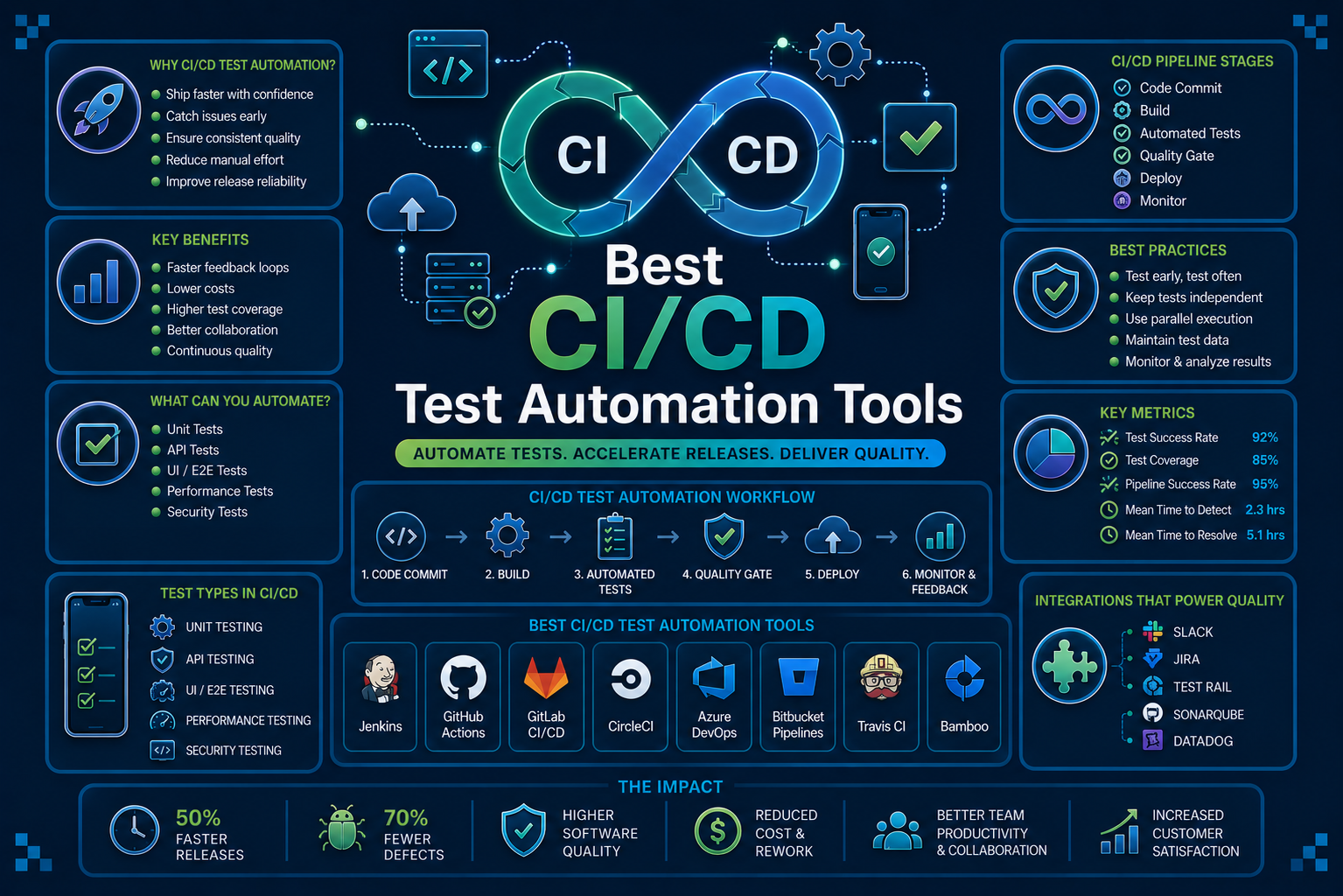

Every team that ships fast eventually hits the same wall. Builds are quick and deployments are automated, but testing is still what slows everyone down. That gap is exactly what CI/CD test automation tools are built to close.
The right tool plugs into your pipeline and runs tests on every commit and every release candidate, with no manual triggers or waiting on QA.
This list covers the 10 best CI/CD test automation tools worth evaluating in 2026, spanning open source frameworks, cloud device platforms, and AI-native tools for web and mobile.
Key Tools
- Panto AI: The leading AI-native CI/CD test automation tool for mobile and web QA, using natural language and self-healing tests.
- Selenium: The industry-standard open source framework for browser-based test automation, integrated into nearly every CI/CD pipeline.
- Appium: The most widely used open source framework for cross-platform mobile test automation in CI/CD.
- Playwright: A modern, fast cross-browser automation framework built by Microsoft for reliable continuous testing.
- Cypress: A JavaScript-first testing tool best suited for developers who want fast, front-end focused test automation.
- Katalon Studio: A low-code platform unifying web, mobile, API, and desktop test automation for CI/CD teams.
- BrowserStack: A cloud device and browser grid offering real device coverage for CI/CD test automation at scale.
- Sauce Labs: An enterprise-grade cloud testing platform built for large-scale continuous testing operations.
- LambdaTest: An AI-native cloud testing platform combining broad cross browser testing coverage with faster CI/CD execution.
- Testsigma: A low-code, AI-assisted tool letting mixed teams automate web, mobile, and API testing in CI/CD.
10 Best CI/CD Test Automation Tools In 2026
1. Panto AI
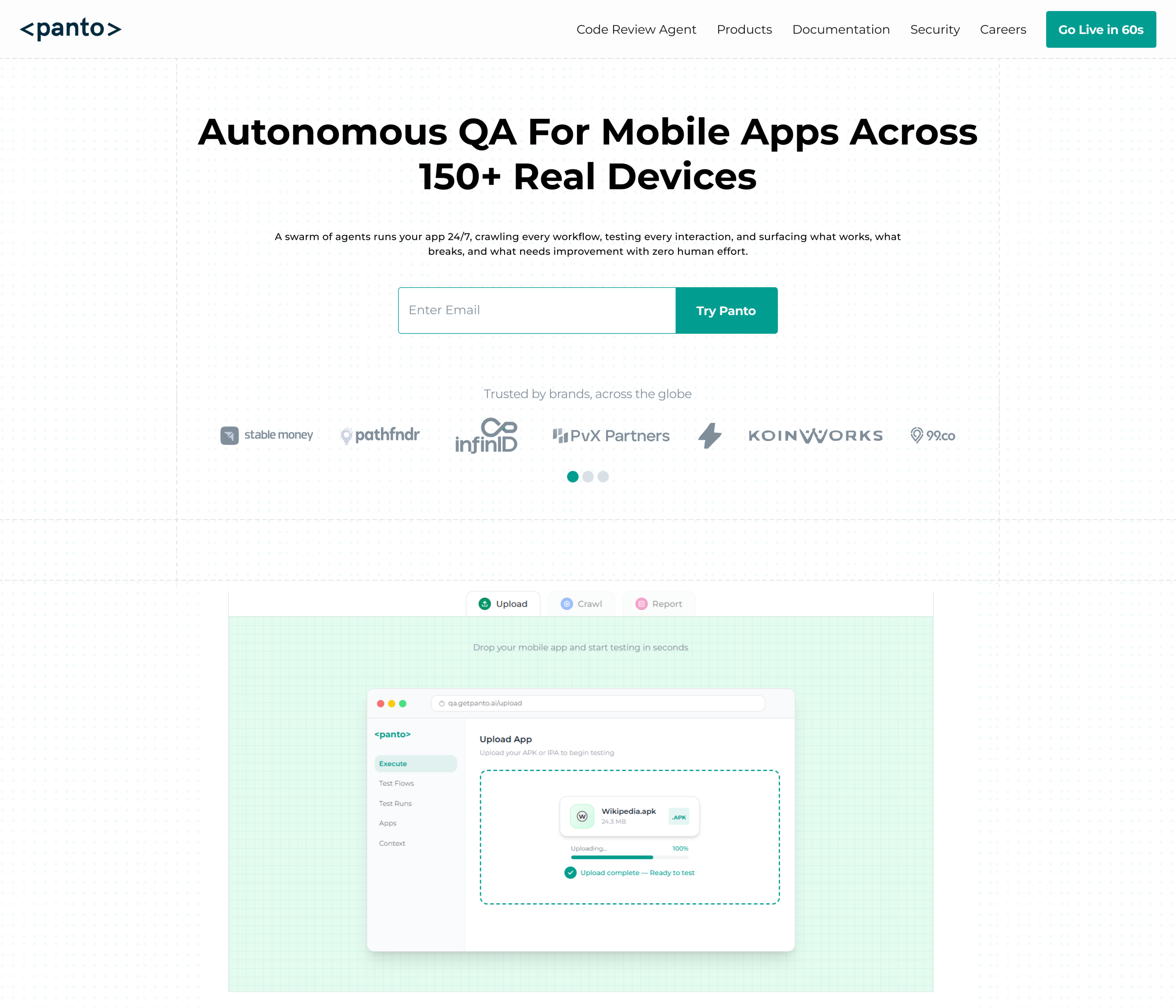
Panto AI is an AI native QA platform built for teams that want mobile and web test automation without the scripting overhead. Testers describe a flow in plain English, and Panto AI navigates the app step by step to execute it.
What sets it apart is how it treats maintenance. Every test converts into a deterministic script, but the underlying AI keeps adapting to UI changes without someone rewriting code every sprint.
Key Features
- Natural language test creation for web, mobile, WebView, and hybrid apps
- Self-healing automation that remaps journeys when the UI changes
- Execution on real devices, emulators, and cloud device farms like BrowserStack and LambdaTest
- AI-driven root cause analysis with human-readable failure summaries
- Vibe Debugging, which connects failing tests to the exact code change that caused them
How It Helps In CI/CD Test Automation
Panto AI gates merges and releases directly from GitHub Actions and GitLab pipelines. Tests run on every push, and because they self-heal, teams stop losing pipeline time to broken locators after routine UI updates.
Benefits
- No scripting skills needed to build or maintain test coverage
- Significantly lower flake rate than locator-based frameworks
Limitations
- Best suited to teams already thinking about AI-assisted QA workflows
- Deeper platform value shows up once the whole suite is adopted, not just one feature
Price: Custom pricing based on team size and device coverage, with a free trial available on request.
2. Selenium
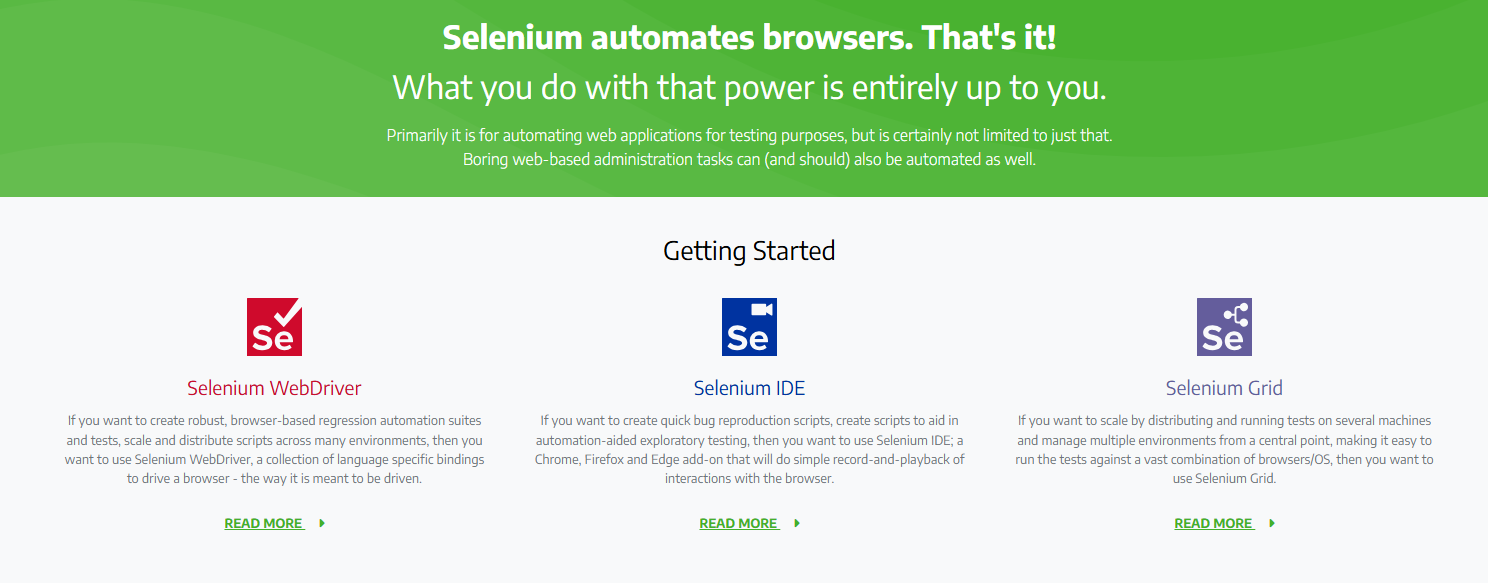
Selenium is the tool most of the test automation industry was built on top of. It automates real browsers through the WebDriver protocol and supports Java, Python, JavaScript, C#, and Ruby.
It is not the newest option here, but its ecosystem is unmatched. Nearly every CI tool, cloud device grid, and reporting framework already has a Selenium integration built in.
Key Features
- WebDriver protocol support across all major browsers
- Grid setup for distributed and parallel test execution
- Language bindings for most popular programming languages
- Massive community documentation and third-party plugin support
How It Helps In CI/CD Test Automation
Selenium Grid runs alongside Jenkins, GitHub Actions, or any CI system to execute browser tests in parallel on every build. It is the backbone that many cloud platforms, including BrowserStack and Sauce Labs, are built around.
Benefits
- Completely free and open source
- Works with almost any language or framework combination
Limitations
- No built in self-healing, so locator maintenance is manual
- Flaky tests are common without disciplined wait strategies
Price: Free and open source. Costs come from the infrastructure and maintenance around it.
3. Appium
Appium extends the WebDriver protocol to mobile, making it the most widely used open source framework for native, hybrid, and mobile web app automation. It uses UiAutomator2 for Android and XCUITest for iOS behind one unified API.
It does not require modifying the app under test, which is why it works across such a wide range of mobile scenarios. It is also the framework most cloud device platforms support by default.
Key Features
- Single API for both Android and iOS automation
- No app source code modification required
- Broad language support including Java, Python, and JavaScript
- Deep integration with device clouds like BrowserStack, Sauce Labs, and LambdaTest
How It Helps In CI/CD Test Automation
Appium test suites run headlessly in CI pipelines against emulators or real device clouds, gating mobile releases the same way Selenium gates web releases. Most mobile CI/CD setups use it as the execution layer underneath a device farm.
Benefits
- Free and open source with a mature community
- True cross-platform coverage from one codebase
Limitations
- High maintenance overhead as locators drift with app updates
- iOS test authoring requires macOS and Xcode
Price: Free and open source. Real device execution in CI typically requires a paid cloud provider.
4. Playwright
Playwright is Microsoft’s browser automation framework and the default choice for teams starting fresh in 2026. It runs against Chromium, Firefox, and WebKit from one API, with auto-waiting built in to reduce flakiness.
Its trace viewer and built-in test runner make debugging failed CI runs noticeably faster than older frameworks, which is why many teams are migrating away from Selenium for web testing.
Key Features
- Cross-browser support for Chromium, Firefox, and WebKit
- Auto-wait mechanism that reduces flaky test failures
- Built-in test runner, trace viewer, and network interception
- Parallel execution and sharding designed for CI environments
How It Helps In CI/CD Test Automation
Playwright ships with official GitHub Actions integration and Docker images, so pipelines can spin up isolated, consistent test environments in minutes. Sharded execution splits large suites across CI runners to keep pipeline times short.
Benefits
- Fast execution and genuinely low flake rates
- Strong debugging tools that save time in CI failures
Limitations
- Primarily focused on web, with limited native mobile support
- Newer framework, so community answers are less extensive than Selenium’s
Price: Free and open source.
5. Cypress
Cypress is a JavaScript-first testing framework built for the modern web. It runs directly in the browser rather than driving it remotely, giving it fast execution and a time-travel debugger that shows what happened at every step.
Developers tend to prefer it because the experience feels closer to writing application code than writing test scripts, which has made it popular with front-end heavy teams.
Key Features
- Time-travel debugging with automatic screenshots and video
- Real-time reload as tests are written
- Network stubbing and request interception
- Cypress Cloud for parallelization, analytics, and flaky test detection
How It Helps In CI/CD Test Automation
Cypress integrates with every major CI provider and can parallelize test runs through Cypress Cloud, cutting suite execution time significantly on larger codebases.
Test recordings attached to CI runs make failed builds easy to diagnose without reproducing locally.
Benefits
- Excellent developer experience and fast feedback loops
- Strong debugging tools built in by default
Limitations
- Limited to Chromium-family and Firefox browsers, with no native Safari support
- Not designed for native mobile app testing
Price: Free and open source core. Cypress Cloud adds paid plans for parallelization and team analytics.
6. Katalon Studio
Katalon Studio started as a free automation tool and has grown into a full platform covering web, mobile, API, and desktop testing. Its low-code interface lets testers without deep programming backgrounds build and maintain suites.
The newer TrueTest feature adds AI-based test generation, analyzing application behavior to suggest scenarios automatically, which puts Katalon closer to the AI-native tools on this list.
Key Features
- Low-code and scripted modes in the same platform
- Web, mobile, API, and desktop testing in one tool
- TrueTest AI-based scenario generation
- Built-in reporting dashboard and DevOps integrations
How It Helps In CI/CD Test Automation
Katalon’s Runtime Engine executes test suites headlessly inside CI pipelines, supporting parallel runs across Jenkins, GitHub Actions, and Azure DevOps. TestOps adds pipeline-level visibility into pass rates and failure trends over time.
Benefits
- Accessible to testers without heavy coding experience
- One platform covers multiple testing types
Limitations
- Free Studio tier does not include CI execution, which requires paid Runtime Engine
- Can get expensive as team size and usage scale
Price: Free Studio tier available. Paid plans for Runtime Engine and TestOps generally start in the range of $67 to $170 per user per month.
7. BrowserStack
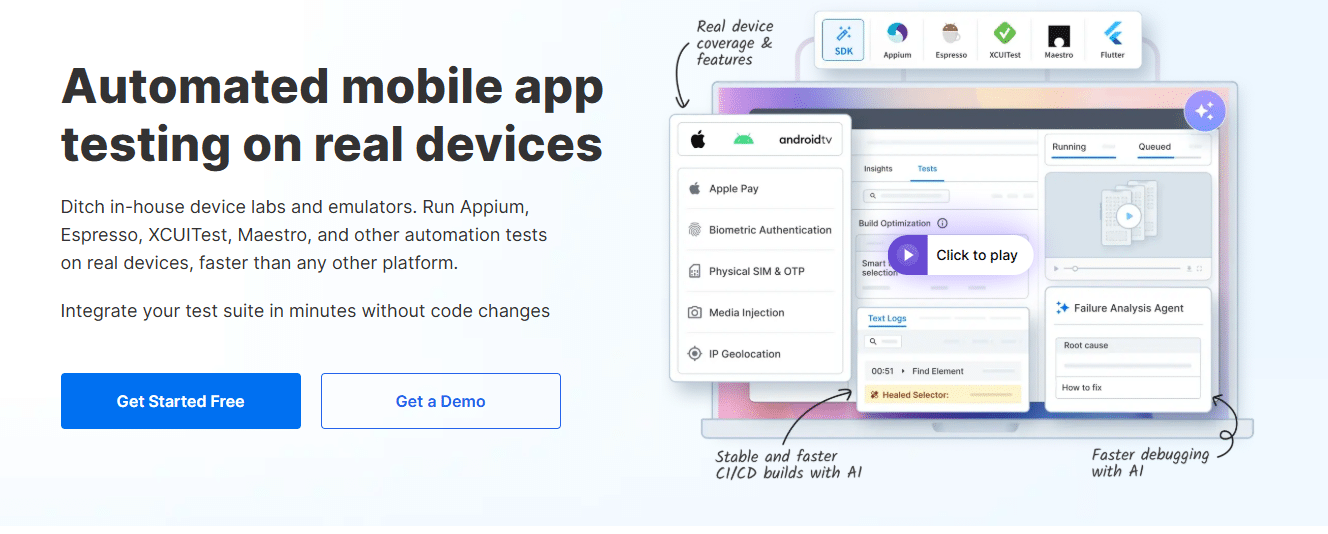
BrowserStack is best known as a cloud device and browser grid, giving teams access to thousands of real devices without maintaining their own lab. App Automate and Automate extend that infrastructure to Appium and Selenium suites.
Beyond raw device access, it has built out Test Observability and Percy for visual regression, positioning itself as a broader quality platform rather than just infrastructure.
Key Features
- Thousands of real devices and browser and OS combinations
- App Automate and Automate for mobile and web test execution
- Percy for automated visual regression testing
- Test Observability for CI pipeline analytics and flaky test detection
How It Helps In CI/CD Test Automation
BrowserStack plugs into existing Selenium or Appium suites, so pipelines run the same tests against real devices instead of emulators. Parallel sessions keep execution time manageable even as suites grow.
Benefits
- Massive, reliable device and browser coverage
- No infrastructure to maintain internally
Limitations
- Pricing scales quickly with parallel sessions and device access
- Requires an existing Selenium or Appium suite to get full value
Price: Live plans start around $29 per user per month. Automate pricing is based on parallel sessions, typically landing between $7,800 and $9,600 per year at 10 parallels before add-ons.
8. Sauce Labs
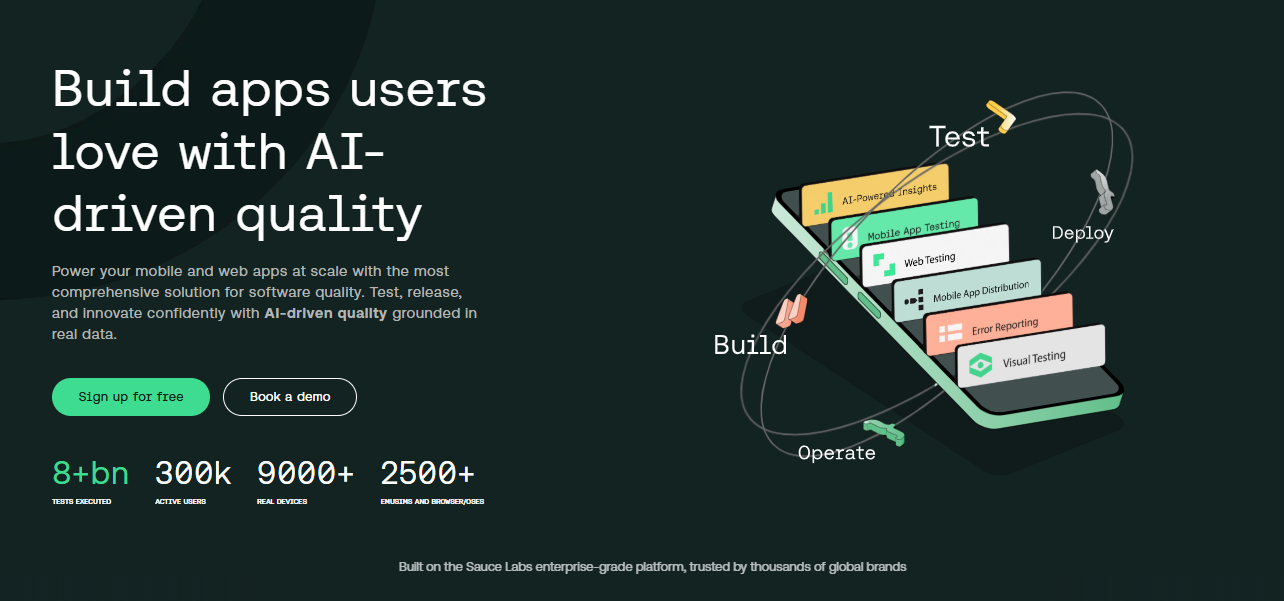
Sauce Labs is one of the most established cloud testing platforms, built around the same Selenium and Appium standards as BrowserStack but with a heavier enterprise focus. It supports functional, visual, and API testing in one dashboard.
Its analytics layer stands out for larger organizations, offering detailed insight into test trends and infrastructure usage across many teams on one account.
Key Features
- Real device and virtual cloud for web and mobile testing
- Selenium and Appium grid support at enterprise scale
- Test analytics and error clustering across teams
- Visual testing and API testing add-ons
How It Helps In CI/CD Test Automation
Sauce Labs runs existing Selenium and Appium suites inside CI pipelines with high parallelization, which matters most for large organizations running thousands of tests daily.
Its analytics help engineering leads spot systemic flakiness across teams, not just individual builds.
Benefits
- Mature infrastructure built for enterprise scale
- Strong analytics for cross-team visibility
Limitations
- Pricing is generally enterprise-focused and less accessible for small teams
- Still requires a coded test suite underneath it
Price: Custom enterprise pricing based on usage and parallel sessions. Contact sales for a quote.
9. LambdaTest
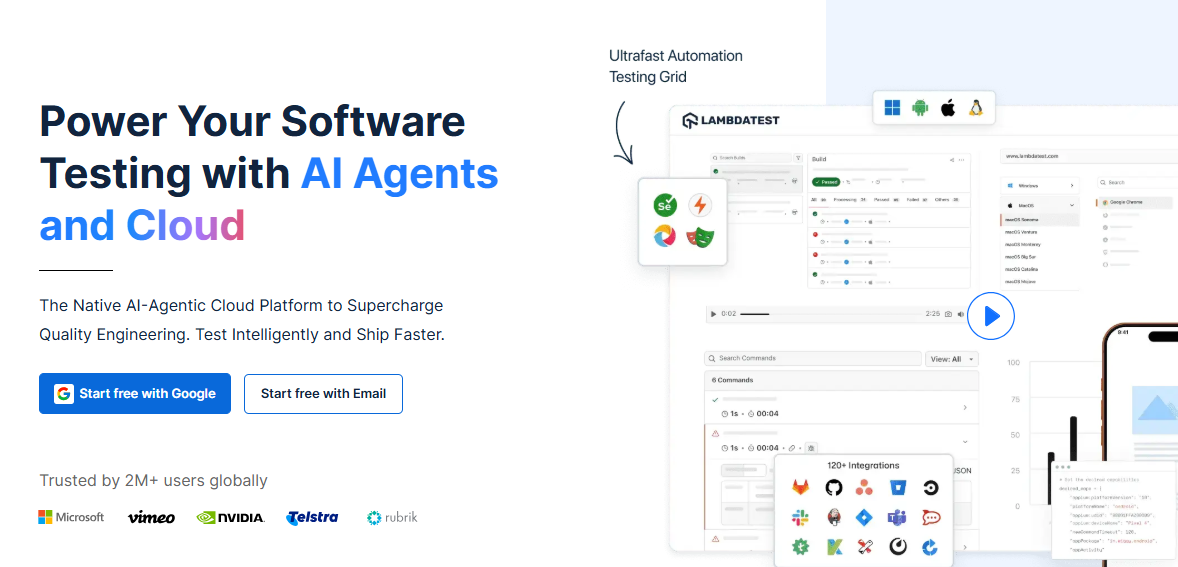
LambdaTest has repositioned itself as an AI-native testing platform under the TestMu AI brand, layering AI agents on top of its original cloud grid.
KaneAI, its flagship assistant, lets testers describe objectives in plain English and generates test steps automatically.
HyperExecute, its high-speed execution engine, is built to cut test suite run times inside CI pipelines, a common complaint with older cloud grids.
Key Features
- 700 plus browser, OS, and device combinations
- KaneAI for natural language test authoring and step generation
- HyperExecute for faster parallel test execution
- Native integration with Selenium, Appium, Cypress, and Playwright
How It Helps In CI/CD Test Automation
LambdaTest connects to Jenkins, GitLab, and GitHub Actions, running existing automation suites at scale while HyperExecute reduces total pipeline execution time. KaneAI can also generate new coverage directly from CI failure patterns.
Benefits
- Broad framework compatibility, not locked into one tool
- Competitive pricing compared to some enterprise-only platforms
Limitations
- AI features are newer and still maturing compared to core grid features
- Full value requires pairing with an existing coded suite
Price: Free plan available for basic use. Paid plans scale by user count and parallel sessions, with enterprise pricing available on request.
10. Testsigma
Testsigma is a low-code, AI-assisted test automation platform built to let developers and manual testers contribute to the same suite. Tests can be written in natural language and executed across web, mobile, and API layers from one place.
Its cloud infrastructure removes the need for a separate device lab, making it a reasonable middle ground between fully coded frameworks and fully AI-native platforms.
Key Features
- Natural language and low-code test authoring
- Unified web, mobile, and API testing
- Cloud execution across real devices and browsers
- Built-in test data management and reusable test steps
How It Helps In CI/CD Test Automation
Testsigma integrates with Jenkins, GitHub Actions, and Azure DevOps to trigger suites automatically on new builds. Its NLP-based authoring lowers the barrier for non-developers to add coverage without slowing down release cycles.
Benefits
- Approachable for mixed teams of developers and manual testers
- Reasonable entry point for teams new to automation
Limitations
- Test-minutes based metering can get expensive as usage scales
- Less flexible than code-first tools for highly custom scenarios
Price: Tiered pricing with a free trial. Costs scale with cloud test-minutes usage, which can push larger teams into higher annual spend.
Comparison Table of Top 10 continuous testing tools
| Tool | Best For | Self-Healing | Platforms | Starting Price |
|---|---|---|---|---|
| Panto AI | AI-native mobile and web QA | Yes | Web, Mobile, WebView, Hybrid | Custom, free trial |
| Selenium | Open source web automation | No | Web | Free |
| Appium | Open source mobile automation | No | Mobile | Free |
| Playwright | Modern cross-browser web testing | Partial | Web | Free |
| Cypress | Front-end developer testing | No | Web | Free, paid Cloud add-on |
| Katalon Studio | Low-code, multi-platform testing | Partial | Web, Mobile, API, Desktop | Free tier, paid from ~$67/mo |
| BrowserStack | Real device and browser cloud | No | Web, Mobile | From $29/mo |
| Sauce Labs | Enterprise-scale cloud grid | No | Web, Mobile | Custom |
| LambdaTest | AI-native cloud testing | Yes | Web, Mobile | Free tier, custom paid |
| Testsigma | Low-code mixed teams | Partial | Web, Mobile, API | Tiered, usage-based |
How To Choose The Right Mobile Test Automation CI/CD Tool For Your Pipeline
There is no single best answer, and the right choice depends on your team’s mobile maturity, technical depth, and how much of your pipeline is already built out. Here is how to think through the most common scenarios.
If you are mobile-first: Prioritize real device coverage and self-healing, since mobile UIs change more often than most teams expect. A tool like Panto AI, or a device cloud paired with Appium, cuts the maintenance drag mobile suites are known for.
If your team is small and code-first: Open source frameworks like Appium or Playwright keep licensing costs at zero, as long as someone owns test maintenance long term. This works best when at least one engineer is comfortable owning the framework itself.
If you have mixed technical skill levels: Low-code or natural language tools bring manual testers, PMs, and junior engineers into automation without bottlenecking coverage on one specialist. This matters most for teams trying to scale coverage faster than they can hire.
If flaky tests are already a problem: Self-healing and AI-based root cause analysis save more engineering time than almost any other feature. Teams losing more than 20 percent of sprint capacity to broken tests should treat this as the top priority, not a nice to have.
If you are testing at enterprise scale: Look for strong parallelization, cross-team analytics, and dedicated support, since a handful of flaky tests can compound into real pipeline delays across many squads. Sauce Labs and BrowserStack were built with this scenario in mind.
If you are an early-stage startup on a tight budget: Start with open source frameworks and a lightweight CI setup. Add a device cloud or AI layer once manual regression testing genuinely becomes a release bottleneck, not before.
If you work in a regulated industry like fintech or healthcare: Favor tools with strong audit trails, detailed reporting, and reliable real device execution, since compliance reviews often require proof that releases were tested consistently. Consistency matters more than raw speed here.
If you are testing hybrid or WebView-heavy apps: Confirm the tool actually supports WebView and in-app browser testing, not just native UI elements, since this is where many mobile frameworks fall short. Browserstack and Panto AI both handle this natively.
If you already have a Selenium or Appium suite: Layer a device cloud like BrowserStack, Sauce Labs, or LambdaTest on top instead of rebuilding from scratch. Your existing scripts stay useful, and you gain real device execution and CI parallelization right away.
If you need broad global device and OS coverage: Cloud platforms with large device libraries, like BrowserStack or LambdaTest, save you from maintaining a physical device lab across regions and OS versions.
If pipeline speed is your biggest constraint: Look specifically at execution engines built for CI, such as HyperExecute or Playwright’s sharding, since parallelization tends to move the needle more than any single feature elsewhere.
Most mature teams end up running more than one tool: a device cloud for infrastructure, an execution framework underneath it, and increasingly an AI layer on top to handle test creation and maintenance.
The starting point matters less than picking something that matches where your team actually is today, not where you hope to be a year from now.
FAQs
What is the difference between CI/CD tools and CI/CD test automation tools?
CI/CD tools like Jenkins or GitHub Actions manage the pipeline, triggering builds and deployments. Test automation tools like Selenium or Panto AI run inside that pipeline to execute and validate tests.
Can AI test automation tools replace manual QA entirely?
Not entirely. They remove most repetitive regression work, but manual testers still matter for exploratory testing and edge cases scripts do not anticipate.
Which tool is best for mobile app testing in CI/CD?
It depends on your team’s technical depth. Appium offers the most control for coded teams, while Panto AI reduces maintenance for teams that want faster coverage without scripting overhead.