

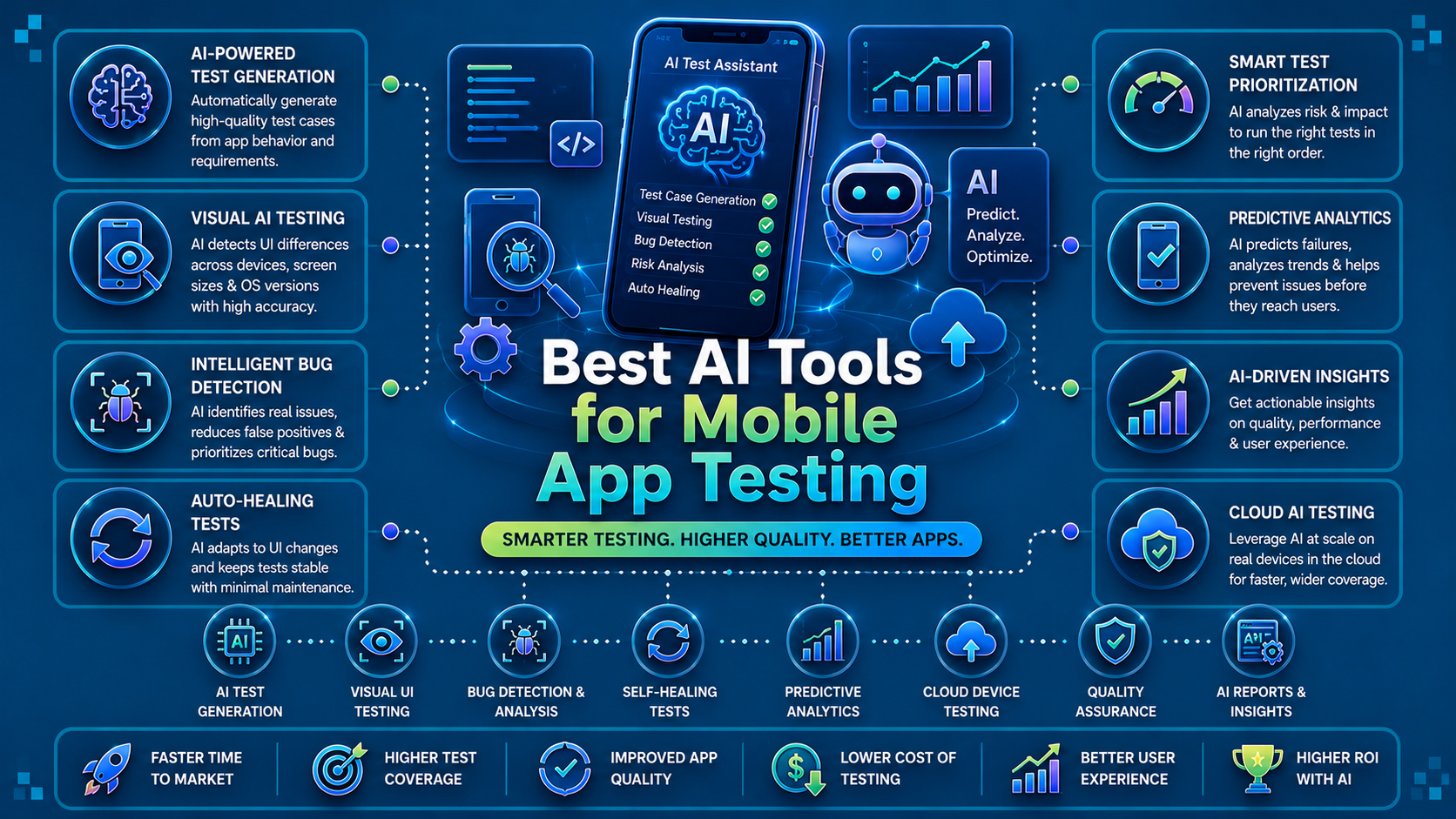

Mobile app quality has always been hard to scale. Device fragmentation, fast release cycles, and constantly changing UI make it nearly impossible to maintain reliable test coverage with traditional automation alone.
AI changes that equation. The best AI tools for mobile app testing today do not just run scripts faster. They generate tests from natural language, heal broken flows automatically, surface root causes without manual triage, and catch visual regressions that code-based checks miss entirely.
This guide covers the 10 best AI-powered mobile testing tools in 2026, what makes each one genuinely useful, and how to match the right tool to your team’s biggest bottleneck.
Key Tools
- Panto AI: AI-native mobile app testing platform for natural-language test creation, self-healing, and root cause analysis.
- Appium With AI Plugins: Open-source mobile automation framework for teams adding AI resilience to existing Appium workflows.
- Mabl: Low-code AI testing tool for unified web and mobile app testing with strong auto-healing.
- Testim: AI-assisted mobile testing platform built for stable locators and fast recovery from UI changes.
- Katalon: Unified automation platform for mobile, web, and API testing with AI self-healing support.
- BrowserStack App Automate With AI: Real-device mobile testing cloud with AI self-healing and test selection for enterprise teams.
- TestMu AI: AI-native mobile testing platform for natural-language test generation and large real-device coverage.
- Functionize: Enterprise AI testing platform designed for complex mobile app testing and multi-step workflows.
- Kobiton: Mobile testing platform that turns manual sessions into automated tests on real devices.
- Tricentis: Enterprise mobile testing platform focused on AI risk-based prioritisation and continuous testing at scale.
The 10 Best AI Tools for Mobile App Testing in 2026
1. Panto AI
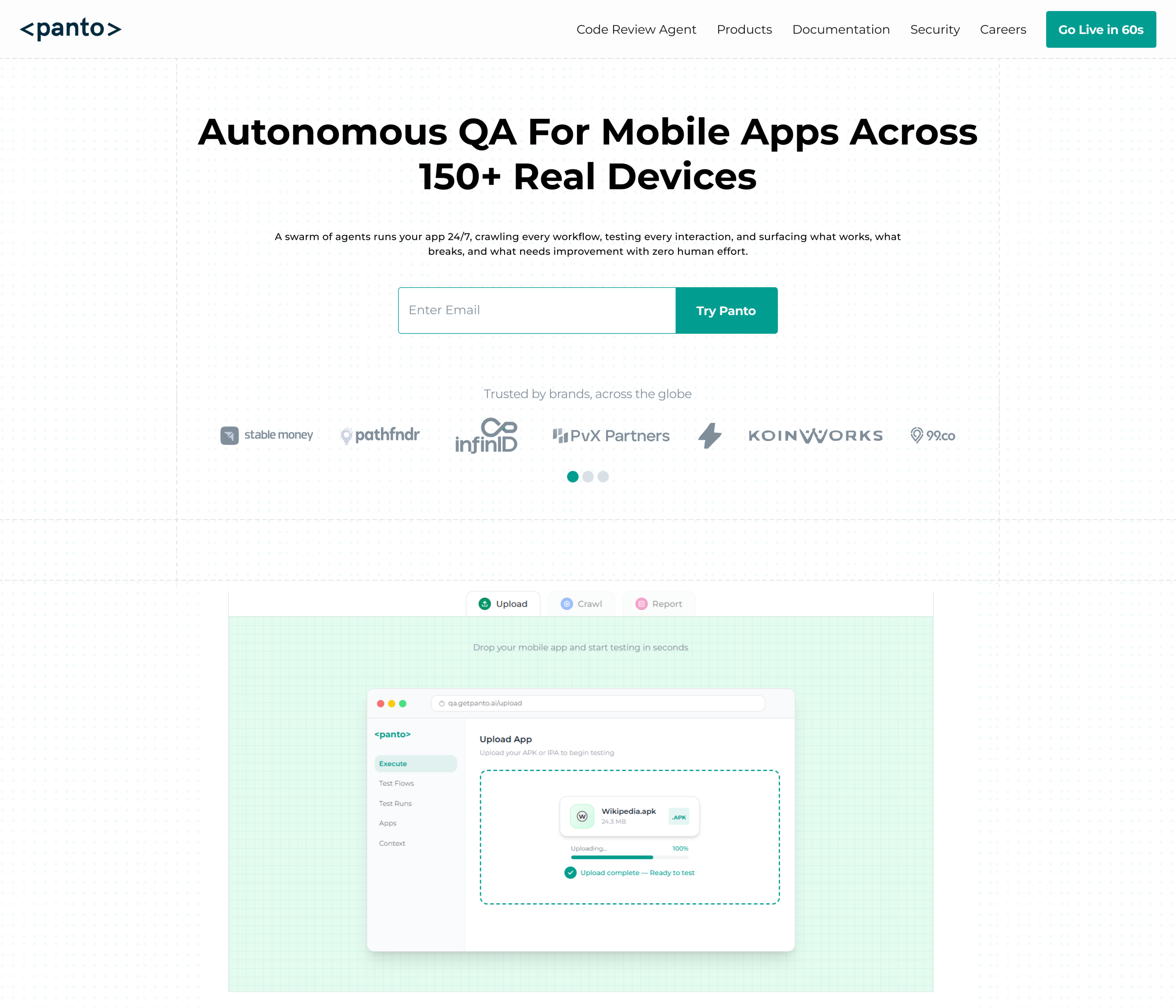
Panto AI is an AI-native mobile QA platform built specifically for teams that want to move from manual and script-heavy testing to intelligent, autonomous mobile app test automation. It combines natural language test creation, real device execution, and AI-driven failure analysis in a single platform without requiring teams to stitch together multiple tools.
What sets Panto apart from general-purpose AI testing tools is its mobile-first design. Every AI capability in the platform, from test generation to root cause analysis, is built around the specific challenges of native Android and iOS testing: gesture handling, device fragmentation, OS version variance, and CI pipeline integration.
Key Features:
- NLP-based test case generation from plain English descriptions
- Real device execution across 150+ Android and iOS physical devices
- Self-healing test automation that adapts to UI changes without manual updates
- AI-powered root cause analysis that links failures to specific code changes or commits
- Vibe Debugging platform connecting visual test failures back to the pull request that caused them
- Appium, Detox, and Maestro script export for version control and CI integration
- Codeless visual flow builder for non-technical QA contributors
- Performance budget enforcement on every PR for CPU, memory, and app start time
- CI/CD integration with automatic test triggering on pull requests
- Free for open source projects with unlimited PR reviews
How Its AI Features Help in Mobile Testing:
Panto’s AI layer addresses the two problems that kill most mobile testing programs: the cost of writing tests and the cost of keeping them working. NLP generation means a QA engineer can describe a checkout flow in plain English and have a working, device-executed test within minutes.
The self-healing layer means that when a designer renames a button or moves a CTA, the test adapts automatically rather than failing and requiring a fix before the next release. The Vibe Debugging platform then connects any failure directly to the code change responsible, eliminating the manual investigation cycle that typically follows a red CI build.
Limitations:
- Primarily optimised for mobile app testing; not designed for web or desktop automation
- Advanced customisation beyond AI-generated scripts may require technical input
- NLP-driven workflows have a learning curve for teams accustomed to purely code-based automation
Best For: Mobile-first teams, lean QA organisations, and AI-native engineering teams that want fast test creation, low-maintenance coverage, and intelligent failure triage on real devices.
Pricing: Free plan at $0 with 15 test flows and 50 minutes of real device execution. Scale plan starts at $999 per month. Enterprise pricing available on request.
2. Appium With AI Plugins
Appium remains the most widely used open source framework for mobile app automation, and its plugin ecosystem has added meaningful AI capabilities over the past two years. While Appium itself is not AI-native, tools like Appium AI Plugin and integrations with platforms like Sauce Labs bring self-healing and intelligent element detection into Appium-based workflows.
For teams with existing Appium investment, this approach allows gradual AI adoption without migrating to a new platform. The trade-off is that AI capabilities are additive rather than foundational, meaning the base framework of Appium still carries its traditional flakiness and maintenance challenges.
Key Features:
- Open source and free to use with broad community support
- AI element detection plugins for more resilient locator strategies
- Supports Android and iOS native, hybrid, and mobile web apps
- Language-agnostic: Java, Python, JavaScript, Ruby, C#, and more
- Works with real devices, emulators, and all major cloud device platforms
- Integration with Sauce Labs, BrowserStack, and other AI-enhanced cloud runners
- WebDriver protocol compatibility for broad toolchain integration
How Its AI Features Help in Mobile Testing:
AI plugins for Appium improve locator resilience by using visual and semantic element identification rather than brittle XPath or ID selectors. This reduces the most common source of test failures in mobile automation testing without requiring a full platform migration.
Paired with an AI-enhanced device cloud, Appium tests can also benefit from intelligent test selection and failure analysis at the execution layer.
Limitations:
- AI capabilities depend on third-party plugins or cloud platforms rather than being built in
- Base framework still requires significant scripting expertise to set up and maintain
- No native test generation, visual AI, or root cause analysis without additional tooling
Best For: Teams with existing Appium investments that want to incrementally add AI resilience without rebuilding their mobile automation stack from scratch.
Pricing: Free and open source. AI-enhanced cloud execution costs vary by provider.
3. Mabl
Mabl is a low-code AI testing platform that uses machine learning to create, maintain, and execute tests across web and mobile environments. Its auto-healing engine is one of the most mature in the market, having been trained on millions of test executions to identify and repair broken element references automatically.
While Mabl started as a web-first tool, its mobile testing capabilities have matured significantly. It supports native mobile app testing alongside web, making it a practical option for teams that need unified AI-powered test coverage across both surfaces.
Key Features:
- ML-powered auto-healing for broken UI element references
- Low-code test authoring with record-and-playback and natural language support
- Visual change detection for catching unintended UI regressions
- Unified coverage across web, mobile, and API testing
- Intelligent test execution that prioritises high-risk tests based on code changes
- CI/CD integration with GitHub Actions, Jenkins, CircleCI, and others
- Detailed test run reports with visual diffs and failure context
How Its AI Features Help in Mobile Testing:
Mabl’s auto-healing engine significantly reduces the test maintenance burden that makes mobile automation unsustainable at scale. When a mobile UI update breaks a test selector, Mabl’s ML model identifies the correct element using surrounding context and updates the test silently.
The visual change detection layer then catches layout issues that functional tests miss, adding a second AI-powered quality check without additional test authoring effort.
Limitations:
- Native mobile support is less mature than its web testing capabilities
- Can be expensive for teams with high test volume and limited web testing needs
- Less suited to teams that need deep real device coverage across many Android OEMs
Best For: Teams that test both web and mobile apps and want a unified AI testing platform with mature auto-healing and visual regression detection.
Pricing: Contact Mabl for current pricing. Free trial available.
4. Testim
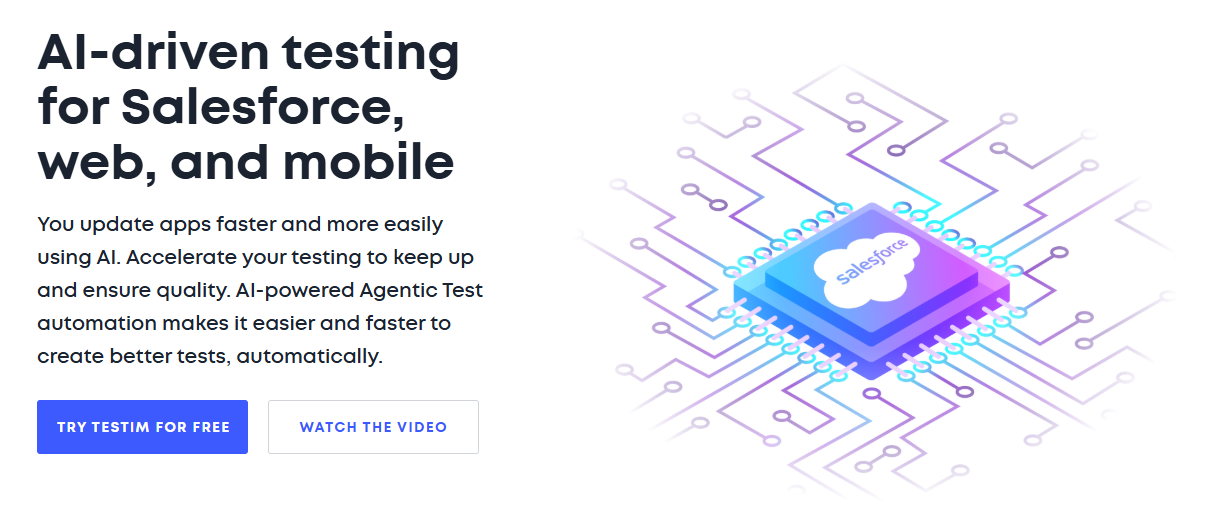
Testim is an AI-assisted test automation platform that uses machine learning to stabilise test locators and reduce flakiness across mobile and web applications. It is one of the earlier AI testing tools to market and has a track record in production environments at mid-size and enterprise organisations.
The platform generates tests through a record-and-playback model enhanced by AI, then applies its locator stability engine to keep those tests running reliably as the app evolves. For teams with high UI churn, Testim’s core value proposition is directly relevant to the most common mobile automation pain point.
Key Features:
- AI-powered smart locators that adapt to UI changes automatically
- Record-and-playback test authoring with JavaScript customisation
- Supports web and mobile testing from a single platform
- Visual test editor accessible to non-technical contributors
- Test branching and parameterisation for broader coverage efficiency
- Integration with GitHub, Jenkins, CircleCI, and Slack
- Detailed test run reports with failure screenshots and execution logs
How Its AI Features Help in Mobile Testing:
Testim’s smart locator system is its primary AI contribution to mobile app testing. Rather than relying on brittle attribute-based selectors, it builds a multi-signal model of each element using visual, structural, and contextual data.
When a mobile UI update changes one signal, the model uses the remaining signals to identify the correct element and update the locator without failing the test. This is particularly valuable for apps that ship frequent design updates.
Limitations:
- Real device coverage is more limited than dedicated mobile testing platforms
- AI stabilisation handles locator drift well but not major flow restructuring
- Can become expensive at scale depending on test execution volume
Best For: Teams with frequent mobile UI updates that need AI-assisted test stability and want a lower-maintenance alternative to traditional record-and-playback tools.
Pricing: Contact Testim for current pricing. Free trial available.
5. Katalon
Katalon is a commercial test automation platform built on top of Appium and Selenium that adds a codeless authoring layer, built-in AI maintenance, and unified test management. Its AI self-healing object repository reduces the manual effort required to keep mobile test suites current after UI changes.
For QA teams that manage mobile, web, and API testing under one program, Katalon provides a consolidated platform that reduces tool sprawl without requiring teams to abandon familiar frameworks.
Key Features:
- AI self-healing object repository for Android and iOS mobile tests
- Codeless and scripted test authoring for mixed technical teams
- Built on Appium for broad device and framework compatibility
- Unified platform covering mobile, web, API, and desktop automation
- Built-in test management, reporting, and CI/CD integration
- Katalon TestCloud for cloud-based mobile device execution
- Integration with Jira, Jenkins, GitHub, and other DevOps tools
How Its AI Features Help in Mobile Testing:
Katalon’s AI self-healing engine monitors the object repository for broken element references after each test run and suggests or applies repairs automatically. This is particularly useful for mobile apps where a single design sprint can invalidate dozens of element selectors across a large test suite.
The unified platform also means AI-assisted mobile tests and web tests share the same reporting layer, giving QA leads a single quality view across all surfaces.
Limitations:
- Performance can degrade with very large or complex mobile test suites
- The underlying Appium dependency inherits some of its stability challenges
- Advanced AI features are locked behind higher-tier paid plans
Best For: QA teams that need unified AI-assisted automation across mobile, web, and API testing without managing multiple frameworks or platforms.
Pricing: Free plan available. Premium plans start at $208 per month. Enterprise pricing on request.
6. BrowserStack App Automate With AI
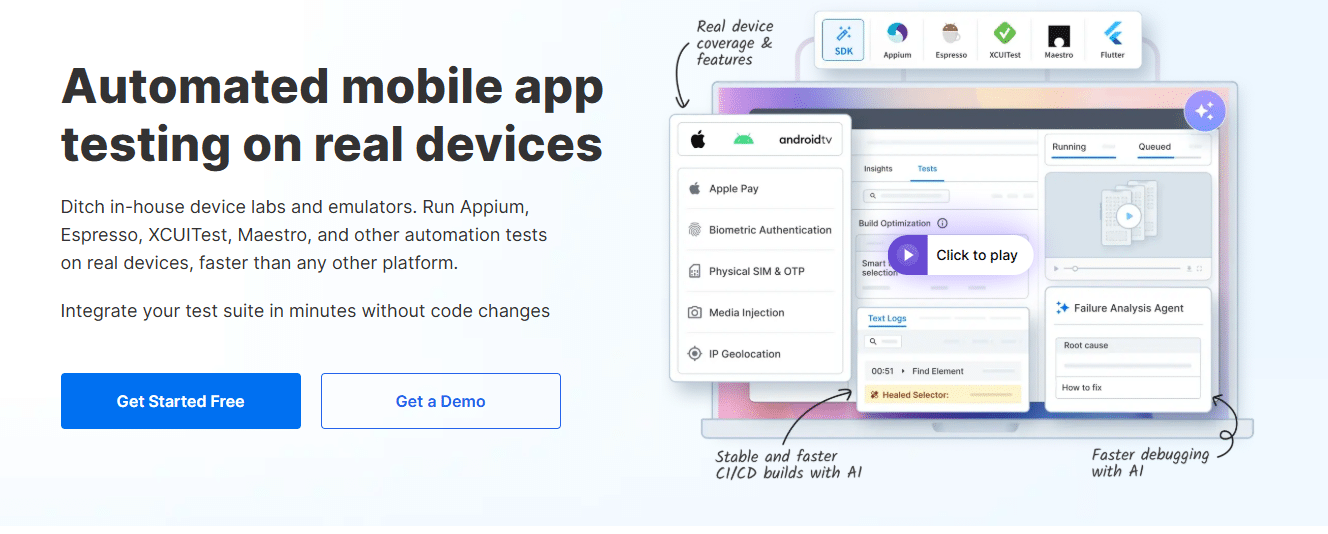
BrowserStack is best known for its device cloud breadth, but its App Automate product has added meaningful AI capabilities including a Self-Healing Agent and a Test Selection Agent that bring intelligence to mobile test execution at scale.
For teams already using BrowserStack for real device coverage, these AI features layer onto existing Appium, Espresso, or XCUITest suites without requiring a platform change. The combination of the largest real device cloud and AI-assisted execution makes it one of the most complete options for enterprise mobile testing programs.
Key Features:
- 3,500+ real Android and iOS devices for mobile app testing
- AI Self-Healing Agent for automatic locator repair during test execution
- Test Selection Agent that identifies which tests to run based on code changes
- AI-powered test reports with failure classification and root cause summaries
- Supports Appium, Espresso, XCUITest, Detox, and Flutter Driver
- Parallel test execution across multiple real devices simultaneously
- Integration with all major CI/CD platforms and test management tools
How Its AI Features Help in Mobile Testing:
BrowserStack’s Test Selection Agent is particularly valuable for large mobile test suites where running the full regression on every commit is impractical. The AI analyses the code diff and historical test failure data to identify the subset of tests most likely to be affected, reducing CI execution time without sacrificing coverage confidence.
The Self-Healing Agent then handles locator drift during execution, reducing the failure noise that makes large suites hard to trust.
Limitations:
- AI features are add-ons to an infrastructure platform rather than core to the product design
- Pricing scales significantly at higher parallelisation and usage tiers
- Teams still need to author and maintain their own test logic
Best For: Enterprise teams with existing Appium or XCUITest suites that want to add AI execution intelligence and self-healing to their current mobile testing investment.
Pricing: App Automate starts at $199 per month billed annually. AI features included on relevant plans.
7. TestMu AI
TestMu AI, formerly LambdaTest, is an AI-native testing platform that combines a large real device cloud with an AI-first automation layer called KaneAI. It positions itself as a full replacement for traditional automation stacks rather than an incremental improvement.
KaneAI generates test cases from natural language, executes them on real devices, and maintains them as the app changes. The combination of 10,000+ real devices and a genuinely AI-native authoring layer makes TestMu AI one of the more complete options in the market for mobile-first teams.
Key Features:
- KaneAI for natural language test case generation and execution
- 10,000+ real Android and iOS devices for cloud-based mobile testing
- AI self-healing for test maintenance after UI changes
- Supports Appium, Espresso, Detox, and XCUITest
- Parallel test execution with HyperExecute for fast CI runs
- Geolocation testing and network condition simulation on real devices
- Integration with Jira, GitHub, Jenkins, and most CI/CD pipelines
How Its AI Features Help in Mobile Testing:
KaneAI removes the scripting barrier entirely for mobile app test creation. A QA engineer describes the intended user flow in plain English, and the AI generates a working test, selects the appropriate real devices, and executes the run.
This dramatically reduces the time from identifying a test need to having verified coverage in CI. The self-healing layer then keeps those tests running as the app evolves, maintaining coverage without a maintenance backlog.
Limitations:
- The brand transition from LambdaTest may create uncertainty for some enterprise buyers
- KaneAI’s AI test generation is strongest for standard flows; complex multi-step scenarios may need manual refinement
- Advanced enterprise procurement processes may need additional validation time
Best For: Teams modernising their mobile testing stack that want AI-native test generation combined with broad real device coverage in a single platform.
Pricing: Free plan available. Real Device Plus Live starts at $39 per month billed annually.
8. Functionize

Functionize is an enterprise AI testing platform that applies machine learning at the test authoring layer to support complex, multi-step application flows. Its Architect feature captures workflows through natural language or record-and-replay and builds tests that are more resilient to change than those produced by traditional automation.
Functionize is particularly suited to organisations replacing legacy Selenium infrastructure who want something less brittle without fully rebuilding their testing model. Its mobile testing support covers native apps alongside web, making it relevant for teams with mixed application portfolios.
Key Features:
- NLP-based test authoring via the Architect feature
- Machine learning model trained on enterprise-scale test data for complex flows
- Self-healing tests that adapt to application changes automatically
- Supports web, mobile, and API testing from a single platform
- AI-powered visual validation for UI regression detection
- Integration with major CI/CD platforms and enterprise ALM tools
- Detailed analytics and failure reporting with AI-generated root cause summaries
How Its AI Features Help in Mobile Testing:
Functionize’s ML model is trained on significantly more enterprise application data than most newer AI testing tools, which makes it stronger for complex, multi-step mobile flows that involve backend dependencies, authentication states, or conditional logic.
The AI authoring layer can capture and reproduce these flows reliably in a way that simpler record-and-replay tools often cannot, making it practical for testing enterprise mobile applications with non-trivial workflows.
Limitations:
- Better suited to complex enterprise applications than lightweight or early-stage mobile apps
- Pricing and onboarding complexity make it a heavy investment for smaller teams
- Setup and initial configuration require meaningful time from the engineering or QA lead
Best For: Enterprise teams replacing legacy Selenium or UFT infrastructure who need AI-powered mobile and web testing for complex, multi-step application workflows.
Pricing: Enterprise pricing; contact Functionize for a quote.
9. Kobiton
Kobiton is a mobile-focused testing platform that combines a real device cloud with AI-augmented test automation. Its AI layer includes scriptless test generation from recorded sessions, Appium self-healing, and intelligent test execution that reduces the manual effort required to maintain mobile test coverage over time.
The platform’s record-to-automate workflow is a standout feature for teams transitioning from manual to automated mobile testing. A QA engineer can perform a manual session on a real device, and Kobiton’s AI generates a reusable automated test from that recording automatically.
Key Features:
- AI-augmented testing with script generation from recorded manual sessions
- Appium self-healing for maintaining test stability after UI changes
- Real device cloud with Android and iOS coverage
- No-code validations for accessibility, visual, and functional checks
- Network condition simulation for testing under degraded connectivity
- On-premises device lab option for regulated industries
- CI/CD integration with major DevOps platforms
How Its AI Features Help in Mobile Testing:
Kobiton’s record-to-automate AI capability is one of the fastest paths from zero automation to real device coverage available today. Manual testers who have never written a line of test code can contribute automated coverage by performing exploratory sessions, and the AI converts those sessions into maintainable scripts.
The Appium self-healing layer then keeps those scripts running as the app updates, reducing the ongoing maintenance burden that typically follows initial automation investment.
Limitations:
- Device inventory is smaller than the largest cloud providers
- AI features are useful but less mature than newer AI-native platforms
- On-premises setup requires more internal infrastructure management
Best For: Teams transitioning from manual to automated mobile app testing who want AI to generate and maintain tests from recorded sessions on real devices.
Pricing: Startup plan starts at $83 per month. Enterprise pricing on request.
10. Tricentis
Tricentis is an enterprise test automation platform with AI capabilities focused on risk-based testing, intelligent test optimisation, and continuous testing for DevOps. Its mobile testing support is part of a broader platform that covers web, API, SAP, and enterprise application testing under unified governance.
For large QA organisations running mobile automation alongside complex enterprise software testing, Tricentis provides AI-assisted impact analysis and test prioritisation that reduces total execution time while maintaining meaningful coverage across all surfaces.
Key Features:
- AI-powered risk-based test prioritisation and impact analysis
- Scriptless and scripted mobile test authoring for Android and iOS
- Continuous testing integration optimised for DevOps and CI/CD pipelines
- AI-assisted test design recommendations based on application risk
- Integration with Jira, ServiceNow, Jenkins, and enterprise ALM tools
- Detailed analytics and test coverage reporting for governance and compliance
- Support for mobile, web, API, SAP, and desktop testing in one platform
How Its AI Features Help in Mobile Testing:
Tricentis’s impact analysis AI is its most differentiated contribution to mobile testing programs at scale. After a code change, the AI analyses which parts of the application are affected and maps that to the relevant test cases, then prioritises execution accordingly.
For large mobile test suites where running everything on every commit is cost-prohibitive, this intelligent prioritisation maintains coverage confidence while keeping CI pipelines fast.
Limitations:
- Priced and architected for enterprise organisations; not practical for smaller teams
- Setup and onboarding require significant time and internal resources
- Can feel heavyweight for teams with mobile-only or simple testing needs
Best For: Large enterprise QA organisations that need AI-assisted mobile testing as part of a broader, governed continuous testing program covering multiple application types.
Pricing: Enterprise pricing; contact Tricentis for a quote.
Comparison Table: Best AI Tools for Mobile App Testing in 2026
| Tool | Primary AI Capability | Mobile Platform | Real Devices | Best For | Pricing |
|---|---|---|---|---|---|
| Panto AI | NLP generation, self-healing, RCA, Vibe Debugging | Android, iOS | 150+ | AI-native mobile QA teams | Free; Scale $999/mo |
| Appium + AI Plugins | AI element detection via plugins | Android, iOS | Via cloud providers | Teams extending existing Appium suites | Free (base); cloud costs vary |
| Mabl | ML auto-healing, visual AI | Android, iOS, Web | Via cloud | Unified web and mobile AI testing | Contact for pricing |
| Testim | Smart locator stabilisation | Android, iOS, Web | Limited | High UI churn teams | Contact for pricing |
| Katalon | AI self-healing object repository | Android, iOS, Web | Via TestCloud | Unified mobile, web, and API QA | Free tier; from $208/mo |
| BrowserStack + AI | Self-healing agent, test selection agent | Android, iOS | 3,500+ | Enterprise teams adding AI to existing suites | From $199/mo |
| TestMu AI | KaneAI NLP generation, self-healing | Android, iOS | 10,000+ | Teams modernising to AI-native testing | Free; from $39/mo |
| Functionize | ML authoring for complex flows, visual AI | Android, iOS, Web | Via cloud | Enterprise teams replacing legacy automation | Enterprise pricing |
| Kobiton | Record-to-automate AI, Appium self-healing | Android, iOS | Real device cloud | Manual-to-automated transition teams | From $83/mo |
| Tricentis | Risk-based AI prioritisation, impact analysis | Android, iOS, Web | Via partners | Enterprise QA governance at scale | Enterprise pricing |
How to Choose the Right AI Mobile Testing Tool
The right tool depends on which problem is actually slowing your team down. Not every AI testing capability solves the same bottleneck.
If the problem is writing tests in the first place, prioritise NLP test generation. Panto AI and TestMu AI’s KaneAI are the strongest options here for mobile-specific use cases.
If the problem is tests breaking after every UI update, prioritise self-healing. Testim, Mabl, Katalon, and BrowserStack’s Self-Healing Agent all address this, with different trade-offs in mobile versus web depth.
Matching AI Capability to Team Type
If the problem is debugging failures after they occur, prioritise AI root cause analysis. Panto AI’s QA testing platform is the most mobile-specific implementation; BrowserStack and Sauce Labs offer this at the cloud execution layer.
If the problem is CI pipelines taking too long, prioritise intelligent test selection. BrowserStack’s Test Selection Agent and Tricentis’s impact analysis engine are both built for this use case at scale.
If your team is transitioning from manual testing and has no automation yet, Kobiton’s record-to-automate workflow is the fastest path to initial AI-generated coverage. If your team is an enterprise replacing legacy infrastructure, Functionize and Tricentis are built for that migration path.
One practical starting point: identify your single biggest testing bottleneck today, whether that is writing tests, maintaining them, debugging failures, or slow CI pipelines, and choose the tool whose AI capability directly addresses that problem.
Adding AI to mobile testing works best when it targets a specific friction point rather than attempting a complete platform overhaul at once. AI-powered mobile app testing is no longer an advanced practice reserved for large engineering organisations.
In 2026, the tools have matured to the point where even small teams can get meaningful AI assistance in test creation, maintenance, and failure analysis without a significant upfront investment. The key is choosing the capability that matches the problem you actually have.