

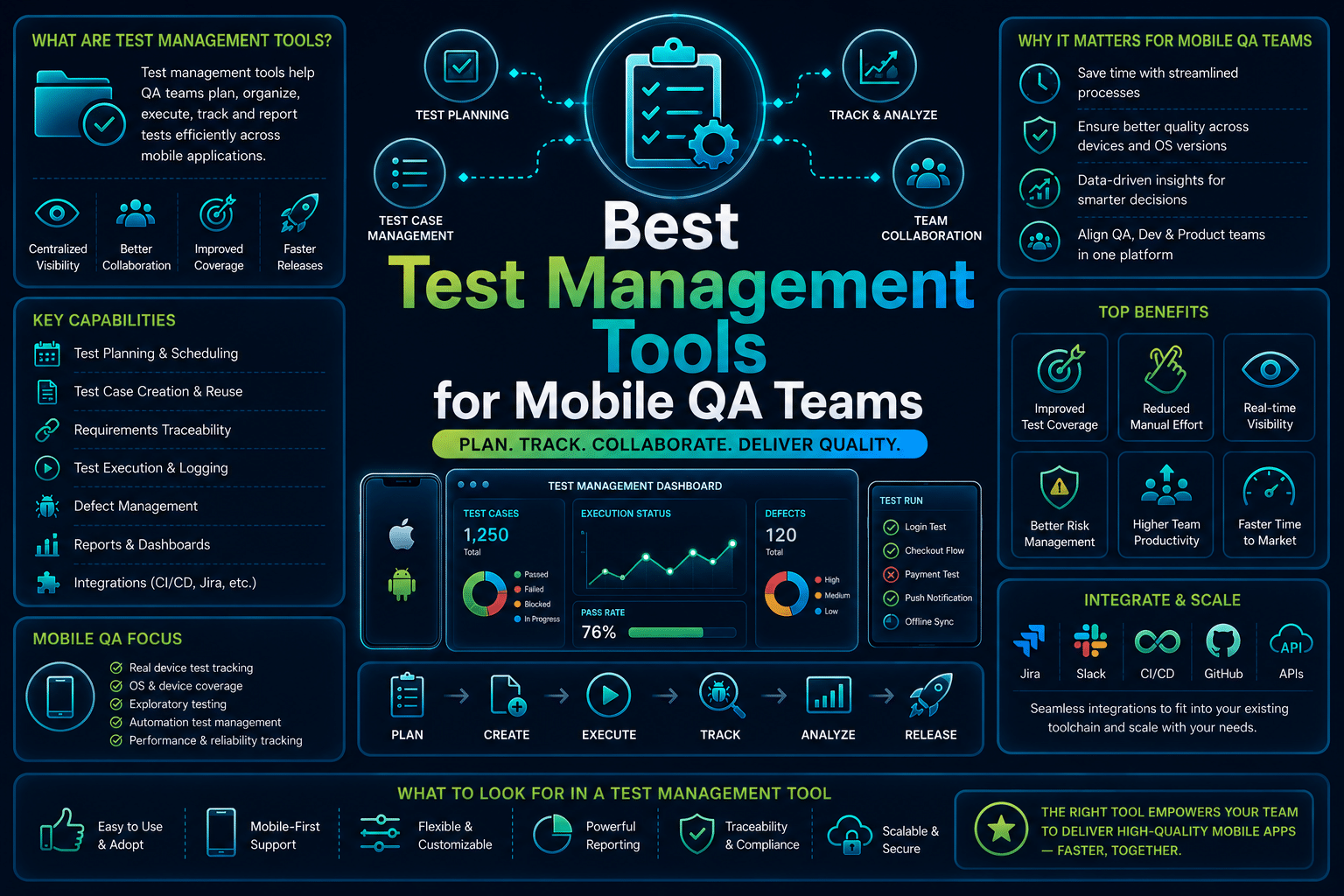

Mobile QA teams tend to accumulate test data across too many places. Test cases sit in a spreadsheet, automation results live in CI logs, and bugs get filed in Jira separately from the test that caught them.
A good test management tool with Jira integration closes that gap. It keeps test cases, execution history, and defects linked directly to the Jira issues your team already tracks releases against.
This guide covers the 10 best test management tools for mobile QA teams with Jira integration in 2026.
Key Tools
- Panto AI: AI-native mobile QA platform that feeds structured, device-level failure data into Jira for mobile test management.
- Zephyr Scale: Native Jira test management add-on best suited for teams wanting zero context-switching between tools.
- Xray: Traceability-focused test management tool built for large, complex mobile QA suites with deep API support.
- Qase: AI-assisted test management platform that generates mobile test cases and syncs two-way with Jira.
- QMetry: Centralized test management tool ideal for mobile QA teams managing overlapping test cases across projects.
- TestRail: Established standalone test management platform offering a proven Jira integration for mobile QA teams.
- AIO Tests: Lightweight, native Jira test management tool best suited for small mobile QA teams avoiding tool sprawl.
- Katalon TestOps: Test orchestration layer for mobile QA teams already standardized on Katalon Studio automation.
- TestMonitor: Test management tool syncing Jira status across broader toolchains like Slack and Azure DevOps.
- AgileTest: Sprint-focused Jira test management tool built for fast-moving agile mobile QA teams.
10 Best Test Management Tools For Mobile QA Teams With Jira Integration
1. Panto AI
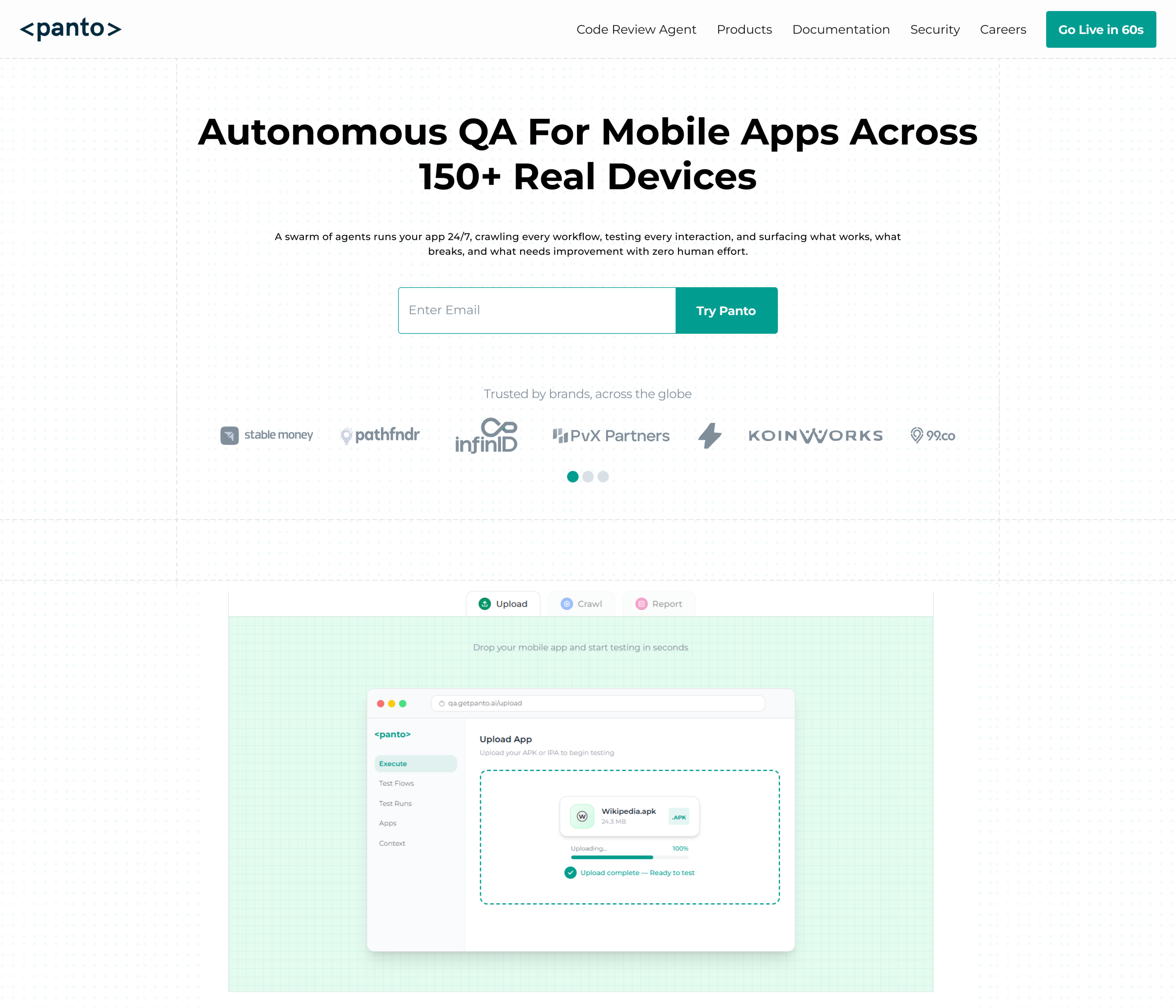
Panto AI is an AI-native mobile QA platform built around real device test execution and self-healing automation.
It is not a traditional test case repository, its role in this list is different from the others: it generates and runs mobile tests, then feeds structured results back into your existing test management stack.
For teams already using Jira to track releases, this matters because failed mobile tests need to become actionable Jira issues automatically, with enough context that a developer does not have to dig through logs to understand what broke.
Key Features
- Natural language test creation with self-healing automation across 150+ real devices
- AI-powered root cause analysis tied to the specific code change behind a failure
- Native CI/CD integration with GitHub Actions, GitLab, Bitrise, and Jenkins
- Structured failure reporting designed to sync cleanly into issue trackers
- Appium and Maestro script export for teams maintaining a separate automation codebase
How It Helps With Jira Integration For Mobile QA Teams
When a test fails on a specific device and OS combination, Panto’s root cause data can be pushed into Jira as a fully contextualized issue, device, OS version, failing step, and the responsible code change, instead of a generic red X.
Benefits
- Removes the manual work of writing up device-specific bug reports
- Keeps Jira issues tied to real execution evidence rather than tester notes
- Reduces back-and-forth between QA and developers on reproduction steps
Limitations
- Not a full test case management system on its own, best paired with a dedicated repository tool for manual test case planning
- Teams wanting a single all-in-one platform may need to combine it with one of the other tools on this list
Price: Free for open source projects with unlimited PR reviews. Paid plans scale with device usage and team size, available on request.
2. Zephyr Scale

Zephyr Scale is one of the most widely adopted native Jira test management add-ons, built directly into the Jira interface rather than as a connected external tool.
Its mobile support comes primarily through automation framework integrations rather than dedicated mobile features.
The tool is positioned for teams that want test management to feel like a natural extension of Jira, not a separate application testers have to context-switch into.
Key Features
- Native Jira add-on with no separate login or interface
- Integration with Selenium, Appium, and other automation frameworks via REST API
- Reusable test case libraries and structured test cycles
- Real-time dashboards for coverage and execution status
- Support for both manual and automated mobile test tracking
How It Helps With Jira Integration For Mobile QA Teams
Because Zephyr Scale lives inside Jira itself, mobile automation results synced through its API show up directly alongside the user stories and bugs they relate to, with no separate reporting layer to maintain.
Benefits
- Zero context-switching since it runs inside Jira natively
- Strong API support for pushing Appium results automatically
- Well-established with a large user base and documentation library
Limitations
- Device-level detail depends entirely on what your automation framework sends through the API
- Less depth in dedicated mobile reporting compared to tools built mobile-first
Price: Tiered pricing based on Jira user count, available through the Atlassian Marketplace.
3. Xray

Xray is built around traceability and automation, making it a common choice for mobile QA teams running larger, more complex test suites.
It supports native integrations with Cucumber, Selenium, JUnit, NUnit, and Robot Framework, with automated results flowing directly into Jira.
Its exploratory testing companion tool extends coverage to mobile and desktop apps specifically, feeding results back into the same Xray and Jira environment.
Key Features
- Native automation framework integration including Cucumber and Selenium
- REST and GraphQL APIs for programmatic access to all test data
- Real-time test indexing at scale for large mobile suites
- Exploratory testing companion tool covering mobile and desktop apps
- Smart orchestration for managing testing across large, complex codebases
How It Helps With Jira Integration For Mobile QA Teams
Xray’s GraphQL API lets mobile automation pipelines push detailed execution data, including device and OS metadata, directly into Jira-linked test runs without manual entry.
Benefits
- Strong traceability from requirements through to test execution and defects
- API depth supports custom mobile reporting dashboards
- Scales well for large, complex mobile test suites
Limitations
- Steeper setup curve than lighter, Jira-native add-ons
- Full feature depth is aimed at larger QA teams, not small startups
Price: Tiered pricing based on Jira Cloud, Server, or Data Center deployment, available through the Atlassian Marketplace.
4. Qase

Qase positions itself as a modern, flexible test management platform with two-way Jira integration and AI-assisted test creation.
Its AIDEN feature can generate test cases from requirements and convert manual test cases into automation-ready scripts.
For mobile QA teams, this AI layer reduces the manual effort of writing device-specific test cases from scratch for every new feature.
Key Features
- Two-way Jira integration linking test cases, runs, and defects to Jira issues
- AIDEN AI assistant for generating and converting test cases
- Customizable dashboards for coverage, pass rates, and release readiness
- Traceability matrix linking test cases to requirements and user stories
- Support for both manual and automated mobile test tracking
How It Helps With Jira Integration For Mobile QA Teams
The two-way sync means a defect logged against a failed mobile test case in Qase automatically creates and updates the corresponding Jira issue, keeping both systems accurate without duplicate data entry.
Benefits
- AI-assisted test case generation saves setup time for new mobile features
- Two-way sync reduces manual duplicate work between tools
- Dashboards give clear release readiness visibility for mobile releases
Limitations
- AI-generated test cases still need human review for mobile-specific edge cases
- Newer platform with a smaller long-term track record than older competitors
Price: Tiered plans based on team size, with a free tier for small teams.
5. QMetry

QMetry is built for continuous testing at scale, with reusable test cases and minimal duplication across projects.
It supports codeless test creation and exploratory testing across web, mobile, and services from a single centralized repository.
The platform is Agile and DevOps-ready, with a built-in REST API for teams that want to connect their own mobile automation pipelines directly.
Key Features
- Codeless test authoring across web, mobile, and API testing
- Centralized repository reducing duplicate test case maintenance
- Built-in REST API for custom pipeline integrations
- Import and export workflows for migrating existing test suites
- Agile and DevOps-ready with continuous testing support
How It Helps With Jira Integration For Mobile QA Teams
QMetry syncs test execution status and defects with Jira automatically, and its centralized repository means mobile test cases tied to multiple Jira epics stay consistent instead of drifting into duplicate versions.
Benefits
- Reduces duplicate test case maintenance across mobile projects
- Codeless authoring lowers the barrier for less technical QA members
- REST API supports custom mobile automation pipeline connections
Limitations
- Interface can feel dense for smaller teams that do not need full enterprise depth
- Full value requires investment in structuring the centralized repository upfront
Price: Plans starting around $15 per agent per month, with a limited free trial available.
6. TestRail
TestRail is a long-established, standalone test management platform with mobile-ready interface support and native Jira integration through a dedicated add-on.
It is commonly paired with third-party automation tools rather than running automation itself.
Its structured test case and run management gives mobile QA teams a clear audit trail across devices and releases, independent of which automation framework generates the underlying results.
Key Features
- Structured test case, suite, and run management
- Native Jira integration via TestRail’s official add-on
- Support for parallel test execution tracking
- Mobile-ready interface for testers working across devices
- Integration with Jenkins, TestRail API, and CI/CD pipelines
How It Helps With Jira Integration For Mobile QA Teams
TestRail’s Jira add-on links test runs and results directly to Jira issues, so a mobile regression cycle spanning dozens of device combinations rolls up into a single, traceable Jira-linked report.
Benefits
- Mature, stable platform with a long track record in QA teams
- Clear audit trail across parallel mobile test runs
- Works well alongside almost any external automation framework
Limitations
- You cannot undo a test step once entered, which can slow correction workflows
- Copying steps between projects is not supported, adding setup time for similar mobile test suites
Price: Starts at $15 per agent per month, with a free trial available.
7. AIO Tests
AIO Tests is built specifically as an all-in-one, streamlined solution for teams that want test management without a steep learning curve.
It runs natively inside Jira, avoiding the need for a separate login or interface.
The platform focuses on keeping the core test management workflow simple, which tends to suit smaller mobile QA teams better than heavier enterprise platforms.
Key Features
- Native Jira integration with no separate application to manage
- Streamlined test case creation and execution tracking
- Support for both manual and automated test result imports
- Reusable test steps to reduce duplicate mobile test case writing
- Straightforward reporting without excessive configuration
How It Helps With Jira Integration For Mobile QA Teams
Because AIO Tests operates entirely inside Jira, mobile test execution results and defects appear directly within existing Jira boards and sprints without any separate sync step to configure.
Benefits
- Minimal setup time compared to standalone platforms
- Good fit for smaller mobile QA teams avoiding tool sprawl
- Native Jira experience keeps the whole team in one workflow
Limitations
- Fewer advanced reporting and analytics options than enterprise-grade tools
- Less suited to very large mobile suites with complex traceability needs
Price: Available through the Atlassian Marketplace with tiered pricing based on user count.
8. Katalon TestOps
Katalon TestOps is the orchestration and reporting layer built on top of Katalon’s broader testing platform, covering enterprise-grade test management alongside lightweight options depending on team size.
It centralizes execution data across environments, including mobile.
For teams already using Katalon Studio to create mobile tests, TestOps adds a management layer specifically designed to work with that automation output.
Key Features
- Centralized test orchestration and reporting across environments
- Integration with Katalon Studio for mobile, web, and API test creation
- Role-based access control for larger QA organizations
- CI/CD pipeline integration for automated test triggering
- Dashboards summarizing execution across distributed mobile test runs
How It Helps With Jira Integration For Mobile QA Teams
TestOps syncs execution results from mobile automation runs into Jira automatically, giving teams centralized visibility instead of digging through separate CI logs to understand mobile test outcomes.
Benefits
- Strong fit for teams already standardized on Katalon Studio
- Centralized reporting simplifies debugging across many mobile environments
- Role-based access suits larger, multi-team QA organizations
Limitations
- Most value comes from pairing it with Katalon Studio rather than using it standalone
- Adds a layer of complexity smaller teams may not need
Price: Plans based on team size and execution volume, available on request.
9. TestMonitor
TestMonitor emphasizes comprehensive test case management alongside synchronization of issue status between Jira and its own platform.
Teams get visibility into current defect states without needing to check Jira separately.
Beyond Jira, it also integrates with Azure DevOps, Slack, and several other project tools, which suits mobile QA teams working across a wider toolchain.
Key Features
- Synchronized issue status between TestMonitor and Jira
- Comprehensive test case creation, sequencing, and management
- Support for both manual and automated mobile testing workflows
- Integration with Azure DevOps, Slack, and Asana beyond Jira
- Clear visibility into current defect and test case states
How It Helps With Jira Integration For Mobile QA Teams
Status changes in Jira sync back into TestMonitor automatically, so mobile QA teams tracking device-specific defects always see current state without manually checking both tools.
Benefits
- Reduces the need to check Jira and the test tool separately for status
- Broader toolchain integrations beyond Jira alone
- Supports both manual and automated mobile test workflows cleanly
Limitations
- Smaller community and resource library compared to more established platforms
- Some mobile-specific reporting still depends on how automation results are formatted before import
Price: Tiered plans based on team size, available on request.
10. AgileTest
AgileTest is built specifically for agile teams that want a flexible, easy to use test management experience inside Jira.
It focuses on staying lightweight rather than trying to match the full enterprise depth of larger competitors.
Its simplicity tends to suit mobile app testing teams working in fast sprint cycles, where heavier tools can slow down day-to-day test case updates.
Key Features
- Native Jira integration built for agile sprint-based workflows
- Flexible test case organization with minimal setup overhead
- Support for linking test cases directly to sprint-level user stories
- Reusable test components to reduce duplicate mobile test writing
- Straightforward execution tracking without heavy configuration
How It Helps With Jira Integration For Mobile QA Teams
AgileTest links mobile test cases directly to the Jira sprint items they validate, so a team moving fast through short cycles can see mobile QA coverage against each sprint without extra reporting steps.
Benefits
- Low setup overhead fits fast-moving agile mobile teams well
- Sprint-level linking keeps testing visibly tied to current work
- Simple enough for smaller QA teams without dedicated tooling specialists
Limitations
- Less depth for large, complex mobile suites with heavy traceability needs
- Fewer advanced analytics features compared to enterprise platforms
Price: Available through the Atlassian Marketplace, tiered by user count.
Comparison of Test Management Tools
| Tool | Best For | Jira Integration Type | Mobile Automation Support | Pricing Model |
|---|---|---|---|---|
| Panto AI | AI-native mobile test execution feeding Jira | Structured failure sync | Native, real devices | Free tier, usage-based |
| Zephyr Scale | Native in-Jira test management | Built-in Jira add-on | Via automation API | Per user, tiered |
| Xray | Traceability at scale for large suites | Native plus GraphQL API | Cucumber, Selenium, and more | Tiered, Marketplace |
| Qase | AI-assisted test case creation | Two-way sync | Manual and automated | Free tier, tiered |
| QMetry | Continuous testing across projects | Native sync | Codeless plus REST API | Per agent, tiered |
| TestRail | Established standalone platform | Dedicated Jira add-on | Via external frameworks | Per agent, tiered |
| AIO Tests | Simple, all-in-one small team tool | Native in-Jira | Manual and automated import | Marketplace, tiered |
| Katalon TestOps | Teams standardized on Katalon Studio | Automated sync | Native with Katalon Studio | Custom, quote-based |
| TestMonitor | Multi-toolchain status visibility | Two-way status sync | Manual and automated | Tiered, quote-based |
| AgileTest | Fast-moving agile sprint teams | Native in-Jira | Manual, sprint-linked | Marketplace, tiered |
How To Choose The Right Tool For Your Mobile QA Team
The right tool depends less on features and more on your specific situation. Match your scenario below to a starting shortlist.
- Automation results already come from Appium, Espresso, or XCUITest. Prioritize tools with strong API support for pulling that data in automatically. Xray and Zephyr Scale both handle this well through native and GraphQL APIs.
- You want AI to reduce manual test case writing. Qase and Panto AI both cut setup work, but at different points in the workflow. Qase generates test cases from requirements, while Panto generates and executes the mobile tests themselves, then reports root cause back to Jira.
- Small team, no dedicated tooling specialist. Lightweight, native-Jira options remove setup overhead entirely. AIO Tests and AgileTest both live inside Jira with minimal configuration required.
- Fast-moving agile team on short sprint cycles. AgileTest links test cases directly to sprint items, so coverage stays visible against current work without extra reporting steps.
- Large, complex regression suites across many device combinations. Xray and Katalon TestOps are both built for scale, with strong traceability and centralized reporting across distributed runs.
- Toolchain extends beyond Jira, into Slack, Azure DevOps, or Asana. TestMonitor syncs status across multiple tools, not just Jira, which matters once QA data needs to reach people outside the Jira workflow.
- Multiple projects sharing overlapping mobile test cases. QMetry‘s centralized repository reduces duplicate test case versions drifting apart across projects.
- Already standardized on Katalon Studio for test creation. Katalon TestOps adds orchestration and reporting on top of automation you are already generating, rather than asking you to switch tools.
- Long-established platform with a proven track record preferred. TestRail has the longest history on this list and a large existing user base, useful if stability matters more than newer AI features.
- You need device-level failure detail to survive the sync into Jira. This is where most tools lose fidelity. Panto AI builds device, OS, and root cause context into every failure report before it reaches Jira, rather than relying on whatever your automation framework happens to pass through.
If more than one scenario applies, prioritize the tool tied to your most expensive problem first. A team drowning in vague, context-free Jira tickets should fix that before optimizing for sprint-level visibility or multi-tool sync.
Conclusion
The right test management tool for a mobile QA team is not necessarily the one with the most features, it is the one that keeps device-level context intact as results flow into Jira. Native Jira add-ons work well for smaller teams wanting simplicity, while standalone platforms with strong APIs suit teams running large, complex mobile automation suites.
Whichever tool you choose, the real test is whether a developer opening a Jira ticket can immediately see what device, OS, and step failed, without chasing down a separate report first.
FAQs
Q: Do I need a mobile-specific test management tool?
A: Not necessarily. Most test management platforms are platform-agnostic. The key differentiator is how well they capture and organize mobile-specific data, such as device models, OS versions, automation results, screenshots, and logs, while integrating with tools like Jira.
Q: What is the difference between native Jira add-ons and standalone test management tools?
A: Native Jira apps like Zephyr Scale and AIO Tests run directly inside Jira, giving teams a unified workflow. Standalone platforms such as TestRail and QMetry operate independently and synchronize test cases, results, and defects with Jira through integrations.
Q: Can AI reduce the manual work involved in mobile test management?
A: Yes. AI can generate test cases, organize test suites, summarize failures, prioritize defects, and automatically create Jira-ready bug reports. Some platforms also use AI to execute tests and identify the most likely root cause of failures, reducing manual investigation.
Q: Which test management tool is best for large mobile regression suites?
A: Xray and Katalon TestOps are among the strongest choices for large mobile regression suites. Both provide robust traceability, automation integrations, reporting, and scalability, making them well suited for enterprise QA teams managing thousands of test cases.