

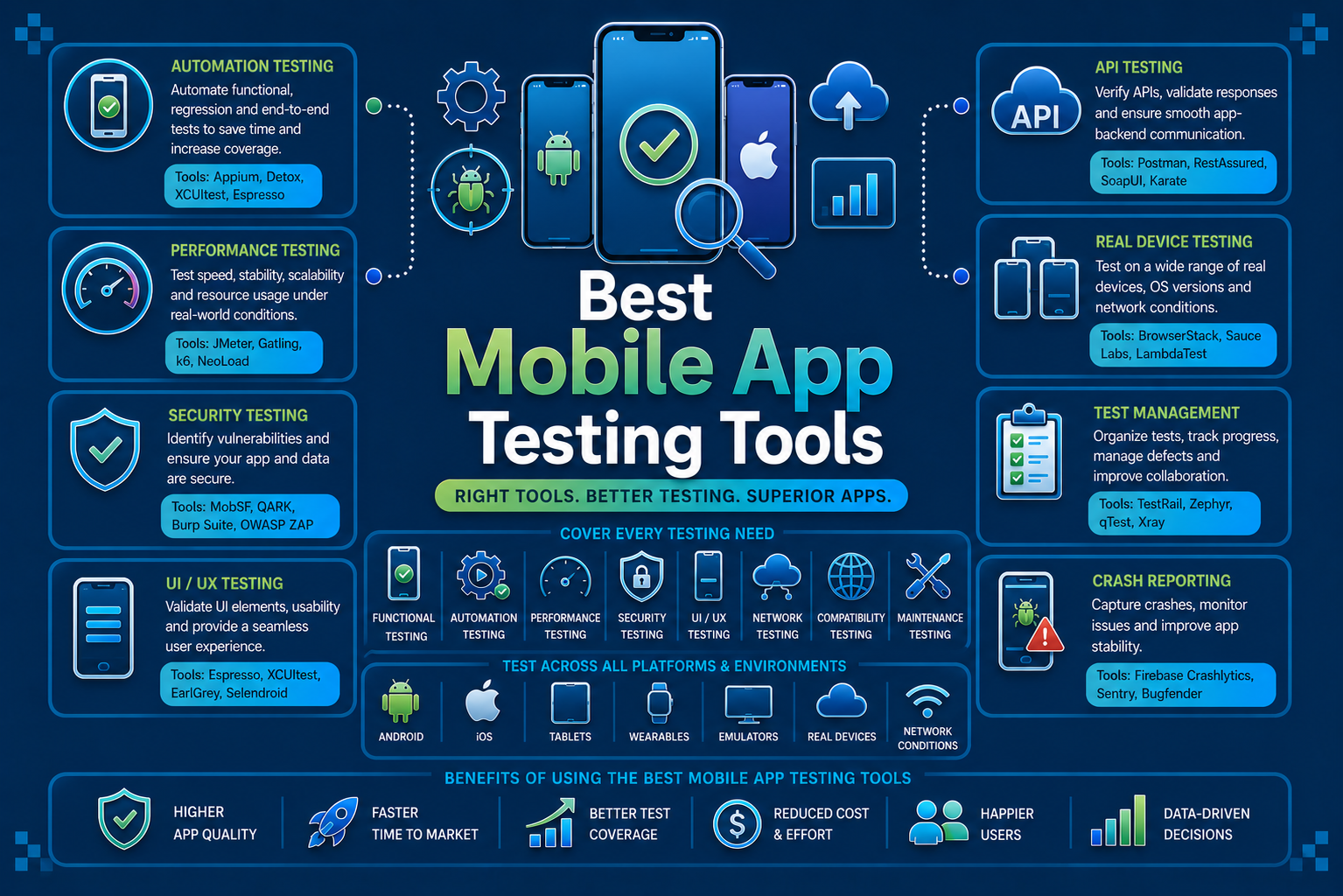

Picking a mobile app testing tool from a flat ranked list rarely works in practice. Tools in this space do not compete with each other the way most comparison guides imply.
The tool that solves a scripting bottleneck is not the same tool that solves a device coverage gap. The tool that works for a five-person startup QA team is the wrong choice for an enterprise organization running thousands of daily test runs across a regulated device infrastructure.
This guide ranks the 10 best mobile app testing tools in 2026 with a category label for each one. The goal is to help you match the right tool to the actual gap in your stack rather than starting from a one-size-fits-all list.
Every tool here covers a different testing layer, and understanding which layer your team needs most is the most important decision you will make before evaluating any specific platform.
Key Tools
- Panto AI: AI-native mobile app testing platform best for automated test generation, self-healing automation, and real device testing.
- Appium: Open source mobile app testing framework ideal for cross-platform automation with maximum flexibility and vendor independence.
- BrowserStack App Automate: Real device cloud platform best for executing mobile app testing across thousands of Android and iOS devices.
- Espresso: Google’s native Android testing framework built for fast, reliable Android app testing and UI automation.
- XCUITest: Apple’s official iOS testing framework designed for high-performance native iOS app testing and automation.
- Maestro: YAML-based mobile app testing framework best for low-code cross-platform automation and fast onboarding for QA teams.
- Detox: React Native end-to-end testing framework optimized for stable, flake-resistant mobile app testing across Android and iOS.
- Katalon: Unified test automation platform best for teams managing mobile, web, API, and desktop testing from one interface.
- TestMu AI: AI-powered mobile app testing platform combining natural language test generation with extensive real device cloud coverage.
- Perfecto: Enterprise mobile app testing platform built for regulated organizations requiring private device clouds and compliance-ready testing.
The 10 Best Mobile App Testing Tools in 2026
1. Panto AI
Category: AI-Native Mobile Testing Platform
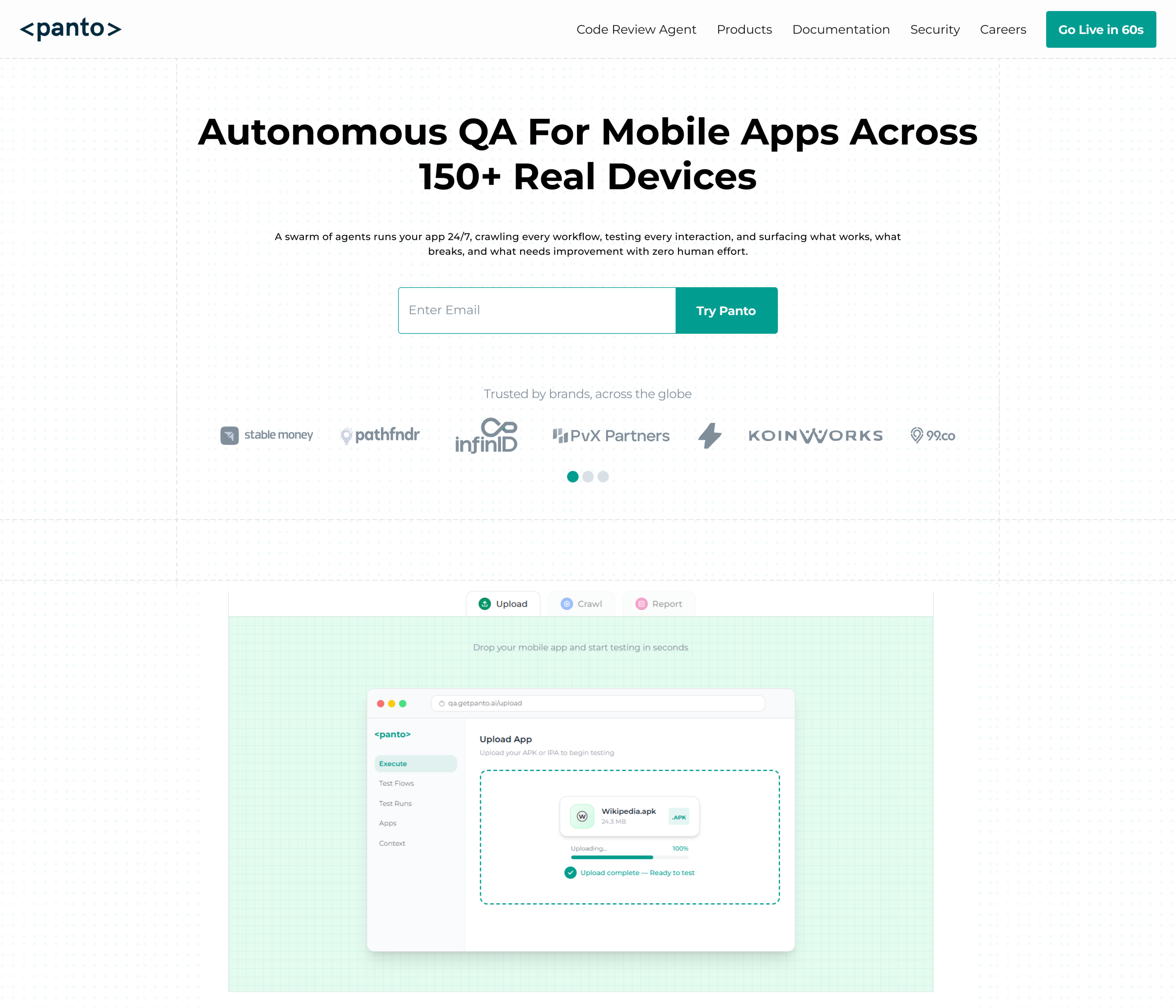
Panto AI is an AI-native mobile QA platform built for teams that need automated mobile app testing without the overhead of writing and maintaining scripts manually. It generates deterministic test flows from plain English descriptions, executes them on 150+ real Android and iOS devices, and maintains those tests automatically as the app evolves through self-healing automation.
What separates Panto from every other tool in this guide is that AI is the operating model, not a bolted-on feature. Test creation, execution, failure analysis, and maintenance all run through AI, which means the platform scales with the app rather than creating proportionally more maintenance work as complexity grows.
Key Features:
- NLP-based test generation from plain English flow descriptions
- Real device execution across 150+ Android and iOS physical devices
- Self-healing automation that adapts to UI changes without manual script updates
- AI-powered root cause analysis linking failures to specific code changes
- Vibe Debugging platform connecting visual failures to the exact pull request responsible
- CI/CD integration with GitHub Actions, GitLab, Bitrise, Jenkins, and Azure DevOps
- Appium and Maestro script export for version-controlled mobile test suites
- Performance budget enforcement on every PR for CPU, memory, and app start time
- Support for iOS native, Android native, React Native, and Flutter apps
- Free for open source projects with unlimited PR reviews
How It Performs in Mobile App Testing:
Panto addresses the two problems that cause mobile testing programs to stall at scale: the cost of writing tests and the cost of keeping them working. A flow that takes hours to script in Appium or XCUITest takes minutes to describe in Panto.
When a UI update breaks a test selector, Panto repairs it automatically rather than adding it to a maintenance backlog. When a build fails in CI, the Vibe Debugging platform surfaces the commit responsible without a manual investigation cycle.
Benefits:
- Dramatically reduces test authoring and maintenance time for mobile QA teams
- Real device execution gives production-accurate results rather than emulator approximations
- Self-healing test automation keeps mobile automation coverage active through rapid UI iteration
- AI root cause analysis turns a red CI build from a debugging session into a quick fix
Limitations:
- Optimized for native mobile app testing; not designed for web or desktop automation
- Smaller device inventory than the largest enterprise device clouds
- NLP-driven workflows have a learning curve for teams used to code-first automation
Best For: Mobile-first teams, lean QA organizations, and AI-native engineering teams that want fast mobile automation testing, low-maintenance coverage, and intelligent failure analysis on real devices.
Pricing: Free plan at $0 with 15 test flows and 50 minutes of real device execution. Scale plan starts at $999 per month. Enterprise pricing available on request.
2. Appium
Category: Open Source Mobile Automation Framework
Appium is the most widely adopted open source framework for mobile automation testing and has been the default cross-platform mobile testing framework for over a decade. It uses the WebDriver protocol to automate native, hybrid, and mobile web apps on Android and iOS without requiring source code access or app modification, and supports test authoring in virtually any programming language.
For teams that need full architectural control over their mobile automation stack, the ability to run tests against any device cloud provider, and zero licensing cost, Appium remains the most portable and flexible foundation available. Its language-agnostic design means existing QA expertise and test infrastructure transfer directly without retraining.
Key Features:
- Open source and free with one of the largest mobile testing communities available
- Supports Android and iOS native, hybrid, and mobile web application testing
- Language-agnostic: write mobile tests in Java, Python, JavaScript, Ruby, C#, and more
- Compatible with all major real device cloud platforms without framework lock-in
- WebDriver protocol for broad CI/CD and toolchain integration
- XCUITest and Espresso drivers for native platform runtime integration
- Extensible plugin ecosystem for adding AI, visual testing, and reporting capabilities
How It Performs in Mobile App Testing:
Appium’s core value in mobile application testing is portability. Teams write tests once in their preferred language and run them against any device cloud, any CI system, and any future infrastructure without modification.
For organizations with decade-long product roadmaps or multi-cloud procurement requirements, Appium’s flexibility is worth more than the convenience of a tighter commercial platform.
Benefits:
- Zero licensing cost with deep community support and a large plugin ecosystem
- Runs on any cloud device platform, eliminating infrastructure vendor lock-in
- Test code can outlast any single tool vendor in the mobile automation ecosystem
- Strong foundation for incrementally adding AI capabilities through plugins or paired platforms
Limitations:
- Requires significant scripting expertise to build stable mobile test suites at scale
- Test flakiness is high without careful synchronization and selector management
- No built-in AI features, self-healing, or test generation without additional tooling
Best For: Engineering teams with strong automation experience that need maximum portability, full control over their mobile automation architecture, and zero vendor lock-in.
Pricing: Free and open source.
3. BrowserStack App Automate
Category: Real Device Cloud
BrowserStack is the most widely used real device cloud for mobile app testing, with over 3,500 real Android and iOS devices available for automated mobile test execution, live manual testing, and visual validation. It is used by over 50,000 development and QA teams globally and carries the compliance certifications, dedicated support structure, and ecosystem integrations that enterprise procurement requires.
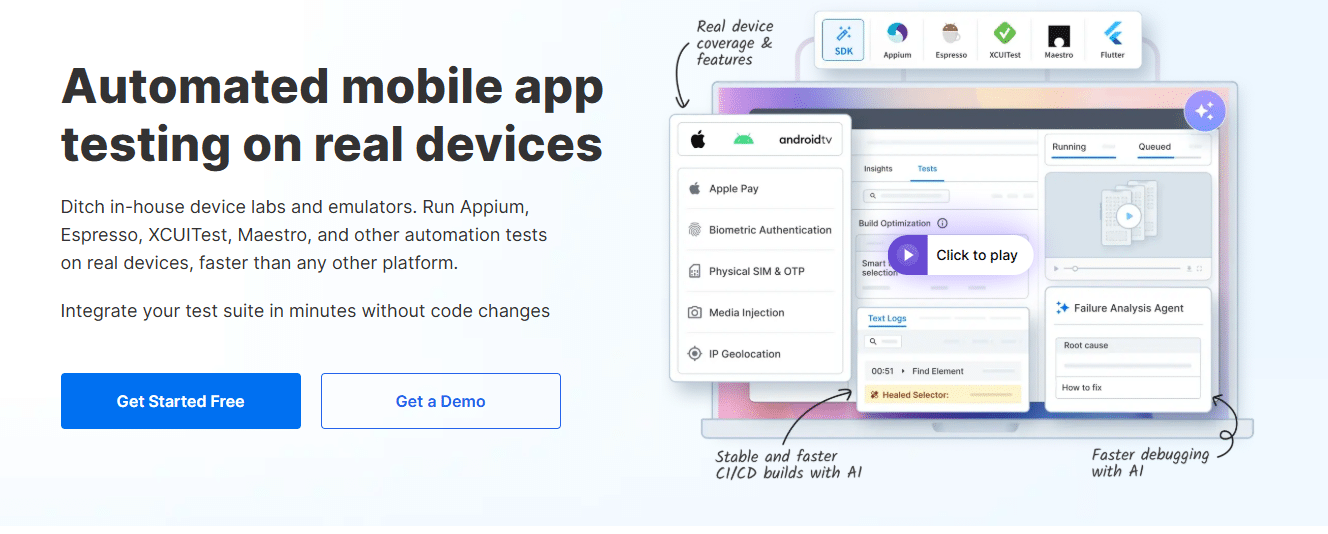
Its App Automate product supports Appium, Espresso, XCUITest, Detox, and Flutter Driver, meaning teams run their existing mobile automation against BrowserStack’s device cloud without rewriting tests. The AI Self-Healing Agent and Test Selection Agent add intelligence to execution at scale, reducing both maintenance overhead and total CI execution time for large mobile regression suites.
Key Features:
- 3,500+ real Android and iOS devices for mobile app testing across device matrix
- Supports Appium, Espresso, XCUITest, Detox, and Flutter Driver for mobile automation
- AI Self-Healing Agent for automatic locator repair during mobile test execution
- Test Selection Agent that prioritizes tests based on code changes to reduce CI time
- Video recordings, device logs, and network logs for every mobile test run
- Parallel execution across multiple real devices simultaneously
- App Percy for visual regression testing across the real device cloud
- SOC 2 Type II, ISO 27001, and GDPR compliance for enterprise mobile testing
How It Performs in Mobile App Testing:
BrowserStack’s value in mobile app testing is real device coverage at production scale. Running mobile automation across dozens of real Android OEM builds and multiple iOS versions simultaneously surfaces the compatibility failures that emulator-only mobile testing misses entirely.
The AI features reduce the maintenance cost of running tests at that breadth, and the compliance certifications mean BrowserStack passes enterprise security reviews without friction.
Benefits:
- Broadest real device coverage for mobile app testing across Android and iOS
- Compliance certifications that satisfy enterprise mobile testing procurement requirements
- AI self-healing reduces locator maintenance across large mobile automation suites
- Detailed per-run capture makes debugging mobile failures faster and more targeted
Limitations:
- Teams must bring their own mobile test automation; BrowserStack provides infrastructure, not authoring
- Pricing scales significantly at higher parallelization tiers and enterprise usage volumes
- Device availability for niche or older models can be inconsistent during peak usage
Best For: Teams with existing Appium, Espresso, or XCUITest suites that need broad real device cloud coverage and enterprise-grade compliance for mobile app testing at scale.
Pricing: App Automate starts at $199 per month billed annually. Enterprise pricing available on request.
4. Espresso

Category: Native Android Testing Framework
Espresso is Google’s official Android UI testing framework, built directly into Android Studio and designed for writing fast, reliable UI and integration tests for native Android apps. It runs in-process alongside the Android app, which gives it direct access to the app’s view hierarchy and eliminates the external server overhead that makes Appium-based Android tests slower and more prone to synchronization issues.
For Android-native development teams, Espresso is the most performant and stable mobile automation testing option available. Its built-in synchronization with the Android UI thread, animations, and async tasks means tests produce consistent pass or fail results rather than the timing-dependent intermittent failures common in external automation frameworks.
Key Features:
- Official Google framework for Android UI and integration testing
- In-process execution eliminating external server layers for Android automation
- Automatic synchronization with the Android UI thread, animations, and async tasks
- Deep integration with Android Studio, Gradle, and the Android build system
- Compatible with Firebase Test Lab and all major Android device cloud platforms
- Espresso Test Recorder for generating Android tests from recorded user interactions
- Supports Android instrumented tests across emulators and real physical devices
How It Performs in Mobile App Testing:
Espresso is the fastest and most stable option for Android mobile app automation because it eliminates every abstraction layer between the test and the Android runtime. Tests run at near-native speed with access to the app’s actual internal state, not an external API approximation of it.
For Android teams running large regression suites in CI, this translates directly into shorter build times and fewer false failures that erode team trust in the test suite.
Benefits:
- Fastest Android test execution of any mobile automation approach for native apps
- Most stable synchronization with Android app state, reducing test flakiness significantly
- Zero additional configuration required since Espresso ships with Android Studio
- Native runtime access means tests can reach Android app internals no external tool can
Limitations:
- Android only; no iOS support from a single test suite
- Requires tests written in Java or Kotlin, limiting accessibility for non-Android developers
- Less portable than Appium for teams testing both Android and iOS from shared infrastructure
Best For: Android-native development teams that prioritize mobile test speed, stability, and deep Android integration over cross-platform portability.
Pricing: Free, included with Android Studio and the Android SDK.
5. XCUITest

Category: Native iOS Testing Framework
XCUITest is Apple’s official UI testing framework for iOS and macOS, built into Xcode and the iOS SDK. It runs as part of the app’s test target and interacts with the iOS accessibility layer natively, providing the most reliable iOS mobile app automation available and direct access to every iOS system interaction including Face ID, biometric prompts, APNs notifications, and system permission dialogs.
For iOS-native development teams, XCUITest is the default starting point for mobile automation testing. Its tight Xcode integration makes it natural to run iOS UI tests as part of every build without additional configuration, and its native runtime access means tests behave consistently across Xcode simulator and real iOS device runs.
Key Features:
- Official Apple framework for iOS and macOS UI and automation testing
- Native Xcode integration with tight iOS build system and CI coupling
- Tests written in Swift or Objective-C for full iOS ecosystem consistency
- Supports gestures, rotations, system alerts, Face ID, Touch ID, and hardware interactions
- Parallel test execution via Xcode test plans for faster iOS regression runs
- Compatible with Xcode Cloud, Bitrise, and all major iOS CI/CD platforms
- Works with all major iOS real device cloud providers including BrowserStack and Sauce Labs
How It Performs in Mobile App Testing:
XCUITest provides the most reliable foundation for iOS mobile app testing because it removes every abstraction layer between the test and the iOS runtime. There is no driver server to configure, no protocol translation layer, and no version compatibility matrix to manage.
Tests run directly against iOS, which means failures reflect actual app behavior rather than tooling configuration issues, making debugging faster and results more trustworthy.
Benefits:
- Fastest iOS test execution with the most reliable synchronization available for iOS apps
- Full access to iOS system interactions that external mobile automation frameworks cannot reach
- Zero additional setup required since XCUITest ships with every Xcode installation
- Consistent behavior across Xcode simulator and real iOS device runs
Limitations:
- iOS and macOS only; no Android support from a single test suite
- Requires Swift or Objective-C, which limits accessibility for non-iOS developers
- Verbose test authoring compared to higher-level cross-platform mobile testing frameworks
Best For: iOS-native development teams that need reliable, high-speed iOS mobile app automation with native system interaction support and tight Xcode integration.
Pricing: Free, included with Xcode and the Apple Developer tools.
6. Maestro
Maestro is a modern, YAML-based mobile testing framework that has grown faster than any other mobile automation tool in the past two years because it removed the scripting barrier that makes other frameworks inaccessible to most QA teams.
Tests are written in plain YAML, readable by anyone on the team, and a single test definition runs on both Android and iOS without modification or separate maintenance.
Maestro’s built-in flakiness tolerance is its most practically valuable differentiator for mobile app testing. Rather than relying on fixed wait conditions that break when animation timing changes, Maestro automatically waits for the app’s actual state before proceeding. For teams where flaky mobile tests have eroded trust in the entire test suite, this synchronization model alone justifies switching.
Key Features:
- YAML-based mobile test authoring with no programming knowledge required
- Single test definition covers both Android and iOS mobile app testing
- Built-in flakiness tolerance with automatic waiting and retry logic
- Maestro Studio for visual mobile test recording and live inspection
- Maestro Cloud for CI-integrated real device execution
- Fast setup with minimal configuration compared to Appium or native frameworks
- Supports Flutter, React Native, and native iOS and Android apps
How It Performs in Mobile App Testing:
Maestro consistently outperforms Appium on the two metrics that matter most for teams building a sustainable mobile automation program: time to first test and ongoing maintenance burden. A team can have a working Maestro test running on a real device faster than they can finish configuring Appium’s server.
Because YAML tests are readable by non-engineers, mobile test updates become part of the standard PR review process rather than a specialized activity blocked behind scripting expertise.
Benefits:
- Lowest barrier to entry for mobile automation testing of any framework in this guide
- Readable YAML makes mobile tests maintainable by the whole team, not just automation engineers
- Built-in flakiness handling significantly reduces false failures in mobile CI pipelines
- Cross-platform coverage from a single test file reduces maintenance across Android and iOS
Limitations:
- Less mature for complex, multi-step enterprise mobile automation scenarios than Appium
- Real device iOS support has some documented limitations compared to Android execution
- YAML-based approach can become unwieldy for very large or deeply nested mobile test suites
Best For: Teams that want fast, readable mobile app test automation without scripting expertise, particularly for developer-led mobile testing programs and CI smoke test suites.
Pricing: Open source and free. Maestro Cloud pricing available on request.
7. Detox
Category: React Native E2E Testing Framework
Detox, developed by Wix, is an end-to-end testing framework purpose-built for React Native apps. Its gray-box synchronization model gives it visibility into the app’s runtime internals, which it uses to synchronize test actions with the app’s actual state rather than relying on fixed timing conditions.
This makes Detox significantly more reliable for React Native mobile app testing than black-box frameworks like Appium.
For React Native teams specifically, Detox solves the flakiness problem that makes most end-to-end mobile test suites unreliable in CI. Tests that pass locally but fail intermittently in CI due to animation timing or async state are the most common reason teams abandon mobile automation programs. Detox’s synchronization engine eliminates the root cause rather than working around it with sleep calls.
Key Features:
- Gray-box E2E testing with automatic synchronization for React Native mobile apps
- Cross-platform: single E2E test suite covers both Android and iOS
- Tests written in JavaScript or TypeScript with Jest as the test runner
- Automatic synchronization with the app’s event loop, animations, and async operations
- Works with real devices and emulators for React Native mobile testing
- First-class integration with React Native CI workflows and build systems
- Active open source community with strong React Native ecosystem alignment
How It Performs in Mobile App Testing:
Detox is the most reliable E2E mobile testing option available specifically for React Native apps. By synchronizing with the app’s actual event loop rather than arbitrary wait times, tests produce consistent results across local and CI environments.
For React Native teams that have tried Appium-based mobile automation and experienced high flakiness rates, Detox’s gray-box approach typically produces a significant improvement in test reliability without requiring framework migration overhead.
Benefits:
- Most reliable React Native mobile E2E testing with industry-leading flakiness reduction
- Single test suite covering both Android and iOS from a JavaScript or TypeScript codebase
- Gray-box synchronization eliminates the timing-related failures common in mobile automation
- Active community and strong React Native ecosystem integration
Limitations:
- Best suited for React Native; limited value for fully native Android or iOS apps
- Android setup is more complex than iOS and has historically been less stable
- Gray-box approach requires app-side integration code that adds initial setup overhead
Best For: React Native development teams that need reliable, flake-resistant cross-platform end-to-end mobile testing without managing two separate native frameworks.
Pricing: Free and open source.
8. Katalon
Category: Unified Mobile and Web Testing Platform
Katalon is a commercial test automation platform that covers mobile, web, API, and desktop testing from a single unified interface. It is built on top of Appium for mobile and adds a codeless authoring layer, AI self-healing, and built-in test management that teams using raw Appium typically need to procure and integrate separately.
For QA teams managing mobile alongside web and API testing programs, Katalon eliminates the tool sprawl that comes from maintaining separate frameworks for each surface.
Its AI self-healing object repository reduces the ongoing maintenance burden of mobile test suites after UI updates, automatically suggesting or applying repairs to broken element references rather than requiring manual scripting updates after every app change.
Key Features:
- Codeless and scripted mobile test authoring for Android and iOS from a single platform
- AI self-healing object repository for maintaining mobile test stability through app updates
- Unified platform covering mobile, web, API, and desktop test automation
- Built on Appium for broad mobile device and framework compatibility
- Katalon TestCloud for cloud-based real device mobile execution
- Built-in test management, analytics, and CI/CD integration
- Integration with Jira, Jenkins, GitHub Actions, and enterprise DevOps toolchains
How It Performs in Mobile App Testing:
Katalon’s value for mobile app testing teams shows most clearly at the reporting layer. QA leads managing mobile alongside web and Android and iOS test programs get a single dashboard rather than separate reporting pipelines for each surface.
The AI self-healing layer reduces the volume of mobile test maintenance after UI changes, which matters particularly for apps with frequent design iteration cycles.
Benefits:
- Unified mobile and web test management eliminates dashboard fragmentation across tools
- Codeless mobile test authoring makes automation accessible to non-developer QA contributors
- AI self-healing reduces mobile test maintenance after routine UI updates
- Enterprise integrations cover the full DevOps toolchain without custom configuration
Limitations:
- Performance can degrade with very large or complex mobile test suites
- Inherits some stability limitations from its underlying Appium dependency
- Advanced mobile AI features and enterprise support are behind higher-tier paid plans
Best For: QA teams managing mobile, web, and API testing programs together that need unified test management and AI-assisted mobile test maintenance without maintaining multiple separate frameworks.
Pricing: Free community plan available. Premium plans start at $208 per month. Enterprise pricing on request.
9. TestMu AI
Category: AI-Native Platform with Large Device Cloud
TestMu AI, formerly LambdaTest, combines a very large real device cloud with KaneAI, its natural language test generation agent. For mobile testing teams, this combination means AI-generated test flows run against a device inventory large enough to cover every Android OEM configuration and iOS version in active use, without needing to bring existing automation or configure a separate device cloud.
KaneAI generates mobile test cases from plain English, executes them across TestMu AI’s device inventory, and maintains them through self-healing as the app evolves. For mobile teams modernizing from script-heavy Appium setups to AI-driven automation, TestMu AI provides both the AI authoring layer and the device infrastructure in one platform.
Key Features:
- KaneAI for natural language mobile test case generation and execution
- Very large real device cloud covering Android and iOS across extensive OS versions
- HyperExecute engine for fast parallel mobile test execution at CI scale
- AI self-healing for maintaining mobile test stability through app and OS updates
- Supports Appium, Espresso, XCUITest, and Detox for mobile automation
- Geolocation testing on real mobile devices for location-dependent app validation
- Integration with Jira, GitHub, Bitrise, and major mobile CI/CD tools
How It Performs in Mobile App Testing:
TestMu AI’s practical advantage for mobile teams starting fresh is that it removes the chicken-and-egg problem between mobile test authoring and device cloud access.
KaneAI generates the tests and runs them on the device cloud in one workflow, which means a team can go from zero mobile automation to running tests across a broad real device matrix within a single sprint rather than spending that sprint just writing Appium scripts.
Benefits:
- Combines AI test generation and large device cloud in a single mobile testing platform
- Fast parallel execution makes large mobile regression suites practical within CI windows
- Strong Android device coverage for OEM-specific mobile compatibility testing
- KaneAI reduces scripting bottlenecks that slow mobile automation adoption
Limitations:
- KaneAI is strongest for standard mobile flows; complex native system interactions may need manual refinement
- Brand transition from LambdaTest may create uncertainty during enterprise procurement processes
- AI test generation accuracy depends on how clearly test flows are described
Best For: Mobile teams modernizing their testing stack that want AI-native test generation combined with large real device cloud coverage in a single platform.
Pricing: Free plan available. Real device plans start at $39 per month billed annually.
10. Perfecto
Category: Enterprise Mobile Testing Platform
Perfecto, part of Perforce, is one of the most established enterprise mobile testing platforms in the market, built specifically for large organizations with strict compliance, security, and governance requirements.
Its private device cloud gives enterprise teams dedicated real device access, which eliminates the shared resource contention that causes unpredictable test execution times on public mobile testing clouds.
For enterprises in regulated industries including banking, healthcare, and insurance, Perfecto’s combination of SOC 2 Type II certification, ISO 27001 compliance, GDPR readiness, and private device pools makes it the most credible option in enterprise mobile testing procurement evaluations.
Key Features:
- Private and public real device cloud with dedicated device access for mobile testing
- SOC 2 Type II, ISO 27001, and GDPR compliance for enterprise security reviews
- Dedicated mobile device access eliminating shared resource contention and queue time
- ML-based noise filtering and AI-powered mobile test analysis
- Support for Appium, Espresso, XCUITest, and other mobile automation frameworks
- Deep CI/CD integration with enterprise toolchains including Azure DevOps and Jenkins
- Audit trails and compliance reporting for regulated industry mobile testing programs
- Role-based access control and enterprise SSO for mobile testing team management
How It Performs in Mobile App Testing:
Perfecto solves the execution predictability problem that public mobile device clouds cannot guarantee. On shared clouds, mobile test run times vary based on demand. For regulated enterprise mobile teams with defined SLAs and testing windows before release cutoffs, that variability is a real operational risk.
Dedicated real device pools eliminate the queue-based unpredictability that makes public cloud mobile testing unreliable for time-critical release processes.
Benefits:
- Private device cloud ensures consistent, predictable mobile test execution times
- Enterprise compliance certifications pass security reviews in regulated industries without exception
- Dedicated device access eliminates mobile test queue delays that affect public cloud platforms
- Audit trails provide governance documentation that enterprise compliance teams require
Limitations:
- Pricing is positioned firmly at the enterprise end of the mobile testing market
- UI and workflow feel dated compared to newer AI-native mobile testing platforms
- Less suited to smaller mobile teams or startups without enterprise procurement processes
Best For: Enterprise mobile QA teams in regulated industries that need private device access, strict compliance certifications, and governance-grade reporting for their mobile testing program.
Pricing: Enterprise pricing; contact Perfecto for a quote.
Quick Reference: Best Mobile App Testing Tool By Use Case
| Use Case | Best Tool | Why |
|---|---|---|
| AI-driven mobile test generation and maintenance | Panto AI | NLP creation, self-healing, real device execution in one platform |
| Cross-platform mobile automation with full control | Appium | Language-agnostic, portable across all cloud providers, open source |
| Real device cloud for existing mobile automation | BrowserStack | 3,500+ devices, enterprise compliance, AI self-healing agent |
| Android-native mobile app testing | Espresso | In-process, fastest Android execution, deepest Android runtime access |
| iOS-native mobile app testing | XCUITest | Native Xcode integration, fastest iOS execution, full system interaction |
| No-code mobile automation testing | Maestro | YAML-based, cross-platform, built-in flakiness tolerance |
| React Native E2E mobile testing | Detox | Gray-box synchronization built specifically for React Native |
| Unified mobile and web test management | Katalon | Single dashboard, AI self-healing, codeless mobile authoring |
| AI testing with large device cloud | TestMu AI | KaneAI generation plus extensive real device coverage |
| Enterprise mobile testing with compliance | Perfecto | Private cloud, SOC 2, dedicated access, audit trails |
How to Build Your Mobile App Testing Stack
No single tool covers the full surface area of mobile application testing. The teams with the most reliable mobile quality programs use a layered stack rather than a single platform.
A practical starting stack for most mobile teams looks like this:
- Foundation layer: Espresso (Android) or XCUITest (iOS) for fast, stable unit and integration-level tests that run on every commit
- Automation layer: Panto AI or Maestro for end-to-end flow coverage without heavy scripting investment
- Device validation layer: BrowserStack or Sauce Labs for cross-device compatibility validation across real Android and iOS hardware before release
- Performance layer: Panto AI’s PR-level performance budgets or Firebase Performance Monitoring for production monitoring
When to Add AI-Native Mobile Testing
- Your mobile test suite is growing faster than your team can maintain it
- UI changes are routinely breaking tests and creating a maintenance backlog that delays releases
- You need to add mobile automation coverage quickly without a full scripting investment
- Debugging failures in CI is taking longer than fixing the actual bugs
- You are scaling QA coverage without scaling headcount proportionally
When to Stay With Open Source Frameworks
- Engineering resources are available and architectural flexibility matters more than speed of adoption
- Your organization requires portability across multiple cloud providers without vendor lock-in
- You need to maintain a mobile automation program across a decade-long product lifecycle
- Your team has deep Appium expertise already invested in existing test suites
When Real Device Testing Is Non-Negotiable
- Handles payments, financial transactions, or sensitive authentication flows
- Uses Face ID, Touch ID, or biometric prompts as part of core user journeys
- Relies on push notifications, deep links, or background state behavior
- Targets Android across multiple manufacturers where OEM customization creates failure modes
- Needs to validate compatibility across more than two iOS versions simultaneously
- Has experienced production bugs that only reproduced on specific device and OS combinations
Conclusion
Mobile app testing in 2026 is not a single-tool decision. The teams with the most reliable mobile quality programs are not the ones with the most tools. They are the ones that matched the right tool to the right problem at the right stage of their testing program.
Appium gives you portability. BrowserStack gives you device coverage. Espresso and XCUITest give you native reliability. Maestro gives you speed of adoption. Detox gives you React Native stability. Each one solves something specific and does not try to solve everything else.
The shift that separates mature mobile testing programs from ones that stall is moving from reactive testing (catching bugs after they ship) to proactive testing (catching them before every merge).
That shift requires automation that runs continuously, heals itself when the app changes, and surfaces the root cause fast enough to fix before the next release. If that is the gap your team is trying to close, Panto AI is where to start.