

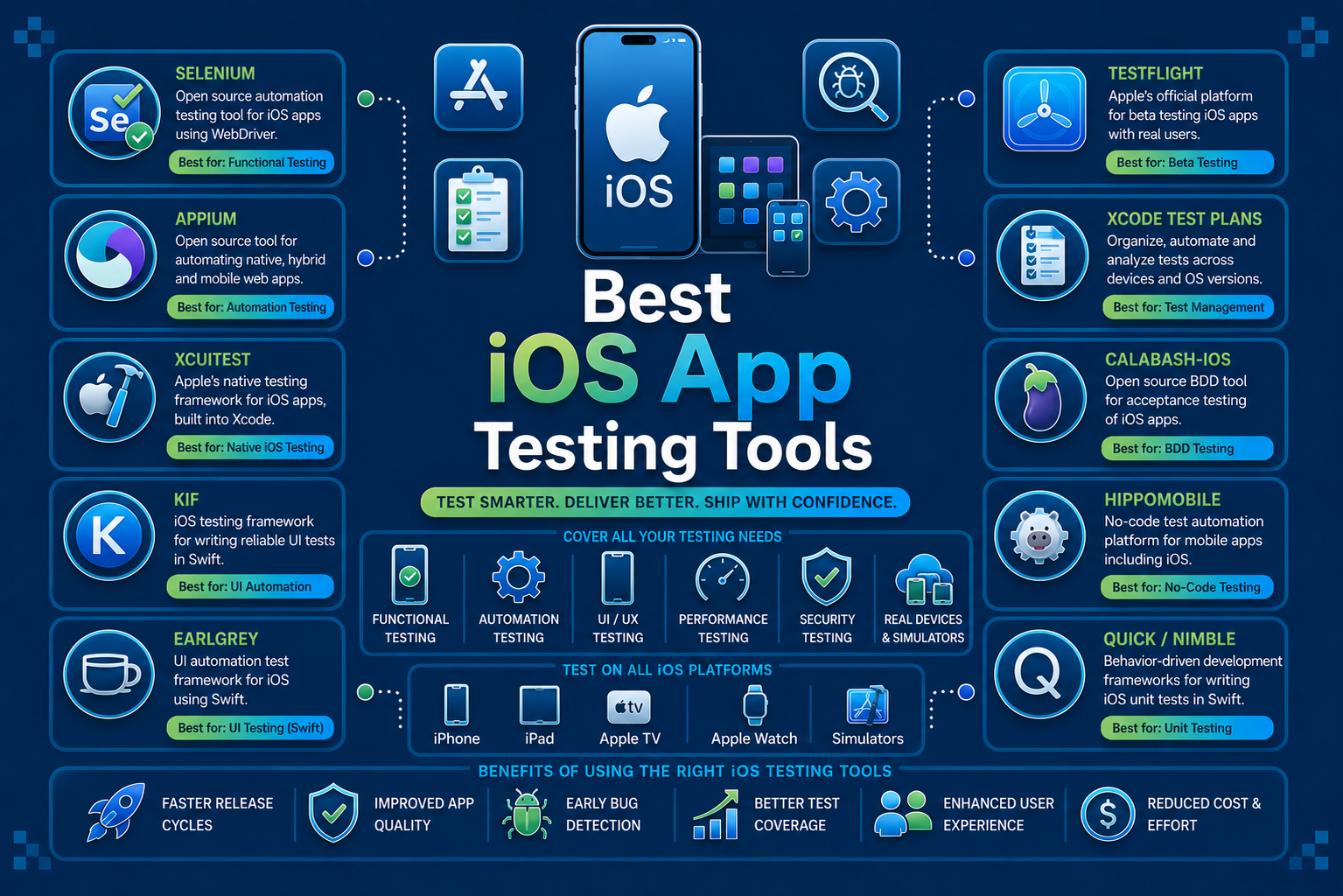

iOS app testing has always carried a higher bar than most platforms.
Apple’s strict app review process, frequent OS updates, and the premium expectations of its user base mean that bugs which might slide on other platforms will surface quickly in production on iOS.
The good news is that iOS testing tooling is genuinely mature.
Apple’s own native frameworks are among the most reliable in mobile testing, and the ecosystem of cloud platforms, AI-native tools, and cross-platform automation frameworks supporting iOS has expanded significantly .
This guide covers the 10 best iOS app testing tools in 2026, how each one approaches iOS-specific testing challenges, and how to choose the right combination for your team’s stack.
Key Tools
- Panto AI: AI-native iOS app testing platform for automated test generation, self-healing, and real device mobile testing.
- XCUITest: Apple’s official iOS app testing framework for reliable native UI automation and seamless Xcode integration.
- Appium: Open source iOS app testing framework ideal for cross-platform mobile automation using a shared codebase.
- EarlGrey: iOS testing framework best for apps with complex asynchronous workflows requiring stable, synchronized UI automation.
- BrowserStack App Automate: Real device cloud platform for scalable iOS app testing across multiple iPhone and iPad models.
- TestMu AI: AI-powered iOS app testing platform combining natural language automation with extensive real device coverage.
- Maestro: YAML-based iOS app testing framework designed for simple, maintainable cross-platform mobile test automation.
- Perfecto: Enterprise iOS app testing platform built for regulated organizations requiring private device clouds and compliance.
- TestFlight: Apple’s official beta testing platform for collecting real user feedback before iOS App Store releases.
- Katalon: Unified automation platform best for iOS, Android, web, and API testing from a single workspace.
The 10 Best iOS App Testing Tools in 2026
1. Panto AI
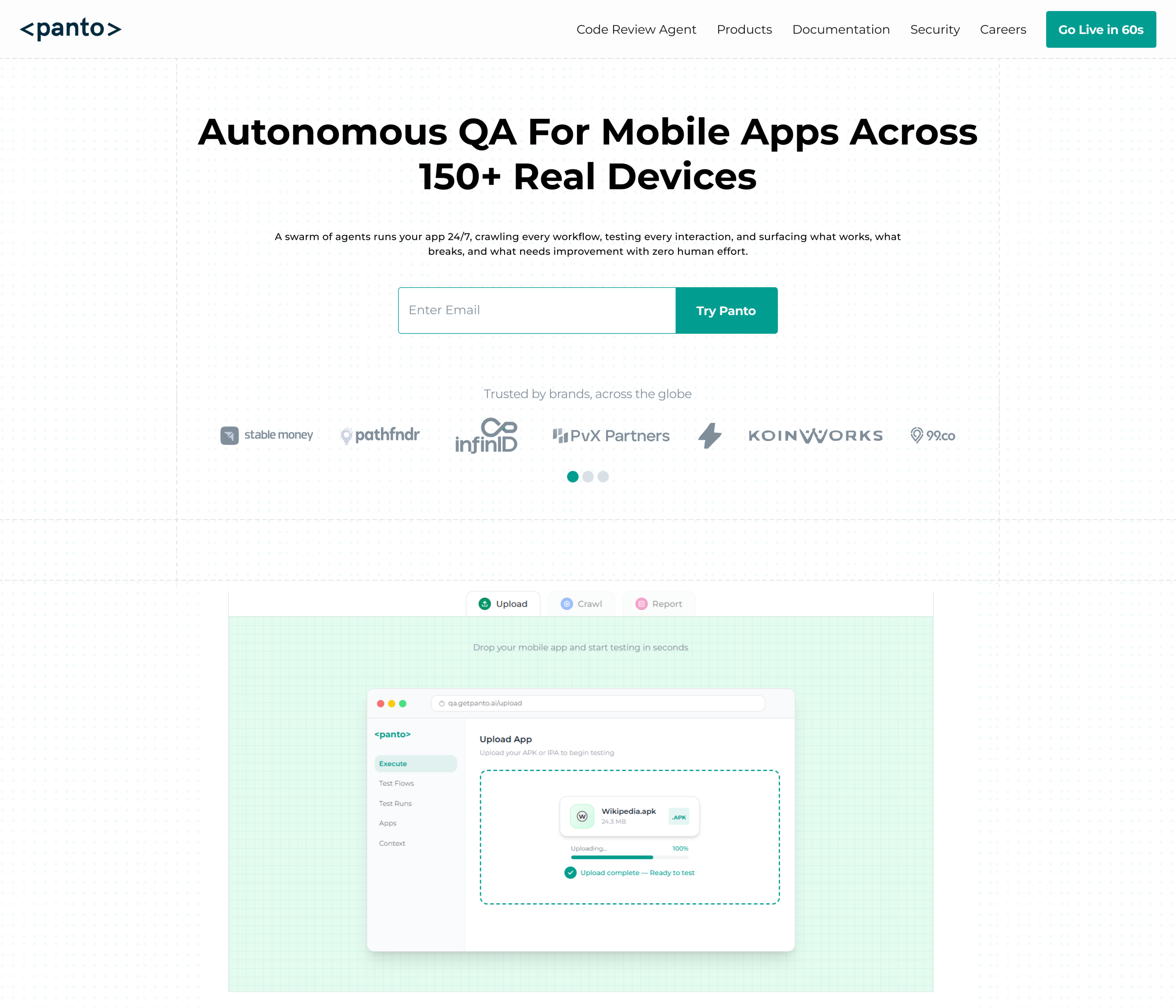
Panto AI is an AI-native mobile QA platform with first-class iOS support alongside Android and Flutter testing. It generates automated iOS test flows from plain English descriptions, executes them on real iOS devices, and maintains those tests automatically through self-healing as the app evolves.
Rather than requiring teams to write and maintain XCUITest or Appium scripts manually, Panto’s AI layer handles test creation and upkeep from the ground up.
For iOS teams specifically, Panto addresses the native interaction gap that limits many automation tools. Its platform supports iOS system-level interactions including permission dialogs, Face ID and Touch ID flows, push notification handling, and deep link validation, all within the same AI-driven test execution that handles standard in-app UI automation.
Key Features:
- NLP-based iOS test generation from plain English flow descriptions
- Real device execution across 150+ iOS physical devices including iPhone and iPad
- Self-healing automation that adapts to iOS UI changes across app updates automatically
- Native iOS system interaction support for Face ID, Touch ID, permission dialogs, and APNs
- AI-powered root cause analysis linking iOS test failures to specific code changes
- Vibe Debugging platform connecting iOS failures to the exact pull request responsible
- Appium and Maestro script export for version-controlled iOS test repositories
- CI/CD integration with GitHub Actions, Bitrise, Xcode Cloud, and Jenkins
- Support for iOS native, hybrid, and React Native apps from a single platform
- Free for open source projects with unlimited PR reviews
How It Performs iOS App Testing:
Panto handles both halves of iOS testing that most tools force teams to split across separate tools: standard in-app UI automation and native iOS system interaction. Face ID flows, APNs-triggered notification testing, and permission grant sequences all execute within the same AI-generated test suite as standard login, checkout, or onboarding flows.
The self-healing layer then keeps those tests working across iOS OS updates, which is particularly valuable given Apple’s annual major iOS releases that routinely change system UI behavior.
Limitations:
- Optimized for native mobile app testing; not designed for iOS web or macOS app testing
- Advanced custom iOS interactions beyond AI-generated flows may require technical configuration
- Smaller iOS device inventory than the largest enterprise cloud platforms
Best For: iOS-first teams and cross-platform mobile teams that want AI-driven test generation, native iOS system interaction support, and self-healing automation without maintaining separate XCUITest and Appium setups.
Pricing: Free plan at $0 with 15 test flows and 50 minutes of real device execution. Scale plan starts at $999 per month. Enterprise pricing available on request.
2. XCUITest
XCUITest is Apple’s official UI testing framework for iOS and macOS, built directly into Xcode and the iOS SDK. It is the standard foundation for iOS app automation testing and the framework that every serious iOS testing strategy builds from, whether used directly or through a higher-level tool.
Because XCUITest runs as part of the app’s test target and interacts with the iOS accessibility layer natively, it is faster, more stable, and more deeply integrated with the iOS runtime than any third-party iOS testing framework. Tests written in Swift or Objective-C run at native speed with direct access to the app’s UI state.
Key Features:
- Official Apple framework for iOS and macOS UI and automation testing
- Built into Xcode with no additional installation or configuration required
- Tests written in Swift or Objective-C for full iOS ecosystem consistency
- Direct iOS accessibility layer interaction for fast, reliable element detection
- Supports gestures, rotations, system alerts, hardware button interactions, and orientation changes
- Parallel test execution via Xcode test plans for faster iOS regression runs
- Compatible with Xcode Cloud, Bitrise, and all major iOS CI/CD platforms
- Works with all major iOS real device cloud providers including BrowserStack and Sauce Labs
How It Performs iOS App Testing:
XCUITest provides the most reliable foundation for automated iOS app testing available today. Its native runtime integration means tests behave consistently across Xcode simulator and real device runs, and the tight Xcode integration makes it natural to run iOS UI tests as part of every build without additional CI configuration.
For teams building iOS-native apps, XCUITest eliminates the additional layer of abstraction that external automation frameworks introduce.
Limitations:
- iOS and macOS only; no Android support from a single test suite
- Verbose test authoring in Swift or Objective-C compared to higher-level frameworks
- No built-in real device cloud; requires pairing with a cloud provider for cross-device iOS testing at scale
Best For: iOS-native development teams that prioritize test reliability and tight Xcode integration for automated iOS app testing, and are comfortable writing tests in Swift or Objective-C.
Pricing: Free, included with Xcode and the Apple Developer tools.
3. Appium
Appium is the most widely adopted open source framework for cross-platform mobile automation, and it remains one of the most common iOS app testing tools for teams that test both iOS and Android from a shared test infrastructure. Its WebDriver-based protocol supports iOS native, hybrid, and mobile web apps without requiring source code access or app modification.
For iOS specifically, Appium uses the XCUITest driver under the hood, bridging the language-agnostic Appium API to Apple’s native iOS automation framework. This means teams can write iOS tests in Java, Python, JavaScript, or any other supported language while still benefiting from XCUITest’s native iOS runtime integration.
Key Features:
- Open source and free with broad ecosystem and community support
- Supports iOS native, hybrid, and mobile web app automation testing
- Language-agnostic: write iOS tests in Java, Python, JavaScript, Ruby, C#, and more
- XCUITest driver for native iOS runtime integration under the hood
- Compatible with all major real iOS device cloud providers
- WebDriver protocol for broad CI/CD and toolchain integration
- No app modification or source code access required for iOS automation
How It Performs iOS App Testing:
Appium’s core contribution to iOS app testing is portability. Teams running iOS alongside Android tests do not need separate tools, scripts, or device configurations for each platform.
The XCUITest driver provides native iOS reliability while the Appium abstraction layer keeps the same test language and infrastructure across both platforms, reducing the total toolchain complexity for cross-platform mobile QA teams.
Limitations:
- Requires significant scripting expertise to build stable iOS automation suites
- XCUITest driver configuration for iOS can be complex and brittle without careful maintenance
- Slower than native XCUITest for iOS-only testing programs due to the abstraction layer
Best For: Cross-platform mobile teams that test iOS and Android together and need a single automation framework that covers both platforms from the same codebase and test infrastructure.
Pricing: Free and open source.
4. EarlGrey

EarlGrey is Google’s open source iOS UI testing framework, designed for testing iOS apps with synchronization built in at the framework level. It interacts with iOS apps using the accessibility layer, similar to XCUITest, but adds automatic synchronization with the app’s main thread, network requests, and animations that reduces test flakiness without requiring explicit wait conditions.
While EarlGrey is less commonly referenced in 2026 iOS testing discussions than XCUITest or Appium, it remains relevant for teams building iOS apps with complex asynchronous operations where standard XCUITest synchronization is insufficient.
Key Features:
- Automatic synchronization with the iOS app’s main thread, network requests, and animations
- Direct iOS accessibility layer interaction for element detection and interaction
- Tests written in Swift or Objective-C for full iOS codebase consistency
- Built-in visibility checker ensuring elements are visible before interactions are performed
- Flexible matching API for locating iOS UI elements across complex view hierarchies
- Works with Xcode and standard iOS CI/CD pipelines
- Open source with Google-backed maintenance
How It Performs iOS App Testing:
EarlGrey’s synchronization model is its primary differentiator from standard XCUITest. For iOS apps with heavy network activity, complex animations, or multiple concurrent async operations, EarlGrey’s automatic wait behavior reduces the timing-related flakiness that requires manual wait conditions in standard XCUITest.
Teams with specific iOS apps where test reliability is a persistent problem despite XCUITest sometimes find EarlGrey’s synchronization model more resilient.
Limitations:
- iOS only, with no Android or cross-platform support
- Less actively developed and community-supported than in its peak adoption period
- Can have conflicts with certain third-party iOS libraries and complex view hierarchies
Best For: iOS development teams building apps with complex asynchronous behavior who need automatic synchronization beyond what standard XCUITest provides natively.
Pricing: Free and open source.
5. BrowserStack App Automate
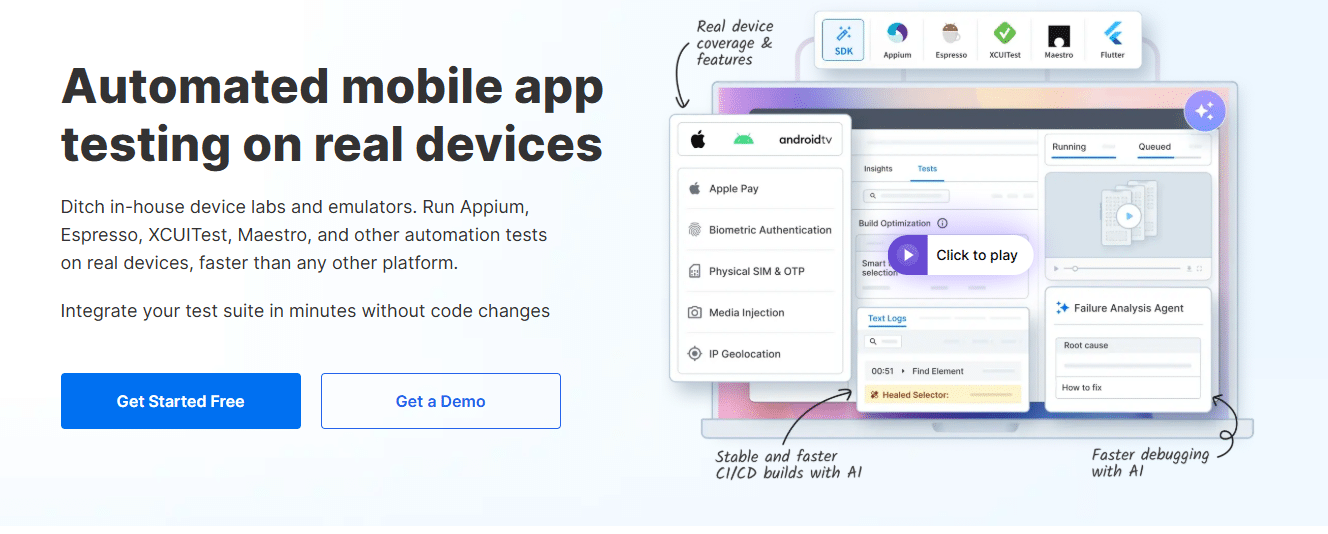
BrowserStack App Automate provides real iOS device cloud access at enterprise scale, with over 3,500 real devices including iPhone and iPad running multiple iOS versions. For iOS teams that need to validate app behavior across the full range of iOS OS versions and device form factors currently in active use, BrowserStack provides the device breadth that in-house device labs cannot match cost-effectively.
Its AI-enhanced capabilities, including a Self-Healing Agent and a Test Selection Agent, add intelligence to iOS test execution at scale, reducing maintenance overhead and CI execution time for large iOS regression suites.
Key Features:
- 3,500+ real devices including iPhone and iPad models across multiple iOS versions
- Supports XCUITest, Appium, and Detox for iOS test execution
- AI Self-Healing Agent for maintaining iOS test stability across app and OS updates
- Test Selection Agent that prioritizes iOS tests based on code changes
- Video recordings, device logs, and network logs per iOS test run
- Parallel execution across multiple real iOS devices simultaneously
- Integration with Xcode Cloud, Bitrise, GitHub Actions, and all major iOS CI/CD pipelines
- App Percy for visual regression testing across the real iOS device cloud
How It Performs iOS App Testing:
BrowserStack’s contribution to iOS app testing is real device coverage at scale. Running the same XCUITest or Appium suite across a matrix of iPhone models and iOS versions surfaces compatibility issues that a single iOS simulator or in-house device cannot catch.
The AI Self-Healing Agent reduces the maintenance cost of running iOS tests across this breadth, automatically repairing locator issues that arise as the app or iOS itself updates.
Limitations:
- Teams must bring their own iOS test automation; BrowserStack provides infrastructure, not test authoring
- Pricing scales significantly at higher parallelization tiers for large iOS device matrices
- iOS simulator access is not provided; all execution is against real devices
Best For: iOS teams with existing XCUITest or Appium suites that need broad real iOS device cloud coverage to validate compatibility across iOS versions and device models at scale.
Pricing: App Automate starts at $199 per month billed annually. Enterprise pricing available on request.
6. TestMu AI
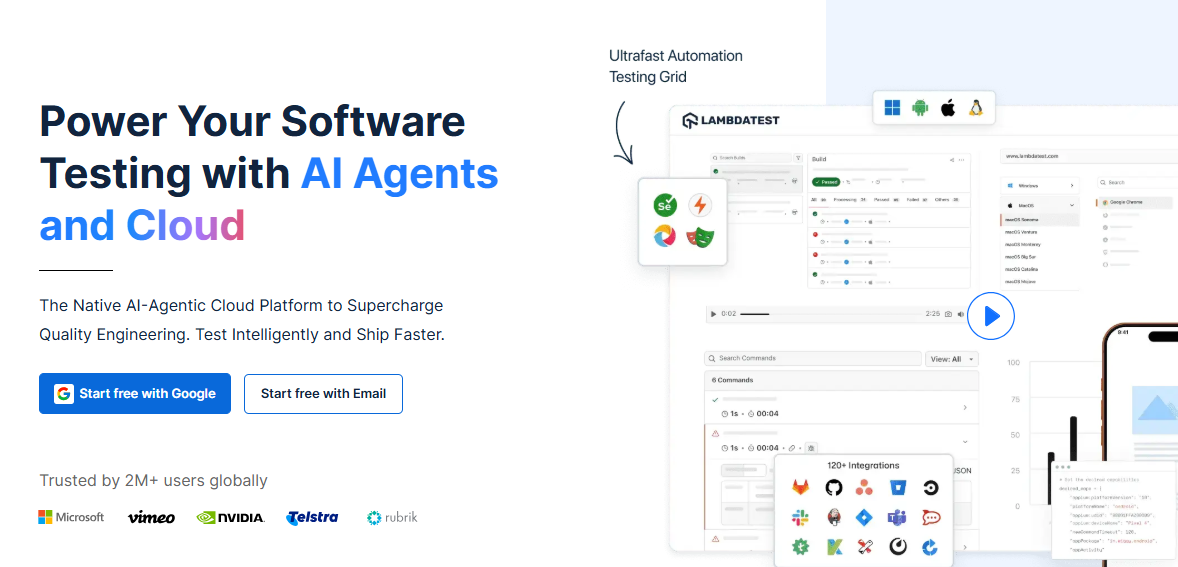
TestMu AI formerly LambdaTest) is an AI-native testing platform that combines a large real iOS device cloud with KaneAI, its natural language test generation agent.
For iOS teams, KaneAI generates XCUITest-compatible test flows from plain English descriptions and executes them across TestMu AI’s real iOS device inventory, reducing the scripting effort required to build and maintain iOS automation coverage.
Its HyperExecute engine provides fast parallel test execution across real iOS devices, making it a strong option for iOS teams running large regression suites that need to complete within tight release windows.
Key Features:
- KaneAI for natural language iOS test case generation and execution
- Large real iOS device cloud including iPhone and iPad models across iOS versions
- HyperExecute engine for fast parallel iOS test execution at scale
- Supports Appium, XCUITest, and Detox for iOS automation
- AI self-healing for maintaining iOS test stability through app updates
- Geolocation testing on real iOS devices for location-dependent app validation
- Integration with Jira, GitHub, Bitrise, and major iOS CI/CD tools
How It Performs iOS App Testing:
TestMu AI’s KaneAI reduces the time from identifying an iOS test need to having running test coverage in CI. A QA engineer describes the intended iOS user flow, KaneAI generates the test, selects appropriate real iOS devices, and executes the run.
For iOS teams with growing apps and limited QA capacity, this reduces the backlog of untested flows that accumulates when scripting is the bottleneck.
Limitations:
- KaneAI is strongest for standard iOS flows; complex native system interactions may need manual refinement
- The brand transition from LambdaTest may create uncertainty during enterprise procurement processes
- AI test generation works best when flows are clearly defined; ambiguous descriptions produce less reliable output
Best For: iOS teams modernizing their testing stack that want AI-native test generation combined with large real iOS device cloud coverage in a single platform.
Pricing: Free plan available. Real device plans start at $39 per month billed annually.
7. Maestro
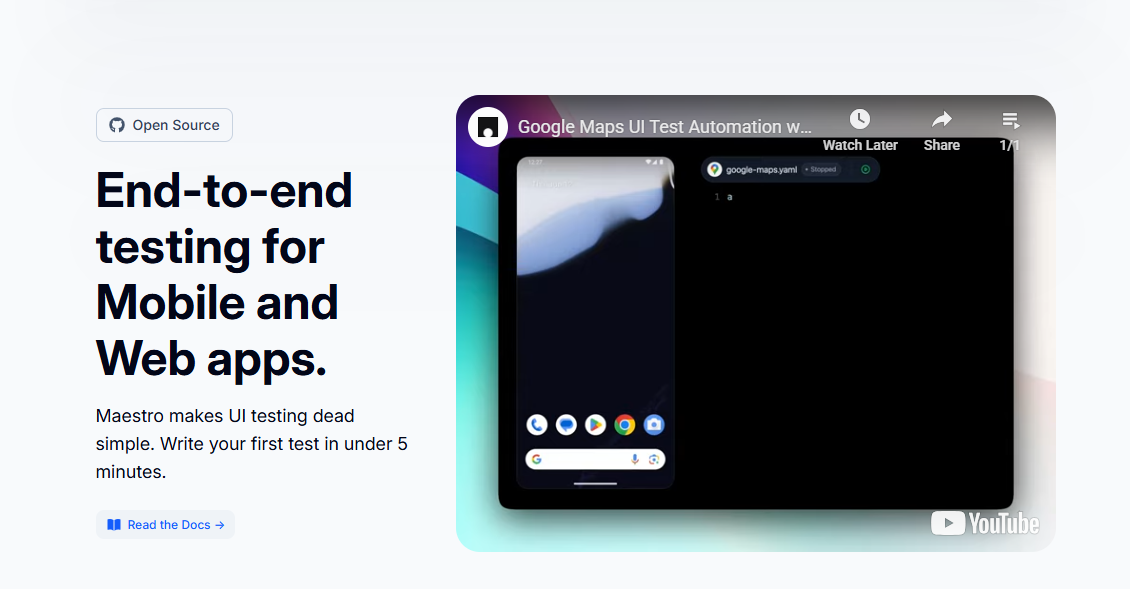
Maestro is a modern, YAML-based mobile testing framework with strong iOS support that has gained significant traction among iOS teams looking for a simpler alternative to XCUITest and Appium. Its declarative syntax makes iOS test authoring accessible to team members without Swift or Objective-C expertise, and its built-in flakiness tolerance handles iOS rendering timing issues automatically.
For iOS teams specifically, Maestro’s handling of iOS system interactions including permission dialogs and notification testing has improved significantly in recent releases, making it a practical choice for teams that want readable, maintainable iOS tests without deep native framework knowledge.
Key Features:
- YAML-based iOS test authoring with no Swift or Objective-C required
- Native iOS support alongside Android, React Native, and Flutter from a single test definition
- Built-in flakiness tolerance that automatically handles iOS animation and rendering delays
- Maestro Studio for visual iOS test recording and inspection
- Maestro Cloud for CI-integrated real iOS device execution
- Fast setup with minimal Xcode configuration compared to XCUITest or Appium
- Active open source community with strong iOS-specific issue tracking
How It Performs iOS App Testing:
Maestro’s flakiness tolerance directly addresses the timing sensitivity that makes iOS UI tests unreliable in CI. iOS animations and rendering transitions that cause standard automation to fail intermittently are handled automatically without requiring explicit wait conditions.
For iOS teams where test reliability is a persistent CI problem, Maestro’s synchronization model can significantly reduce false failures without requiring a framework migration.
Limitations:
- Complex iOS native system interactions are less mature than in Patrol or XCUITest
- Real device iOS support has some documented limitations compared to Android execution
- YAML-based approach can become unwieldy for very large or complex iOS test suites
Best For: iOS teams that want readable, maintainable iOS test coverage without requiring Swift or native iOS testing expertise across the full QA team.
Pricing: Open source and free. Maestro Cloud pricing available on request.
8. Perfecto
Perfecto is an enterprise iOS testing platform with a private device cloud, SOC 2 certification, and dedicated iOS device access for organizations that need consistent, uncontested real device execution for iOS testing programs. Its enterprise positioning makes it a common choice in regulated industries where test data residency and compliance certification are procurement requirements.
Its private iOS device cloud eliminates the shared resource contention that causes unpredictable test execution times on public device clouds, which is particularly relevant for iOS testing programs where consistent execution speed is critical for CI pipeline reliability.
Key Features:
- Private and public iOS real device cloud with dedicated device access
- SOC 2, ISO 27001, and GDPR compliance certifications for enterprise iOS testing
- AI-powered test analysis and smart iOS test reporting
- Dedicated iOS device access to eliminate shared resource contention
- Support for XCUITest, Appium, and other iOS automation frameworks
- Deep integration with enterprise CI/CD and ALM toolchains including Azure DevOps
- Role-based access control and enterprise SSO for iOS testing team management
- Audit trails and compliance reporting for regulated industry iOS testing programs
How It Performs iOS App Testing:
Perfecto’s private iOS device cloud ensures that iOS test execution times are consistent and predictable rather than variable based on shared resource availability.
For enterprise iOS teams with SLA-backed release processes, this consistency directly reduces the risk of CI pipeline delays caused by device queue contention on shared public clouds.
Limitations:
- Pricing is positioned firmly at the enterprise end of the market
- UI can feel dated compared to newer AI-native iOS testing platforms
- Less suitable for smaller iOS teams without enterprise procurement processes
Best For: Enterprise iOS teams in regulated industries including banking, healthcare, and insurance that need private iOS device access, strict compliance certifications, and governance-grade reporting.
Pricing: Enterprise pricing; contact Perfecto for a quote.
9. TestFlight
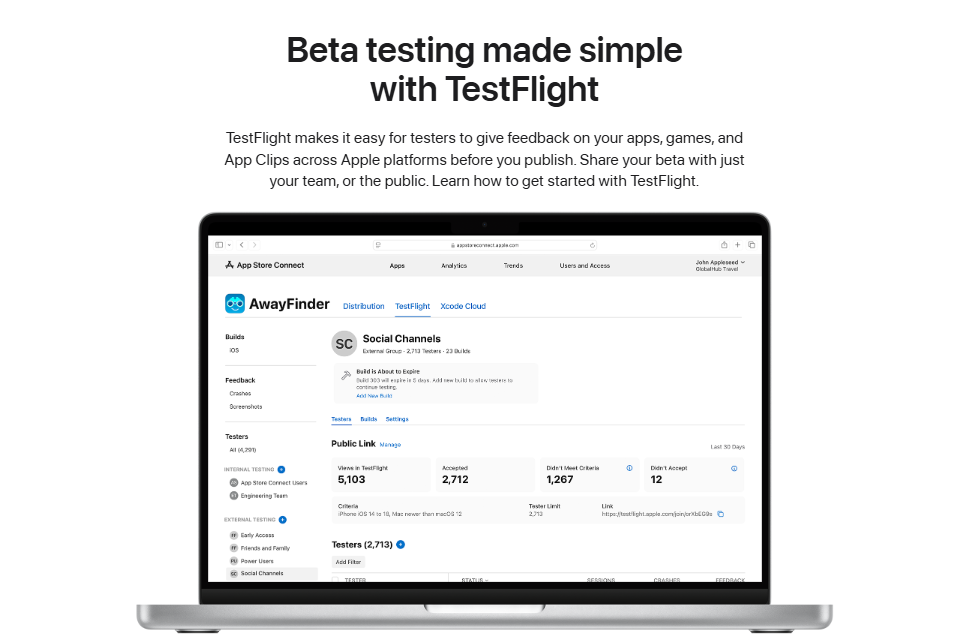
TestFlight is Apple’s official beta testing platform for iOS apps, providing a structured distribution mechanism for getting pre-release iOS builds into the hands of internal testers and external beta users before App Store submission. While it is not an automation framework, it is an essential part of any comprehensive iOS app testing strategy.
TestFlight handles the distribution logistics that sit between automated iOS testing and real user validation: code-signed builds, version management, tester feedback collection, and crash reporting. For iOS teams, it is the official channel for gathering real user feedback on iOS app quality before public release.
Key Features:
- Official Apple beta distribution for iOS, macOS, tvOS, and watchOS apps
- Internal testing for up to 100 team members and external testing for up to 10,000 users
- Automatic crash reporting and feedback submission from iOS beta testers
- Deep link to specific test scenarios for targeted iOS beta testing
- Build expiry management keeping iOS test builds current during testing cycles
- Direct integration with App Store Connect and Xcode for iOS build distribution
- Free as part of the Apple Developer Program
How It Performs iOS App Testing:
TestFlight closes the gap between automated iOS test results and real user experience validation. Automated XCUITest and Appium suites catch functional regressions, but real users discover usability issues, device-specific edge cases, and performance problems that scripted tests miss entirely.
TestFlight makes that real user validation structured and manageable rather than ad hoc, with proper version tracking and feedback collection built in.
Limitations:
- Requires manual tester participation rather than automated execution
- Build processing time can delay iOS testing workflows when rapid iteration is needed
- External tester feedback quality varies without structured testing instructions provided to testers
Best For: iOS teams that need structured beta distribution and real user feedback collection as part of their pre-release iOS app testing workflow, particularly before major iOS releases or feature launches.
Pricing: Free, included with Apple Developer Program membership at $99 per year.
10. Katalon
Katalon is a commercial test automation platform that covers iOS mobile testing as part of a unified mobile, web, and API testing solution. Built on Appium for iOS, it adds a codeless authoring layer, AI self-healing, and built-in test management that iOS teams typically need to integrate separately when working with raw XCUITest or Appium.
For iOS QA teams with mixed technical skill sets, Katalon’s combination of codeless and scripted iOS test authoring makes it accessible to team members without native iOS testing expertise while retaining the flexibility needed for more complex test scenarios.
Key Features:
- Codeless and scripted iOS test authoring for mixed-skill iOS QA teams
- AI self-healing object repository for maintaining iOS test stability through app updates
- Built on Appium for broad iOS device and framework compatibility
- Unified platform covering iOS, Android, web, and API testing from a single dashboard
- Katalon TestCloud for cloud-based real iOS device execution
- Built-in iOS test management, analytics, and CI/CD integration
- Integration with Jira, Jenkins, GitHub Actions, and enterprise DevOps toolchains
How It Performs iOS App Testing:
Katalon consolidates the iOS testing workflow for teams that manage iOS alongside web and Android testing. The AI self-healing repository reduces the maintenance burden when iOS app updates change element references in existing tests, and the unified dashboard gives QA leads visibility across iOS, Android, and web coverage in one place rather than across separate tool dashboards.
Limitations:
- Performance can degrade with very large or complex iOS test suites
- Inherits some XCUITest driver stability limitations through its Appium dependency
- Advanced iOS-specific features are locked behind higher-tier paid plans
Best For: iOS QA teams managing testing across multiple platforms including web and Android that need unified test management, codeless iOS test authoring, and AI-assisted test maintenance in one platform.
Pricing: Free community plan available. Premium plans start at $208 per month. Enterprise pricing on request.
Comparison Table: Best iOS App Testing Tools in 2026
| Tool | Type | iOS Real Devices | AI Features | Native iOS Integration | Best For | Pricing |
|---|---|---|---|---|---|---|
| Panto AI | AI-native platform | 150+ | NLP generation, self-healing, RCA | Yes (Face ID, APNs, permissions) | AI-driven iOS test generation and maintenance | Free; Scale $999/mo |
| XCUITest | Native Apple framework | Yes (via Xcode) | None | Native | iOS-native teams, foundational UI testing | Free |
| Appium | Open source framework | Via cloud providers | Via plugins | Via XCUITest driver | Cross-platform iOS and Android automation | Free |
| EarlGrey | Open source framework | Yes | None | Native accessibility layer | Complex async iOS apps needing synchronization | Free |
| BrowserStack | Cloud platform | 3,500+ | Self-healing, test selection | Via XCUITest and Appium | Large-scale real iOS device cross-version testing | From $199/mo |
| TestMu AI | AI-native platform | Large cloud | KaneAI NLP, self-healing | Via Appium and XCUITest | Modernizing iOS testing with AI generation | Free; from $39/mo |
| Maestro | Open source framework | Via Maestro Cloud | None | Limited | Readable iOS tests without Swift expertise | Free |
| Perfecto | Enterprise cloud | Private cloud | Smart reporting | Via XCUITest and Appium | Enterprise regulated industry iOS testing | Enterprise pricing |
| TestFlight | Beta distribution | Real user devices | None | Native Apple | Pre-release iOS beta testing and user feedback | Free |
| Katalon | Commercial platform | Via TestCloud | AI self-healing | Via Appium | Unified iOS, Android, and web test management | Free; from $208/mo |
How to Choose the Right iOS App Testing Tool
The right iOS testing setup depends on your team’s technical depth, the complexity of your app’s native iOS interactions, and whether you test iOS alone or alongside Android and web.
- Building a new iOS testing program from scratch? Start with XCUITest as the foundation and layer in real device cloud access through BrowserStack or TestMu AI once your core test suite is stable.
- Testing iOS and Android from a shared test infrastructure? Use Appium to maintain a single framework across both platforms, or Maestro for a YAML-based cross-platform approach.
- Running complex iOS apps with heavy async behavior and animation? Evaluate EarlGrey’s automatic synchronization model before committing to standard XCUITest.
- Want AI-driven iOS test generation without writing XCUITest scripts manually? Use Panto AI for NLP-based test creation with native iOS system interaction support including Face ID and APNs.
- Need real iOS device cloud coverage across multiple OS versions? BrowserStack and TestMu AI both offer the breadth needed for comprehensive iOS version compatibility testing.
- Working in a regulated industry with compliance requirements for iOS testing? Perfecto’s private device cloud and SOC 2 certification address enterprise security review requirements.
- Need structured beta distribution and real user feedback before App Store submission? Add TestFlight as the final validation layer before every iOS release regardless of which automation tools you use.
Conclusion
iOS app testing in 2026 has a mature tooling ecosystem. Apple’s own XCUITest remains the most reliable foundation, the AI-native platforms have meaningfully reduced scripting overhead, and the real device cloud options have expanded to cover every iOS version and device form factor teams realistically need to test against.
The strongest iOS testing strategies combine tools deliberately: XCUITest or an AI-driven platform like Panto AI for in-app automation, a real device cloud for cross-version validation, and TestFlight for real user feedback before each release.
No single iOS testing tool covers every layer of that stack, and teams that try to force one tool to do everything tend to end up with a brittle setup that breaks under the pressure of Apple’s annual iOS release cycle.
Start with your biggest current gap: if scripting overhead is the bottleneck, add AI-driven generation. If device coverage is the gap, add a real device cloud. If real user validation is missing, add TestFlight. iOS app quality is built layer by layer, and matching each tool to the layer it is built for is what makes the whole stack reliable.