

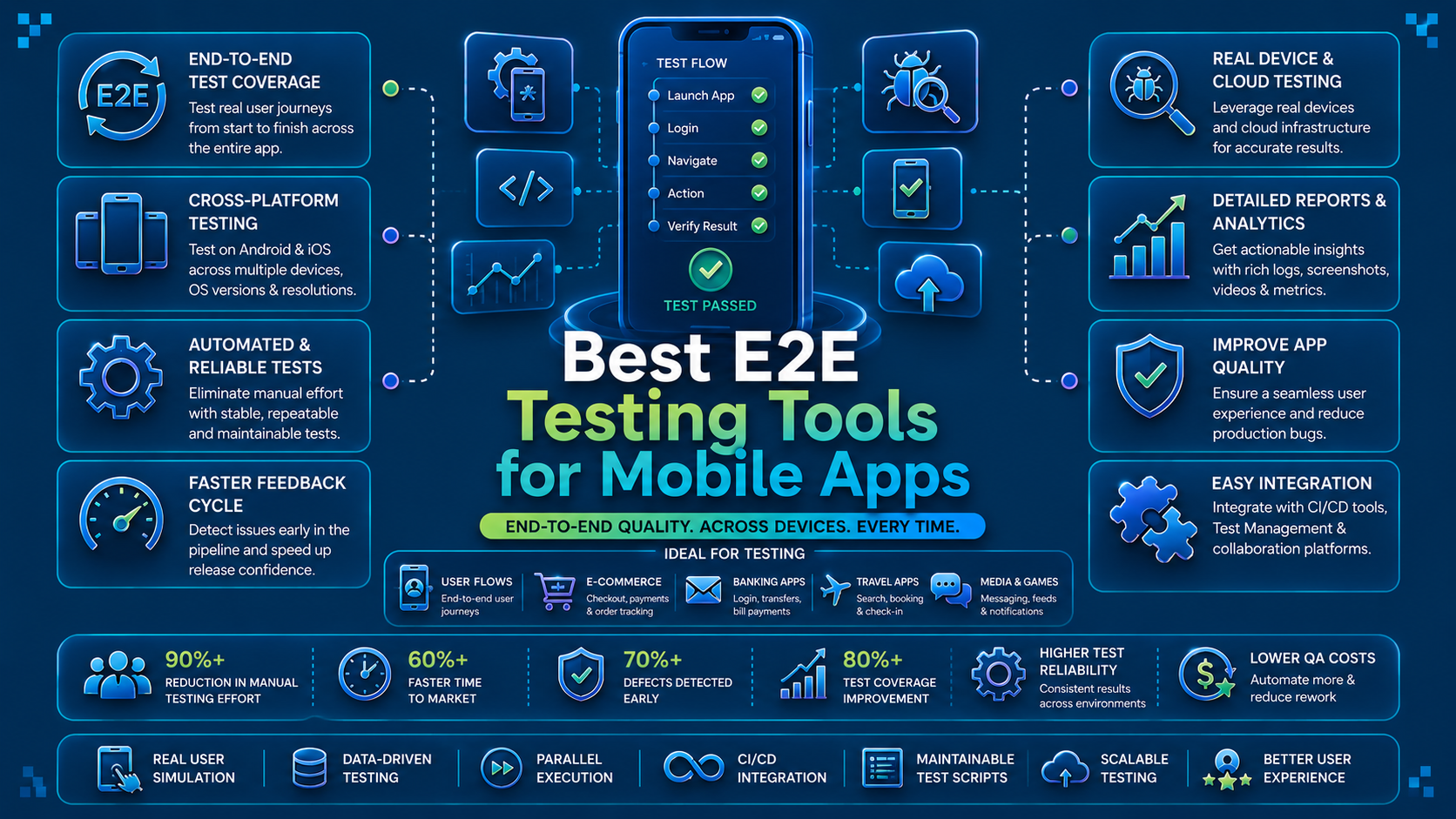

Shipping a mobile app without end-to-end tests is a gamble. Unit tests validate individual components. Integration tests check how those components talk to each other. But only E2E testing confirms that a real user can complete a real flow, from login to checkout to confirmation, without hitting a broken screen.
End-to-end tests for mobile apps are harder to build and maintain than their web equivalents. Device fragmentation, OS version differences, gesture handling, and native UI frameworks all add complexity that browser-based E2E tools were never designed to handle.
This guide covers the 10 best end-to-end testing tools for mobile apps in 2026, what each one brings to a mobile E2E testing program, and how to match the right tool to your stack.
Key Tools
- Panto AI: AI-native mobile E2E testing platform for self-healing automation and real-device execution.
- Appium: Open-source mobile end-to-end testing framework ideal for teams needing maximum flexibility.
- Detox: React Native E2E testing framework designed to minimize flaky mobile test execution.
- Maestro: YAML-based mobile E2E testing tool suited for fast, low-code test creation.
- Espresso: Google’s Android testing framework built for fast, reliable native mobile E2E testing.
- XCUITest: Apple’s native iOS E2E testing framework for stable, production-ready automation.
- Katalon: Unified QA automation platform combining mobile E2E testing with self-healing capabilities.
- WebdriverIO: JavaScript-first E2E testing framework simplifying Appium-powered mobile automation workflows.
- BrowserStack App Automate: Real-device cloud platform for scalable mobile end-to-end testing coverage.
- Testim: AI-assisted E2E testing solution reducing maintenance through adaptive smart locators.
The 10 Best End-to-End Testing Tools for Mobile Apps in 2026
1. Panto AI
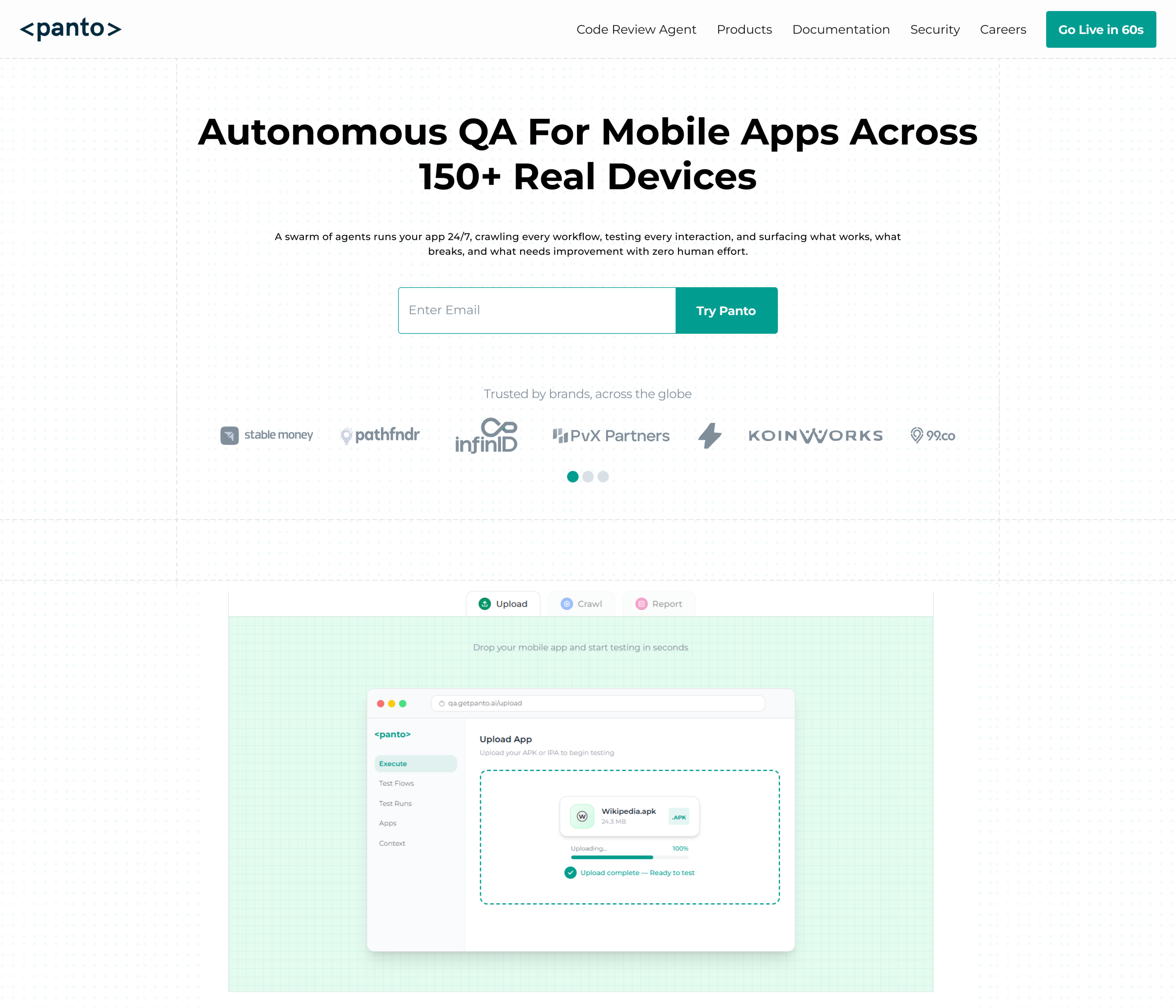
Panto AI is an AI-native mobile QA platform that handles end-to-end test creation, execution, and maintenance without requiring teams to write or manage test scripts manually. Built for Android and iOS, it generates full E2E test flows from plain English descriptions, runs them on real devices, and keeps them working as the app evolves through self-healing automation.
What makes Panto particularly strong for mobile end-to-end testing is that every layer of the platform is designed around the specific challenges of native app E2E coverage. From gesture-aware test generation to CI-integrated real device execution, it addresses the friction points that make mobile E2E programs expensive to build and hard to sustain.
Key Features:
- NLP-based E2E test generation from plain English flow descriptions
- Real device execution across 150+ Android and iOS physical devices
- Self-healing automation that adapts E2E tests to UI changes automatically
- AI-powered root cause analysis linking E2E test failures to specific code changes
- Vibe Debugging platform connecting visual failures to the pull request that caused them
- Appium, Detox, and Maestro script export for version-controlled E2E test suites
- Codeless visual flow builder for building end-to-end tests without scripting
- Performance budget enforcement on every PR for CPU, memory, and app start time
- Automatic E2E test triggering on pull requests via CI/CD integration
- Free for open source projects with unlimited PR reviews
How It Helps With E2E Testing for Mobile Apps:
Panto removes the two biggest barriers to sustained mobile E2E test coverage: the cost of writing tests and the cost of keeping them current. Teams describe a user journey once, and the AI generates a working end-to-end test that runs on real devices and self-heals when the UI changes.
The automated QA layer then connects any E2E failure directly to the commit responsible, turning what is usually a lengthy investigation into a one-click diagnosis.
Limitations:
- Optimised specifically for mobile app E2E testing; not designed for web or desktop
- Advanced customisation beyond AI-generated E2E tests may require technical input
- NLP-driven workflows have a learning curve for teams used to purely code-based approaches
Best For: Mobile-first teams and lean QA organisations that want fast E2E test creation, low-maintenance coverage, and AI-assisted failure triage across real Android and iOS devices.
Pricing: Free plan at $0 with 15 test flows and 50 minutes of real device execution. Scale plan starts at $999 per month. Enterprise pricing available on request.
2. Appium
Appium is the most widely used open source framework for mobile end-to-end testing. It uses the WebDriver protocol to automate native, hybrid, and mobile web apps on Android and iOS without requiring source code access or app modification. It has been the default choice for mobile E2E automation for over a decade and remains the most portable option across device clouds, CI systems, and programming languages.
For teams that need full control over their E2E test architecture and want to run tests across multiple cloud providers without framework lock-in, Appium remains the most reliable foundation. Its broad ecosystem means almost every mobile testing tool, cloud platform, and CI system supports it natively.
Key Features:
- Open source and free with a large, active community
- Supports Android and iOS native, hybrid, and mobile web E2E testing
- Language-agnostic: write end-to-end tests in Java, Python, JavaScript, Ruby, or C#
- No source code access or app modification required
- Compatible with all major real device cloud platforms
- WebDriver protocol for broad toolchain and CI integration
- Extensive plugin ecosystem for extending E2E test capabilities
How It Helps With E2E Testing for Mobile Apps:
Appium’s primary value in mobile end-to-end testing is portability and ecosystem breadth. E2E tests written in Appium run on any device cloud, integrate with any CI system, and can be maintained by any engineer familiar with standard WebDriver conventions.
For organisations that cannot afford vendor lock-in, Appium gives the most flexibility across a long-running E2E testing program.
Limitations:
- Requires significant scripting expertise to build and maintain stable E2E test suites
- Flakiness can be high without careful synchronization and selector management
- No built-in AI features, self-healing, or test generation capabilities
- Slower execution than platform-native frameworks like Espresso
Best For: Engineering teams with strong automation experience that need full architectural control over their mobile E2E testing stack and maximum portability across platforms and providers.
Pricing: Free and open source.
3. Detox
Detox is an end-to-end testing framework developed by Wix specifically for React Native apps. It takes a gray-box approach to mobile E2E testing, meaning it has visibility into the app’s runtime internals and uses that to synchronize test actions with the app’s actual state rather than relying on fixed wait times or polling.
This makes Detox significantly more reliable for React Native end-to-end tests than black-box frameworks like Appium. The gray-box synchronization layer eliminates the most common source of E2E test flakiness: timing mismatches between test commands and app UI rendering.
Key Features:
- Gray-box E2E testing with automatic synchronization for React Native apps
- Cross-platform: single E2E test suite covers both Android and iOS
- Tests written in JavaScript or TypeScript with Jest as the test runner
- Automatic synchronization with the app’s event loop, animations, and async operations
- Works with real devices and emulators
- First-class integration with popular React Native CI workflows
- Active open source community with strong React Native ecosystem alignment
How It Helps With E2E Testing for Mobile Apps:
Detox solves the flakiness problem that makes end-to-end test suites unreliable in CI. For React Native teams, the gray-box synchronization means tests wait for the right app state automatically rather than timing out or running ahead of the UI.
The result is an E2E test suite that produces consistent pass or fail results rather than intermittent noise that teams learn to ignore.
Limitations:
- Best suited for React Native; limited value for fully native Android or iOS apps
- Android setup is more complex than iOS and has historically been less stable
- Gray-box approach requires app-side integration that adds setup overhead
Best For: React Native development teams that need reliable, flake-resistant cross-platform end-to-end testing without managing two separate E2E frameworks.
Pricing: Free and open source.
4. Maestro
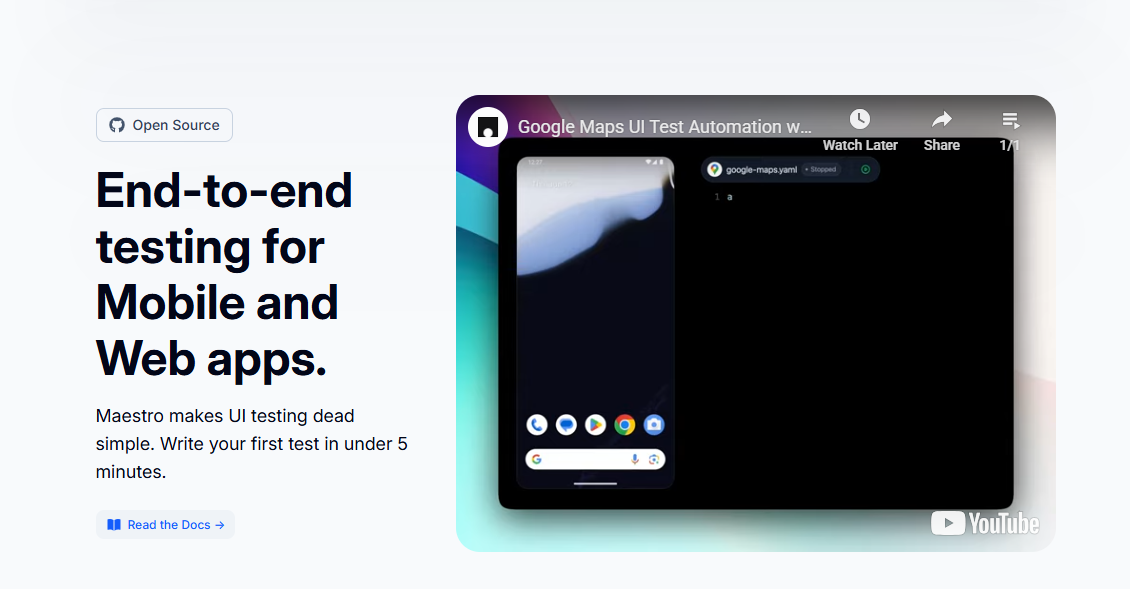
Maestro is a modern open source mobile E2E testing framework that prioritises simplicity and speed of adoption. Tests are written in YAML rather than code, which removes the scripting barrier and makes end-to-end test authoring accessible to QA engineers and product contributors who are not professional developers.
Despite its simplicity, Maestro handles the full range of native mobile interactions including scrolling, swiping, conditional logic, and back-navigation. It has become one of the fastest-growing mobile E2E testing frameworks in the market because teams can go from zero to a working end-to-end test suite in hours rather than days.
Key Features:
- YAML-based E2E test authoring requiring no programming knowledge
- Supports Android and iOS from a single test definition file
- Maestro Studio for visual test recording and live inspection
- Built-in handling for common mobile E2E patterns: scroll, tap, swipe, type
- Maestro Cloud for CI-integrated real device execution
- Fast setup with minimal configuration and no complex driver management
- Active open source community with frequent releases and strong documentation
How It Helps With E2E Testing for Mobile Apps:
Maestro lowers the entry cost to mobile end-to-end testing more than any other framework. Teams that previously could not justify the time investment to build an Appium suite can have meaningful E2E test coverage running in CI within a single sprint.
The YAML format also makes end-to-end tests readable and reviewable by non-engineers, which improves visibility into what is actually being tested across the app.
Limitations:
- Real device iOS support has documented limitations compared to Android emulator support
- YAML-based approach can become difficult to manage for very large or complex E2E test suites
- Less mature than Appium for advanced scenarios requiring deep platform-level interaction
Best For: Teams that want fast, readable mobile end-to-end test coverage without engineering overhead, particularly for developer-led E2E testing programs and smoke test suites.
Pricing: Open source and free. Maestro Cloud pricing available on request.
5. Espresso
Espresso is Google’s official UI testing framework for Android, designed to write fast and reliable end-to-end tests for native Android apps. It runs in-process alongside the app, which gives it direct access to the app’s internals and eliminates the external server layer that makes Appium slower and more prone to synchronisation issues.
Espresso is the most performant option for Android end-to-end testing. Tests run faster, synchronise more reliably with the app’s UI thread, and produce more consistent results in CI than any black-box alternative for Android-native applications.
Key Features:
- Official Google framework for Android UI and E2E testing
- In-process execution for fast, deterministic end-to-end test runs
- Automatic synchronisation with the Android UI thread, animations, and async tasks
- Built-in support for gestures, view interactions, and intent testing
- Deep integration with Android Studio, Gradle, and the Android build system
- Compatible with Firebase Test Lab and other Android-focused cloud platforms
- Espresso Test Recorder for generating E2E tests from recorded interactions
How It Helps With E2E Testing for Mobile Apps:
Espresso provides the most stable and performant foundation for Android end-to-end tests. The in-process architecture means tests execute at near-native speed and synchronise with the app’s actual state without needing explicit wait conditions.
For Android teams running large E2E test suites in CI, this translates directly into faster build times and fewer false failures.
Limitations:
- Android only; no iOS support
- Requires tests written in Java or Kotlin, limiting accessibility for non-Android developers
- Less portable than Appium for teams testing on both Android and iOS
Best For: Android-native development teams that prioritise E2E test speed, stability, and deep integration with the Android development and build toolchain.
Pricing: Free and open source, included with Android Studio.
6. XCUITest
XCUITest is Apple’s native UI testing framework for iOS and macOS. Introduced with Xcode 7, it replaced UIAutomation as the standard for end-to-end testing on the iOS platform and has been the default choice for iOS E2E automation ever since.
Like Espresso on Android, XCUITest runs as part of the app’s test target and integrates tightly with Xcode. Its native access to the iOS accessibility layer makes it the most reliable foundation for iOS end-to-end tests, with consistent behavior across simulator and real device runs.
Key Features:
- Official Apple framework for iOS and macOS E2E testing
- Native integration with Xcode, the iOS simulator, and real device testing
- Tests written in Swift or Objective-C
- Supports gestures, rotations, system alerts, and hardware button interactions
- Parallel test execution via Xcode test plans
- Compatible with Xcode Cloud, Bitrise, and other iOS-focused CI platforms
- Works with BrowserStack, Sauce Labs, and other real device cloud providers
How It Helps With E2E Testing for Mobile Apps:
XCUITest provides the most reliable end-to-end test coverage available for iOS apps. Its native runtime integration means E2E tests behave consistently across Xcode simulator runs and real device execution, which removes the environment discrepancies that cause false failures in cross-platform frameworks.
For teams that need to trust their iOS E2E test results, XCUITest is the most dependable option.
Limitations:
- iOS and macOS only; no Android support
- Requires familiarity with Swift or Objective-C
- Verbose test authoring compared to higher-level mobile E2E frameworks
Best For: iOS-native development teams that need reliable, framework-native end-to-end testing with tight Xcode integration and consistent real device behavior.
Pricing: Free, included with Xcode.
7. Katalon
Katalon is a commercial test automation platform that combines a codeless E2E authoring layer with built-in test management, reporting, and CI integration. It is built on top of Appium and Selenium but abstracts their complexity behind a unified interface that works for both technical and non-technical contributors.
For QA teams that need to manage end-to-end test coverage across mobile, web, and API in one platform without maintaining separate frameworks, Katalon is a practical consolidation option that preserves framework flexibility through its underlying Appium layer.
Key Features:
- Codeless and scripted E2E test authoring for Android and iOS
- Unified platform covering mobile, web, API, and desktop E2E testing
- AI self-healing object repository for maintaining E2E test stability
- Built on Appium for broad mobile E2E compatibility and device cloud support
- Built-in test management, analytics, and CI/CD integration
- Katalon TestCloud for cloud-based real device E2E execution
- Integration with Jira, Jenkins, GitHub Actions, and other DevOps tools
How It Helps With E2E Testing for Mobile Apps:
Katalon consolidates the mobile E2E testing workflow into a single tool that handles authoring, execution, and reporting without requiring teams to integrate multiple platforms.
The AI self-healing object repository reduces the maintenance burden when app updates break element references in existing end-to-end tests, and the unified reporting layer gives QA leads visibility across mobile and web E2E coverage in one place.
Limitations:
- Performance can degrade with large or complex mobile E2E test suites
- Inherits some stability limitations from its underlying Appium dependency
- Advanced AI and reporting features are behind higher-tier paid plans
Best For: QA teams that need unified end-to-end test management across mobile, web, and API without maintaining multiple frameworks or separate reporting pipelines.
Pricing: Free community plan available. Premium plans start at $208 per month. Enterprise pricing on request.
8. WebdriverIO
WebdriverIO is a JavaScript and TypeScript test automation framework that wraps Appium in a cleaner, more developer-friendly API. It handles the low-level session management, retries, and parallel execution logic that Appium requires teams to manage manually, making it a strong choice for JavaScript-native engineering teams that want mobile E2E automation without Appium’s raw complexity.
WebdriverIO’s unified interface covers both browser and mobile app E2E testing from the same codebase, which makes it particularly useful for teams that test web and mobile surfaces using a shared JavaScript test infrastructure.
Key Features:
- JavaScript and TypeScript-native mobile E2E testing built on Appium
- Cleaner, chainable API that simplifies Appium session and selector management
- Unified E2E testing across web browsers and native mobile apps
- Built-in retry logic, parallel execution, and test runner orchestration
- Works with real devices, emulators, and all major cloud device platforms
- Extensive plugin ecosystem including reporters, services, and custom commands
- Strong integration with Jest, Mocha, and Jasmine as test runners
How It Helps With E2E Testing for Mobile Apps:
WebdriverIO reduces the operational overhead of running Appium-based mobile E2E tests at scale. The framework handles the boilerplate that makes raw Appium difficult to maintain, including session management, element waiting strategies, and parallel device orchestration.
For JavaScript teams, the ability to write mobile and web end-to-end tests in the same language with the same toolchain reduces context switching and simplifies CI configuration.
Limitations:
- Still inherits Appium’s underlying complexity and some of its flakiness characteristics
- Requires JavaScript or TypeScript proficiency; not accessible to non-developers
- Mobile E2E testing configuration is more involved than dedicated mobile-first frameworks
Best For: JavaScript and TypeScript engineering teams that want Appium-powered mobile E2E testing with a cleaner API and unified browser plus mobile test infrastructure.
Pricing: Free and open source.
9. BrowserStack App Automate
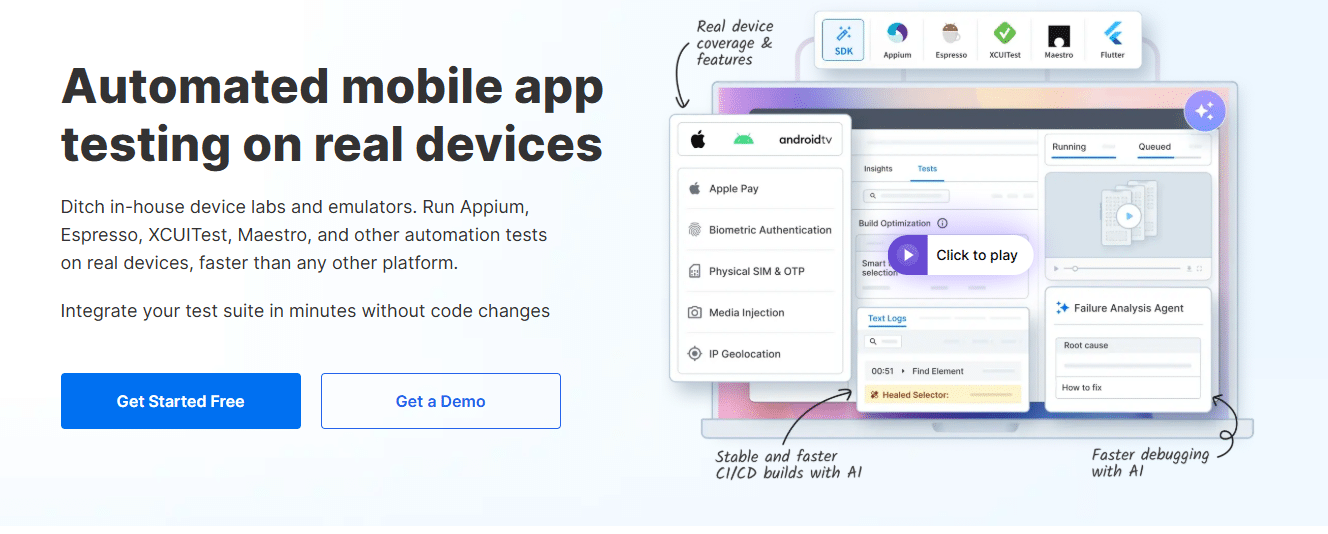
BrowserStack App Automate provides cloud-based real device execution for mobile end-to-end tests at scale. With access to over 3,500 real Android and iOS devices, it gives teams the device breadth needed to validate E2E test coverage across the full range of OS versions, screen sizes, and manufacturer builds that real users run.
Its AI-assisted features, including a Self-Healing Agent and Test Selection Agent, add intelligence to E2E test execution without requiring teams to change their automation approach. Teams bring their existing Appium, Espresso, or XCUITest end-to-end tests and run them against BrowserStack’s device cloud.
Key Features:
- 3,500+ real Android and iOS devices for cloud-based E2E test execution
- AI Self-Healing Agent for automatic locator repair during E2E test runs
- Test Selection Agent that identifies high-risk tests based on code changes
- Supports Appium, Espresso, XCUITest, Detox, and Flutter Driver
- Video recordings, device logs, and network logs for every E2E test run
- Parallel execution across multiple real devices simultaneously
- Integration with all major CI/CD platforms and test management tools
How It Helps With E2E Testing for Mobile Apps:
BrowserStack provides the real device infrastructure that most mobile E2E testing programs eventually need but cannot justify maintaining in-house.
Running end-to-end tests across dozens of Android OEM builds and multiple iOS versions simultaneously surfaces compatibility issues that single-device or emulator-only E2E coverage misses entirely. The Test Selection Agent also reduces total E2E test execution time by prioritising the tests most likely to be affected by a given code change.
Limitations:
- Teams must bring their own E2E test automation; BrowserStack provides infrastructure, not authoring
- Pricing scales significantly at higher parallelisation and usage tiers
- Occasional device availability constraints during peak usage periods
Best For: Teams with existing mobile E2E test suites that need real device cloud infrastructure to run cross-device compatibility validation at scale without managing physical device labs.
Pricing: App Automate starts at $199 per month billed annually. Enterprise plans available on request.
10. Testim
Testim is an AI-assisted test automation platform that uses machine learning to stabilise end-to-end test locators and reduce the maintenance burden that makes mobile E2E testing programs expensive to sustain.
Its smart locator engine builds a multi-signal model of each UI element so that when a design update changes one attribute, the remaining signals identify the correct element and the test continues without failing.
For mobile teams that ship frequent UI updates and have experienced high E2E test maintenance costs as a result, Testim’s core value proposition is directly relevant. The platform generates tests through a record-and-replay model enhanced by AI and maintains those tests automatically as the app evolves.
Key Features:
- AI-powered smart locators that adapt to UI changes during E2E test execution
- Record-and-replay E2E test authoring with JavaScript customisation for complex flows
- Supports web and mobile end-to-end testing from a single platform
- Visual test editor for non-technical QA contributors
- Test branching and parameterisation for comprehensive E2E test coverage
- Integration with GitHub, Jenkins, CircleCI, and other CI/CD pipelines
- Detailed E2E test run reports with failure screenshots and execution context
How It Helps With E2E Testing for Mobile Apps:
Testim’s smart locator system targets the most common reason mobile E2E tests break: UI changes that invalidate element selectors. By using visual, structural, and contextual signals to identify elements rather than a single brittle attribute, Testim keeps end-to-end tests running through routine app updates without manual intervention.
This is particularly valuable for mobile apps with active design iteration where maintaining E2E test coverage would otherwise require constant script updates.
Limitations:
- Real device coverage is more limited than dedicated mobile device cloud platforms
- AI stabilisation handles locator drift well but not major end-to-end flow restructuring
- Can become expensive at higher E2E test execution volumes
Best For: Teams with frequent mobile UI updates that need AI-assisted E2E test stability and want a lower-maintenance alternative to script-heavy end-to-end automation.
Pricing: Contact Testim for current pricing. Free trial available.
Comparison Table: Best End-to-End Testing Tools for Mobile Apps in 2026
| Tool | Platform | Type | AI Features | Real Devices | Best For | Pricing |
|---|---|---|---|---|---|---|
| Panto AI | Android, iOS | AI-native platform | NLP generation, self-healing, RCA | 150+ | AI-first mobile E2E teams | Free; Scale $999/mo |
| Appium | Android, iOS | Open source framework | Via plugins | Via cloud providers | Full architectural control | Free |
| Detox | Android, iOS | Open source framework | None | Yes | React Native E2E testing | Free |
| Maestro | Android, iOS | Open source framework | None | Via Maestro Cloud | Low-overhead E2E coverage | Free |
| Espresso | Android only | Native framework | None | Yes | Android-native E2E testing | Free |
| XCUITest | iOS only | Native framework | None | Yes | iOS-native E2E testing | Free |
| Katalon | Android, iOS, Web | Commercial platform | AI self-healing | Via TestCloud | Unified mobile and web E2E | Free; from $208/mo |
| WebdriverIO | Android, iOS, Web | Open source framework | None | Via cloud providers | JS/TS teams extending to mobile | Free |
| BrowserStack | Android, iOS | Cloud platform | Self-healing, test selection | 3,500+ | Real device E2E at scale | From $199/mo |
| Testim | Android, iOS, Web | AI-assisted platform | Smart locator stabilisation | Limited | High UI churn E2E programs | Contact for pricing |
How To Choose The Right Mobile E2E Testing Tool
The best mobile E2E testing tool depends on your app, team structure, and biggest testing challenge. Some teams struggle with test creation, others with maintenance, and many need broader device coverage as their applications scale.
Choose Based On Your Platform
- Android apps: Start with Espresso for native testing and add Appium or BrowserStack when you need broader device coverage.
- iOS apps: XCUITest remains the standard foundation for native iOS automation.
- React Native apps: Detox is often the best starting point because it was built specifically for React Native applications.
- Cross-platform apps: Appium, Panto AI, and Katalon offer broader support across Android and iOS environments.
Choose Based On Your Biggest Testing Challenge
If test creation takes too much time
- Panto AI — Best for AI-generated tests, NLP and no-code test creation, and real-device execution.
- Maestro — Best for teams that want a simple, lightweight framework with a fast learning curve.
If test maintenance is becoming a burden
- Testim — Uses smart locators to reduce failures caused by UI changes.
- Katalon — Includes self-healing capabilities that automatically adapt to application updates.
If device coverage is the priority
- BrowserStack — Provides access to one of the largest collections of real mobile devices for testing.
- Appium + BrowserStack — A popular combination for scaling existing E2E suites across many devices.
If you need one platform for web and mobile testing
- Katalon — Unified web testing, mobile testing, API testing and desktop application testing.
- WebdriverIO — Flexible automation framework that supports both web and mobile workflows.
Final Thoughts
Mobile E2E testing is one of the most valuable investments a development team can make. Well-designed end-to-end tests running on real devices help catch production issues earlier, improve release confidence, and reduce costly user-facing defects.
The key is choosing a tool your team can maintain over time. The most powerful framework is not always the best choice: the right tool is the one that fits your workflow, scales with your application, and enables consistent testing without creating unnecessary maintenance overhead.