


A mobile regression suite that takes four hours to run sequentially can often finish in under twenty minutes when parallelized correctly.
That difference is not a minor optimization, it is the gap between a CI pipeline developers trust and one they route around.
Mobile test parallelization means running multiple tests, or the same test across multiple devices and OS versions, at the same time instead of one after another.
As device fragmentation grows, sequential execution stops being a viable option for any team shipping regularly.
This guide covers the 10 best tools for mobile test parallelization in 2026, based on what actually holds up at scale in CI.
Key Tools
- Panto AI: AI-native mobile QA platform delivering native mobile test parallelization across 150+ real devices with self-healing automation.
- BrowserStack App Automate: Large-scale real device cloud built for parallel mobile testing across thousands of device and OS combinations.
- Sauce Labs: Enterprise parallel test execution platform running hundreds of simultaneous mobile sessions with compliance-ready private cloud options.
- LambdaTest HyperExecute: AI-driven test orchestration tool that optimizes parallel mobile test distribution to minimize total execution time.
- Firebase Test Lab: Google’s cloud testing infrastructure for teams running matrix-based parallel mobile tests across Android and iOS.
- Kobiton: Mobile-first device cloud supporting hybrid parallel test execution across both cloud and private device labs.
- pCloudy: Zero-setup cloud platform for running parallel mobile tests on real devices with built-in network simulation.
- Katalon TestOps: Orchestration layer for scheduling and managing mobile test parallelization across distributed CI environments.
- Appium Grid: Open source solution for self-hosted mobile test parallelization, ideal for teams wanting full infrastructure control.
- Bitrise: Mobile-focused CI/CD platform with parallel test execution built directly into its build pipeline workflow.
10 Best Tools For Mobile Test Parallelization In 2026
1. Panto AI
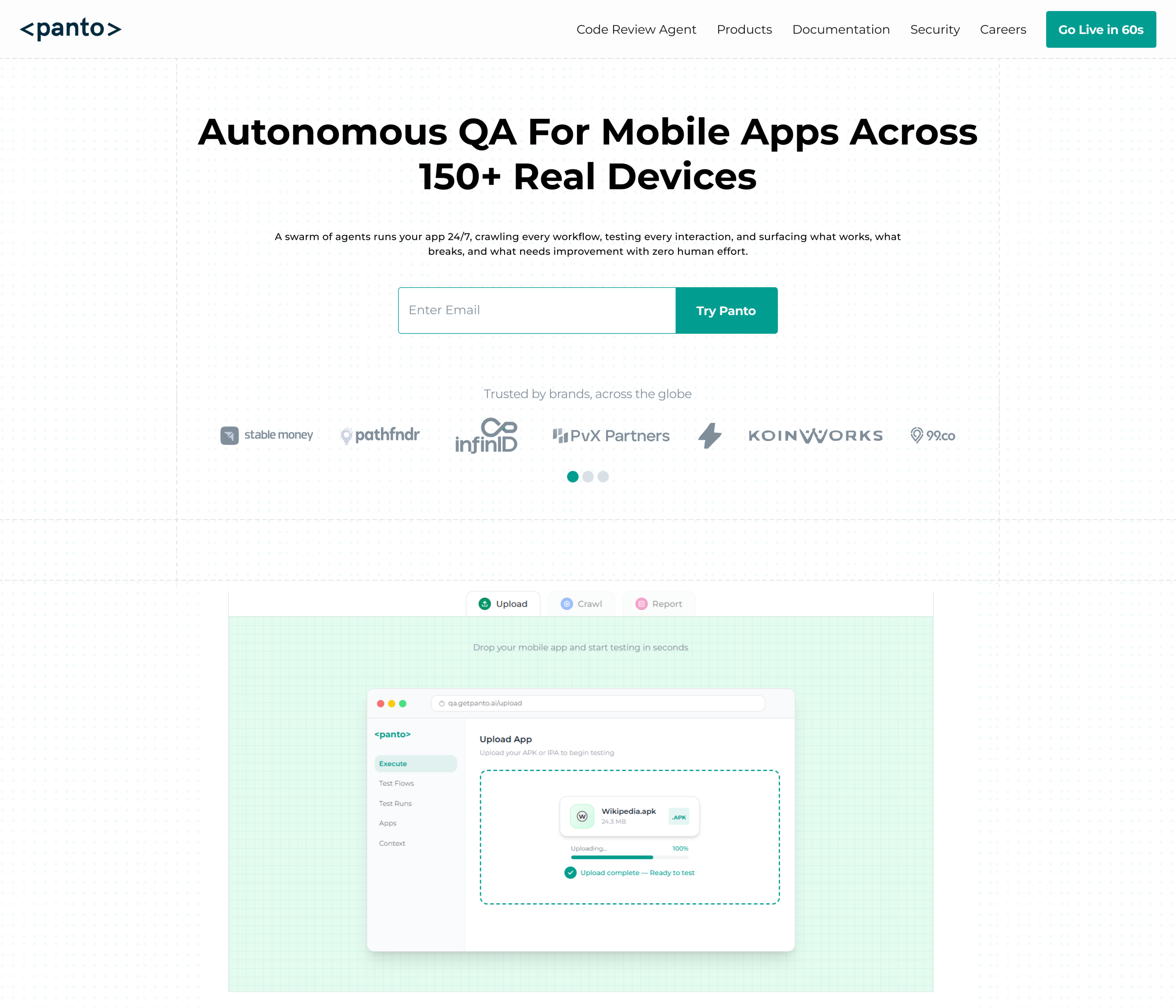
Panto AI is an AI-native mobile QA platform built around real device execution at scale. Test parallelization here is handled natively across a fleet of over 150 real Android and iOS devices, rather than bolted on as a separate configuration layer.
Because tests are generated and maintained with self-healing automation, parallel runs stay stable even as the app changes between releases, which is often where parallelized suites quietly start failing for unrelated reasons.
Key Features
- Parallel execution across 150+ real devices out of the box
- Self-healing test maintenance that keeps parallel runs stable through UI changes
- AI-powered root cause analysis to separate real failures from environment noise
- Native CI/CD integration with GitHub Actions, GitLab, Bitrise, and Jenkins
- Appium and Maestro script export for teams needing portable test code
How It Helps With Mobile Test Parallelization
Panto distributes test runs across its real device fleet automatically, so teams do not need to manually configure device pools or manage queueing logic themselves.
Benefits
- Removes the manual setup typically required to parallelize across real devices
- Self-healing reduces the false failures that often appear at scale in parallel runs
- Root cause analysis speeds up triage when multiple parallel tests fail together
Limitations
- Built specifically for mobile, not a fit for teams needing web parallelization in the same tool
- Teams with heavily customized Appium grids will need time to migrate
Price: Free for open source projects with unlimited PR reviews. Paid plans scale with device usage and team size, available on request.
2. BrowserStack App Automate
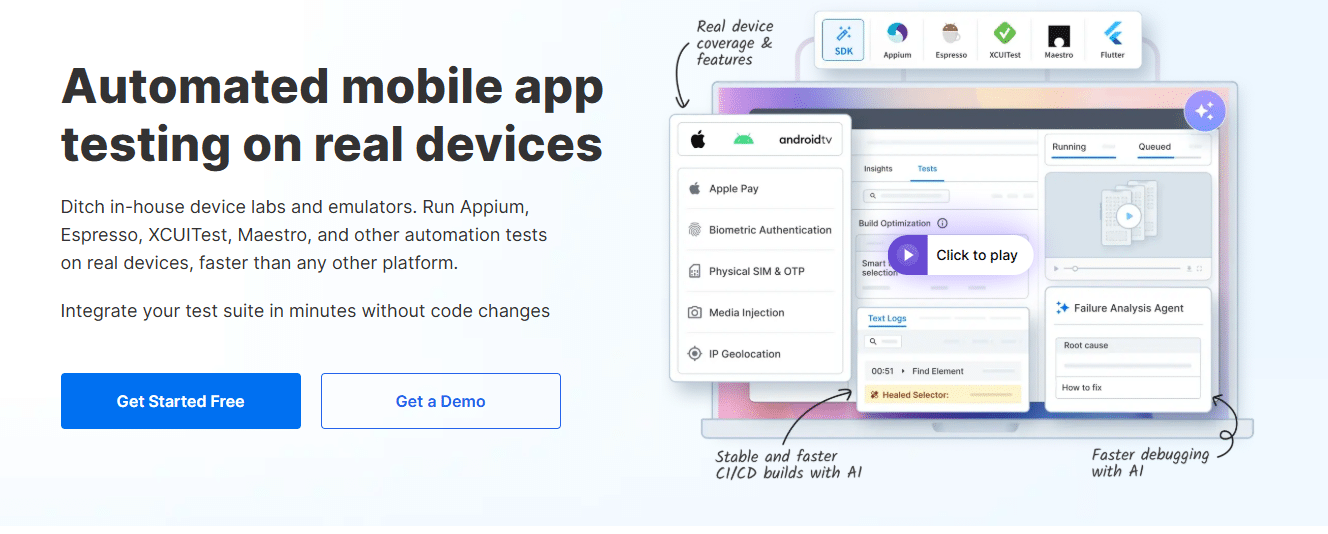
BrowserStack is one of the most established real device cloud platforms, and its App Automate product is built to run large numbers of mobile test sessions in parallel.
It supports Appium, Espresso, and XCUITest, making it a common fit for teams with existing automation frameworks.
The platform’s device inventory is large enough that most teams rarely hit queueing delays, even during high-traffic CI windows.
Key Features
- Parallel test execution across thousands of real device and OS combinations
- Native support for Appium, Espresso, and XCUITest frameworks
- Detailed video, log, and network capture for every parallel session
- Integration with Jenkins, GitHub Actions, CircleCI, and Bitbucket Pipelines
- Local testing support for apps behind firewalls or in staging environments
How It Helps With Mobile Test Parallelization
BrowserStack allocates real devices dynamically across parallel sessions, letting teams scale from a handful of concurrent tests to hundreds without managing physical infrastructure.
Benefits
- Large device inventory minimizes queueing during peak CI usage
- Framework flexibility supports teams already invested in Appium or native frameworks
- Strong observability makes debugging failures across parallel runs faster
Limitations
- Costs scale quickly with high parallel session counts
- Advanced configuration options can require real onboarding time for new teams
Price: Plans based on parallel session count and device minutes, available on request.
3. Sauce Labs
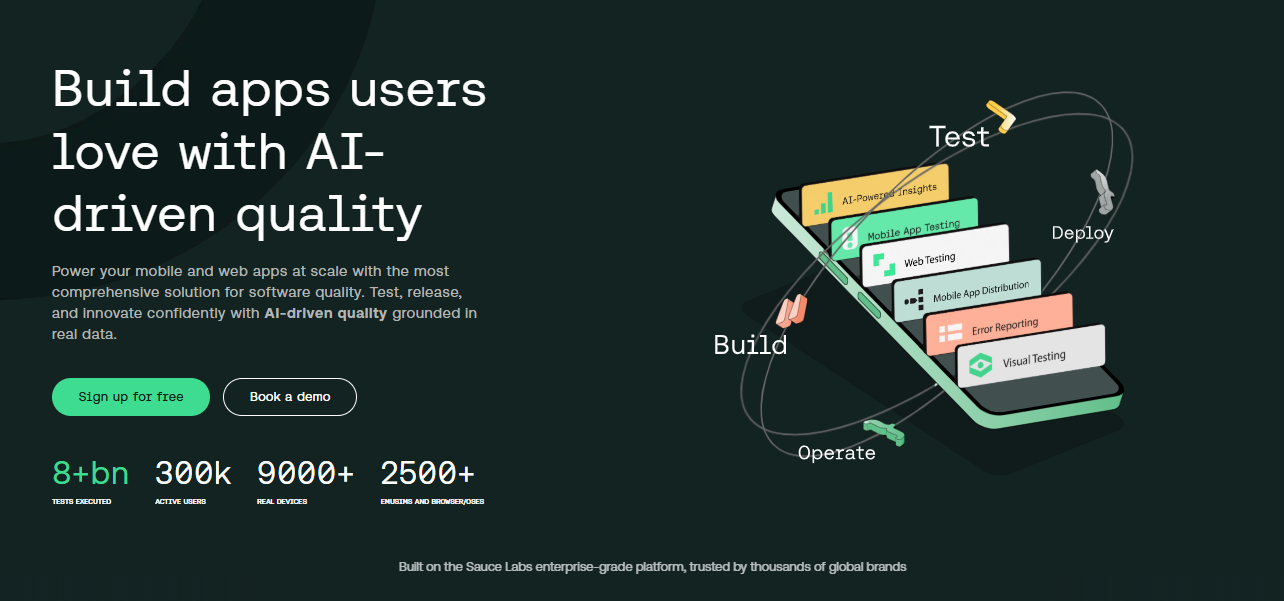
Sauce Labs positions itself around enterprise-scale parallel execution, capable of running hundreds of test sessions simultaneously across real and virtual mobile devices.
It is often the choice for larger organizations with compliance or governance requirements alongside raw execution speed.
A private cloud option is available for teams that need dedicated infrastructure rather than shared device pools.
Key Features
- Parallel execution across hundreds of simultaneous device sessions
- Real and virtual device options within the same platform
- Private cloud deployment for compliance-heavy organizations
- Integration with Azure DevOps and most major CI/CD pipelines
- Detailed session analytics and failure investigation tooling
How It Helps With Mobile Test Parallelization
Sauce Labs’ infrastructure is built to absorb large parallel loads without meaningful queue time, which matters most for enterprise suites running thousands of tests per build.
Benefits
- Handles very high parallel session volumes reliably
- Private cloud option supports strict compliance and security needs
- Strong fit for enterprise teams already using Azure DevOps
Limitations
- Contact-only pricing makes early cost estimation harder than competitors with public rates
- Debugging tooling is less developed than some newer, AI-native competitors
Price: Enterprise pricing available on request, no public pricing tier.
4. LambdaTest HyperExecute
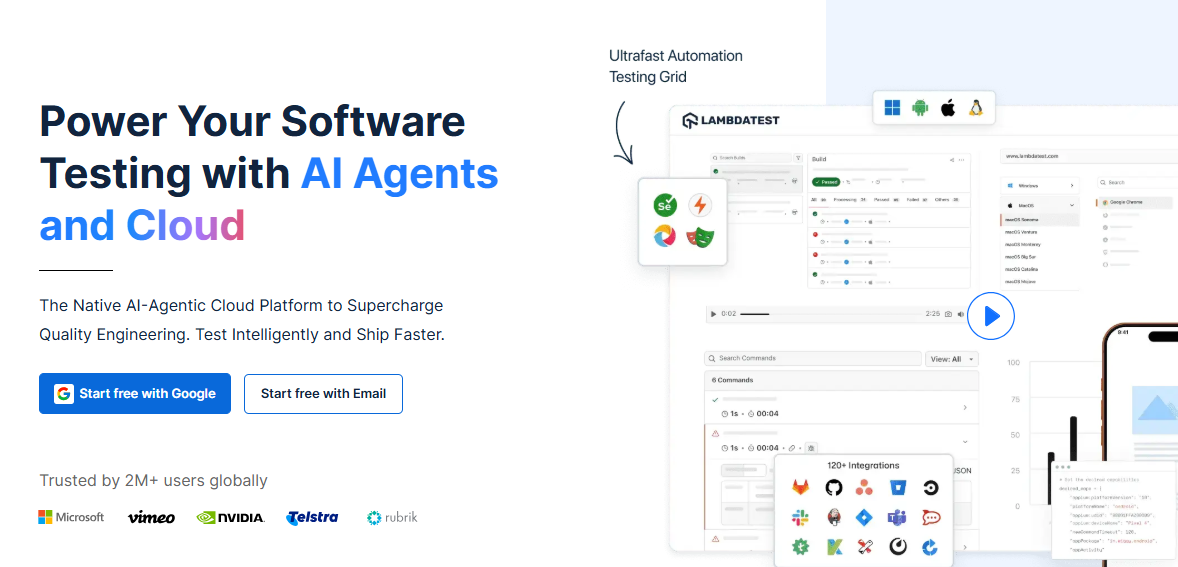
LambdaTest’s HyperExecute platform is built specifically around optimizing how parallel test suites get distributed, rather than just offering raw parallel capacity.
It analyzes a test suite and determines an execution strategy designed to minimize total run time.
This makes it particularly relevant for teams whose CI bottleneck is specifically suite execution time rather than device availability.
Key Features
- AI-driven analysis of test suites to optimize parallel distribution
- Real-time monitoring and notifications during active parallel runs
- Integration with Google Cloud, GitHub, GitLab, and Bitbucket
- Support for Appium-based mobile test frameworks
- Smart test orchestration to reduce redundant execution
How It Helps With Mobile Test Parallelization
LambdaTest’s HyperExecute reorders and distributes test execution intelligently across available resources, aiming to cut total wall-clock time rather than simply running more tests at once.
Benefits
- Directly targets execution time as the optimization goal, not just parallel count
- Broad CI/CD integration options across major platforms
- Real-time visibility into active parallel sessions
Limitations
- Performance can degrade on very large-scale mobile test runs
- Less mature real device inventory compared to BrowserStack or Sauce Labs
Price: Usage-based pricing tied to test execution minutes, available on request.
5. Firebase Test Lab
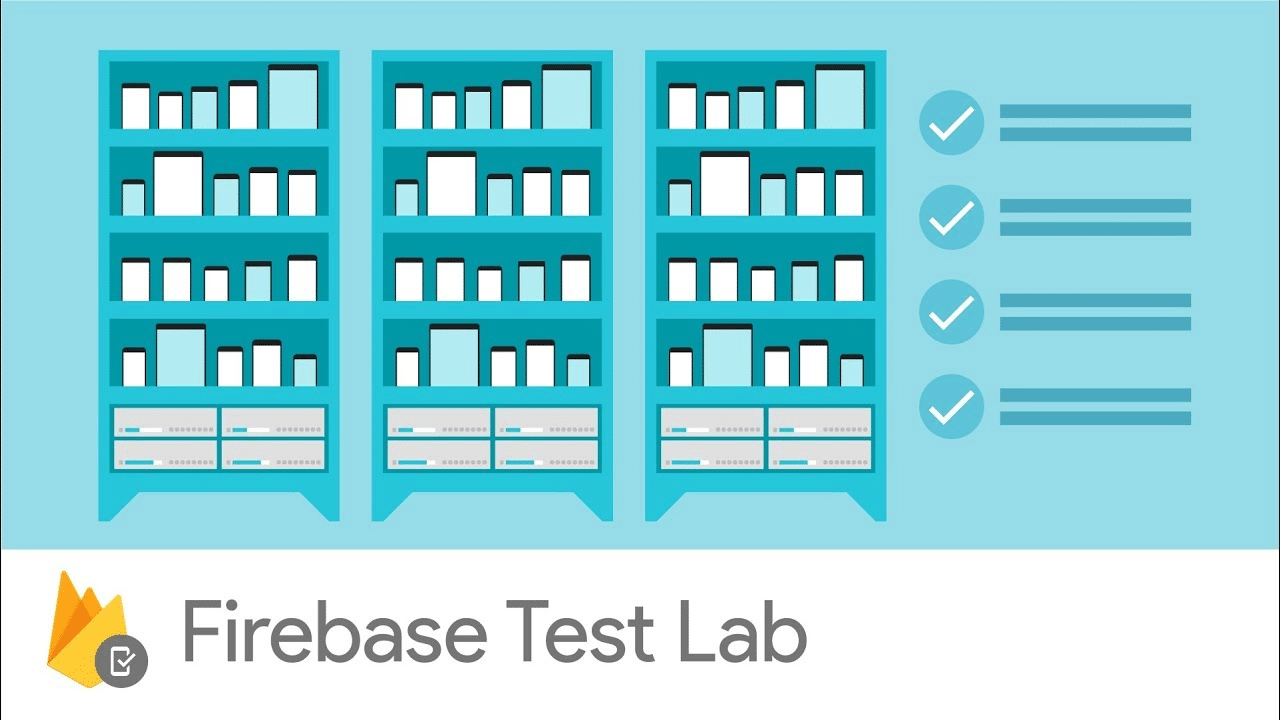
Firebase Test Lab is Google’s cloud-based mobile testing infrastructure, built around running tests across a matrix of real and virtual Android and iOS devices in parallel.
It is a natural fit for teams already inside the Google Cloud and Firebase ecosystem.
Matrix testing lets teams define device, OS, and locale combinations once, and Test Lab handles distributing runs across all of them simultaneously.
Key Features
- Matrix testing across multiple device, OS, and locale combinations
- Native integration with Android Studio and Firebase CI workflows
- Support for Espresso, XCUITest, and instrumented test frameworks
- Automatic crash and performance reporting per parallel run
- Pay-per-use pricing tied directly to test matrix size
How It Helps With Mobile Test Parallelization
Test Lab runs a defined matrix of device and OS combinations concurrently, so a single test definition automatically becomes dozens of parallel executions without extra configuration.
Benefits
- Deep, native integration for teams already building on Firebase or Google Cloud
- Matrix testing removes manual device combination setup
- Pay-per-use pricing keeps costs predictable for smaller suites
Limitations
- Less flexible outside the Google Cloud and Firebase ecosystem
- Real device selection is narrower than dedicated device cloud vendors
Price: Pay-per-use pricing based on device testing minutes, with a limited free tier.
6. Kobiton
Kobiton is a mobile-first device cloud built around real device access, with parallel execution as a core part of its infrastructure rather than an add-on.
Its focus stays specifically on mobile, without spreading coverage across web or desktop testing.
The platform also supports connecting a team’s own internal device lab into its parallel execution scheduling, which is less common among cloud-only competitors.
Key Features
- Parallel execution across Kobiton’s real device cloud
- Support for connecting private, on-premise device labs into the same scheduler
- Native gesture and multi-touch support for complex mobile interactions
- Appium script compatibility for existing automation suites
- Visual test reporting with screenshots and session video
How It Helps With Mobile Test Parallelization
Kobiton schedules parallel sessions across both its cloud device inventory and any connected private devices, giving teams flexibility in how they scale execution.
Benefits
- Hybrid cloud and private device scheduling is a genuine differentiator
- Mobile-only focus means deeper support for native gesture testing
- Appium compatibility eases migration for existing suites
Limitations
- Smaller overall device inventory than the largest cloud vendors
- Feature set outside of execution and reporting is narrower than full-suite platforms
Price: Plans based on device access and parallel session count, available on request.
7. pCloudy
pCloudy runs mobile tests on real devices hosted in its own cloud, with parallel execution built to scale across that device matrix directly.
It emphasizes zero local setup, since both device access and execution happen entirely in pCloudy’s infrastructure.
Network condition simulation is available per session, which matters for teams that need to test parallel runs under varying connectivity, not just varying devices.
Key Features
- Parallel test execution across real cloud-hosted devices
- Network condition simulation per parallel session
- Support for Appium-based scripted and codeless test creation
- Visual testing and screenshot comparison across parallel runs
- CI/CD integration with major pipeline tools
How It Helps With Mobile Test Parallelization
pCloudy allocates real devices from its cloud pool to run tests concurrently, letting teams scale parallel execution without owning or maintaining physical device infrastructure.
Benefits
- No local device lab needed to start running tests in parallel
- Network simulation adds a realistic testing dimension beyond device coverage
- Works with both scripted and codeless test creation approaches
Limitations
- Cloud device costs can accumulate quickly at high parallel volumes
- Device inventory is smaller than the largest enterprise cloud vendors
Price: Tiered plans based on device minutes and parallel session count, available on request.
8. Katalon TestOps
Katalon TestOps is the orchestration layer built on top of Katalon’s broader testing platform, focused specifically on managing and scaling parallel test execution across environments.
It sits above individual test creation, handling scheduling, distribution, and reporting for large suites.
This makes it more of a coordination tool than a device cloud itself, often paired with a separate device provider for actual mobile execution.
Key Features
- Test orchestration and scheduling across parallel execution environments
- Centralized reporting and analytics across distributed test runs
- Integration with Katalon Studio for mobile, web, and API test creation
- CI/CD pipeline integration for automated parallel triggering
- Role-based access control for team-level governance
How It Helps With Mobile Test Parallelization
TestOps coordinates how and when parallel mobile test runs execute across connected environments, giving teams centralized visibility rather than scattered logs across separate tools.
Benefits
- Strong fit for teams managing parallel execution across many environments at once
- Centralized reporting simplifies debugging large parallel test runs
- Governance features suit larger, multi-team organizations
Limitations
- Requires pairing with a device provider for actual mobile execution
- Adds a layer of complexity smaller teams may not need
Price: Plans based on team size and execution volume, available on request.
9. Appium Grid
Appium Grid is the open source approach to mobile test parallelization, distributing test sessions across multiple Appium server nodes.
It gives teams full control over their execution infrastructure without recurring cloud device costs.
Because it is self-hosted, the actual parallel capacity depends entirely on how much physical or virtual device infrastructure a team is willing to maintain.
Key Features
- Open source, self-hosted parallel test distribution
- Full control over node configuration and device allocation
- Compatible with existing Appium-based test suites
- No licensing cost beyond infrastructure and maintenance
- Flexible integration with any CI/CD system through standard Appium hooks
How It Helps With Mobile Test Parallelization
Appium Grid distributes incoming test sessions across configured nodes, letting teams run tests concurrently on whatever device or emulator infrastructure they have connected.
Benefits
- No per-session or per-device cloud costs
- Full control over infrastructure and data handling
- Works directly with existing Appium test suites without rewrites
Limitations
- Requires significant setup and ongoing infrastructure maintenance
- Scaling parallel capacity means physically adding device or emulator resources
Price: Free and open source, though physical or cloud infrastructure costs apply.
10. Bitrise
Bitrise is a mobile-focused CI/CD platform with parallelization built into its build and test pipeline rather than offered as a separate product.
Teams can split test suites across parallel build steps directly within their existing Bitrise workflow.
Its mobile-specific focus means pipeline configuration accounts for mobile build quirks, like code signing and app packaging, that general-purpose CI tools often handle less smoothly.
Key Features
- Parallel test step execution within mobile-specific CI pipelines
- Native handling of mobile build concerns like code signing and packaging
- Integration with third-party device cloud providers for execution
- Build and test analytics tracked across parallel pipeline runs
- Wide library of pre-built pipeline steps for mobile workflows
How It Helps With Mobile Test Parallelization
Bitrise splits test execution across parallel pipeline steps as part of the CI workflow itself, reducing total build time without requiring a separate orchestration tool.
Benefits
- Parallelization built directly into the CI pipeline rather than bolted on separately
- Mobile-specific pipeline handling reduces build configuration friction
- Wide step library speeds up initial pipeline setup
Limitations
- Actual device execution still depends on pairing with a device cloud provider
- Parallel capacity is tied to Bitrise’s own build concurrency limits and plan tier
Price: Free tier available for small teams. Paid plans scale with build concurrency and minutes.
Comparison of Best Mobile Test Parallelization Tools
| Tool | Best For | Parallelization Approach | Real Device Support | Pricing Model |
|---|---|---|---|---|
| Panto AI | AI-native mobile QA with self-healing | Native across 150+ real devices | Yes | Free tier, usage-based |
| BrowserStack App Automate | Large-scale real device parallel execution | Dynamic device allocation | Yes, large inventory | Quote-based |
| Sauce Labs | Enterprise-scale parallel execution | Hundreds of simultaneous sessions | Real and virtual | Enterprise, quote-based |
| LambdaTest HyperExecute | Optimizing execution time, not just count | AI-driven distribution strategy | Yes | Usage-based |
| Firebase Test Lab | Teams on Google Cloud or Firebase | Matrix testing across combinations | Real and virtual | Pay-per-use, free tier |
| Kobiton | Hybrid cloud and private device scheduling | Cloud plus connected private devices | Yes | Quote-based |
| pCloudy | Zero-setup cloud parallel execution | Cloud device pool allocation | Yes | Tiered, usage-based |
| Katalon TestOps | Orchestrating parallel runs across environments | Scheduling and coordination layer | Requires device provider | Quote-based |
| Appium Grid | Full control, no cloud costs | Self-hosted node distribution | Depends on infrastructure | Free, open source |
| Bitrise | Parallelization inside mobile CI pipelines | Parallel build steps | Requires device provider | Free tier, paid plans |
How To Choose The Right Parallelization Tool For Your Team
Start with where your bottleneck actually is. If it is device availability, prioritize large real device clouds like BrowserStack or Sauce Labs.
If the bottleneck is execution strategy rather than device count, LambdaTest HyperExecute is built specifically to optimize how tests get distributed.
Teams already inside the Google ecosystem get the most value from Firebase Test Lab, since matrix testing removes manual combination setup entirely.
For teams wanting parallel execution with minimal ongoing maintenance and self-healing built in, Panto AI removes the infrastructure question entirely by handling device allocation natively.
Budget-conscious teams with strong internal infrastructure skills can run Appium Grid for free, accepting the tradeoff of managing their own device or emulator pool.
Conclusion
Mobile test parallelization is no longer optional for teams shipping regularly, it is the difference between a CI pipeline that supports fast releases and one that quietly slows every merge down.
The right tool depends on whether your constraint is device availability, execution strategy, or ongoing maintenance overhead.
Teams evaluating these options should weigh real device inventory size, how execution is distributed, and how much manual setup the platform actually removes, not just whether parallel testing is technically supported.
FAQs
Q: What is mobile test parallelization?
A: Mobile test parallelization is the practice of running multiple tests, or the same test across multiple devices and OS versions, simultaneously instead of one after another. By distributing execution across several devices, teams can dramatically reduce test runtime and accelerate release cycles.
Q: How much faster is parallel mobile testing than sequential testing?
A: It depends on your test suite and available devices, but parallel execution can reduce test time from hours to minutes. The biggest gains come from running tests across multiple devices, operating systems, and configurations at the same time.
Q: Do I need a real device cloud to parallelize mobile tests?
A: No. You can parallelize tests on self-hosted infrastructure using tools like Appium Grid. However, most teams choose cloud device platforms because they provide instant access to large device fleets without the cost and maintenance of managing physical hardware.
Q: Does parallel testing increase flaky test rates?
A: It can if tests share data, environments, or resources across concurrent sessions. Proper test isolation, independent test data, and self-healing automation significantly reduce the risk of flaky failures during parallel execution.
Q: Which mobile testing frameworks support parallel execution?
A: Appium, Maestro, Espresso, XCUITest, and Detox all support parallel execution, either natively or through supporting infrastructure such as Appium Grid or cloud device farms. Most commercial testing platforms also provide built-in parallelization across real Android and iOS devices.
Q: When should I start using mobile test parallelization?
A: Parallelization becomes valuable once your regression suite begins slowing development or delaying releases. If developers regularly wait for test results before merging code or shipping builds, running tests in parallel is one of the fastest ways to improve CI/CD performance.