

AI-powered code compliance checking has become non-negotiable for engineering teams in 2026. Traditional manual code reviews simply cannot keep pace with the volume and velocity of modern development cycles.
The convergence of rapid AI-assisted code generation and stricter code compliance requirements means development teams face an unprecedented challenge: ship faster without sacrificing security or regulatory adherence.
The market has responded with intelligent automation that combines static analysis engines, reinforcement learning, and contextual awareness to catch bugs, security vulnerabilities, and compliance violations before they reach production.
What separates leading solutions from the rest is how well they align code changes with business context, reduce false positives that waste developer time, and integrate seamlessly into existing workflows without friction.
What Are Compliance-as-Code Tools?
Compliance as code (CaC) is the practice of encoding regulatory and internal policy requirements directly into automated checks within your CI/CD pipeline, so compliance becomes a continuous, verifiable process rather than a periodic audit.
Traditional compliance workflows rely on manual reviews, quarterly audits, and checklist-driven sign-offs. These approaches cannot scale with modern development velocity. When a team ships dozens of pull requests per day, manual compliance checks become a bottleneck.
AI-powered compliance-as-code platforms take this further by using machine learning to interpret policy intent, not just pattern-match against static rules. This means:
- Policies are version-controlled alongside application code
- Every PR is automatically checked against regulatory frameworks (SOC 2, HIPAA, PCI-DSS, OWASP) before merging
- Violations are flagged in real time, in the developer’s existing workflow — not in a separate compliance dashboard
- Audit trails are generated automatically for every change, eliminating manual evidence collection
- AI models adapt to your team’s specific standards over time, reducing false positives
The best compliance-as-code tools in 2026 blur the line between code quality enforcement and regulatory compliance — making both the responsibility of every developer, not just a security or compliance team.
Continuous Automated Code Compliance Audits: What to Look For
A continuous audit tells you where you stand right now. The shift to continuous compliance auditing is one of the most important changes in how engineering teams manage regulatory risk in 2026. Here’s what separates a true continuous audit capability from basic scanning:
1. PR-Triggered vs. Scheduled Scans
Scheduled scans (nightly or weekly) introduce a compliance gap, in the form of code that fails a policy check may already be in production before the scan runs. PR-triggered scanning enforces compliance at the point of merge, before any non-compliant code ever reaches your main branch.
2. Audit Trail Generation
A continuous audit is only as useful as the evidence it produces. Look for platforms that automatically generate timestamped, tamper-resistant logs of every scan result, reviewer decision, and merge action.
3. OWASP Top 10 & Regulatory Framework Mapping
The best platforms map detected issues directly to regulatory frameworks and not just to internal severity scores. When a finding is mapped to OWASP Top 10, PCI-DSS Requirement 6, or HIPAA Security Rule §164.312, compliance teams can use scan results directly as audit evidence without manual translation.
4. Baseline Analysis
Introducing a compliance tool to an existing codebase often surfaces hundreds of historical issues. Platforms with baseline analysis ensure that developers focus only on new violations introduced in each PR, rather than being overwhelmed by legacy technical debt.
12 Best Platforms to explore for Code Compliance
1. Panto AI: Context-Aligned Code Intelligence
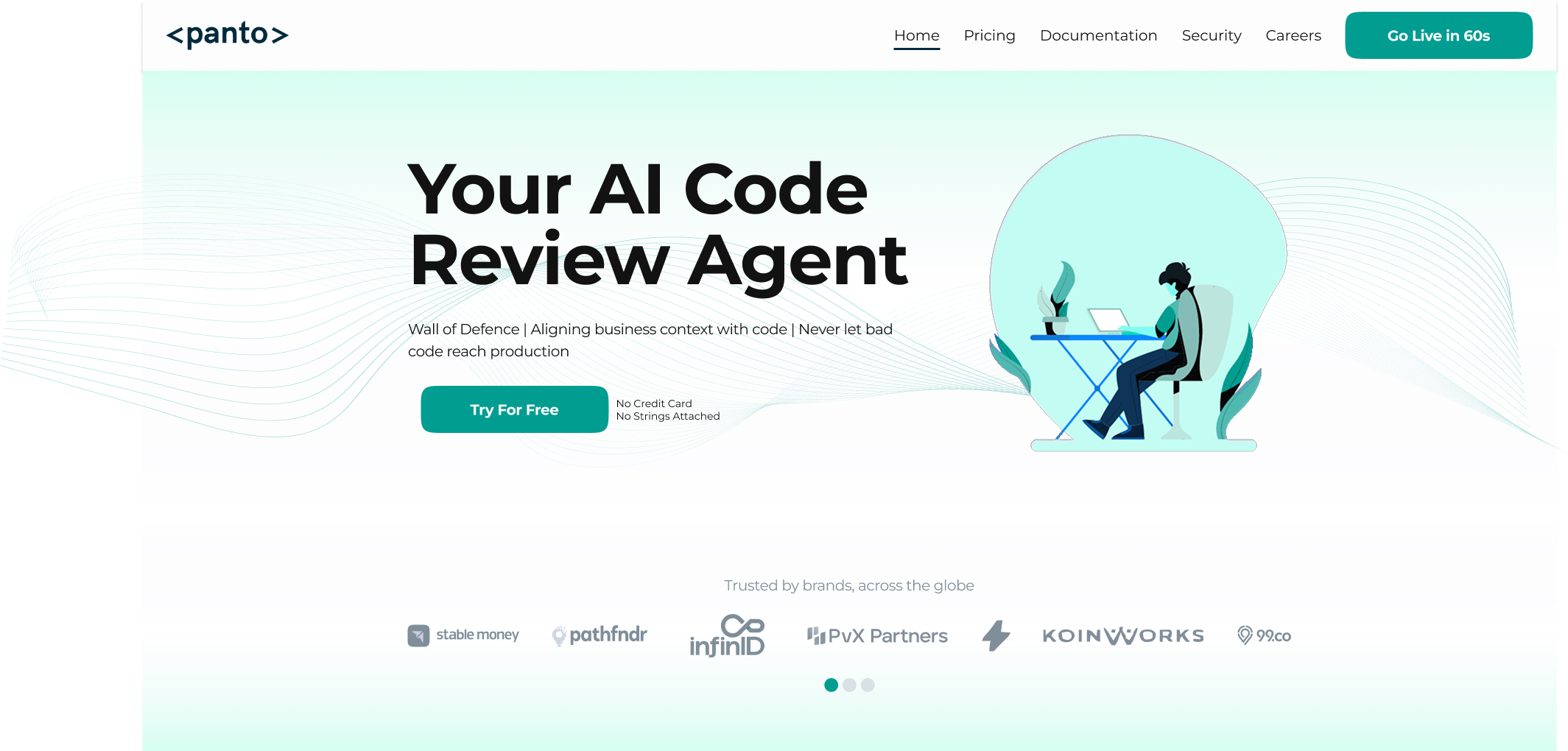
Panto AI stands out as the intelligent bridge between code quality and business alignment. Unlike traditional code review tools that focus purely on syntax and security patterns, Panto AI integrates proprietary AI aligned with your business context from Jira and Confluence.
Every PR review happens in the context of your actual business requirements, not in isolation. The platform excels at generating automated PR summaries in seconds across GitHub, GitLab, and Bitbucket.
Enterprise-Level Compliance
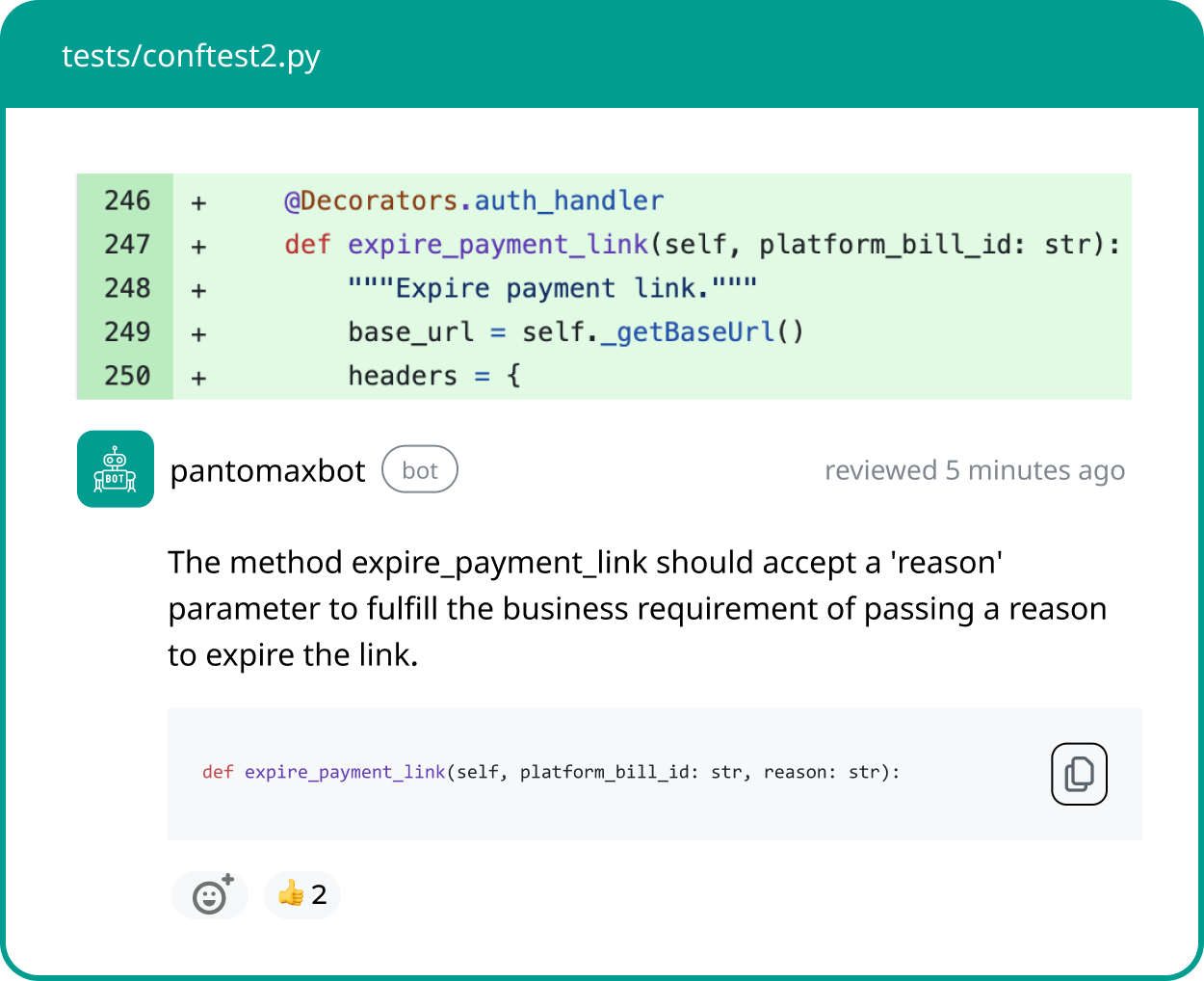
Panto’s PR chat feature allows developers to reply directly to Panto’s comments, turning code review into a conversation rather than one-way feedback. The platform reviews code across 30+ languages, reducing noise dramatically.
Panto AI’s “Wall of Defense” approach ensures bad code never reaches production. With CERT-IN compliance certification, zero code retention policies, and on-premise compatibility, it addresses the strictest enterprise security requirements.
The platform is trusted by 500+ developers managing 5 million+ lines of code, proving its reliability at scale and delivering consistent enterprise-grade performance across diverse teams.
Best For
Enterprise teams requiring business-context alignment and regulatory compliance without compromising developer experience.
2. Qodo: Agentic Code Review
Qodo redefines code review through multi-agent automation. Rather than treating each pull request as an isolated artifact, Qodo operates as a persistent Codebase Intelligence Engine that understands how changes interact across your entire system.
This allows detection of breaking changes, architectural drift, and code duplication whether a change affects one repository or a thousand, making it ideal for distributed engineering organizations.
Automated Workflow Intelligence
The platform runs automated PR workflows that replicate what senior engineers typically perform manually: security posture validation, CI signal assessment, test impact analysis, schema compatibility checks, cross-repository usage detection, and compliance requirement enforcement.
When violations are detected, Qodo generates remediation patches aligned with existing code conventions, enabling one-click fixes rather than extended comment threads and accelerating resolution significantly.
Qodo’s context engine and 15+ automated PR workflows set it apart for complex organizations. The platform supports on-premise deployment, VPC options, and offers zero-retention SaaS with SOC2 and GDPR compliance certifications.
Best For
Large organizations with complex codebases requiring deep architectural understanding and automated code compliance enforcement.
3. Bito: Codebase-Aware PR Reviews
Bito delivers the speed competitive development demands. Teams using Bito report 89% faster merge times and 34% reduction in regressions—KPIs that translate directly to shorter time-to-market and improved stability.
The AI code review agent examines every line with codebase awareness, meaning it understands your project’s specific patterns, conventions, and architecture for highly contextual feedback.
Smart Review and Customization
Integration with GitHub, GitLab, Bitbucket, and Azure DevOps is seamless. The platform runs static analysis using built-in OWASP and OSS checks, identifies issues and bugs, and provides smart suggestions with clear priority ratings for effort and quality.
Developers can customize code reviews by providing guidelines that enforce best practices, and the system dynamically learns from accepted suggestions to improve over time and adapt to team standards.
Bito’s conversational interface lets teams execute actionable commands that convert code review discussions into ready-to-apply changes. Deployment options include cloud-hosted or on-premises Docker containers for strict data residency requirements.
Best For
GitHub and GitLab-native teams wanting rapid PR cycles with minimal setup overhead.
4. CodeAnt AI: One-Click Fixes
CodeAnt AI cuts code review time by 50% through intelligent automation. This YC-backed platform performs line-by-line code reviews across 30+ languages using a proprietary language-agnostic AST engine.
Every pull request receives AI analysis that summarizes changes, detects code quality issues, identifies application security vulnerabilities (SAST), spots infrastructure misconfigurations (IaC), and scans for exposed secrets, keys, and tokens.
Automated Remediation Engine
The differentiator is immediate remediation. Where traditional scanners like SonarQube flag issues, CodeAnt AI automatically generates one-click fixes aligned with your codebase patterns and conventions.
The platform supports custom company policies defined in plain English rather than complex configuration files. Infrastructure-as-Code security scanning catches misconfiguration risks across Docker, Terraform, and Kubernetes manifests.
CodeAnt AI is trusted by Fortune 1000 companies and mid-market teams alike. It maintains minimal false positives while supporting 30+ coding languages natively with SOC 2 and ISO 27001 compliance certifications.
Best For
Enterprise teams with high-security requirements seeking automated, actionable feedback without manual intervention.
5. SonarQube: Open-Source Foundation
SonarQube remains the gold standard for code quality platforms combining maintainability analysis with security testing. The Community Edition provides comprehensive static analysis at zero cost, while enterprise editions add advanced security features.
SonarQube analyzes code across 35+ programming languages, detecting bugs, vulnerabilities, code smells, and technical debt with customizable quality gates that block merges until standards are met.
Integration and Customization Depth
The platform integrates seamlessly into CI/CD pipelines and IDEs, providing real-time feedback during development. Quality gates can enforce minimum criteria around code coverage, linting thresholds, and security standards.
Recent updates expanded SonarQube’s Advanced Security offering to include software composition analysis (SCA) and secrets detection alongside traditional SAST capabilities and vulnerability scanning.
SonarQube excels at tracking historical trends and technical debt over time. Monorepo support enables consistent code quality standards across hundreds of repositories with custom rules for domain-specific best practices.
Best For
Open-source projects and organizations wanting to build their code quality foundation on proven, community-backed infrastructure.
6. Veracode: Analysis for Enterprise Security
Veracode stands alone in its binary analysis capability, scanning compiled code without requiring source code access. This makes it essential for enterprises using third-party components or legacy systems where source availability is limited.
The platform supports 100+ programming languages and frameworks with industry-leading accuracy—false positive rates below 1.1% mean developers focus on real vulnerabilities, not noise and alert fatigue.
Enterprise-Grade SAST Solutions
The platform achieves median scan times of just 90 seconds, enabling rapid feedback during development. Veracode SAST integrates into the IDE, repository, and CI/CD pipeline at multiple stages for comprehensive coverage.
IDE scanning provides immediate developer feedback, Pipeline scanning enables build-time validation, and Policy scanning delivers comprehensive pre-deployment analysis with expert remediation guidance.
Enterprise features include centralized policy management across multiple business units, detailed security audit trails, and comprehensive code compliance reporting for regulated industries like finance, healthcare, and government.
Best For
Financial services, healthcare, and government organizations requiring binary analysis, low false positives, and comprehensive compliance documentation.
7. Snyk Code: Developer-First Speed
Snyk Code represents a paradigm shift toward developer experience. The platform delivers near real-time feedback in IDEs and CI/CD pipelines through a semantic scanning engine optimized for speed.
Independent benchmarks show Snyk Code is 5x faster than SonarQube and up to 106x faster than LGTM on identical codebases—a meaningful difference when developers are waiting for scan results in their development cycle.
AI-Generated Fixes and Easy Integration
The approach is fundamentally different from traditional SAST tools. Rather than complex tuning and configuration, Snyk Code works out of the box with minimal setup required to get started.
AI-generated fixes are 80% accurate, meaning developers can apply suggestions with confidence. The platform integrates IDE plugins that embed seamlessly into the developer workflow while maintaining security rigor.
Snyk Code combines pattern-based detection with data flow analysis, catching subtle injection flaws, authentication bypasses, and other high-risk patterns. Easy-to-understand data flow diagrams help developers understand the “why” behind findings.
Best For
DevOps teams and security-conscious development organizations prioritizing developer velocity without sacrificing security coverage.
8. GitHub CodeQL: Native Security
GitHub CodeQL eliminates tool sprawl for organizations already committed to GitHub’s ecosystem. The CodeQL analysis engine performs semantic code search by treating code as queryable data.
This allows precise detection of specific vulnerability patterns, and the community contributes thousands of verified queries for common attack vectors across web, mobile, and backend applications.
Integrated Security Capabilities
The platform offers three integrated security capabilities: CodeQL code scanning detects vulnerabilities using semantic queries, secret scanning spots hardcoded credentials and API keys before they reach production, and dependency review validates open-source components.
All three operate natively within GitHub’s PR workflow, requiring no external tooling or configuration. Push protection prevents secrets from being committed in the first place, triggering alerts to organization owners and security managers.
Recent GitHub Advanced Security updates include AI code assurance to validate AI-generated code quality before deployment, addressing the emerging challenge of securing AI-assisted development.
Best For
GitHub-native organizations wanting unified security without external tool dependencies.
9. DeepSource: AI-Powered Remediation
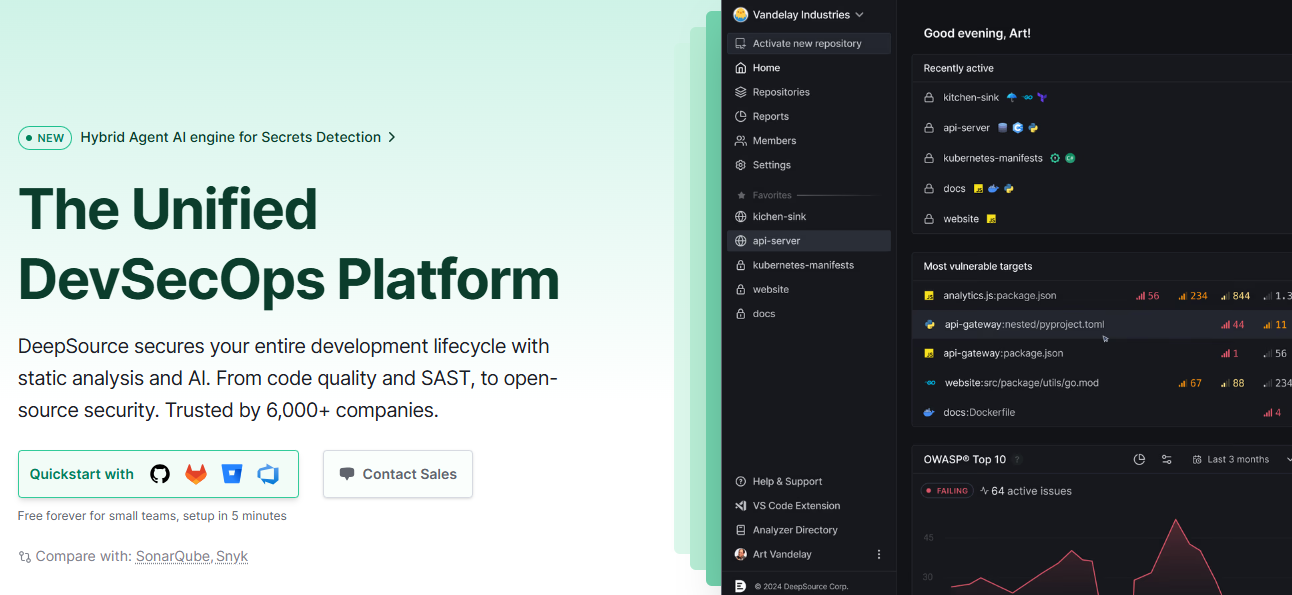
DeepSource prioritizes fixing issues faster than detecting them. The Autofix™ AI evolution moves beyond deterministic pattern matching to LLM-powered intelligence that generates thoughtful, idiomatic fixes.
Where legacy Autofix handled 30% of issues, Autofix™ AI addresses the vast majority, dramatically reducing manual remediation overhead and accelerating code quality improvement across teams.
Comprehensive Analysis and Integration
The platform detects 5,000+ code quality and security issues across multiple programming languages. Baseline analysis ensures developers focus only on new issues introduced in their PR, eliminating review of historical technical debt.
Automated code formatting runs on every commit, while issue suppression and metric thresholds let teams ignore false positives efficiently and focus on actionable improvements.
DeepSource’s first-class integrations with Jira, GitHub Issues, Slack, and Vanta automate workflow context. OWASP Top 10 reporting satisfies compliance requirements for regulated industries.
Best For
Quality-first organizations wanting to reduce time from issue detection to resolution through intelligent, LLM-powered automation.
10. Codacy: Enterprise Code Quality
Codacy delivers enterprise-grade automated code review focusing on code style, static analysis, duplication detection, and standards enforcement. The platform analyzes code across 40+ programming languages, transforming complex code metrics into actionable insights.
Real-time feedback triggers immediately when code is pushed, speeding iteration cycles significantly and keeping developers informed of code quality issues as they work.
Metrics-Driven Quality Management
Customizable quality gates let teams set minimum criteria for merging code, such as coverage or linting thresholds. Test coverage tracking identifies frequently changed files with inadequate test protection, helping teams prevent regression.
The DevOps intelligence system provides comprehensive visibility into technical debt across entire organizations. Teams can visualize how code quality evolves over time and identify patterns in technical debt accumulation.
Codacy’s strength lies in consistent metric tracking and trending over time. Integration with GitHub, GitLab, and Bitbucket ensures compatibility with existing workflows and existing source control systems.
Best For
Mid-sized teams wanting comprehensive code quality metrics, test coverage enforcement, and technical debt tracking across multiple repositories.
11. Code Climate Quality: Business-Aligned Metrics
Code Climate bridges the gap between technical metrics and business outcomes. Automated PR comments provide immediate feedback, while the platform’s 10-point technical debt assessment gives real-time feedback on code quality.
The focus on ROI-driven metrics resonates with engineering leadership needing to justify investments in code quality initiatives and demonstrate value to stakeholders and business executives.
Business-Focused Code Quality Communication
Test coverage tracking identifies which files change frequently but lack adequate test protection—high-risk areas prone to regression. The platform aggregates metrics into dashboards that communicate engineering effectiveness to product and business stakeholders.
This translation of technical metrics into business language often accelerates adoption and funding for quality initiatives. Code Climate’s automated code review workflow reduces manual overhead while maintaining consistency.
Integration with GitHub and GitLab provides visibility within PR workflows, making code quality checks part of the normal development process rather than a separate gate or afterthought.
Best For
Engineering organizations needing to demonstrate code quality ROI to business stakeholders through business-aligned metrics.
12. Aikido Security: Compliance Automation
Aikido Security attacks the compliance problem head-on. The platform delivers AI-driven SAST insights while automating compliance monitoring for SOC 2, GDPR, HIPAA, and ISO standards.
For regulated industries like healthcare and finance, audit readiness is a constant concern—Aikido generates exportable compliance reports automatically, reducing the burden of manual audit preparation.
AI-Driven Analysis and Compliance Automation
The AI-driven static code analysis quickly scans repositories for vulnerabilities, misconfigurations, and code quality issues at pre-commit and merge stages. Secrets detection spots hardcoded credentials and API keys before reaching production.
The continuous compliance monitoring removes the pain of manual audit preparation. Aikido achieves up to 95% noise reduction through advanced contextual analysis and learning-based prioritization.
Integration spans GitHub, GitLab, Azure DevOps, CircleCI, and standard CI/CD workflows. The predictable pricing model eliminates surprise costs as organizations scale code quality initiatives.
Best For
Regulated industries (healthcare, finance, fintech) requiring automated code compliance monitoring and audit-ready documentation alongside code security.
| Platform | Languages | False Positives | Compliance | Key Feature | Best For |
|---|---|---|---|---|---|
| Panto AI | 30+ | Ultra-low | SOC 2, GDPR, HIPAA | Business context, PR summaries | Enterprise teams |
| Qodo | 15+ | Very low | SOC 2, GDPR | Agentic workflows, context engine | Large codebases |
| Bito | All major | Low | ISO 27001 | 89% faster merges | GitHub/GitLab teams |
| CodeAnt AI | 30+ | Minimal | SOC 2, ISO 27001 | One-click fixes, IaC scanning | Fortune 1000 |
| SonarQube | 35+ | Moderate | Customizable | Code smells, quality gates | Open-source projects |
| Veracode | 100+ | <1.1% | OWASP standards | Binary analysis, 90 sec scans | Finance/Government |
| Snyk Code | Multiple | Very low | Multiple standards | 5x faster than competitors | DevOps teams |
| GitHub CodeQL | Popular langs | Low | Built-in GitHub | Native integration, queries | GitHub workflows |
| DeepSource | Multiple | Low | OWASP Top 10 | Autofix AI, 5000+ checks | Quality-first teams |
| Codacy | 40+ | Low | Customizable | Quality gates, tech debt | Mid-sized teams |
| Code Climate Quality | Popular langs | Moderate | Customizable | ROI metrics, PR comments | Measuring ROI |
| Aikido Security | Multiple | 95% reduction | SOC 2, GDPR, ISO, HIPAA | Secrets detection, compliance | Regulated industries |
AI Code Compliance Tools for Regulated Industries
Engineering teams in finance, healthcare, and government operate under regulatory frameworks that go far beyond standard software quality requirements.
A missed vulnerability or a non-compliant code change doesn’t just create technical debt, it can trigger regulatory penalties, breach notification obligations, or customer data exposure. The following platforms are purpose-built or well-suited for regulated environments:
Finance (PCI-DSS, SOC 2, ISO 27001)
Financial services teams face strict requirements around data handling, access control, and audit logging. The most important capabilities for this sector:
- Immutable audit trails for every code change and review decision
- PCI-DSS and SOC 2 compliance reporting built into the PR workflow
- Zero-code retention policies to ensure source code never leaves the organization’s environment
- Role-based access controls aligned with financial governance frameworks
Panto AI’s CERT-IN certification and on-premise deployment option make it well-suited for financial institutions that cannot send code to third-party cloud infrastructure. Veracode and Aikido also offer strong compliance reporting for finance teams.
Healthcare (HIPAA, HITECH)
Healthcare software teams must ensure that PHI (protected health information) is never exposed through application vulnerabilities. Key requirements:
- Automated detection of hardcoded credentials, secrets, and API keys that could expose patient data
- HIPAA-aligned audit logs documenting who reviewed what and when
- Static analysis coverage for common healthcare API vulnerabilities (FHIR, HL7 integrations)
- On-premise or private cloud deployment to satisfy BAA (Business Associate Agreement) requirements
Veracode is the most established choice for large health systems. Panto AI’s zero-code-retention policy and on-premise support also make it viable for healthcare engineering teams managing sensitive codebases.
Government & Defense
Government contractors and public sector engineering teams often operate under FISMA, FedRAMP, or NIST 800-53 frameworks. These environments require:
- On-premise or air-gapped deployment options
- FIPS 140-2 compliant cryptography in the scanning pipeline
- Detailed chain-of-custody audit logs for all code changes
- Support for custom security policies aligned with agency-specific standards
How AI Platforms Flag Noncompliant Code?
The best AI code compliance platforms don’t just scan and report, they actively flag noncompliant code at the PR level, preventing violations from ever merging into your main branch. Here’s how the leading approaches differ:
Inline PR Comments
Rather than generating a separate compliance dashboard, the most developer-friendly platforms surface violations directly inside the pull request interface, as inline comments on the specific lines that violate a policy. This keeps developers in their existing workflow and dramatically reduces the time between detection and remediation.
Merge Blocking
The strongest compliance enforcement mechanism is blocking non-compliant pull requests from merging until all violations are resolved. By enforcing policy gates directly within platforms such as GitHub, GitLab, and Bitbucket, organizations ensure that code failing security, regulatory, or internal governance checks cannot be promoted into protected branches.
Real-Time vs. Post-Commit Flagging
Some platforms flag issues within seconds of a PR being opened, keeping developers in flow. Others run deeper scans that take minutes but catch more complex violations. For compliance-focused teams, a combination of fast surface-level flagging and thorough deep scanning is the most effective approach.
Code Guideline Enforcement vs. Vulnerability Detection: Understanding the Difference
A common point of confusion when evaluating AI code compliance tools is the distinction between guideline enforcement and vulnerability detection. These are related but distinct capabilities, and the best platforms handle both.
Vulnerability Detection
Vulnerability detection focuses on security risks: exposed secrets and API keys, insecure dependencies (SCA), injection vulnerabilities, authentication weaknesses, and CVEs in third-party libraries. Tools like Snyk, Semgrep, and Veracode excel here. The output is a security finding mapped to a CVE or CWE identifier, with a severity score.
Code Guideline Enforcement
Guideline enforcement covers:
- Coding standards: naming conventions, file structure, comment requirements
- Architectural rules: layer separation, dependency direction, module boundaries
- Style consistency: formatting, indentation, import ordering
- Team-specific policies: custom rules encoding your organization’s internal standards
- Business requirement alignment: ensuring code changes match the intent of the Jira/Confluence spec they claim to implement
Panto AI as an Automated RL Verifier
Most AI code compliance tools use static rule engines. They match code patterns against a predefined list of violations. This approach is fast but brittle: it produces false positives when code is technically compliant but contextually fine, and it misses violations that don’t match known patterns.
Panto AI takes a fundamentally different approach: reinforcement learning (RL). Rather than relying on a fixed ruleset, Panto AI’s RL engine continuously improves its signal accuracy by learning from developer feedback, team-specific coding patterns, and business context from Jira and Confluence.
What This Means in Practice
- False positives decrease over time as the model learns which patterns are acceptable for your specific codebase and team
- Novel violations — patterns not in any static ruleset — are caught through contextual understanding rather than rule matching
- The platform adapts to regulatory changes without requiring manual rule updates
- Each organization’s instance improves independently, meaning the model becomes more accurate the longer your team uses it
In enterprise safety-critical environments, this RL verification capability means Panto AI functions as an automated verifier, continuously validating that every code change meets both technical compliance standards and business intent, and improving that validation over time.
Conclusion
The best AI-powered code compliance checking platform is the one that aligns with your regulatory requirements, development workflows, and engineering maturity.
Whether your organization is focused on protecting healthcare data under HIPAA, securing payment systems for PCI DSS, achieving SOC 2 attestation, or building an enterprise-wide information security program around ISO 27001, the right platform should operationalize compliance as part of everyday software delivery.
In 2026, compliance can no longer be treated as a periodic audit exercise or a final checkpoint before release. It must be embedded directly into the development lifecycle, where policies are continuously validated, risks are surfaced early, and audit evidence is generated automatically.
AI-powered code compliance tools make this possible by translating regulatory requirements into actionable engineering controls and enforcing them at scale.