

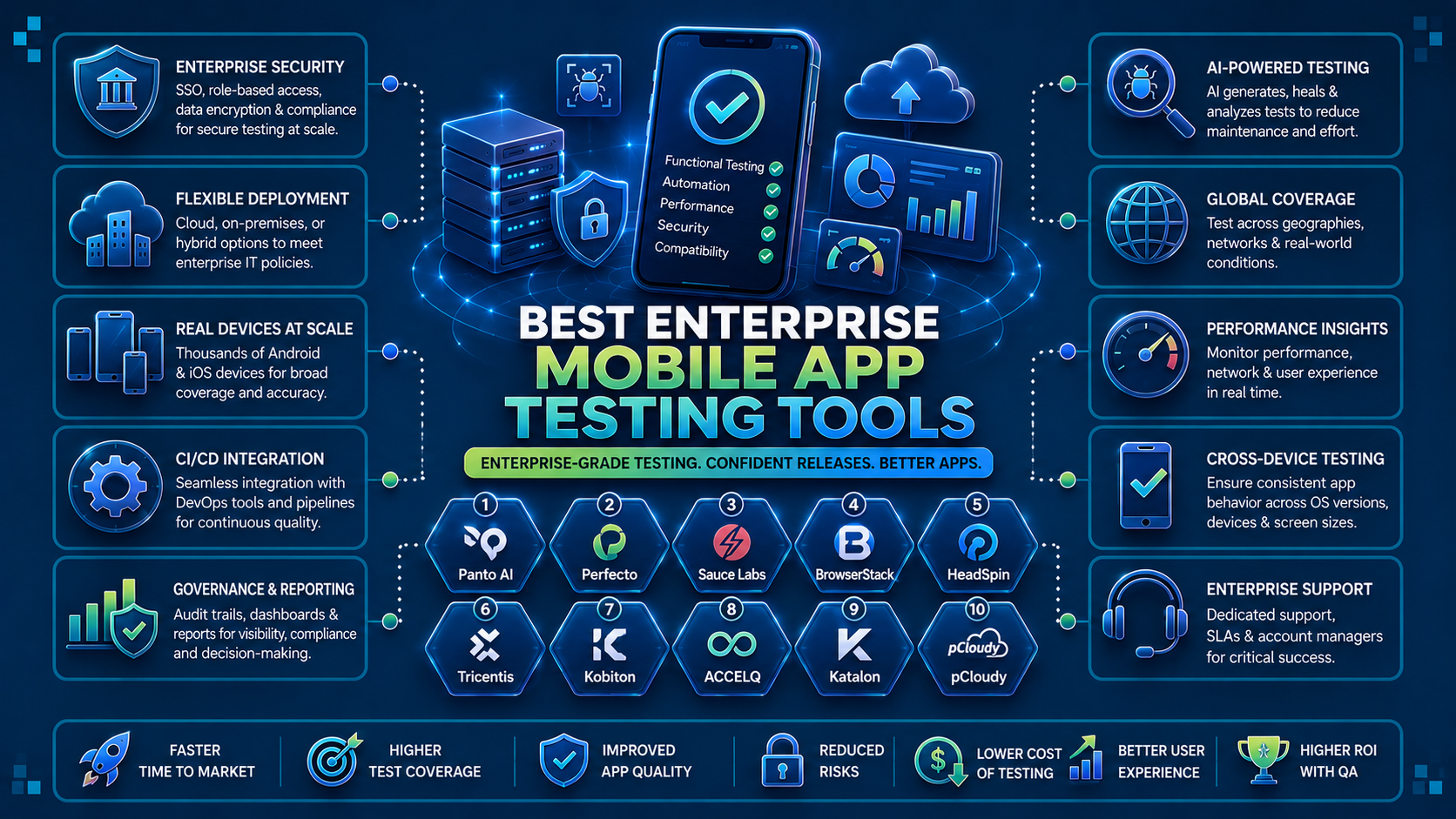

Enterprise mobile app testing is not just a larger version of startup mobile testing. The scale is different, the stakes are different, and the requirements around compliance, security, access control, and governance are entirely different.
An enterprise QA organization running hundreds of parallel tests across thousands of real devices, integrating with procurement-approved CI systems, and satisfying security reviews needs a platform built for that operational reality.
This guide covers the 10 best enterprise mobile app testing tools in 2026, what makes each one genuinely suited to enterprise-scale programs, and how to match the right platform to your organization’s specific requirements.
Key Tools
- Panto AI: AI-native enterprise mobile app testing for teams that want automated test generation and self-healing.
- Perfecto: Enterprise mobile app testing platform built for regulated teams needing private cloud device access and compliance.
- Sauce Labs: Unified enterprise testing platform for mobile, web, and API automation with strong compliance and analytics.
- BrowserStack: Real device cloud for enterprise mobile testing, ideal for broad cross-device coverage and secure scale.
- HeadSpin: Performance-focused enterprise mobile testing platform for validating real-world app experience across networks and geographies.
- Tricentis: Enterprise test automation suite for governed mobile testing across mobile, web, API, SAP, and desktop.
- Kobiton: Mobile testing platform for enterprises that need cloud execution plus on-premises device lab deployment.
- ACCELQ: Codeless enterprise mobile app testing platform with hybrid execution for cloud and on-premises environments.
- Katalon: Flexible enterprise mobile testing tool for mixed QA teams needing codeless and scripted automation.
- pCloudy: Enterprise mobile app testing platform for distributed teams that need real devices, regional data centers, and collaboration.
The 10 Best Enterprise Mobile App Testing Tools in 2026
1. Panto AI
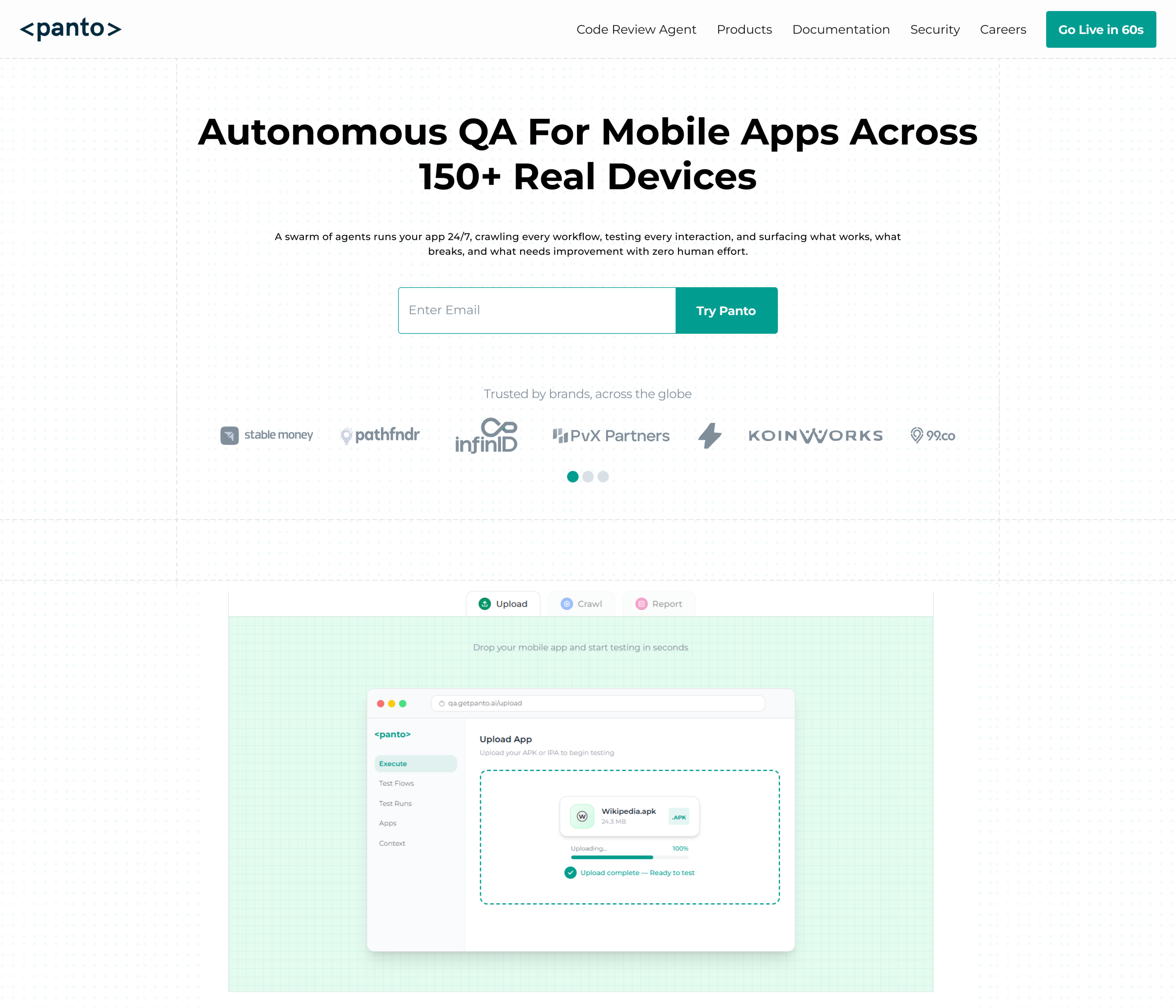
Panto AI is an AI-native mobile QA platform purpose-built for teams that need enterprise-grade mobile testing without the operational overhead of managing large, brittle test suites. Its combination of NLP-based test generation, real device execution, and self-healing automation makes it particularly well-suited to enterprise mobile teams dealing with high release velocity and complex UI churn.
For enterprise organizations, Panto’s value proposition is about reducing the headcount required to maintain meaningful mobile test coverage. Instead of scaling QA teams linearly with product complexity, Panto’s AI layer generates, executes, and maintains tests automatically, allowing enterprise QA programs to expand coverage without expanding team size proportionally.
Key Features:
- NLP-based test generation from plain English flow descriptions for rapid enterprise test authoring
- Real device execution across 150+ Android and iOS physical devices
- Self-healing automation that adapts enterprise test suites to UI changes without manual intervention
- AI-powered root cause analysis linking failures to specific code changes or pull requests
- Vibe Debugging platform connecting visual failures to the exact commit responsible
- CERT-IN compliance and on-premises deployment options for enterprise data residency requirements
- CI/CD integration with GitHub Actions, GitLab, Bitrise, Jenkins, and Azure DevOps
- Appium and Maestro script export for version-controlled enterprise test repositories
- SSO support and role-based access control for enterprise team management
- Dedicated enterprise support with SLA-backed response times
Limitations:
- Optimized specifically for mobile app testing; not designed for web or desktop enterprise applications
- Smaller device inventory than the largest enterprise device cloud providers
- AI-driven workflows have a learning curve for teams with deeply established code-first automation practices
Best For: Enterprise mobile-first teams and organizations with high release velocity that want AI-driven test generation and maintenance to scale QA coverage without proportional headcount growth.
Pricing: Free plan available. Scale plan starts at $999 per month. Enterprise pricing with dedicated support, SLAs, and on-premises deployment available on request.
2. Perfecto
Perfecto, part of Perforce, is one of the most established enterprise mobile testing platforms in the market. It is built specifically for large organizations with strict compliance, security, and governance requirements, and is widely used in banking, healthcare, insurance, and other regulated industries.
Its private cloud offering gives enterprise teams dedicated device access, which eliminates the shared resource contention that causes test flakiness and unpredictable execution times in public device clouds. For enterprises where test reliability is a regulatory requirement rather than just a quality preference, dedicated device access is a meaningful differentiator.
Key Features:
- Private and public real device cloud with 10,000+ Android and iOS devices
- SOC 2, ISO 27001, and GDPR compliance certifications for enterprise security reviews
- Dedicated device access to eliminate shared resource contention
- ML-based noise filtering for large enterprise test suites
- AI-powered self-healing test scripts for reduced maintenance overhead
- Deep CI/CD integration with enterprise toolchains including Azure DevOps, Jenkins, and GitLab
- Role-based access control and SSO integration for enterprise identity management
- Audit trails and compliance reporting for regulated industries
- BlazeMeter integration for performance testing alongside functional mobile tests
Limitations:
- Pricing is positioned firmly at the enterprise end of the market
- UI can feel dated compared to newer AI-native platforms
- Cloud deployment options are more limited than BrowserStack or Sauce Labs in some regions
Best For: Enterprise teams in regulated industries including banking, healthcare, and insurance that need private device access, strict compliance certifications, and governance-grade reporting.
Pricing: Enterprise pricing; contact Perfecto for a quote.
3. Sauce Labs
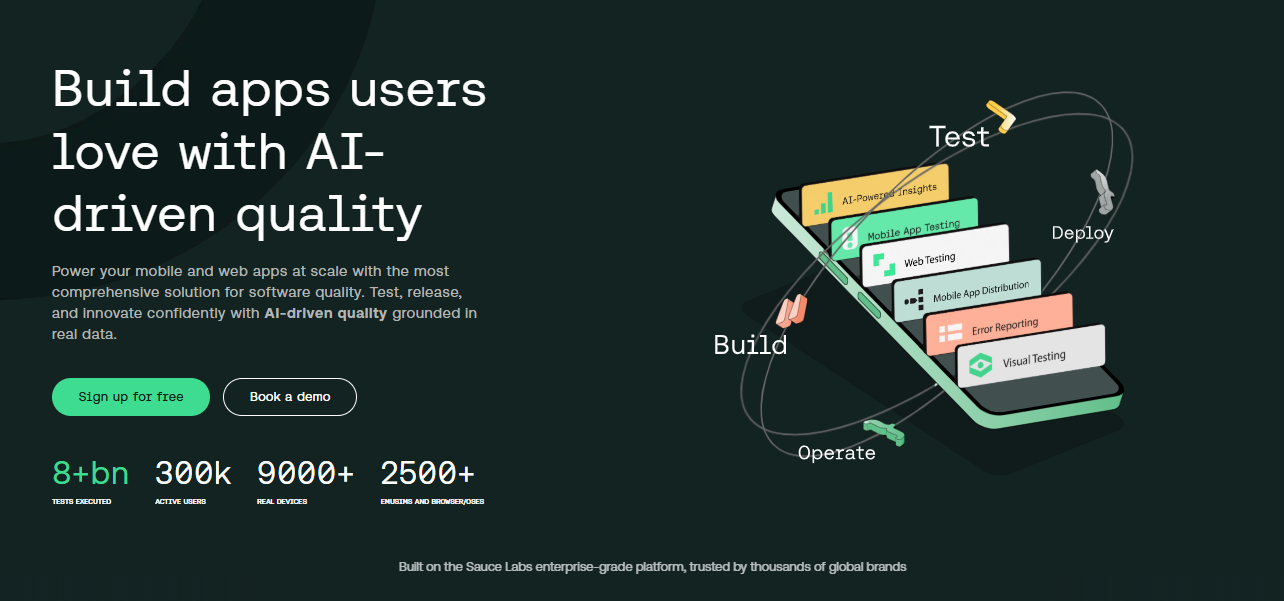
Sauce Labs is a mature, enterprise-grade mobile and web testing platform with SOC 2 certification, a large real device cloud, and AI-assisted test analytics. It is one of the most commonly referenced platforms in enterprise procurement evaluations for mobile testing.
Its unified platform covers mobile, browser, and API testing under a single dashboard, which makes it particularly appealing to enterprise organizations that want to consolidate testing infrastructure across multiple application surfaces without managing separate vendor relationships.
Key Features:
- Large real device cloud covering Android and iOS for enterprise-scale parallel execution
- SOC 2 Type II certified for enterprise security and compliance requirements
- AI-powered test failure analysis and error classification to reduce manual triage
- Sauce Orchestrate for advanced enterprise test pipeline management
- Unified coverage across mobile, web, and API testing from a single platform
- Extended debugging with video, network, performance, and device logs per test run
- Enterprise SSO integration and role-based access control
- Dedicated account management and SLA-backed support for enterprise customers
- Integration with Jira, Jenkins, GitHub Actions, and enterprise ALM tools
Limitations:
- Pricing scales significantly at high parallelization and usage tiers
- Platform breadth can feel complex for teams with mobile-only testing needs
- Real device availability for niche or older models can be inconsistent at peak usage times
Best For: Enterprise QA organizations running mobile and web testing programs that need a unified platform with strong compliance credentials, AI-assisted failure triage, and dedicated enterprise support.
Pricing: Usage-based enterprise pricing; contact Sauce Labs for a quote.
4. BrowserStack
BrowserStack is the largest real device cloud in the market, with over 3,500 real Android and iOS devices and a trusted reputation in enterprise procurement processes globally. It is used by over 50,000 development and QA teams and carries the compliance credentials, enterprise integrations, and support structure that large organizations require.
Its enterprise offering includes dedicated account management, private device pools, and advanced security features including IP whitelisting, audit logs, and single sign-on integration. The AI Self-Healing Agent and Test Selection Agent add intelligence to enterprise test execution without requiring teams to rebuild their existing automation investment.
Key Features:
- 3,500+ real Android and iOS devices for enterprise-scale cross device mobile testing
- SOC 2, ISO 27001, and GDPR compliance for enterprise security reviews
- Private device pools for dedicated, uncontested enterprise device access
- AI Self-Healing Agent for automatic locator repair in large enterprise test suites
- Test Selection Agent that reduces enterprise CI execution time by running only impacted tests
- Enterprise SSO, IP whitelisting, and audit log capabilities
- Dedicated account management and enterprise SLA support
- Integration with all major CI/CD platforms and enterprise ALM tools
- App Percy for visual regression testing across the enterprise device cloud
Limitations:
- Pricing scales significantly at higher parallelization and enterprise usage tiers
- Teams must bring their own automation; BrowserStack provides infrastructure, not test authoring
- Occasional queue times during peak usage even on enterprise plans
Best For: Enterprise organizations that need the broadest possible real device coverage for existing Appium, Espresso, or XCUITest automation suites, with strong compliance credentials and dedicated enterprise support.
Pricing: Enterprise pricing with dedicated support and private device pools; contact BrowserStack for a quote.
5. HeadSpin

HeadSpin takes a performance-intelligence approach to enterprise mobile testing, deploying real devices across a global network of carrier connections to capture actual user experience data under real network conditions. It is particularly strong for enterprises testing apps that need to perform consistently across geographies and carrier networks.
Its AI-powered analytics layer goes beyond pass or fail reporting to surface experience quality metrics, including rendering latency, API response times, and third-party service behavior, that are often invisible to standard functional testing platforms.
Key Features:
- Global network of real devices on actual carrier connections across multiple countries
- AI-powered performance intelligence and user experience analytics
- Real network conditions rather than simulated throttling for accurate enterprise performance data
- Automated root cause analysis for performance regressions across device and network variables
- Support for Appium and standard enterprise automation frameworks
- Session recording with device logs, network traces, and UI performance metrics
- Enterprise SSO and access control integration
- Dedicated support for enterprise accounts with performance engineering expertise
Limitations:
- More specialized for performance and experience intelligence than broad functional regression coverage
- Higher cost than general-purpose enterprise device cloud platforms
- Steeper learning curve for QA teams not focused on performance engineering
Best For: Global enterprise teams that need real-world performance validation across carrier networks and geographies, particularly for consumer apps where experience quality directly impacts retention metrics.
Pricing: Enterprise pricing; contact HeadSpin for a quote.
6. Tricentis
Tricentis is one of the most widely used enterprise test automation platforms, covering mobile, web, API, SAP, and desktop testing under a unified governance framework. Its risk-based testing engine and AI-assisted impact analysis make it particularly well-suited to large enterprises running complex, multi-application testing programs.
For enterprise organizations with QA governance requirements, Tricentis provides audit trails, test coverage dashboards, and risk reporting that give leadership visibility into quality posture before each release.
Key Features:
- Risk-based AI test prioritization that identifies high-impact tests for each code change
- Scriptless and scripted mobile test authoring for diverse enterprise team skill sets
- Unified platform covering mobile, web, API, SAP, and desktop testing for enterprise consolidation
- AI-assisted impact analysis to reduce total enterprise CI execution time
- Deep integration with Jira, ServiceNow, Jenkins, and enterprise ALM and ITSM toolchains
- Compliance reporting and audit trails for enterprise governance requirements
- Role-based access control and enterprise SSO integration
- Dedicated enterprise support with implementation and onboarding services
Limitations:
- Priced and architected for large enterprise organizations; significant investment for smaller teams
- Setup and onboarding require meaningful time and internal resources
- Can feel heavyweight for enterprises with mobile-only testing needs
Best For: Large enterprise QA organizations that need mobile testing as part of a governed, multi-application continuous testing program with risk-based execution and compliance reporting.
Pricing: Enterprise pricing; contact Tricentis for a quote.
7. Kobiton
Kobiton is a mobile-focused enterprise testing platform that combines a real device cloud with AI-augmented test automation and both cloud and on-premises deployment options. Its on-premises device lab capability is a meaningful differentiator for enterprises in regulated industries where test data cannot leave the corporate network.
Its AI-driven scriptless automation and record-to-automate workflow make it accessible to enterprise QA organizations that are scaling from manual to automated mobile testing, without requiring deep scripting expertise across the entire team.
Key Features:
- Real device cloud and on-premises device lab for regulated enterprise environments
- AI-augmented scriptless automation from recorded manual sessions
- Appium self-healing for enterprise test suite stability
- SOC 2 and enterprise security compliance certifications
- No-code and visual validations for functional and accessibility checks
- Parallel test execution across enterprise device matrices
- Enterprise SSO and role-based access control
- Integration with enterprise CI/CD platforms and test management tools
- Dedicated enterprise support with onboarding and implementation services
Limitations:
- Device inventory is smaller than the largest enterprise cloud providers
- AI features are less mature than AI-native platforms built specifically for test generation
- On-premises setup requires significant internal infrastructure management
Best For: Enterprise teams in regulated industries that need on-premises device lab options alongside cloud execution, or organizations transitioning large manual QA programs to automated mobile testing.
Pricing: Enterprise pricing; contact Kobiton for a quote.
8. ACCELQ
ACCELQ is a codeless enterprise test automation platform that covers mobile, web, API, and desktop testing from a single interface. Its hybrid execution architecture is particularly distinctive for enterprise environments: teams can route security-sensitive tests to private on-premises device pools while running standard flows against public cloud devices, all from the same codeless interface.
For enterprise organizations operating under Zero Trust or MDM security frameworks, this architecture eliminates the need to maintain two separate testing toolchains for internal and externally accessible application flows.
Key Features:
- Codeless mobile test automation for Android and iOS without scripting
- Hybrid execution routing between public cloud and private on-premises device pools
- AI-driven Autopilot engine for automated test case generation and maintenance
- Unified platform covering mobile, web, API, database, and packaged enterprise apps
- Zero Trust and MDM-compatible local agent for corporate device execution
- No app re-signing required for on-premises enterprise device testing
- Enterprise SSO, role-based access control, and audit trail capabilities
- Forrester Wave 2025 Leader recognition for enterprise test automation
- Integration with enterprise ALM, CI/CD, and defect management toolchains
Limitations:
- Codeless approach may limit flexibility for enterprise teams requiring advanced custom scripting
- Enterprise pricing and contact-based sales make early cost comparison difficult
- Learning curve for teams migrating from code-heavy automation frameworks
Best For: Enterprise organizations operating under strict security constraints that need hybrid cloud and on-premises mobile test execution from a single codeless platform without compromising corporate device management policies.
Pricing: Enterprise pricing; contact ACCELQ for a quote.
9. Katalon
Katalon is a commercial test automation platform that serves enterprise teams across mobile, web, API, and desktop testing. It is built on Appium for mobile, adding a codeless authoring layer, AI self-healing, and built-in test management that enterprise teams typically need to procure separately when using raw open source frameworks.
For enterprise organizations with mixed QA skill sets including both developers and non-technical testers, Katalon’s combination of codeless and scripted authoring makes it accessible across the full team without forcing everyone into a single technical approach.
Key Features:
- Codeless and scripted mobile test authoring for diverse enterprise team skill sets
- AI self-healing object repository for enterprise test suite stability
- Built-in test management, analytics, and CI/CD integration
- Unified coverage across mobile, web, API, and desktop enterprise applications
- Katalon TestCloud for cloud-based real device execution
- SSO integration and role-based access control for enterprise teams
- Integration with Jira, Jenkins, GitHub Actions, and enterprise DevOps toolchains
- Enterprise support with dedicated account management and SLA options
- Compliance reporting and test coverage analytics for enterprise governance
Limitations:
- Performance can degrade with very large or complex enterprise mobile test suites
- Inherits some stability limitations from its underlying Appium dependency
- Advanced features and enterprise support are behind higher-tier paid plans
Best For: Enterprise QA organizations with mixed technical skill sets that need unified mobile and web test automation with built-in test management, without procuring and integrating multiple separate platforms.
Pricing: Enterprise plans available; contact Katalon for enterprise pricing and SLA options.
10. pCloudy
pCloudy is an enterprise mobile testing platform with over 300,000 registered users spanning small teams to large enterprise organizations. It offers a real device cloud, no-code automation, AI-powered analytics, and regional data center options that address data sovereignty requirements for enterprises operating across multiple geographies.
Its collaborative features allow distributed enterprise testing teams to share device sessions in real time, which is particularly useful for global organizations with QA teams across multiple time zones working against shared release schedules.
Key Features:
- Real device cloud with 5,000+ Android and iOS devices for enterprise-scale testing
- No-code test automation for enterprise teams without deep scripting expertise
- AI-powered analytics and performance monitoring for enterprise mobile apps
- Regional data center options for enterprise data residency and sovereignty requirements
- Real-time device session sharing for distributed enterprise QA teams
- Support for Appium, Espresso, and XCUITest enterprise automation frameworks
- Network simulation and performance monitoring for enterprise app quality validation
- Integration with enterprise CI/CD platforms and test management tools
- Enterprise SSO and access control for large team management
Limitations:
- AI capabilities are less advanced than newer AI-native enterprise platforms
- Enterprise support quality can vary depending on region and plan tier
- Device availability for very specific niche models can be inconsistent
Best For: Global enterprise teams with distributed QA organizations that need regional data center options, real-time device session sharing, and scalable real device coverage across Android and iOS.
Pricing: Enterprise pricing available; contact pCloudy for a quote.
Comparison Table: Best Enterprise Mobile App Testing Tools in 2026
| Tool | Deployment Options | Compliance | AI Features | Real Devices | Best For | Pricing |
|---|---|---|---|---|---|---|
| Panto AI | Cloud, On-Premises | CERT-IN | NLP generation, self-healing, RCA | 150+ | AI-driven enterprise mobile QA | From $999/mo; Enterprise on request |
| Perfecto | Private Cloud, Public Cloud | SOC 2, ISO 27001, GDPR | ML noise filtering, self-healing | 10,000+ | Regulated enterprise industries | Enterprise pricing |
| Sauce Labs | Cloud | SOC 2 Type II | Failure analysis, error classification | Large | Unified mobile and web enterprise QA | Enterprise pricing |
| BrowserStack | Cloud, Private Pool | SOC 2, ISO 27001, GDPR | Self-healing, test selection | 3,500+ | Broadest real device cloud coverage | Enterprise pricing |
| HeadSpin | Global carrier network | Enterprise grade | Performance intelligence AI | Global network | Performance-focused global enterprises | Enterprise pricing |
| Tricentis | Cloud, On-Premises | Enterprise grade | Risk-based AI, impact analysis | Via partners | Multi-application enterprise governance | Enterprise pricing |
| Kobiton | Cloud, On-Premises | SOC 2 | Scriptless AI, self-healing | Real device cloud | Regulated industries, on-premises need | Enterprise pricing |
| ACCELQ | Cloud, Hybrid, On-Premises | Zero Trust compatible | AI Autopilot, codeless generation | Via cloud and local | Strict security enterprise environments | Enterprise pricing |
| Katalon | Cloud | Enterprise grade | AI self-healing | Via TestCloud | Mixed skill enterprise QA teams | Enterprise pricing |
| pCloudy | Cloud, Regional DCs | Enterprise grade | AI analytics | 5,000+ | Global distributed enterprise teams | Enterprise pricing |
How to Choose the Right Enterprise Mobile Testing Tool
Enterprise mobile testing tool selection is less about individual features and more about organizational fit across security, scale, and workflow integration.
Start with your compliance requirements. If your organization operates in banking, healthcare, or insurance, the shortlist begins with platforms that carry SOC 2 Type II, ISO 27001, and GDPR certifications: Perfecto, Sauce Labs, BrowserStack, and Kobiton all qualify. Tools without these certifications will not pass enterprise security reviews regardless of their technical capabilities.
Matching Platform to Enterprise Scale and Structure
If your enterprise QA team is distributed across geographies, HeadSpin’s global carrier network and pCloudy’s regional data center options address the network and data sovereignty challenges that single-region cloud platforms cannot.
If your organization needs on-premises device execution due to data classification policies or MDM constraints, Kobiton and ACCELQ both offer this without requiring teams to manage two separate toolchains.
If your enterprise wants to reduce the QA headcount required to maintain growing mobile test coverage, Panto AI’s AI-driven test generation and self-healing automation directly address that operational constraint.
If your enterprise runs testing programs across mobile, web, SAP, and desktop under a single governance framework, Tricentis is the only platform on this list purpose-built for that level of consolidation.
Enterprise Procurement Considerations
Beyond technical fit, enterprise procurement teams should validate vendor stability, implementation support quality, and contract flexibility. Request reference customers in your industry vertical, confirm SLA terms in writing, and run a proof of concept on your actual application with your actual team before committing to an enterprise contract.
The best enterprise mobile app testing platform is the one that fits your existing security posture, supports your team’s technical skill set, and scales with your release cadence without requiring a parallel investment in platform management expertise.