

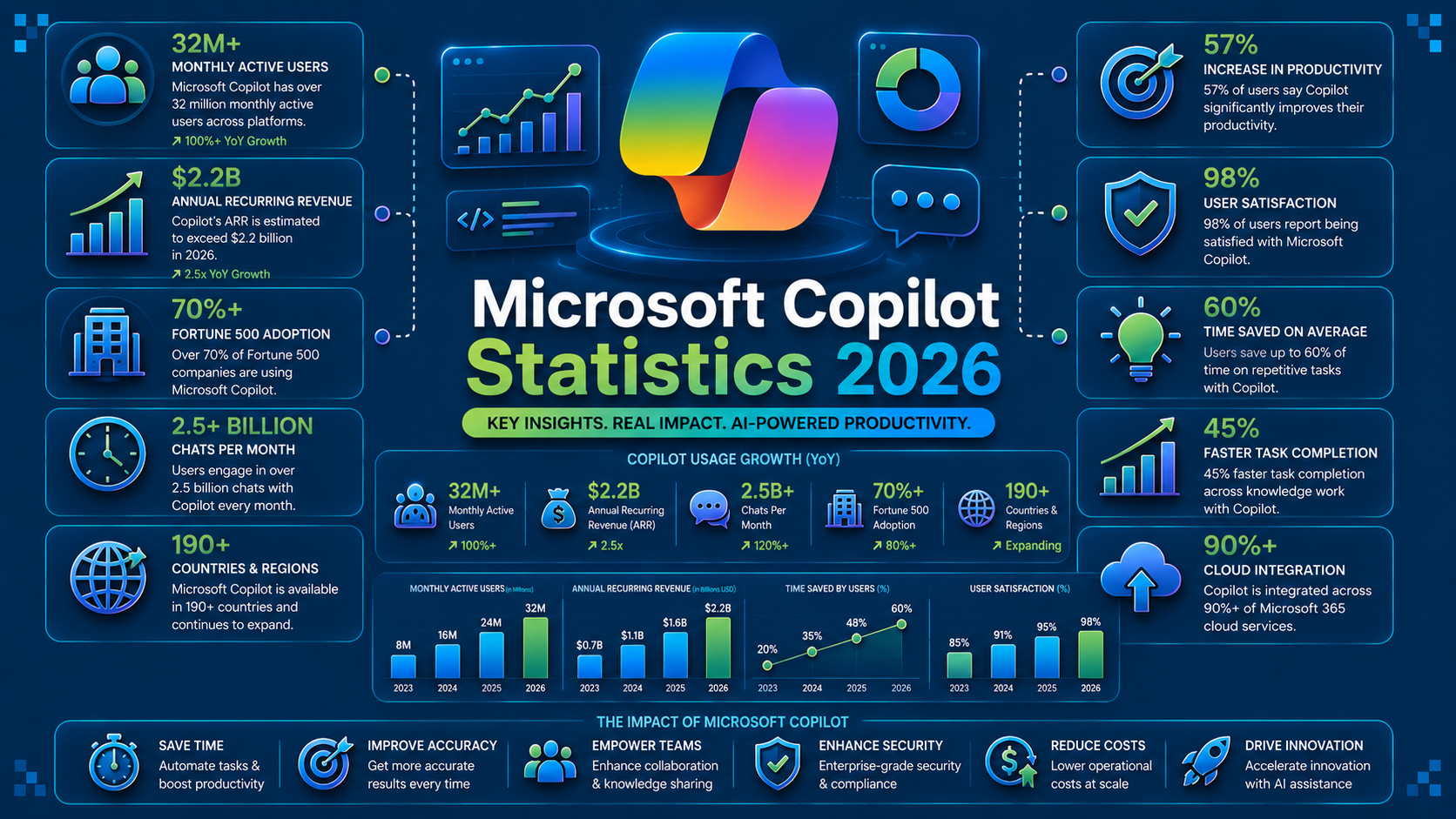

Microsoft says more than 20 million paid Microsoft Copilot seats are now in use, and more than 90% of the Fortune 500 use Microsoft Copilot.
At the same time, Microsoft’s broader Microsoft 365 ecosystem spans over 430 million people using Microsoft 365 apps, more than 450 million commercial paid seats, and 89.0 million consumer subscribers.
That makes Microsoft Copilot one of the largest enterprise AI deployments in the market, because it sits inside an installed base that is already massive.
This article looks at the latest public numbers on Microsoft Copilot users, adoption, usage patterns, financial economics, enterprise rollouts, geography, and broader market trends.
Microsoft Copilot Statistics: Key Insights And Takeaways
- Microsoft has disclosed more than 20 million paid Microsoft Copilot seats, which means the product has already moved from early enterprise trials into mass commercial deployment.
- More than 90% of the Fortune 500 now use Microsoft Copilot, showing unusually deep penetration among large enterprises.
- In Microsoft’s own early-user research, 70% of users said Copilot made them more productive and 68% said it improved the quality of their work.
- Microsoft’s early-user study found an average time saving of 14 minutes per day, while 22% of users said they saved more than 30 minutes a day.
- A UK government trial found users saved 26 minutes a day on average, and 82% said they would not want to return to their pre-Copilot working conditions.
- Forrester’s commissioned TEI study estimated a 116% ROI, $19.7 million NPV, and 9 hours saved per user per month for the composite organization.
At A Glance: Microsoft Copilot Statistics 2026
| Metric | Figure |
|---|---|
| Paid Microsoft Copilot seats | 20M+ |
| Fortune 500 adoption | 90%+ |
| Microsoft 365 commercial seats | 450M+ |
| Microsoft 365 app users | 430M+ |
| Microsoft 365 consumer subscribers | 89M |
| Users completing tasks faster | 73% |
| Higher productivity | 70% |
| Better work quality | 68% |
| First drafts completed faster | 85% |
| Average time saved | 14 min/day |
| UK Government trial | 26 min/day |
| Microsoft Copilot Business | $21/user/month |
| Microsoft 365 commercial revenue growth | 17% |
| Forrester ROI | 116% |
| Net present value | $19.7M |
| Time saved per user | 9 hours/month |
| Wipro monthly active usage | 95%+ |
| Infosys monthly active usage | 91%+ |
| TCS active AI usage | 86% |
Microsoft Copilot Statistics: Deep Dive
1. Microsoft Copilot Statistics: User Statistics
Microsoft measures Copilot’s scale through paid Microsoft Copilot seats, reflecting its enterprise-first deployment strategy.
As of 2026, the company reports more than 20 million paid Copilot seats, making it one of the largest publicly disclosed enterprise AI deployments.
Copilot’s rapid adoption is supported by Microsoft’s extensive productivity ecosystem.
This includes more than 450 million commercial Microsoft 365 paid seats, over 430 million Microsoft 365 app users, and 89 million Microsoft 365 consumer subscribers.
This installed base gives Microsoft a significant advantage in expanding Copilot adoption across both enterprise and consumer productivity workflows.
| Metric | Latest Published Figure |
|---|---|
| Paid Microsoft Copilot seats | 20 million+ |
| Microsoft 365 commercial paid seats | 450 million+ |
| Microsoft 365 app users | 430 million+ |
| Microsoft 365 consumer subscribers | 89 million |
2. Microsoft Copilot Statistics: Usage And Adoption Statistics
The best public usage data comes from Microsoft’s own studies.
In its early-user survey of 297 Copilot users, 73% said they could complete tasks faster, 85% said Copilot helped them get to a good first draft faster, and 77% said they would not want to give it up.
Microsoft also reported average time savings of 14 minutes per day, or 1.2 hours per week.
Microsoft’s product studies said Copilot made it easier to catch up on missed meetings (86%), take action after meetings (84%), and process email more efficiently (64%).
In task-based experiments, Copilot users were 29% faster overall, and in one meeting-summary test they finished nearly 4x faster than the control group.
As AI-generated code becomes more common across enterprise software development, teams are also adopting AI code review agents to identify bugs, security issues, and code quality problems before release.
The UK government’s cross-government trial found an average saving of 26 minutes per day, 83% adoption during the experiment’s peak, and only 17% of users reporting no clear time savings.
In app-level usage, 34% used Copilot daily in Teams, 33% daily in Outlook, and 25% daily in Word. Excel and PowerPoint adoption lagged, with top adoption rates of 23% and 24% respectively.
| Usage metric | Figure |
| Users saying Copilot makes them more productive | 70% |
| Users saying Copilot improves work quality | 68% |
| Users saying they complete tasks faster | 73% |
| Users saying Copilot speeds first drafts | 85% |
| Average time saved per day | 14 minutes |
| UK trial average time saved | 26 minutes/day |
| UK trial adoption rate | 83% at peak |
| Teams maximum adoption | 71% |
| Word weekly usage | 43% weekly, plus 25% daily |
Microsoft’s 2026 Work Trend Index adds a broader behavioral lens.
A privacy-preserving analysis of more than 100,000 chats in Microsoft Copilot found that 49% of conversations supported cognitive work such as analysis, problem-solving, evaluation, and creative thinking.
Another 19% supported working with people, 15% finding information, and 17% producing work.
Microsoft also reported in the 2026 Work Trend Index that 82% of business leaders expect digital labor, including AI agents and copilots, to become an essential part of their workforce strategy within the next 12 to 18 months.
Microsoft Copilot Adoption Statistics
Microsoft Copilot has rapidly transitioned from pilot deployments to large-scale enterprise adoption.
Key published adoption statistics include:
- 20 million+ paid Microsoft Copilot seats
- 90%+ of Fortune 500 companies use Microsoft Copilot
- 73% of users complete tasks faster
- 70% report higher productivity
- 68% report improved work quality
- 85% say Copilot helps them create first drafts faster
- Average productivity gain of 14 minutes per day
- UK Government trial measured 26 minutes saved per day
Together, these figures indicate that Microsoft Copilot adoption is increasingly being measured through productivity improvements and enterprise deployment rather than consumer usage alone.
3. Microsoft Copilot Statistics: Demographics Statistics
Public demographic breakdowns for Microsoft Copilot are limited, so the clearest statistics come from trial populations rather than consumer-style age charts.
In the UK government experiment, respondents were equally distributed across age and gender, covered 14 professions, and the sample included 14,500 anonymized users.
The same trial showed that Copilot’s impact varied by role.
13 of 15 professions saw more than 25% of respondents use Copilot daily in Teams, while 11 of 15 professions saw more than 40% weekly use in Word.
In other words, occupational context matters more than a simple age or gender split when measuring Copilot adoption.
Microsoft’s own early-user studies also point to function-specific demand.
Among 133 Microsoft sales users surveyed, the average time saved was 90 minutes per week, and 83% said Copilot for Sales made them more productive.
In customer service testing, Microsoft compared 6,500 Copilot users against a 5,000-person control group.
| Audience signal | Figure |
| UK trial professions represented | 14 professions |
| UK trial age/gender balance | Equally distributed |
| Microsoft sales sample | 133 users |
| Sales time saved | 90 minutes/week |
| Customer service experiment | 6,500 users vs 5,000 control |
4. Microsoft Copilot Statistics: Revenue And Financial Statistics
Microsoft does not disclose standalone revenue for Copilot, but the company has published several financial metrics that demonstrate its commercial impact.
Microsoft says Copilot is contributing to higher average revenue per user (ARPU) across Microsoft 365 Commercial.
In FY26 Q2, Microsoft reported 17% growth in Microsoft 365 commercial cloud revenue, alongside 6% growth in commercial paid seats to more than 450 million.
In its FY25 Annual Report, Microsoft also reported 15% growth in Microsoft 365 commercial cloud revenue, driven by continued seat expansion and higher revenue per user.
Microsoft Copilot Business is priced at $21 per user per month with an annual commitment, or $25.20 per user per month on a monthly commitment.
Microsoft also includes Copilot Chat at no additional cost for eligible Microsoft Entra account users with a qualifying Microsoft 365 subscription.
The strongest publicly available evidence for Copilot’s financial impact comes from Forrester’s Total Economic Impact (TEI) study.
For a composite organization with 25,000 employees and $6.25 billion in annual revenue, the study estimated:
- 116% return on investment (ROI)
- $19.7 million net present value (NPV)
- 9 hours saved per user per month
- Up to 2.6% increase in topline revenue
- 0.24% reduction in operating expenditures
- 25% reduction in employee onboarding time
Microsoft Copilot Financial Statistics
| Metric | Figure |
|---|---|
| Microsoft 365 commercial cloud revenue growth (FY26 Q2) | 17% |
| Microsoft 365 commercial cloud revenue growth (FY25) | 15% |
| Microsoft 365 commercial paid seats | 450M+ |
| Copilot Business (annual commitment) | $21/user/month |
| Copilot Business (monthly commitment) | $25.20/user/month |
| Copilot Chat | Included for eligible Microsoft 365 users |
| Forrester ROI | 116% |
| Net Present Value (NPV) | $19.7M |
| Time saved per user | 9 hours/month |
| Topline revenue increase | Up to 2.6% |
| Operating expenditure reduction | 0.24% |
| Employee onboarding time reduction | 25% |
5. Microsoft Copilot Statistics: Enterprise Adoption Statistics
Enterprise adoption is where Microsoft Copilot’s scale becomes clearest. Microsoft says more than 90% of the Fortune 500 use it, and it has already landed in some of the world’s largest companies.
Barclays, for example, announced a rollout to 100,000 employees globally after starting with 15,000.
Microsoft’s largest enterprise deployments continue to expand. Infosys, TCS, and Wipro have each deployed Microsoft Copilot to more than 100,000 employees.
Microsoft also reported that the number of organizations with more than 100,000 Microsoft 365 Copilot seats has doubled year over year, highlighting accelerating enterprise-scale deployments.
Microsoft reported a 4× year-over-year increase in organizations with more than 50,000 Copilot seats.
Within these deployments, Infosys reported 91%+ monthly active usage, TCS reported 86% active AI usage, and Wipro exceeded 95% monthly active usage.
Microsoft 365 Copilot’s rollout among Fortune 500 organizations mirrors broader enterprise AI adoption trends seen across the developer ecosystem. Read our report on AI agent statistics in 2026 →
| Enterprise adoption metric | Figure |
| Fortune 500 usage | >90% |
| Barclays rollout | 100,000 employees |
| Infosys, TCS, Wipro combined | 300,000+ seats |
| Infosys monthly active users | >91% |
| TCS active daily AI use | 86% |
| Wipro monthly active usage | >95% |
| Wipro prompts | 7.5 million/month |
| Wipro time saved | 250,000+ FTE days/quarter |
6. Microsoft Copilot Statistics: Market Share And Competitive Statistics
Microsoft Copilot’s biggest competitive advantage is not standalone user volume but its integration into the Microsoft 365 ecosystem.
As AI accelerates software development across enterprise teams, static application security testing (SAST) helps organizations detect vulnerabilities early in the development lifecycle before code reaches production.
Microsoft has more than 20 million paid Copilot seats, over 450 million commercial Microsoft 365 paid seats, and more than 430 million Microsoft 365 app users.
This makes Microsoft has one of the largest enterprise distribution channels for AI products.
While comparisons between enterprise AI platforms are not perfectly equivalent, Microsoft’s publicly disclosed deployment scale significantly exceeds that of many standalone AI assistants.
For example, OpenAI reported more than 7 million ChatGPT for Work seats in late 2025, with ChatGPT Enterprise seats growing 9× year over year.
Microsoft’s installed Microsoft 365 base gives Copilot a substantial advantage in enterprise distribution and adoption.
Unlike consumer AI chatbots, Microsoft positions Copilot as a productivity layer embedded across Word, Excel, Outlook, Teams, and other Microsoft 365 applications.
Copilot Chat is included at no additional cost for eligible Microsoft 365 users.
On the other hand, Microsoft 365 Copilot is offered as a paid add-on for commercial customers, allowing organizations to adopt AI directly within existing workflows.
Microsoft Copilot Competitive Position
| Platform / Metric | Publicly Disclosed Scale | What It Indicates |
|---|---|---|
| Microsoft Copilot | 20M+ paid seats | Largest publicly disclosed Copilot deployment |
| Microsoft 365 Commercial | 450M+ paid seats | Massive enterprise distribution channel |
| Microsoft 365 Apps | 430M+ users | Large existing user ecosystem for Copilot adoption |
| ChatGPT for Work | 7M+ seats | Major standalone enterprise AI deployment |
| ChatGPT Enterprise | 9× YoY seat growth | Rapid enterprise adoption |
7. Microsoft Copilot Statistics: Regional And Geographic Statistics
Microsoft says Microsoft Copilot is generally available for purchase worldwide in public clouds, which makes it one of the more globally distributed enterprise AI products.
Microsoft has also been adding regional infrastructure, including in-country data processing for qualified UAE organizations.
Microsoft’s 2026 Work Trend Index surveyed 20,000 workers across 10 countries: the US, Brazil, Australia, India, Japan, France, Germany, Italy, the Netherlands, and the UK.
That matters because it shows Copilot-related work patterns are no longer being measured in a single market.
Asia is especially visible in the latest enterprise rollouts.
Microsoft’s June 2026 announcement on Infosys, TCS, and Wipro came from India and described the region as one of the fastest-moving markets for Copilot adoption.
Within that rollout, Wipro reported 95%+ monthly active usage, while Infosys exceeded 91% monthly active users.
| Geography metric | Figure |
| Global availability | Generally available worldwide in public clouds |
| WTI 2026 countries | 10 countries |
| WTI 2026 sample | 20,000 workers |
| UAE data processing | Local processing announced for qualified UAE orgs |
| India enterprise rollout | 300,000+ seats across three firms |
8. Microsoft Copilot Statistics: Market Trends And Industry Growth
The Copilot story sits inside a much larger AI spending cycle. Gartner forecasts worldwide AI spending of $2.52 trillion in 2026, up 44% year over year, and says generative AI model spending will grow 80.8% in 2026.
That macro backdrop helps explain why Microsoft keeps expanding Copilot from a chat assistant into a broader workflow and agent platform.
Microsoft’s own 2026 Work Trend Index suggests Copilot is increasingly used for high-value work rather than simple prompting.
As AI assistants become embedded in enterprise workflows, organizations are increasingly adopting AI automation testing to validate AI-driven user journeys and business-critical workflows before deployment.
In its telemetry, 49% of conversations were classified as cognitive work, and 58% of surveyed AI users said they were producing work they could not have produced a year earlier.
Microsoft also found that 66% of AI users said AI let them spend more time on high-value work.
Broader enterprise adoption is also rising across the AI market. McKinsey’s 2025 State of AI survey found 88% of respondents said their organizations use AI in at least one business function, up from 78% a year earlier.
The rise of workplace copilots reflects broader shifts in enterprise AI investment, like AI coding and AI tools.
| Market trend | Figure |
| Worldwide AI spend in 2026 | $2.52 trillion |
| AI spending growth | 44% YoY |
| GenAI model spending growth | 80.8% |
| Copilot cognitive-work share | 49% |
| Organizations using AI in at least one function | 88% |
Conclusion
Microsoft Copilot has crossed the scale threshold that matters: more than 20 million paid seats, more than 90% of the Fortune 500, and a distribution base of over 450 million commercial Microsoft 365 seats.
Public studies also show measurable workplace value, including 14 to 26 minutes saved per day and a 116% ROI in Forrester’s commissioned analysis.
The broader signal is that Microsoft Copilot is no longer just a feature add-on; it is becoming a workflow layer inside one of the largest software footprints in the world.
With enterprise AI spending still rising sharply and Microsoft pushing Copilot deeper into chat, search, notebooks, and agents, the next phase is likely to be measured less by novelty and more by sustained operational usage.
FAQ’s
Q: How big is the AI agent market in 2026?
A: The AI agent market is growing rapidly. Based on MarketsandMarkets’ published forecasts, the market is projected to reach approximately $11.5 billion in 2026, up from $7.8 billion in 2025. Other research firms estimate even larger market sizes due to broader definitions that include adjacent AI automation and infrastructure categories.
Q: What percentage of enterprises are using AI agents?
A: Enterprise adoption is already widespread, though deployment maturity varies. PwC reports that 79% of companies are adopting AI agents, while WRITER found that 97% of executives deployed AI agents during the past year. However, LangChain’s research suggests that only 51% of organizations have agents running in production, indicating that many deployments are still in early stages.
Q: What is the ROI of AI agents?
A: Most organizations report measurable value from AI agents, but results vary significantly. Anthropic found that 80% of organizations achieved economic benefits from AI adoption, while WRITER reported that only 23% have realized significant ROI specifically from AI agents. The gap highlights a common pattern: productivity gains often arrive quickly, while enterprise-wide transformation takes longer to materialize.
Q: What are the most common AI agent use cases?
A: The most widely adopted AI agent use cases center on knowledge work and process automation. LangChain reports research and summarization (58%), personal productivity (53.5%), and customer service (45.8%) as the leading categories. Anthropic’s data also highlights data analysis and report generation (60%) and internal process automation (48%) as major enterprise applications.
Q: What are the biggest challenges in deploying AI agents?
A: Security, governance, and data readiness remain the primary barriers. WRITER found that 67% of executives worry their organization has experienced a breach related to unauthorized AI usage, while 36% lack a formal AI governance framework. Anthropic’s research also identified system integration (46%) and data quality issues (42%) as major obstacles to successful deployment.
Q: How many AI agents will exist by 2028?
A: According to IDC projections cited by Microsoft, there could be approximately 1.3 billion AI agents in operation by 2028. While forecasts vary, this has become one of the most frequently referenced indicators of the scale expected for the agent economy over the next several years.
Q: Which industries are leading AI agent adoption?
A: Software development is currently one of the strongest adoption categories, with 59% of organizations using AI agents for coding, testing, debugging, or documentation workflows. Other leading sectors include data analysis and reporting (60%) and customer service (45.8%), reflecting the fact that AI agents deliver the greatest value in high-volume digital workflows with repeatable processes.