

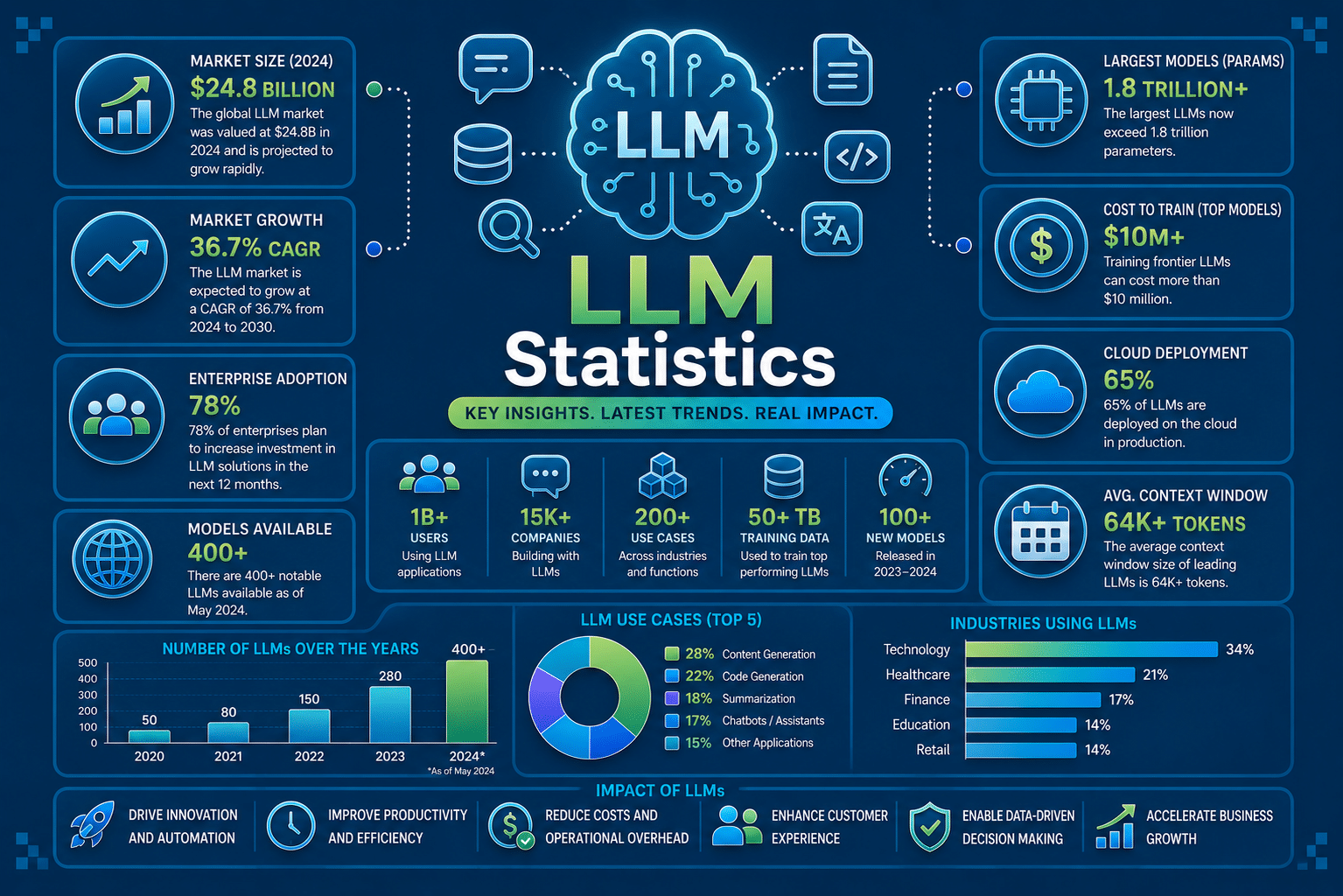

Large language models (LLMs) have become one of the fastest-growing technologies in history, transforming how individuals, developers, and enterprises create content, write code, search for information, and build AI-powered applications.
ChatGPT reached 900 million weekly active users by February 2026, while Google’s Gemini app surpassed 900 million monthly active users, underscoring the massive global adoption of generative AI.
The industry’s growth extends well beyond consumer usage. OpenAI surpassed a $20 billion annualized revenue run rate, Anthropic reached a $14 billion run rate, and more than 85,000 enterprises are now building with Google’s Gemini models.
Meanwhile, 84–85% of developers regularly use AI tools, and the global LLM market is projected to grow from $7.81 billion in 2025 to nearly $130 billion by 2034.
This article brings together the latest verified LLM statistics for 2026, covering user growth, adoption, revenue, enterprise usage, market share, developer adoption, regional trends, and industry forecasts from official company announcements, market research firms, developer surveys, and other credible public sources.
Key Insights & Takeaways
- ChatGPT reached 900 million weekly active users in February 2026, making it the world’s largest standalone AI chatbot.
- Google’s Gemini app surpassed 900 million monthly active users by May 2026, more than doubling from 400 million a year earlier.
- ChatGPT has 50 million paying subscribers as of 2026, highlighting rapid consumer adoption of premium AI services.
- The global LLM market was valued at $7.81 billion in 2025 and is projected to approach $130 billion by 2034.
- OpenAI exceeded a $20 billion annualized revenue run rate in 2025, making it one of the fastest-growing software companies ever.
- Anthropic reached a $14 billion annualized revenue run rate by early 2026, driven primarily by enterprise and developer usage.
- Global AI spending is forecast to reach $2.52 trillion in 2026, representing a 44% year-over-year increase, according to Gartner.
| Metric | Figure |
|---|---|
| ChatGPT weekly active users | 900M |
| Gemini monthly active users | 900M |
| Google AI Overviews monthly users | 2.5B |
| Google AI Mode monthly users | 1B+ |
| ChatGPT paid subscribers | 50M |
| Anthropic business customers | 300K+ |
| Developers regularly using AI tools | 84–85% |
| Developers using AI daily | 51% |
| OpenAI annualized revenue | $20B+ |
| Anthropic ARR | $14B |
| Global LLM market (2025) | $7.81B |
| Projected LLM market (2034) | ~$130B |
| Forecast CAGR | 36.7% |
| ChatGPT traffic share | 64.5% |
| Gemini traffic share | 21.5% |
| ChatGPT + Gemini traffic share | ~86% |
| North America LLM market share | 32.1% |
| Enterprises building with Gemini | 85,000+ |
| Gemini Enterprise paid seats | 8M+ |
| Global AI spending (2026) | $2.52T |
LLM (Large Language Model) Statistics: A Deep Dive
1. LLM (Large Language Model) Statistics: User Statistics
The user base for leading LLM platforms has grown at an unprecedented pace. ChatGPT remains the largest standalone AI application by active users, while Google’s Gemini ecosystem has expanded rapidly through Search, Android, Workspace, and other Google products.
To give a look into the sheer users for LLM platforms, OpenAI had more than 2 million paying business users by February 2025, up from 1 million in September 2024.
Developer traffic for OpenAI’s reasoning models doubled over six months, while traffic to the o3 model increased fivefold after launch, highlighting strong growth beyond consumer usage.
Check out our full report on OpenAI’s revenue, adoption and more →
| Platform / Metric | Figure |
|---|---|
| ChatGPT weekly active users (Feb 2026) | 900 million |
| ChatGPT weekly active users (Mid-2025) | 700 million |
| ChatGPT monthly active users (Feb 2023) | 100 million |
| Gemini monthly active users (May 2026) | 900 million |
| Gemini monthly active users (May 2025) | 400 million |
| AI Overviews monthly users | 2.5 billion |
| AI Mode monthly users | 1 billion+ |
| Anthropic business customers | 300,000+ |
LLM (Large Language Model) Statistics: ChatGPT User Growth
| Date | Weekly Active Users |
|---|---|
| Dec 2022 | 1 million |
| Jan 2023 | 57 million |
| Feb 2023 | 100 million |
| Sep 2023 | 150 million |
| Aug 2024 | ~200 million |
| Oct 2024 | 250 million |
| Dec 2024 | 300 million |
| Feb 2025 | 400 million |
| Mid-2025 | 700 million |
| Oct 2025 | 800 million |
| Feb 2026 | 900 million |
LLM (Large Language Model) Statistics: Key User Statistics
- ChatGPT reached 900 million weekly active users by February 2026, making it the world’s largest standalone AI chatbot.
- ChatGPT surpassed 400 million weekly active users in February 2025 before growing to 700 million just a few months later.
- ChatGPT became the fastest-growing consumer application in history, reaching 100 million monthly active users roughly two months after launch.
- Google’s Gemini app more than doubled from 400 million monthly active users in May 2025 to 900 million by Google I/O 2026.
- Google’s AI Overviews now reach 2.5 billion monthly users, making it one of the largest AI-powered consumer products globally.
- AI Mode has surpassed 1 billion monthly active users, reflecting rapid adoption of conversational AI search.
- Anthropic serves more than 300,000 business customers, reflecting its stronger enterprise focus compared with consumer-oriented AI assistants.
LLM (Large Language Model) Statistics: Platform User Comparison
The global user base for large language models has expanded rapidly over the past two years, with multiple AI platforms now serving hundreds of millions of users every month.
Together, these milestones demonstrate that LLMs have become mainstream consumer and enterprise technologies.
ChatGPT remains the largest standalone AI chatbot, while Google’s AI ecosystem reaches billions of users through Search, Android, Workspace, and Gemini.
| Platform | Latest Published User Metric |
|---|---|
| ChatGPT | 900 million weekly active users |
| Google Gemini | 900 million monthly active users |
| Google AI Overviews | 2.5 billion monthly users |
| Google AI Mode | 1 billion+ monthly users |
| Claude | 300,000+ business customers |
2. LLM (Large Language Model) Statistics: Usage & Adoption Statistics
Large language models are used for everything from answering questions and writing content to software development and education. OpenAI’s largest-ever ChatGPT usage study found that most interactions focus on practical tasks, while developer surveys show AI has become a standard part of modern software workflows.
Check out our complete report on ChatGPT’s usage, revenue and other metrics →
LLM (Large Language Model) Statistics: Usage at a Glance
| Metric | Statistic |
|---|---|
| Conversations focused on practical tasks | ~75% |
| Asking (information & advice) | 49% |
| Doing (task completion) | 40% |
| Expressing (creativity & reflection) | 11% |
| Personal use | ~70% |
| Work-related use | ~30% |
| Tutoring & teaching | ~10% of all messages |
| Developers using AI tools | 84–85% |
| Developers using AI daily | 51% |
LLM (Large Language Model) Statistics: ChatGPT Usage Breakdown
| Primary Use Case | Share of Usage |
|---|---|
| Asking (information, advice, research) | 49% |
| Doing (writing, planning, coding, completing tasks) | 40% |
| Expressing (creative writing, reflection, exploration) | 11% |
LLM (Large Language Model) Statistics: Key LLM Usage Statistics
LLM Usage Statistics
Recent studies show that LLM adoption extends well beyond casual experimentation.
Some of the most significant published usage statistics include:
- Approximately 75% of ChatGPT conversations focus on practical tasks.
- 49% of interactions involve asking questions, researching information, or seeking advice.
- 40% of conversations focus on completing work such as writing, planning, coding, or analysis.
- Around 70% of ChatGPT usage is personal, while 30% is work-related.
- 84–85% of developers now regularly use AI tools.
- 51% of professional developers use AI tools every day.
These trends indicate that LLMs are increasingly used for productivity, software development, education, and knowledge work rather than purely experimental use.
3. LLM (Large Language Model) Statistics: Demographics Statistics
Large language model adoption is becoming increasingly diverse across age groups, genders, occupations, and regions. While early adoption skewed toward younger male users and software developers, recent research shows the user base has broadened significantly as AI tools become mainstream.
LLM (Large Language Model) Statistics: Demographics at a Glance
| Metric | Statistic | Source |
|---|---|---|
| ChatGPT users with feminine names (July 2025) | 52% | OpenAI / NBER |
| ChatGPT users with feminine names (Jan 2024) | 37% | OpenAI / NBER |
| Messages from users aged 18–25 | 46% | OpenAI / NBER |
| Work-related messages from users aged 36–45 | 31.4% | OpenAI / NBER |
| Work-related messages from users aged 18–25 | 22.5% | OpenAI / NBER |
| ChatGPT adoption growth in low-income countries | 4× faster than high-income countries | OpenAI |
| Developers regularly using AI tools | 85% | JetBrains Developer Ecosystem Survey |
LLM (Large Language Model) Statistics: Key LLM Demographic Statistics
- Women accounted for 52% of ChatGPT users (based on users with classifiable first names) by July 2025, up from 37% in January 2024, indicating that the early gender gap has largely disappeared.
- Users aged 18–25 generated 46% of all ChatGPT messages, making young adults the platform’s largest age group.
- Among users aged 36–45, 31.4% of messages were work-related—the highest share of any age group studied.
- By comparison, only 22.5% of messages from users aged 18–25 were work-related, suggesting younger users rely more on ChatGPT for learning and personal tasks.
- ChatGPT adoption in low-income countries grew more than four times faster than in high-income countries by mid-2025, highlighting the rapid global expansion of generative AI.
- 85% of developers report regularly using AI tools, demonstrating that software engineers remain one of the largest professional user groups for LLMs.
LLM (Large Language Model) Statistics: LLM User Segments
| User Segment | Key Statistic |
|---|---|
| Young adults (18–25) | 46% of ChatGPT messages |
| Developers | 85% regularly use AI tools |
| Women (July 2025) | 52% of users with classifiable names |
| Users in low-income countries | Adoption growing 4× faster than high-income countries |
| Professionals (36–45) | 31.4% of messages are work-related |
LLM (Large Language Model) Statistics: What the Demographics Show
- The gender balance of LLM users has shifted from being predominantly male to slightly female-majority.
- Young adults remain the most active users, although middle-aged professionals are more likely to use LLMs for work.
- Adoption is expanding fastest in emerging markets, where growth rates significantly exceed those of high-income economies.
- Developers continue to represent one of the most engaged user groups, with AI tools becoming a standard part of modern software development workflows.
4. LLM (Large Language Model) Statistics: Revenue & Financial Statistics
The financial growth of the LLM industry has accelerated rapidly over the past two years, driven by enterprise adoption, API usage, and paid AI subscriptions.
OpenAI and Anthropic have emerged as two of the fastest-growing AI companies, while the broader LLM market continues to expand at a projected CAGR of nearly 37%.
Read our report on Anthropic’s growth, finance, revenue and more →
LLM (Large Language Model) Statistics: Revenue Statistics at a Glance
| Metric | Figure |
|---|---|
| OpenAI annualized revenue (2025) | $20+ billion |
| OpenAI revenue (H1 2025) | $4.3 billion |
| OpenAI projected FY2025 revenue | ~$13 billion |
| OpenAI valuation (2026) | ~$730 billion |
| Anthropic revenue (2025) | ~$6 billion |
| Anthropic revenue run rate (2026) | $14 billion |
| Claude Code revenue run rate | $2.5 billion |
| Anthropic valuation (2026) | $380 billion |
| Global LLM market size (2025) | $7.81 billion |
| Projected LLM market (2034) | ~$130 billion |
| Global AI spending (2026) | $2.52 trillion |
| GenAI model spending growth (2026) | 80.8% YoY |
LLM (Large Language Model) Statistics: OpenAI Revenue Statistics
| Metric | Statistic |
|---|---|
| Revenue (2024) | ~$6 billion |
| Revenue (H1 2025) | $4.3 billion |
| Projected FY2025 revenue | ~$13 billion |
| Annualized revenue run rate | $20+ billion |
| Paid ChatGPT subscribers | 50 million |
| Company valuation | ~$730 billion |
LLM (Large Language Model) Statistics: Key OpenAI Financial Statistics
- OpenAI surpassed a $20 billion annualized revenue run rate in 2025.
- The company generated $4.3 billion in revenue during the first half of 2025, exceeding its total revenue for all of 2024.
- Reuters reported OpenAI was targeting approximately $13 billion in full-year 2025 revenue.
- ChatGPT reached 50 million paid subscribers in 2026.
- OpenAI’s private valuation climbed to approximately $730 billion, making it one of the world’s most valuable private technology companies.
LLM (Large Language Model) Statistics: Anthropic Revenue Statistics
| Metric | Statistic |
|---|---|
| Revenue (2024) | ~$700 million |
| Revenue (2025) | ~$6 billion |
| Revenue run rate (2026) | $14 billion |
| Claude Code revenue run rate | $2.5 billion |
| Revenue from enterprise & developers | ~80% |
| Company valuation | $380 billion |
LLM (Large Language Model) Statistics: Key Anthropic Financial Statistics
- Anthropic increased revenue from approximately $700 million in 2024 to $6 billion in 2025.
- The company reached a $14 billion annualized revenue run rate by February 2026.
- Claude Code alone achieved a $2.5 billion revenue run rate.
- Business subscriptions for Claude Code quadrupled during early 2026.
- Enterprise customers now generate more than half of Claude Code’s revenue.
- Approximately 80% of Anthropic’s revenue comes from enterprise and developer workloads.
- Anthropic reached a $380 billion valuation following its $30 billion funding round.
LLM (Large Language Model) Statistics: Market Growth Statistics
| Market Metric | Statistic |
|---|---|
| Global LLM market size (2025) | $7.81 billion |
| Projected market size (2034) | ~$130 billion |
| Forecast CAGR (2026–2034) | 36.7% |
| Global AI spending (2026) | $2.52 trillion |
| AI spending growth | 44% YoY |
| GenAI model spending growth | 80.8% YoY |
| Alphabet Cloud annual revenue run rate (2025) | $50+ billion |
LLM (Large Language Model) Statistics: Key LLM Financial Statistics
- OpenAI leads the commercial LLM market with an annualized revenue run rate exceeding $20 billion.
- Anthropic’s revenue grew nearly ninefold, from ~$700 million in 2024 to ~$6 billion in 2025.
- Claude Code became a multibillion-dollar business, reaching a $2.5 billion annualized revenue run rate.
- The global LLM market was valued at $7.81 billion in 2025 and is projected to approach $130 billion by 2034.
- Gartner forecasts global AI spending will reach $2.52 trillion in 2026, representing 44% year-over-year growth.
- Gartner also expects generative AI model spending to increase by 80.8% in 2026, reflecting continued enterprise investment in foundation models.
- Alphabet reported its Cloud business surpassed a $50 billion annual revenue run rate, with Gemini identified as a major driver of AI-related growth.
This financial data illustrates how quickly the LLM industry has evolved from experimental AI research into a multibillion-dollar software market.
As enterprise adoption, API consumption, and premium AI subscriptions continue to grow, analysts expect both vendor revenues and overall market size to expand significantly over the remainder of the decade.
5. LLM (Large Language Model) Statistics: Enterprise Adoption Statistics
Enterprise adoption has become one of the strongest indicators of long-term LLM growth.
Google reports that more than 85,000 enterprises are building with Gemini models, enterprise usage has increased 35× year over year, and organizations have purchased more than 8 million paid Gemini Enterprise seats.
Anthropic, meanwhile, serves 300,000+ business customers, with approximately 80% of its revenue generated from enterprise and developer workloads.
LLM (Large Language Model) Statistics: Enterprise Statistics at a Glance
| Metric | Figure | Why It Matters |
|---|---|---|
| Enterprises building with Gemini | 85,000+ | Google’s enterprise AI ecosystem |
| Gemini enterprise usage growth | 35× YoY | Rapid enterprise adoption |
| Gemini Enterprise paid seats | 8 million+ | Paid business users |
| Companies using Gemini Enterprise | 2,800+ | Enterprise customer base |
| Top 20 SaaS companies using Gemini | 95% | Strong penetration among software leaders |
| Top 100 companies using Gemini | 80% | Broad enterprise adoption |
| Claude business customers | 300,000+ | Anthropic enterprise footprint |
| Anthropic revenue from enterprise & developers | ~80% | Enterprise-first revenue model |
LLM (Large Language Model) Statistics: Key LLM Enterprise Statistics
- More than 85,000 enterprises are building applications with Google’s Gemini models.
- Enterprise Gemini usage increased 35× year over year, according to Alphabet.
- Google has sold over 8 million paid Gemini Enterprise seats across 2,800+ organizations.
- 95% of the world’s top 20 SaaS companies use Gemini AI in some capacity.
- 80% of the top 100 companies use Gemini AI products.
- Anthropic serves more than 300,000 business customers with Claude.
- Approximately 80% of Anthropic’s revenue comes from enterprise and developer workloads rather than consumer subscriptions.
LLM (Large Language Model) Statistics: Enterprise Adoption by Vendor
| Company | Enterprise Statistic |
|---|---|
| Google Gemini | 85,000+ enterprises, 8M+ paid seats, 35× YoY usage growth |
| OpenAI | Enterprise products adopted by thousands of organizations, including major Fortune 500 companies (OpenAI does not publicly disclose enterprise customer count) |
| Anthropic Claude | 300,000+ business customers, ~80% of revenue from enterprise & developers |
6.LLM (Large Language Model) Statistics: Market Share & Competitive Statistics
The latest user statistics also illustrate the pace of adoption.
ChatGPT has reached 900 million weekly active users, Google’s Gemini app now exceeds 900 million monthly active users, and Google AI Overviews serve 2.5 billion monthly users.
These milestones indicate that large language models have transitioned from early-adopter tools to mainstream consumer and enterprise technologies.
Competition among LLM platforms has intensified over the past year, although ChatGPT continues to dominate global AI chatbot traffic.
Google’s Gemini has recorded the fastest growth among major competitors, while Claude, DeepSeek, Perplexity, Grok, and Microsoft Copilot collectively account for a much smaller share of web traffic.
LLM (Large Language Model) Statistics: Market Share & Competitive Statistics at a Glance
| Platform / Metric | Statistic |
|---|---|
| ChatGPT traffic share (Jan 2026) | 64.5% |
| Gemini traffic share (Jan 2026) | 21.5% |
| ChatGPT + Gemini combined | ~86% |
| Gemini traffic share (Jan 2025) | 5.7% |
| Gemini traffic share (Dec 2025) | 18.2% |
| ChatGPT traffic share (Sept 2025) | ~79% |
| Gemini monthly visits (Sept 2025) | 1.1 billion |
| ChatGPT audience loyalty | 82.2% |
| Gemini audience loyalty | 49.1% |
LLM (Large Language Model) Statistics: Key LLM Market Share Statistics
Traffic-based market share continues to be dominated by ChatGPT and Google Gemini.
According to Similarweb estimates for January 2026:
| Platform | Estimated AI Chatbot Traffic Share |
|---|---|
| ChatGPT | 64.5% |
| Gemini | 21.5% |
| All other major LLMs combined | ~14% |
Additional market share highlights include:
- ChatGPT and Gemini together account for approximately 86% of global AI chatbot traffic.
- Gemini increased its estimated traffic share from 5.7% in January 2025 to 21.5% in January 2026.
- ChatGPT maintained approximately 82.2% audience loyalty, compared with 49.1% for Gemini.
These figures illustrate that although competition is increasing, ChatGPT continues to lead the consumer LLM market while Gemini has recorded the fastest growth among major competitors.
LLM (Large Language Model) Statistics: Competitive Landscape
| Platform | Estimated Web Traffic Position | Key Strength |
|---|---|---|
| ChatGPT | #1 (64.5%) | Largest user base and strongest consumer adoption |
| Gemini | #2 (21.5%) | Fastest traffic growth and Google ecosystem integration |
| DeepSeek | Single-digit share | Open-source reasoning models |
| Claude | Single-digit share | Enterprise and developer adoption |
| Perplexity | Single-digit share | AI-powered search |
| Grok | Single-digit share | Integration with X platform |
| Microsoft Copilot | Single-digit share | Microsoft 365 and Windows ecosystem |
7. LLM (Large Language Model) Statistics: Developer & API Statistics
Developer adoption has become one of the biggest growth drivers for large language models. Millions of developers now build with LLM APIs, while AI coding assistants have become part of everyday software development workflows.
LLM (Large Language Model) Statistics: Developer & API Statistics at a Glance
| Metric | Figure | Why It Matters |
|---|---|---|
| Developers building with Gemini | 9 million+ | Google’s LLM developer ecosystem |
| Developers using AI tools | 85% | AI has become mainstream in software development |
| Professional developers using AI daily | 51% | Indicates frequent production use |
| OpenAI inference volume | 19 billion tokens per minute | Demonstrates massive API demand |
| GitHub Copilot users | 10 million+ | Largest AI coding assistant by user base |
| Gemini CLI GitHub stars | 105,000+ | Strong open-source adoption |
| Gemini CLI GitHub forks | 14,000+ | High developer contribution and usage |
LLM (Large Language Model) Statistics: Key LLM Developer Statistics
- More than 9 million developers have built applications using Google’s Gemini models.
- OpenAI’s infrastructure processed approximately 19 billion tokens per minute by May 2026, illustrating the scale of LLM API usage.
- 85% of developers report regularly using AI tools in their development workflow, according to the JetBrains Developer Ecosystem Survey.
- 51% of professional developers say they use AI tools every day, according to Stack Overflow’s 2025 Developer Survey.
- GitHub Copilot has surpassed 10 million users, making AI-assisted coding one of the fastest-growing software categories.
- Google’s open-source Gemini CLI has accumulated 105,000+ GitHub stars, reflecting strong developer interest.
- The Gemini CLI repository has also recorded 14,000+ GitHub forks, indicating widespread community adoption and contributions.
LLM (Large Language Model) Statistics: Developer Ecosystem Statistics
| Developer Ecosystem Metric | Statistic |
|---|---|
| Gemini developers | 9M+ |
| Developers using AI tools | 85% |
| Developers using AI daily | 51% |
| OpenAI API throughput | 19B tokens/minute |
| GitHub Copilot users | 10M+ |
| Gemini CLI GitHub stars | 105K+ |
| Gemini CLI GitHub forks | 14K+ |
8. LLM (Large Language Model) Statistics: Regional & Geographic Statistics
LLM adoption varies significantly by region. North America currently leads the market by revenue, while Asia-Pacific is the fastest-growing region as AI adoption accelerates across consumer and enterprise applications. Emerging economies are also seeing substantially faster growth than mature markets.
LLM (Large Language Model) Statistics: Regional Statistics at a Glance
| Region / Market | Statistic | Why It Matters |
|---|---|---|
| North America | 32.1% of global LLM market revenue (2024) | Largest regional LLM market |
| United States | Largest national LLM market in North America | Leads enterprise and consumer adoption |
| India | #2 market for Claude usage after the U.S. | One of the fastest-growing AI user bases |
| India | ~45% of Claude usage relates to software development | Developer-led adoption dominates |
| Asia-Pacific | Fastest-growing regional LLM market | Driven by mobile-first AI adoption and enterprise investment |
| Global Android ecosystem | Gemini-powered Circle to Search available on 580+ million devices | Massive worldwide AI distribution |
| Low-income countries | ChatGPT adoption growing 4× faster than high-income countries (2025) | AI adoption expanding rapidly in emerging markets |
LLM (Large Language Model) Statistics: Key LLM Regional Statistics
- North America accounted for 32.1% of global LLM market revenue in 2024, making it the largest regional market.
- The United States remains the largest individual country market for commercial LLM platforms including ChatGPT and Claude.
- India is Anthropic Claude’s second-largest market, behind only the United States.
- Approximately 45% of Claude usage in India is related to software development, highlighting the country’s strong developer ecosystem.
- Google’s Gemini-powered Circle to Search is available on more than 580 million Android devices worldwide, significantly expanding LLM reach across Asia and emerging markets.
- ChatGPT adoption in low-income countries grew more than four times faster than in high-income countries by mid-2025, indicating rapid global diffusion beyond mature markets.
- Asia-Pacific continues to record the highest projected growth rate among all LLM regions, supported by expanding cloud infrastructure, mobile AI adoption, and government AI initiatives.
9. LLM (Large Language Model) Statistics: Market Trends & Industry Growth
The LLM category is part of a broader generative AI boom. Industry forecasts point to sustained explosive growth. Gartner projects total enterprise AI spending will reach $2.52 trillion in 2026 (a 44% increase), with generative AI components growing 80.8% that year. McKinsey’s 2025 survey found 78% of companies use AI in at least one business function and 71% use generative AI regularly.
Market research firms estimate the LLM sector itself was ~$7.8 billion in 2025 and could surge past $35 billion by 2030. The number of new AI startups and funding deals is also climbing: Anthropic raised $30 billion in early 2026 (post-money $380B valuation) and OpenAI raised $110 billion (Amazon $50B, Nvidia $30B, etc.) at a ~$730B valuation.
In summary, LLMs are rapidly moving from research novelties to core business tools; usage trends and spending forecasts suggest the category will continue to grow by dozens of percent per year over the next decade.
Conclusion
LLMs have undergone explosive growth: by 2026, ChatGPT serves ~900 million weekly users and Google Gemini has ~900 million monthly users. This scale of adoption has driven corresponding revenue booms (e.g. OpenAI’s run-rate passing $20 billion in 2025).
The industry’s main trend is mass adoption across consumers, businesses, and developers. LLMs are quickly moving from novelty to utility, solving everyday tasks (writing, coding, search) and boosting productivity.
These numbers signal that LLMs are becoming foundational technology. The huge user bases and high enterprise uptake suggest LLM-powered tools will continue integrating into products and workflows. For businesses and developers, this means AI assistants are now mainstream resources.
For the market, the trend points to sustained growth in AI spending: organizations are investing heavily in LLMs, and analysts forecast generative AI to command a large, growing share of the tech economy. In short, LLMs have gone from research demos to a trillion-dollar ecosystem in just a few years, and their influence is set to keep expanding.
FAQs
Q: How many users do LLM platforms have?
A: LLM platforms now serve hundreds of millions of users worldwide. ChatGPT reached approximately 900 million weekly active users in early 2026, while Google Gemini reported 900 million monthly active users. Claude has a smaller but rapidly growing user base of around 20 million users, reflecting its stronger enterprise focus.
Q: What is the revenue or ARR of leading LLM providers?
A: Revenue growth has been rapid across the sector. OpenAI increased from roughly $6 billion in revenue during 2024 to an annualized run rate of $20+ billion in 2025. Anthropic reached an estimated $14 billion ARR by early 2026 after generating around $6 billion in revenue during 2025.
Q: What are the most common use cases for LLMs?
A: LLMs are primarily used for answering questions, generating content, coding assistance, research, summarization, and conversational support. Around 49% of ChatGPT usage involves information or advice, while roughly 40% focuses on completing tasks such as writing documents or generating code. In software development, AI coding assistants are now used by approximately 62% of developers.
Q: How fast is LLM adoption growing?
A: Adoption continues to accelerate. ChatGPT grew from 100 million users shortly after launch to around 900 million weekly users by early 2026. Gemini more than doubled its user base from 400 million to 900 million monthly users in roughly a year, while enterprise usage continues to expand as organizations increasingly integrate generative AI into daily workflows.
Q: Which organizations and regions use LLMs the most?
A: North America remains the largest LLM market, accounting for roughly 32% of global adoption. Google says more than 85,000 organizations build with Gemini, while usage is growing rapidly across Asia. India has become one of Claude’s largest markets, particularly for software development, highlighting the increasingly global adoption of LLM platforms.
Q. How many people use LLMs?
Publicly reported usage across leading LLM platforms exceeds several billion monthly users when measured collectively. ChatGPT reported 900 million weekly active users, Google Gemini reached 900 million monthly active users, Google AI Overviews serve 2.5 billion monthly users, and Google AI Mode surpassed 1 billion monthly users.
Q. Which LLM has the largest market share?
Based on Similarweb’s January 2026 estimates, ChatGPT accounts for 64.5% of global AI chatbot web traffic, followed by Google Gemini at 21.5%. Together, the two platforms represent approximately 86% of global generative AI chatbot traffic.