

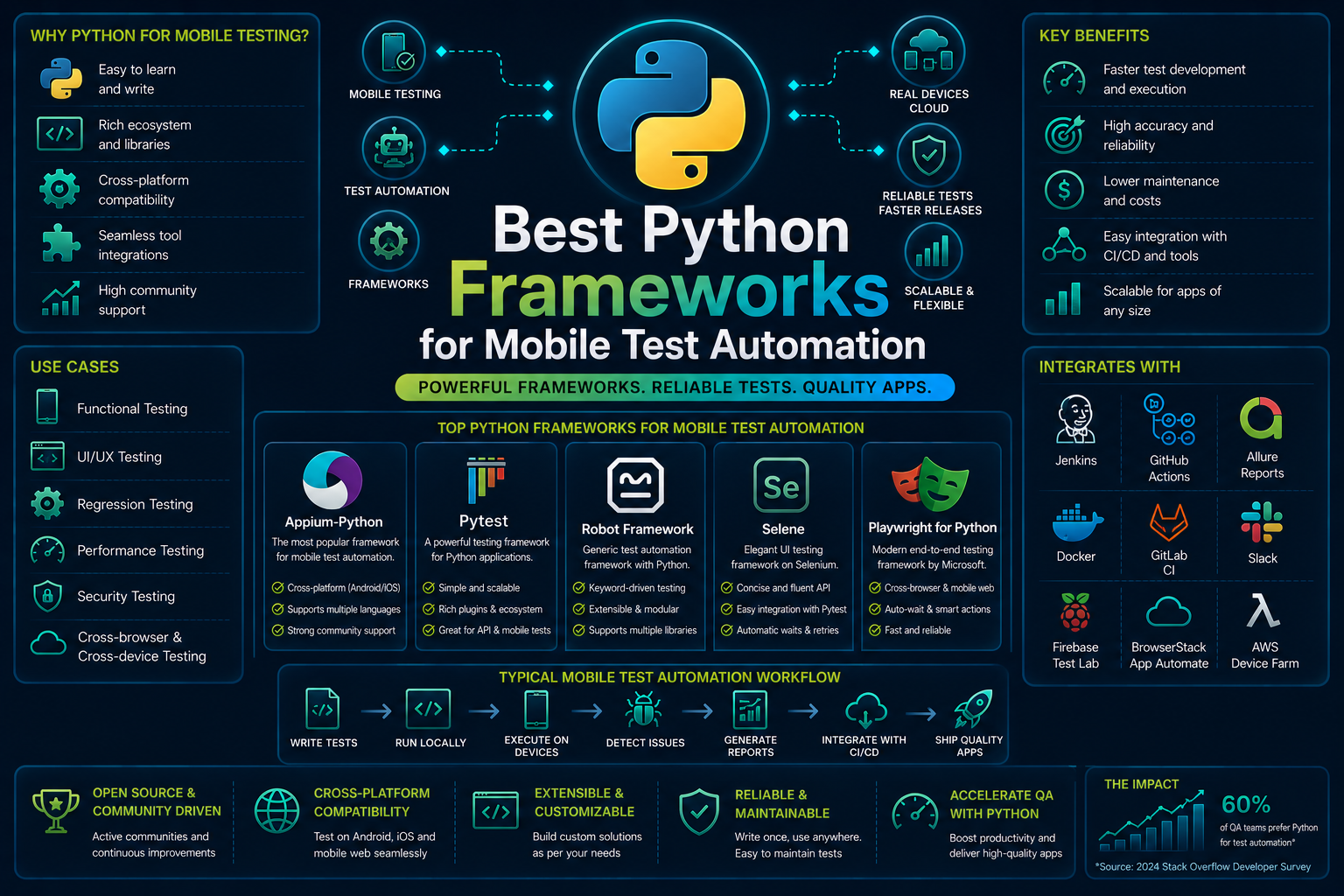

Most guides to Python testing frameworks treat mobile as an afterthought, a single bullet point next to Appium before moving on to web and API testing.
That leaves mobile QA teams without a real comparison of what actually works for Android and iOS specifically.
This guide of Python frameworks for mobile test automation fixes that gap. Every framework here is evaluated specifically on how it handles mobile test automation in Python, not general-purpose Python testing.
We researched what BrowserStack, TestGrid, TestMu AI, and other established testing blogs already rank for, and built this around frameworks mobile QA teams actually use, including several that generic Python testing roundups skip entirely.
Key Tools
- Appium (Python Client): The most widely used Python framework for mobile test automation, covering Android and iOS from one codebase.
- Robot Framework With AppiumLibrary: Keyword-driven mobile testing best suited for QA teams that include non-developers.
- Pytest With Appium-Python-Client: Ideal for teams standardizing mobile, API, and backend testing under one Python framework.
- Behave: A BDD framework using Gherkin syntax for business-readable mobile test automation scenarios.
- Uiautomator2: A fast, Android-only Python library that skips Appium’s server for direct device communication.
- Facebook-WDA: A Python client offering direct, low-level iOS automation control beyond Appium’s driver.
- Airtest: An image recognition-based framework built for testing apps with custom-rendered UI, including games.
- Poco: A cross-engine UI automation framework for apps built with Unity, Cocos2d, or similar rendering engines.
- Tidevice: A Python library focused on iOS device management, app installation, and lifecycle tasks.
- Frida: A dynamic instrumentation toolkit used for runtime and security-focused mobile QA testing.
Why Python Is A Common Choice For Mobile Test Automation
Python’s readability and massive library ecosystem make it a natural fit for QA teams that need to move fast without a steep language learning curve. Test scripts stay short and reviewable, even for testers who are not full-time developers.
The mobile testing space adds a layer most general Python guides miss. Some frameworks reach mobile devices through Appium’s WebDriver protocol, while others talk to Android and iOS natively without Appium in the loop at all.
10 Best Python Frameworks For Mobile Test Automation
1. Appium (Python Client)
Appium remains the most widely used cross-platform mobile automation framework in Python, built on the WebDriver protocol.
The official Python client library, Appium-Python-Client, wraps Appium’s server commands into a Pythonic API that most mobile QA teams already know.
Because Appium supports native, hybrid, and mobile web apps on both Android and iOS from a single codebase, it tends to be the default starting point before teams evaluate anything more specialized.
Key Features
- Cross-platform support for Android and iOS from one test codebase
- WebDriver protocol compatibility with existing Selenium knowledge
- Support for native, hybrid, and mobile web app testing
- Large plugin and driver ecosystem for extending core functionality
- Active open source community with frequent releases
How It Acts As A Python Framework For Mobile QA Teams
Appium-Python-Client exposes Appium’s full gesture and element interaction API through standard Python syntax, letting QA teams write mobile tests using the same pytest or unittest structure they already use elsewhere.
Benefits
- Broadest cross-platform mobile coverage of any framework on this list
- Existing Selenium and WebDriver knowledge transfers directly
- Huge community means most issues already have a documented fix
Limitations
- WebDriver protocol overhead makes it slower than native-only libraries
- Session setup and capability configuration can be fragile across Appium server versions
Price: Free and open source, with costs limited to whatever device infrastructure you run it against.
2. Robot Framework With AppiumLibrary
Robot Framework is a keyword-driven automation framework built on Python, and its AppiumLibrary extension brings mobile testing capability into that same keyword syntax.
Test cases read closer to plain English than raw Python code.
This makes it a common choice for QA teams that include non-developers, since a tester can write a mobile test case without writing conventional Python functions, an approach also common among the tools in our Android app testing tools comparison.
Key Features
- Keyword-driven syntax readable by non-developers
- AppiumLibrary extension for native Android and iOS gesture support
- Built-in HTML reporting and logging without extra configuration
- Tabular test data syntax for structured, reusable test cases
- Support for combining mobile keywords with other Robot libraries in one suite
How It Acts As A Python Framework For Mobile QA Teams
AppiumLibrary translates Robot Framework’s keyword calls into Appium commands under the hood, so a QA team writes readable mobile test steps while Python and Appium handle execution behind the scenes.
Benefits
- Lowers the barrier for QA members without deep Python experience
- Reporting comes built in, without needing a separate tool
- Reusable keyword libraries reduce duplicate test logic across suites
Limitations
- Customizing HTML reports beyond the defaults is genuinely difficult
- Parallel test execution support is weaker than code-first alternatives
Price: Free and open source, maintained by the Robot Framework Foundation.
3. Pytest With Appium-Python-Client
Pytest is the most widely adopted general-purpose Python testing framework, and pairing it with Appium-Python-Client turns it into a capable mobile automation setup.
Its fixture system and plugin ecosystem carry directly over into mobile test suites.
Teams already using pytest for backend or API testing often extend the same framework into mobile rather than adopting a separate tool just for that layer.
Key Features
- Fixture-based setup and teardown for device sessions
- Massive plugin ecosystem, including parallel execution and HTML reporting plugins
- Parametrized testing to run one test case across multiple devices or configurations
- Clean, minimal syntax with no boilerplate class structure required
- Strong CI/CD integration across nearly every major pipeline tool
How It Acts As A Python Framework For Mobile QA Teams
Pytest fixtures manage Appium driver sessions cleanly across test files, so mobile test setup and teardown stay consistent without repeating connection logic in every test.
Benefits
- One framework can cover mobile, API, and backend testing together
- Plugin ecosystem covers almost any reporting or execution need
- Minimal syntax keeps test files easy to read and maintain
Limitations
- Pytest’s own test structure is not directly compatible with other Python test frameworks
- Requires pairing with Appium or another driver, since pytest alone has no mobile capability
Price: Free and open source.
4. Behave
Behave is a Python behavior-driven development framework using Gherkin syntax, the same Given-When-Then format popularized by Cucumber.
Paired with Appium, it lets teams describe mobile test scenarios in business-readable language.
This BDD approach works well when QA, product, and engineering need to agree on expected mobile app behavior before automation even begins.
Key Features
- Gherkin syntax for readable, business-facing test scenarios
- Integration with Appium for underlying mobile device interaction
- Support for reusable step definitions across multiple feature files
- Compatible with Django and Flask for teams testing companion backends
- Tag-based test organization for running specific scenario subsets
How It Acts As A Python Framework For Mobile QA Teams
Behave maps Gherkin scenario steps to Python functions that call Appium commands, so a mobile test scenario written in plain language executes as a real, automated mobile test underneath.
Benefits
- Scenarios are readable by non-technical stakeholders without translation
- Encourages clear agreement on expected behavior before writing automation
- Step reuse across features reduces duplicate mobile test logic
Limitations
- Extra abstraction layer between Gherkin and Appium can slow debugging
- Less flexible than pytest for complex, code-heavy test logic
Price: Free and open source.
5. Uiautomator2
Uiautomator2 is a Python library that communicates directly with Android’s UI Automator framework, bypassing Appium’s server entirely.
This direct connection makes it noticeably faster for pure Android automation.
Because it skips the WebDriver translation layer, it tends to be the choice for teams that only need Android coverage and want to minimize test execution time, a workflow covered in more depth in our Android app test automation guide.
Key Features
- Direct communication with Android’s UI Automator, no Appium server required
- Fast element location and interaction compared to WebDriver-based tools
- Support for complex gestures including swipe, drag, and multi-touch
- Access to Android-specific features like toast message detection
- Lightweight installation with minimal setup overhead
How It Acts As A Python Framework For Mobile QA Teams
Uiautomator2 exposes Android UI Automator’s native capabilities through a Python API, letting QA teams write direct Android test scripts without configuring or maintaining a separate Appium server.
Benefits
- Meaningfully faster execution than Appium-based Android testing
- Fewer moving parts, since no Appium server needs separate maintenance
- Direct access to Android-specific behaviors Appium abstracts away
Limitations
- Android-only, with no path to iOS coverage in the same framework
- Smaller community and documentation base than Appium
Price: Free and open source.
6. Facebook-WDA
Facebook-WDA is a Python client for Facebook’s WebDriverAgent, communicating directly with iOS devices without routing through Appium’s server. It gives teams lower-level control over iOS automation than a WebDriver abstraction typically allows.
This makes it appealing for iOS-focused QA teams that have hit limitations with Appium’s iOS driver and want more direct access to WebDriverAgent’s capabilities, the same audience covered in our iOS app testing tools roundup.
Key Features
- Direct communication with WebDriverAgent on iOS devices
- Lower-level access to iOS UI elements and gestures
- Faster execution than routing through Appium’s iOS driver
- Support for both simulators and real iOS devices
- Compatible with existing WebDriverAgent setups already used for other tooling
How It Acts As A Python Framework For Mobile QA Teams
Facebook-WDA wraps WebDriverAgent’s HTTP interface in Python, letting QA teams script iOS interactions directly against the same automation layer WebDriverAgent exposes, without an Appium server in between.
Benefits
- More direct control over iOS automation than Appium’s abstraction layer
- Faster execution for iOS-specific test suites
- Useful fallback when Appium’s iOS driver hits a limitation
Limitations
- iOS-only, offering no cross-platform coverage
- Requires more manual WebDriverAgent setup knowledge than Appium abstracts away
Price: Free and open source.
7. Airtest
Airtest is a Python-based UI automation framework originally built by NetEase for game testing, though it extends well to general mobile app automation.
It uses image recognition alongside standard element location, which helps with apps that render custom UI elements standard tools cannot read.
This image-based approach makes it particularly useful for apps built with custom rendering engines, where traditional element-based selectors struggle, a rendering challenge also explained in our Flutter app testing guide.
Key Features
- Image recognition-based element location alongside standard selectors
- Cross-platform support for Android, iOS, and Windows applications
- Built-in IDE, AirtestIDE, for visual test recording and debugging
- Poco integration for structured UI hierarchy access
- Report generation with screenshots for each test step
How It Acts As A Python Framework For Mobile QA Teams
Airtest’s Python API lets QA teams script mobile interactions using either image matching or standard locators, giving coverage for custom-rendered UI elements that selector-only frameworks cannot reliably find.
Benefits
- Works on custom-rendered UI where standard element selectors fail
- Visual IDE lowers the barrier for teams new to automation scripting
- Cross-platform coverage beyond just mobile, including desktop apps
Limitations
- Image recognition can be sensitive to resolution and theme changes
- Smaller adoption outside of game testing compared to Appium
Price: Free and open source, with AirtestIDE available as a free companion tool.
8. Poco
Poco is a cross-engine UI automation framework, often paired with Airtest, built to access UI hierarchies in apps using custom rendering engines like Unity or Cocos2d.
Where Airtest relies on image matching, Poco reads the actual UI structure directly.
This makes Poco particularly relevant for mobile QA teams testing apps built with game engines or custom Flutter-style rendering, where standard mobile selectors see nothing usable.
Key Features
- Direct UI hierarchy access for custom rendering engines
- Support for Unity, Cocos2d, and other non-native UI frameworks
- Python API consistent with Airtest for combined test scripting
- Cross-platform support across Android and iOS
- Element querying similar to standard selector-based frameworks
How It Acts As A Python Framework For Mobile QA Teams
Poco exposes a queryable UI tree for apps whose rendering engine hides elements from standard mobile selectors, letting QA teams write structured, selector-style tests instead of relying purely on image recognition.
Benefits
- Solves UI access for custom rendering engines standard tools cannot read
- Pairs naturally with Airtest for combined image and structural testing
- Selector-style queries feel familiar to teams used to Appium
Limitations
- Narrow use case, mainly relevant for game-engine or custom-rendered apps
- Smaller community and fewer learning resources than mainstream frameworks
Price: Free and open source.
9. Tidevice
Tidevice is a Python library focused on iOS device management and communication, handling tasks like app installation, device information retrieval, and low-level iOS interaction.
It is often used alongside a full testing framework rather than as a standalone test runner.
For iOS-focused mobile QA teams, it fills a gap that Appium and WebDriverAgent-based tools do not fully cover around device lifecycle management, one of the areas iOS app test automation handles natively on the platform side.
Key Features
- App installation and uninstallation via Python scripting
- Device information retrieval including battery, storage, and system data
- Low-level iOS protocol communication for device management tasks
- Screen recording and screenshot capture support
- Works well paired with Facebook-WDA or Appium in a broader test setup
How It Acts As A Python Framework For Mobile QA Teams
Tidevice handles the device management layer around iOS testing, installing builds and retrieving device state, so a paired framework like Facebook-WDA or Appium can focus purely on UI interaction.
Benefits
- Fills a real gap in iOS device lifecycle management
- Useful for CI pipelines that need to install fresh builds before each run
- Lightweight and focused, without unnecessary feature bloat
Limitations
- Not a full test automation framework on its own
- iOS-only, with no equivalent Android functionality
Price: Free and open source.
10. Frida
Frida is a dynamic instrumentation toolkit with Python bindings, used less for standard UI testing and more for runtime analysis and security-focused mobile QA.
It lets teams hook into a running app’s functions and inspect or modify behavior in real time.
Mobile QA teams working on security-sensitive apps, particularly in fintech or healthcare, often use Frida alongside a standard UI framework rather than replacing one.
Key Features
- Runtime function hooking for both Android and iOS apps
- Dynamic analysis of app behavior without modifying the app’s source code
- Python API for scripting instrumentation logic
- Support for bypassing common security checks during test environments
- Active community focused on mobile security research
How It Acts As A Python Framework For Mobile QA Teams
Frida’s Python bindings let QA teams script runtime checks against how an app actually behaves under specific conditions, covering security and behavioral edge cases that UI-only frameworks cannot observe.
Benefits
- Covers security and runtime behavior testing no UI framework addresses
- Works alongside existing UI automation rather than replacing it
- Strong fit for regulated industries with security testing requirements
Limitations
- Steep learning curve compared to standard UI automation frameworks
- Not a replacement for functional UI testing, only a complement to it
Price: Free and open source.
Where Panto AI Fits Into This Picture
Panto AI is not a Python framework, and it does not compete with the libraries on this list on those terms.
Panto AI, is an AI-native mobile QA platform that generates and runs tests from plain English descriptions, executing them across 150 or more real Android and iOS devices.
For teams weighing whether to invest in a Python framework at all, Panto works as an alternative path rather than an addition to the stack.
Instead of writing and maintaining Appium locators, pytest fixtures, or Robot Framework keywords, a tester describes a flow and Panto AI’s Flutter test automation or its equivalent builds and maintains the automation behind it.
This matters most for the maintenance burden every framework above eventually creates.
Appium locators break on UI changes, uiautomator2 and Facebook-WDA scripts need updating as OS versions shift, and Frida hooks require ongoing security research to stay current.
Panto’s self-healing automation absorbs many of those changes automatically, and for teams shipping both a Flutter and a native module, React Native test automation coverage sits in the same platform rather than a separate tool.
For teams that still want portable, code-level test assets, it can export tests as Appium or Maestro scripts, giving a path back into the Python ecosystem if needed later.
How These Python Frameworks Compare And Which To Choose
| Framework | Best For | Platform Coverage | Uses Appium | Pricing |
|---|---|---|---|---|
| Appium (Python Client) | Broad cross-platform coverage | Android and iOS | Yes | Free |
| Robot Framework + AppiumLibrary | Non-developer friendly test writing | Android and iOS | Yes | Free |
| Pytest + Appium-Python-Client | Teams standardizing on pytest | Android and iOS | Yes | Free |
| Behave | Business-readable BDD scenarios | Android and iOS | Yes | Free |
| Uiautomator2 | Fast, Android-only automation | Android only | No | Free |
| Facebook-WDA | Direct, low-level iOS control | iOS only | No | Free |
| Airtest | Custom-rendered or game UI apps | Android, iOS, Windows | No | Free |
| Poco | UI hierarchy access for game engines | Android and iOS | No | Free |
| Tidevice | iOS device management and lifecycle | iOS only | No | Free |
| Frida | Security and runtime behavior testing | Android and iOS | No | Free |
How To Choose The Right Python Framework For Mobile Testing
Start with your platform scope. Teams needing both Android and iOS from one codebase should stay with Appium, Robot Framework, pytest, or Behave, all of which support both platforms through Appium.
If your team is Android-only and execution speed matters, uiautomator2 removes the Appium server layer entirely and runs noticeably faster.
iOS-only teams hitting limitations with Appium’s driver should evaluate Facebook-WDA for UI control and tidevice for device management, often used together rather than alone.
Apps built on custom rendering engines, whether game engines or Flutter-style canvases, need Airtest or Poco instead of standard selector-based tools, since neither Appium nor uiautomator2 can reliably read that UI.
Security-sensitive apps in regulated industries should add Frida alongside whichever UI framework the team already uses, since none of the other frameworks on this list cover runtime behavior analysis.
Teams that want to skip the maintenance overhead of any of these frameworks entirely should look at Panto AI, which trades manual script maintenance for self-healing test automation that adapts to UI changes on its own.
What Makes A Framework Genuinely Mobile-Ready In Python
A Python library being usable with a mobile app is not the same as being built for mobile testing.
A few things separate frameworks that genuinely support mobile from ones that technically can, the same distinction that separates the strongest entries in our roundup of mobile app testing tools.
- Direct device or simulator communication, not just HTTP requests to a generic driver
- Gesture support for swipes, pinches, and multi-touch, not just taps
- Platform-specific hooks for permissions, notifications, and app lifecycle events
- Active maintenance, since mobile OS updates break automation tooling faster than web APIs change
Appium-Based vs Native Python Libraries
Most Python mobile automation runs through Appium, which translates WebDriver commands into platform-specific instructions for Android and iOS.
This gives broad cross-platform coverage at the cost of an extra translation layer.
A smaller set of libraries talk to the device directly, either through Android’s UI Automator or iOS’s WebDriverAgent, without going through Appium’s server at all.
These tend to be faster and lighter, but usually cover only one platform.
Both approaches show up on this list, since the right choice depends on whether your team needs cross-platform coverage or deep, single-platform control, similar to the tradeoffs covered in Android app test automation.
Conclusion
Python’s mobile testing ecosystem is broader than most general testing guides suggest, spanning Appium-based frameworks, direct platform libraries, and specialized tools for custom UI and security testing.
The right choice depends on your platform coverage needs, team skill level, and how much locator maintenance your team is willing to take on long term.
For teams that want that maintenance handled rather than managed by hand, an AI-native platform like Panto AI offers a genuinely different path, one that still respects the option to export back into Python-based automation when needed.
FAQs
Q: Is Appium still the best Python framework for mobile testing in 2026?
A: For broad cross-platform mobile coverage, Appium remains one of the strongest Python options in 2026. It supports both Android and iOS and has a mature ecosystem, although platform-specific libraries such as uiautomator2 and Facebook-WDA can offer better performance and lower-level control for single-platform testing.
Q: Do I need Appium to test mobile apps with Python?
A: No. Python developers can use libraries such as uiautomator2, Facebook-WDA, Airtest, and Poco to communicate with mobile devices without running an Appium server. The right choice depends on the platform, application type, and level of device control required.
Q: Which Python mobile testing framework is easiest for non-developers?
A: Robot Framework is one of the most accessible options because its keyword-driven syntax is designed to be readable without advanced Python knowledge. Behave is another option, using Gherkin-style scenarios that allow testers to describe behavior in plain, business-readable language.
Q: Can Python frameworks test Flutter apps or mobile games?
A: Standard selector-based frameworks such as Appium can have limitations with Flutter apps and game engines because these applications often render their own UI rather than exposing a conventional native view hierarchy. Airtest and Poco are better suited to applications that require image-based or engine-aware interaction.
Q: Is Panto AI a replacement for Python mobile testing frameworks?
A: It can be an alternative for teams that want to reduce the need to write and maintain mobile test scripts manually. Panto AI’s AI automation testing lets teams create and execute mobile tests from natural-language instructions, while teams that prefer code-based workflows can continue using frameworks such as Appium.