

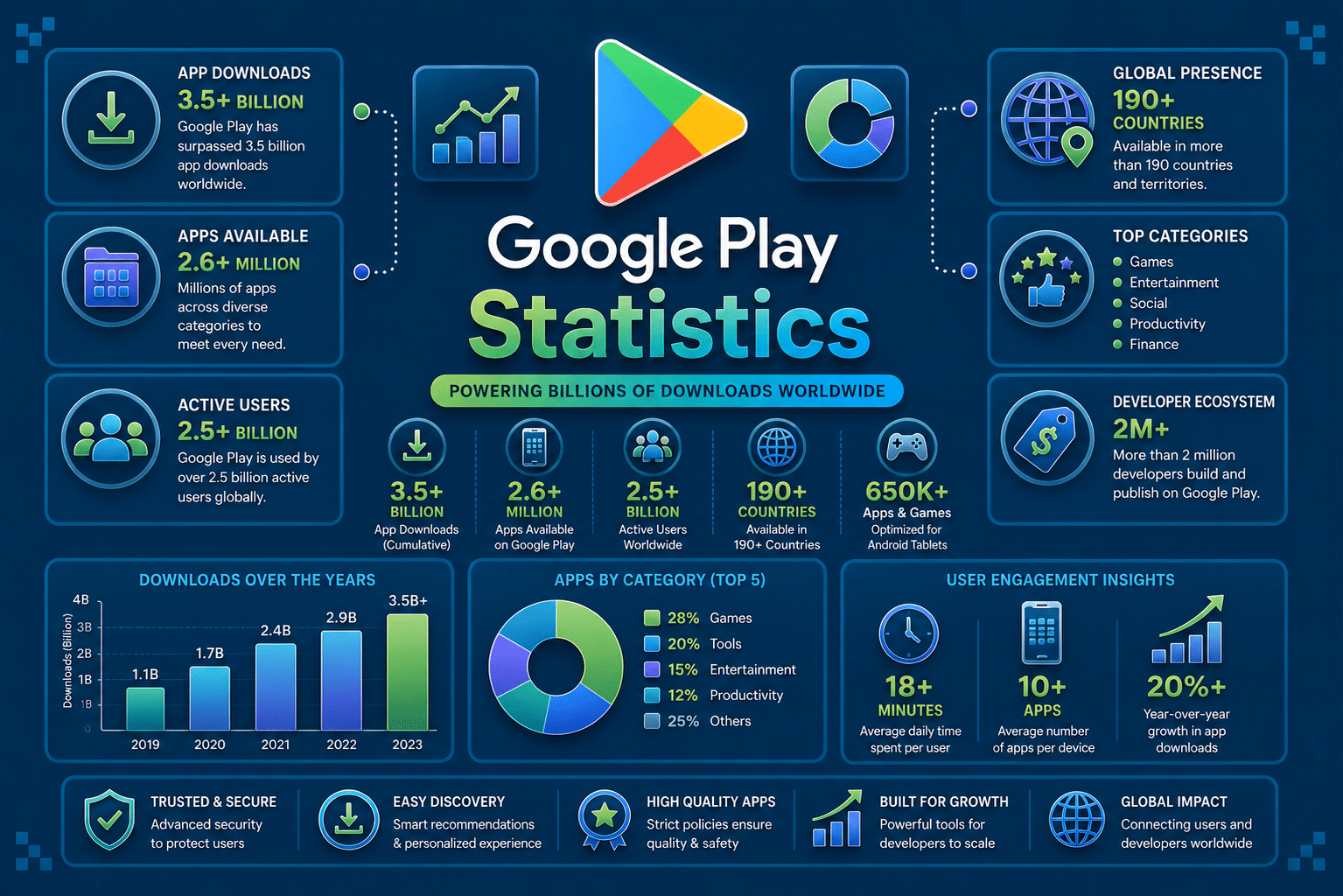

Google Play now reaches more than 2.5 billion people every month across 190+ countries, while Google says more than 2 million developers work with the platform.
Independent market trackers also estimate that consumers spent $49.2 billion on Google Play in 2025, up 13% year over year.
Those numbers show why Google Play still matters even in a mature app market: it combines massive audience scale, a very large app catalog, and a monetization engine that keeps expanding.
This article looks at Google Play users, app supply, usage patterns, revenue, competitive position, geography, and broader mobile-market trends.
Key Insights from Google Play Statistics 2026
- Google Play reaches more than 2.5 billion monthly users across 190+ countries, making it one of the world’s largest app distribution platforms.
- More than 2 million developers build and publish apps on Google Play, according to Google.
- Google Play hosts 2,396,759 apps across 739,499 publishers, making it one of the largest app marketplaces globally.
- Consumers spent an estimated $49.2 billion on Google Play in 2025, with revenue growing 13% year over year.
- 97.05% of all Google Play apps are free, highlighting the dominance of the freemium app business model.
- India recorded 18 billion Google Play downloads in 2025, accounting for 22.1% of global Google Play installs, the highest share of any country.
Google Play Statistics 2026 at a Glance
| Metric | Figure |
| Monthly users | 2.5B+ people |
| Countries reached | 190+ |
| Developers | 2M+ |
| Apps available | 2,396,759 |
| Publishers | 739,499 |
| Free apps share | 97.05% |
| New apps per day | 2,442 |
| Consumer spend in 2025 | $49.2B |
| Revenue growth in 2025 | +13% YoY |
| Google One revenue | $2.633B |
Google Play Statistics: A Deep Dive
1. Google Play Statistics: User Statistics 2026
Google’s last publicly stated platform-scale user figure remains more than 2.5 billion monthly users, which is a useful anchor for Google Play’s audience size.
The same announcement also said Google Play operates in over 190 countries and supports more than 2 million developers, so the user base is matched by a very large supply-side ecosystem.
| Year | Google Play user / ecosystem milestone | Figure |
| 2012 | Google Play launched globally | Launch year |
| 2022 | Monthly Google Play audience | 2.5B+ people |
| 2022 | Countries covered | 190+ |
| 2022 | Developers on the platform | 2M+ |
| 2026 | Apps indexed by 42matters | 2,396,759 |
The user side of Google Play is also shaped by the broader Android app economy.
Access Partnership research, cited by Google, said 255 billion apps were downloaded in 2022 and the average smartphone user had around 90 apps installed.
That matters because Google Play sits in the middle of a market where users are already app-rich, so growth depends less on first-time discovery and more on retention, monetization, and product quality.
Teams building cross-platform Android applications increasingly rely on React Native automated testing to validate releases across different devices before publishing updates to Google Play.
2. Google Play Statistics: Usage & Adoption Statistics 2026
Usage on the mobile app market remains high even as growth slows.
Sensor Tower reported 136 billion downloads across iOS and Google Play in 2024, then said total downloads edged up to nearly 150 billion in 2025, while consumers spent 5.3 trillion hours in apps that year.
As engagement continues to rise, comprehensive mobile app testing becomes increasingly important for maintaining app quality across every update.
The same report puts that at roughly 3.6 hours per day per mobile user. For our complete report on mobile app statistics, see here →
| Usage metric | Figure |
| Global app downloads, 2024 | 136B across iOS + Google Play |
| Global app downloads, 2025 | Nearly 150B across iOS + Google Play |
| Time spent in apps, 2025 | 5.3T hours |
| Average time per day | ~3.6 hours per mobile user |
| Average smartphone apps installed | ~90 apps |
A key adoption trend is that downloads have flattened while engagement and monetization remain resilient.
Sensor Tower says downloads have hovered around 135–140 billion a year since 2020.
This suggests Google Play’s growth story is now more about extracting value from a mature audience than adding brand-new mobile users.
Since many Android applications today are built with Flutter, investing in automated Flutter app testing helps teams detect regressions before every Play Store release.
3. Google Play Statistics: Demographics Statistics 2026
AppTweak’s 2025 Google Play country data shows that Google Play demand is heavily concentrated in a handful of large Android markets, led by India at 18 billion downloads.
| Country | Google Play app downloads, 2025 | Share of Google Play downloads | YoY growth |
| India | 18B | 22.1% | -16% |
| Brazil | 7.7B | 9.4% | -11% |
| United States | 5.8B | 7.1% | -5% |
| Indonesia | 5.7B | 7.0% | -0.3% |
| Mexico | 3.8B | 4.6% | -10% |
| Philippines | 2.6B | 3.2% | -8% |
| Turkey | 2.4B | 3.0% | -13% |
| Pakistan | 2.3B | 2.9% | -16% |
| Egypt | 1.8B | 2.2% | -168% |
| Germany | 1.7B | 2.1% | +2% |
India’s 22.1% share makes it the single most important Google Play demand center in AppTweak’s data, while Brazil, the U.S., and Indonesia form the next tier.
The pattern matters because it shows Google Play is strongest where Android is strongest: large populations, mobile-first behavior, and high app-install frequency.
Organizations shipping Android apps at scale typically combine continuous delivery with Android app testing automation to catch device-specific issues before production.
4. Google Play Statistics: Revenue & Financial Statistics 2026
Business of Apps estimates that consumers spent $49.2 billion on Google Play in 2025, up 13% from the previous year.
It also estimates that the App Store made $117 billion in 2025, which means Google Play still monetizes at a lower level than Apple even though both stores dominate the app economy outside China.
| Revenue metric | Figure |
| Google Play consumer spend, 2025 | $49.2B |
| Google Play revenue growth | +13% YoY |
| App Store consumer spend, 2025 | $117B |
| Google Play’s top grossing app, 2025 | Google One at $2.633B |
Revenue is also concentrated at the top. Google One alone generated $2.633 billion, while TikTok earned $1.684 billion and the next two apps in the ranking were tied at $587 million each.
Google One remained the highest-grossing application on Google Play during 2025 with an estimated $2.633 billion in consumer spending, demonstrating the shift toward subscription-driven monetization.
That concentration shows how much of Google Play’s monetization comes from a relatively small number of breakout titles and subscriptions.
Google Play’s category mix also helps explain the revenue profile.
Business of Apps’ broader mobile-revenue data shows that the app economy remains subscription- and IAP-driven, and Google Play itself captured $31 billion of mobile game spend in 2025.
That implies games accounted for roughly 63% of Google Play consumer spend, leaving the rest to non-gaming subscriptions, utilities, productivity, media, and commerce apps.
5. Google Play Statistics: Enterprise Adoption Statistics 2026
Google Play is not an enterprise software product in the traditional SaaS sense, but it is deeply business-facing.
Google says more than 2 million developers build on Play, and Play Console is positioned as the tool to publish, monetize, and grow apps and games at scale.
Google Play Pass also offers access to over 1,000 apps and games, showing that curated distribution still has room inside the platform.
| Business / adoption metric | Figure |
| Developers on Google Play | 2M+ |
| Google Play Pass catalog | 1,000+ apps and games |
| Play Console purpose | publish, monetize, grow |
| Benchmarking in Play Console | compare against similar apps |
Google’s own Play Console statistics page emphasizes benchmarking, trend analysis, and comparison against peer apps, which tells you Google Play is increasingly a performance platform as much as a distribution store.
As Android development becomes increasingly complex, many engineering teams are adopting AI powered mobile automation to reduce manual QA effort and accelerate release cycles.
Google reports that Play Integrity API is now used by millions of apps to help detect fraud, abuse, and compromised devices before transactions occur.
6. Google Play Statistics: Market Share & Competitive Statistics 2026
Outside China, Apple and Google together control more than 95% of the app store market through iOS and Android, according to Business of Apps.
That makes Google Play a structural half of the global app-store duopoly, even though it earns less consumer spend than Apple’s App Store.
| Metric | Google Play | Apple App Store |
| Apps and games, 2025/2026 snapshot | 2,396,759 | 2.42M |
| Free apps share | 97.05% | 95.8% |
| Consumer spend, 2025 | $49.2B | $117B |
| Market structure | Part of >95% duopoly outside China | Part of >95% duopoly outside China |
The revenue gap is material. Google Play’s $49.2 billion in 2025 consumer spend is still large, but it is far below the App Store’s $117 billion.
At the same time, Google Play’s install scale remains enormous, so the platform’s competitive edge is breadth and reach, not the highest consumer spend per user.
7. Google Play Statistics: Developer / Platform Statistics 2026
The Google Play catalog remains huge even after stronger quality controls. 42matters counts 2,132,712 apps and 264,047 games, with games making up 11.02% of the store. It also says 97.05% of apps are free and only 2.95% are paid.
According to Google, developers distributed over 200 billion app updates through Google Play during 2024, highlighting the growing importance of automated release validation.
| Platform metric | Figure |
| Total apps | 2,396,759 |
| Apps (non-games) | 2,132,712 |
| Games | 264,047 |
| Free apps | 2,325,295 |
| Paid apps | 70,668 |
| Categories | 49 |
| New apps per day | 2,442 |
| New apps per month | 87,913 |
| Apps with ratings | 1,124,704 |
This ecosystem is still highly active.
Even with a catalog that already exceeds 2.39 million apps, Google Play continues to add nearly 2,443 apps a day,
This shows that the platform’s main challenge is no longer supply scarcity but discoverability and quality control.
8. Google Play Statistics: Regional Statistics 2026
Google Play’s global reach is driven primarily by large Android markets in Asia, Latin America, and North America.
According to AppTweak’s 2025 country analysis, India remained the largest Google Play market with 18 billion downloads, accounting for 22.1% of all Google Play installs worldwide.
Brazil, the United States, and Indonesia followed as the next three largest markets, highlighting Android’s particularly strong adoption across emerging economies.
These four countries alone generated 45.6 billion Google Play downloads during the reporting period.
Google Play Statistics: Top Google Play Markets by Downloads
| Country | Google Play Downloads (2025) | Share of Global Google Play Downloads | YoY Growth |
| India | 18.0B | 22.1% | -16% |
| Brazil | 7.7B | 9.4% | -11% |
| United States | 5.8B | 7.1% | -5% |
| Indonesia | 5.7B | 7.0% | -0.3% |
| Mexico | 3.8B | 4.6% | -10% |
| Philippines | 2.6B | 3.2% | -8% |
| Turkey | 2.4B | 3.0% | -13% |
| Pakistan | 2.3B | 2.9% | -16% |
| Egypt | 1.8B | 2.2% | -16.8% |
| Germany | 1.7B | 2.1% | +2% |
Several regional trends stand out from the data:
- India recorded 18 billion Google Play downloads, representing 22.1% of all Google Play installs worldwide.
- Brazil ranked second with 7.7 billion downloads, accounting for 9.4% of global installs.
- The United States generated 5.8 billion downloads, representing 7.1% of Google Play’s worldwide download volume.
- Indonesia reached 5.7 billion downloads, narrowly trailing the U.S. while posting the smallest decline among the four largest markets (-0.3% YoY).
- The top four markets (India, Brazil, the U.S., and Indonesia) together generated 45.6 billion downloads, representing nearly 56% of all downloads in AppTweak’s top-10 dataset.
- Germany was the only country in the top ten to record positive year-over-year growth (+2%), while most major Android markets experienced modest declines.
The geographic distribution of installs shows that Google Play continues to benefit from strong demand in high-population countries where Android remains the dominant mobile operating system.
India alone generated more than twice as many Google Play downloads as Brazil, the second-largest market.
The regional data also suggests that Google Play has entered a mature phase in many of its largest markets.
Rather than rapid expansion in downloads, future growth is increasingly expected to come from higher user engagement, subscription revenue, and in-app spending.
This is particularly increased in large Android-first economies across Asia, Latin America, and parts of Africa.
9. Google Play Statistics: Market Trends & Industry Growth 2026
The broader mobile-app market is still growing, but the growth profile has changed.
Sensor Tower says total downloads across iOS and Google Play rose only 0.8% in 2025 to nearly 150 billion, while revenue from in-app purchases and paid apps and games reached $167 billion, up 10.6% year over year.
Sensor Tower also reports that consumer spending across mobile applications reached $167 billion in 2025, increasing 10.6% year over year, even as download growth remained below 1%.
In other words, monetization is growing faster than raw installs.
| Market trend metric | Figure |
| Total downloads across iOS + Google Play, 2025 | Nearly 150B |
| YoY download growth | +0.8% |
| Time spent in apps, 2025 | 5.3T hours |
| Mobile IAP and paid revenue, 2025 | $167B |
Google’s own ecosystem framing supports that same maturity narrative. Access Partnership research cited by Google says 255 billion apps were downloaded in 2022.
The average smartphone user has about 90 apps installed, which means app markets are now competing for attention inside already crowded phones.
Conclusion
Google Play remains a giant: 2.5 billion+ monthly users, 2.396 million apps, and $49.2 billion in estimated 2025 consumer spend.
The store is still overwhelmingly free-first, with 97.05% of apps listed as free and 2,442 new apps arriving each day.
The bigger story is that Google Play has moved from pure growth to monetization efficiency.
India’s 18 billion downloads and the broader mobile market’s $167 billion in annual app spending show that scale still matters, but the strongest gains now come from revenue, retention, and top-tier app performance.
FAQs
Q: How many users does Google Play have?
A: Google says Google Play serves more than 2.5 billion monthly users across 190+ countries, making it the world’s largest Android app marketplace.
Q: How many apps are on Google Play in 2026?
A: According to 42matters’ 2026 dataset, Google Play hosts approximately 2.40 million apps, with new titles added every day across every major app category.
Q: How much revenue does Google Play generate?
A: Business of Apps estimates that consumers spent $49.2 billion on Google Play in 2025, representing 13% year-over-year growth compared with 2024.
Q: Which country generates the most Google Play downloads?
A: India remained the largest Google Play market in 2025, recording approximately 18 billion app downloads and accounting for 22.1% of global installs.
Q: What percentage of Google Play apps are free?
A: Nearly all Google Play apps are free to download. The 42matters 2026 dataset shows that 97.05% of listed apps are free, while fewer than 3% require an upfront purchase.
Q: How many new apps are published on Google Play each day?
A: Google Play continues to grow rapidly, with 42matters estimating an average of 2,442 new apps published every day, or roughly 87,900 new apps each month.
Q: Is Google Play bigger than Apple’s App Store?
A: It depends on the metric. By revenue, Apple’s App Store is larger, generating approximately $117 billion in 2025 versus Google Play’s $49.2 billion. By global reach, Google Play remains one half of the dominant app store duopoly, together with the App Store accounting for more than 95% of the global app store market outside China.