

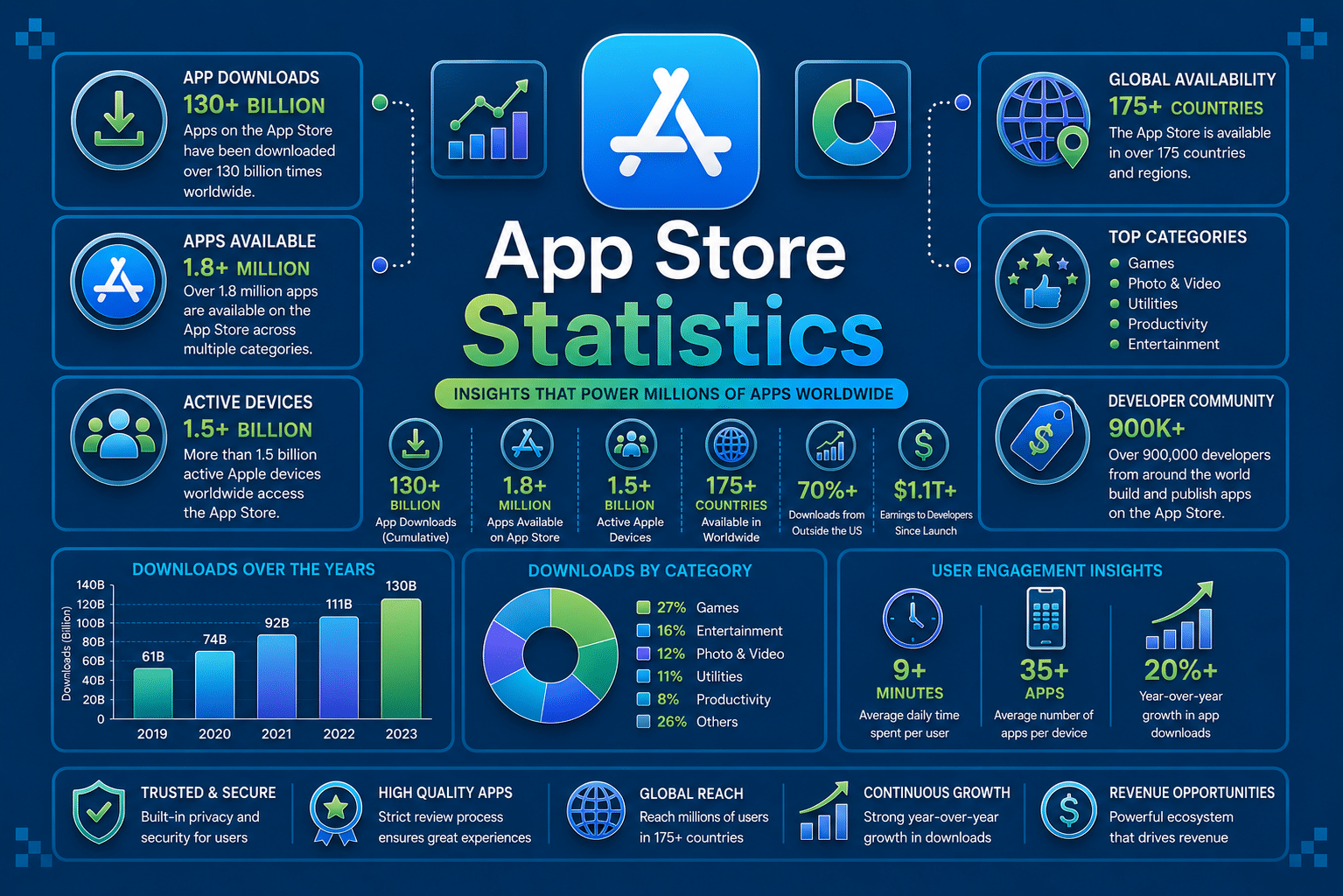

The Apple App Store now serves over 850 million weekly users across 175 countries and regions.
In 2025, the App Store ecosystem facilitated over $1.4 trillion in total developer billings and sales, nearly tripling in size since 2019.
App Store is the primary commercial layer for iOS software, subscription services, digital goods, and an expanding share of physical retail and travel commerce conducted through mobile.
As the mobile app ecosystem continues to evolve, Panto AI helps engineering teams automate testing across Android and iOS applications before every release.
This article covers Apple App Store statistics across downloads, revenue, developer activity, geographic distribution, competitive benchmarks, fraud prevention, and market trends as of mid-2026.
Key Insights: Apple App Store Statistics at a Glance
- The App Store records approximately 37–38 billion app downloads annually
- Consumer spending on iOS reached $117.6 billion in 2025, a 13.6% increase from 2024
- The App Store ecosystem facilitated $1.4 trillion in developer billings and sales in 2025
- More than 90% of App Store ecosystem transactions did not incur any Apple commission
- Apple blocked $2.2 billion in potentially fraudulent transactions in 2025, part of a six-year total exceeding $11.2 billion
- Games account for $51.9 billion of App Store consumer spending in 2025; non-gaming apps accounted for $64.8 billion
- iOS users spend 2.1× more per app than Android users
- The App Store generated approximately 70.5% of combined iOS and Google Play consumer spending in 2025
- ChatGPT was the most downloaded free iPhone app in the US in 2025
- Over 40 of the top 100 App Store apps featured consumer-facing AI capabilities in 2025
- Apple’s App Review team evaluated over 9.1 million app submissions in 2025
- The App Store is available in 175 countries and regions and supports over 45 currencies
Apple App Store Statistics 2026 at a Glance
| Metric | Figure |
| Annual downloads | ~37 billion (2025) |
| Weekly active users | 850 million+ |
| Consumer spending (iOS) | $117.6 billion (2025) |
| Total ecosystem billings and sales | $1.4 trillion (2025) |
| Physical goods/services in ecosystem | $1.1 trillion (2025) |
| Digital goods/services in ecosystem | $149 billion (2025) |
| In-app advertising revenue (ecosystem) | $151 billion (2025) |
| Games consumer spending | $51.9 billion (2025) |
| Non-game consumer spending | $64.8 billion (2025) |
| Fraudulent transactions blocked (2025) | $2.2 billion |
| Six-year fraud prevention total | $11.2 billion+ |
| App submissions reviewed (2025) | 9.1 million |
| New developers welcomed (2025) | 306,000+ |
| Countries / storefronts | 175 |
| App Store commission (standard) | 30% |
| Small Business Program rate | 15% (under $1M proceeds) |
| US external payment commission | 0% (as of May 2025) |
Apple App Store Statistics: Deep Dive
1. Apple App Store Statistics: Download Statistics
The App Store has grown from 500 apps at launch in 2008 to approximately 1.86–2.42 million apps available today.
Annual download volume on the App Store reached approximately 37 billion in 2025, per electroiq and Sensor Tower estimates.
For context, Google Play recorded an estimated 136 billion downloads over the same period — roughly 3.7× more than the App Store. Read our complete report on Google Play statistics here →
That gap reflects Android’s broader global footprint in lower-income markets, not higher per-user engagement. iOS users download fewer apps but generate significantly more revenue per download.
Apple App Store Statistics: Download Volume Over Time
| Year | Estimated Downloads |
| 2024 | ~36 billion |
| 2025 | ~37 billion |
| 2026 (projected) | ~38 billion |
The US generated 8.5 billion App Store downloads in 2025 (+14.42% YoY), followed by China at approximately 6.6 billion downloads. Japan posted consistent growth at +13.98% YoY.
The UK saw monthly active users surge +78.39% YoY — the highest MAU growth of any major App Store market in 2025. Vietnam led the top 10 by download growth rate at +15.50% YoY.
2. Apple App Store Statistics: Revenue Statistics
Revenue is where the App Store’s structural advantage is clearest. iOS generates substantially more consumer spending per download than Google Play, across nearly every category.
Maintaining that monetization advantage requires consistent quality across devices, making iOS app testing an essential part of every App Store release cycle.
Consumer spending on the App Store reached $117.6 billion in 2025, a 13.6% increase over 2024. Of that total:
- $51.9 billion came from games
- $64.8 billion came from non-gaming apps — the first year non-gaming outpaced gaming in absolute terms
The broader ecosystem figure is considerably larger.
Apple’s June 2026 report, produced by economists at Analysis Group, measured $1.4 trillion in total developer billings and sales in 2025.
This encompasses retail, travel, food delivery, and other commerce conducted through iOS apps.
Physical goods and services alone accounted for $1.1 trillion of that total.
App Store Revenue Breakdown (2025)
| Revenue Type | 2025 Figure |
| Total consumer spending (iOS) | $117.6 billion |
| Games consumer spending | $51.9 billion |
| Non-game consumer spending | $64.8 billion |
| Physical goods/services (ecosystem) | $1.1 trillion |
| Digital goods/services (ecosystem) | $149 billion |
| In-app advertising (ecosystem) | $151 billion |
| Total ecosystem billings and sales | $1.4 trillion |
The US App Store generated $20.2 billion in revenue in 2025, the highest of any single country market, per FoxData Market Intelligence.
Apple App Store Statistics: Apple App Store vs. Google Play: Competitive Statistics
The App Store generates significantly more consumer spending than Google Play despite lower total download volumes, a gap that has remained stable for several years.
iOS App Store vs. Google Play (2025)
| Metric | Apple App Store | Google Play |
| Consumer spending | $117.6 billion | $49.2 billion |
| App Store share of combined revenue | ~70.5% | ~29.5% |
| Annual downloads | ~37 billion | ~136 billion |
| Spend per user vs Android | 2.1× more | Baseline |
| EU alternative marketplace adoption | <3% | — |
iOS users spend 2.1× more per app than Android users on average.
The App Store captured approximately 70.5% of combined consumer spending across both major stores in 2025, from roughly 21% of total combined downloads.
This illustrates how sharply monetization diverges between the two platforms.
3. Apple App Store Statistics: Usage and App Categories
Games remain the dominant category by both downloads and revenue.
By download share, games account for approximately 30–41% of all App Store downloads, followed by Photo and Video (~10%), Shopping (~8%), and Entertainment (~7%).
By revenue, games generated $51.9 billion in consumer spending in 2025, representing approximately 44% of total direct consumer spending.
Business of Apps notes non-gaming apps crossed $64.8 billion in the same period, outpacing gaming in absolute terms for the first time.
AI apps marked the most significant category-level shift in 2025.
More than 40 of the top 100 App Store apps featured consumer-facing AI capabilities, and those apps collectively showed stronger billing growth than other top-100 apps.
Apple App Store Statistics: Category Breakdown by Download Share (2024–2025)
| Category | Share of Downloads |
| Games | 30–41% |
| Photo and Video | ~10% |
| Shopping | ~8% |
| Entertainment | ~7% |
4. Apple App Store Statistics: Developer and Platform Statistics
The App Store serves over 850 million weekly users across 175 countries and regions.
Apple’s App Review team processed 9.1 million app submissions in 2025 and welcomed more than 306,000 new developers to the platform .
At this scale, comprehensive mobile app testing helps teams deliver reliable experiences across different iPhone models, iPads, operating system versions, and network conditions.
Apple App Store Statistics: Developer Ecosystem Metrics
| Metric | Figure |
| App submissions reviewed (2025) | 9.1 million |
| New developers welcomed (2025) | 306,000+ |
| Developer accounts banned (fraud) | 193,000 |
| Developer enrollment rejections | 138,000+ |
| Apps using Apple Pay / StoreKit | 680,000+ |
| Supported currencies | 45 |
| Supported local payment methods | 195 |
| Standard commission rate | 30% |
| Small Business Program rate | 15% |
| Small Business Program threshold | $1M in annual proceeds |
The App Store Small Business Program reduces commissions from 30% to 15% for developers earning under $1 million in annual proceeds. Apple states that the vast majority of developers on the App Store qualify .
88% of EU developers pay no Apple commission at all, and 75% are enrolled in the Small Business Program with reduced rates, per Apple’s own November 2025 analysis.
5. Apple App Store Statistics: Fraud Prevention Statistics
Apple publishes annual fraud prevention data as part of its regulatory positioning. The figures below are self-reported by Apple and have not been independently audited.
In 2025, Apple blocked $2.2 billion in potentially fraudulent transactions, bringing the six-year cumulative total to over $11.2 billion .
Apple App Store Statistics: Fraud Prevention (2025)
| Metric | Figure |
| Fraudulent transactions blocked | $2.2 billion |
| Six-year fraud prevention total | $11.2 billion+ |
| Risky app submissions rejected | 2 million+ |
| Fraudulent account creation attempts blocked | 1.1 billion+ |
| Customer accounts deactivated | 40.4 million |
| Developer accounts permanently banned | 193,000 |
| Stolen credit cards blocked | 5.4 million |
Modern App Store fraud has expanded beyond stolen payment credentials.
Apple’s 2025 report specifically highlighted enforcement against fake reviews, chart manipulation, cloned apps, subscription scams, and bot-driven installsle, May 2026).
6. Apple App Store Statistics: Geographic Statistics
The US is the largest single App Store market by both download volume and revenue. Regional dynamics have shifted considerably over the past six years.
Apple App Store Statistics: Top App Store Markets by Downloads (2025)
| Country | Downloads (2025) | Revenue (2025) | YoY Download Growth |
| United States | 8.5 billion | $20.2 billion | +14.42% |
| China | ~6.6 billion | High (2nd globally) | MAU decline: -6.44% |
| Japan | — | High monetization | +13.98% |
| United Kingdom | — | Growing | +14.83% / MAU +78.39% |
| Vietnam | — | Emerging | +15.50% (fastest top 10) |
Key regional findings:
- App Store billings and sales have more than doubled in China and more than tripled in both the US and Europe over the past six years
- Travel was the second-largest spending category in the US, Europe, Japan, Australia, New Zealand, and Brazil
- In China, physical goods and services comprised approximately 90% of total billings and sales, versus ~70% elsewhere in the world
- General retail ranked as the #1 spending category across all regions
The US accounted for $20.2 billion in App Store revenue in 2025, the highest of any single market.
7. Apple App Store Statistics: Most Downloaded and Highest-Grossing Apps
Most Downloaded Free iPhone Apps (US, 2025)
| Rank | App | Category |
| 1 | ChatGPT | AI / Productivity |
| 2 | Threads | Social |
| 3 | Search | |
| 4 | TikTok | Video / Social |
| 5 | Messaging | |
| 6 | Social | |
| 7 | YouTube | Video |
| 8 | Google Maps | Navigation |
| 9 | Gmail | |
| 10 | Google Gemini | AI |
ChatGPT was the most downloaded free iPhone app in the US in 2025 — the first AI app to claim the top spot in Apple’s annual ranking. It ranked fourth in 2024 and did not appear in the top 10 in 2023.
For a deeper look at ChatGPT’s growth, downloads, revenue, and adoption trends, see our complete ChatGPT statistics report.
Google Gemini was the only other AI chatbot to reach the top 10, placing tenth.
Between January and November 2025, ChatGPT accumulated more than 900 million global downloads, pushing total installs past 1.3 billion since its May 2023 iOS launch.
ChatGPT’s mobile app reached $2 billion in cumulative lifetime consumer spending by mid-2025 — approximately 30× the combined lifetime mobile spending of rival AI apps including Claude, Copilot, and Grok.
8. Apple App Store Statistics: Market Trends and Regulatory Context
AI is reshaping App Store category economics. Over 40 of the top 100 App Store apps featured consumer-facing AI capabilities in 2025, and those apps showed stronger billing growth than the rest of the top 100.
As AI-powered applications become more complex, many development teams are adopting AI automation testing to validate dynamic user journeys and AI-assisted workflows before deployment.
Apple integrated ChatGPT directly into iOS via Visual Intelligence and iOS 26 expands on-device AI across the platform.
The regulatory environment shifted materially in 2025.
Following the April 2025 contempt ruling in Epic v. Apple, US developers can link to external payments at 0% Apple commission — the first time no-commission external linking has been available on iOS in the US.
The Ninth Circuit upheld the contempt finding in December 2025. Apple was separately fined €500 million by the European Commission in April 2025 for non-compliance with the EU Digital Markets Act (DMA).
Despite the DMA requiring Apple to allow alternative app stores in the EU since March 2024, EU alternative marketplace adoption rates remain below 3% as of 2025.
VisionOS is an early-stage but growing category. visionOS apps for Apple Vision Pro exceeded 4,200 AR/VR titles by Q1 2026.
Conclusion
The Apple App Store generated $117.6 billion in direct consumer spending in 2025 and facilitated $1.4 trillion in total ecosystem transactions, nearly three times the scale of 2019.
The platform serves over 850 million weekly users, and non-gaming apps crossed gaming in absolute spending for the first time, while AI-powered apps posted the strongest billing growth of any segment in the top 100.
What these figures collectively signal is that the App Store has matured from a software distribution channel into a full commerce and advertising infrastructure.
For developers and market observers, the App Store’s ability to generate nearly 2.5× the consumer spending of Google Play from a fraction of the downloads is the defining characteristic of the iOS platform.
FAQs
Q: How many users does the Apple App Store have?
A: Apple reports that the App Store serves more than 850 million average weekly users across 175 countries and regions, making it one of the world’s largest digital app marketplaces.
Q: How much revenue does the Apple App Store generate?
A: Consumer spending on the App Store reached approximately $117.6 billion in 2025. Looking beyond app purchases alone, Apple says its developer ecosystem generated $1.4 trillion in billings and sales across physical goods, digital goods, services, and in-app advertising.
Q: How many apps are available on the Apple App Store?
A: Current estimates range from roughly 1.86 million to 2.42 million apps. The difference comes from how research firms count regional variants, enterprise apps, hidden listings, and inactive titles.
Q: How many apps are downloaded from the App Store each year?
A: Industry estimates from Sensor Tower and electroiq put App Store downloads at approximately 37 billion in 2025. Apple does not publish an official annual download figure.
Q: What commission does Apple charge on App Store purchases?
A: Apple’s standard App Store commission is 30%. Developers earning under $1 million annually qualify for the 15% Small Business Program. In the United States, developers can now link users to external payment options with 0% Apple commission following the April 2025 Epic v. Apple ruling, while developers in the EU are subject to Apple’s Core Technology Commission and alternative distribution terms.
Q: What are the most popular App Store categories?
A: Games remain the largest category by both downloads and consumer spending, generating approximately $51.9 billion in 2025. However, non-gaming apps collectively generated even more revenue, reaching $64.8 billion. Among the top-performing apps, AI-powered applications were the fastest-growing segment by consumer spending.
Q: How does the Apple App Store compare with Google Play?
A: The App Store generated approximately $117.6 billion in consumer spending during 2025, compared with $49.2 billion for Google Play. That gave Apple roughly 70.5% of combined two-store revenue despite accounting for only about 21% of total downloads, highlighting the significantly higher spending per iOS user.