

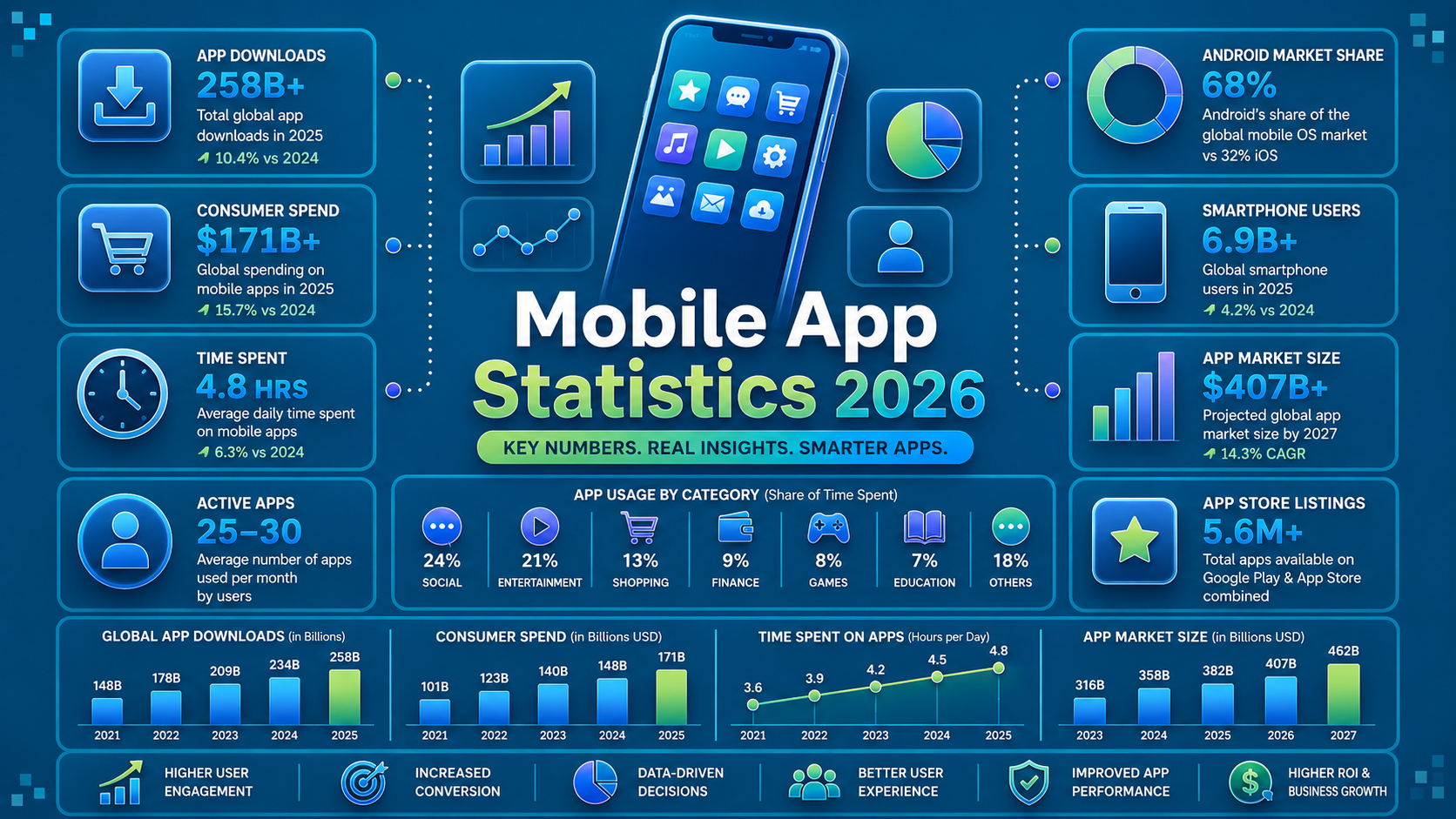

Mobile app usage is still expanding at a massive scale. In 2025, app stores recorded roughly 142.2 billion app and game downloads, which works out to about 389.6 million downloads a day by simple division.
At the same time, Apple said the App Store alone reached over 850 million average weekly users globally, showing that mobile apps are no longer a niche channel but a core digital habit.
This article looks at the biggest mobile app statistics for 2026, including users, usage, downloads, app creation, revenue, market share, and regional trends.
Mobile App Statistics 2026: Key Insights & Takeaways
- 142.2 billion app and game downloads in 2025 equal about 389.6 million downloads a day, underscoring how large the mobile install economy still is.
- App-only downloads still reached 96.9 billion in 2025, or roughly 265.5 million per day, even without counting games.
- The two biggest stores saw 5,244 new releases in the last 24 hours in 42matters’ live snapshot, showing how fast the supply side keeps moving.
- Apple said the App Store reached 850 million+ weekly users, and developers have earned more than $550 billion on the platform since 2008.
- Global mobile app monetization reached $167 billion in 2025, while the App Store ecosystem alone facilitated $1.4 trillion in billings and sales.
- App usage intensity remains high: consumers spent 5.3 trillion hours in mobile apps in 2025, or about 3.6 hours per day per user.
Mobile App Statistics 2026 at a Glance
| Metric | Figure |
| App + game downloads in 2025 | 142.2 billion |
| App-only downloads in 2025 | 96.9 billion |
| App + game downloads per day | ~389.6 million/day |
| App-only downloads per day | ~265.5 million/day |
| New app releases in the last 24 hours | 5,244 |
| App Store weekly users | 850 million+ |
| App Store consumer spending in 2025 | $117.6 billion |
| Google Play revenue in 2025 | $49.2 billion |
| Global mobile app IAP revenue in 2025 | $167 billion |
| Apple App Store apps + games | 2.42 million |
| Google Play apps | 1.58 million |
Mobile App Statistics 2026: Deep Dive
1. Mobile App Statistics 2026: Users, Usage & Adoption Statistics
Mobile app adoption is now nearly universal at the device layer and deeply habitual at the usage layer. DataReportal says 5.83 billion people use a mobile phone worldwide, equal to 70.4% of the global population.
7.648 billion smartphones are in use globally, or about 89% of all mobile phones. That creates an enormous base for app adoption before engagement is even measured.
On the usage side, Sensor Tower estimated that consumers spent 5.3 trillion hours in mobile apps across iOS and Google Play in 2025, which works out to about 3.6 hours per day per mobile user.
It also said generative AI apps crossed 1 trillion sessions, signaling that some app categories are becoming routine rather than experimental.
Apple said the App Store had over 850 million average weekly users across 175 countries and regions, reinforcing how large the active app audience has become.
| Usage / adoption metric | Figure | What it shows |
|---|---|---|
| Mobile phone users worldwide | 5.83 billion | Broad global reach. |
| Global mobile phone adoption | 70.4% | More than 7 in 10 people use a mobile phone. |
| Smartphones in use worldwide | 7.648 billion | Smartphones dominate the mobile base. |
| Smartphones as share of mobile phones | ~89% | Most mobile devices are app-capable smartphones. |
| App Store weekly users | 850 million+ | Massive active audience for discovery and usage. |
| Time spent in iOS + Google Play apps | 5.3 trillion hours | Apps remain a daily habit at global scale. |
| Average time spent per mobile user | 3.6 hours/day | Strong engagement intensity across the market. |
| Generative AI app sessions | 1 trillion+ | A category crossing into routine use. |
| Total downloads across iOS + Google Play | Nearly 150 billion | Adoption remains high even in a mature market. |
| YoY download growth | 0.8% | Install growth is slowing, but still positive. |
| Generative AI app downloads | 3.8 billion | One of the fastest-growing adoption categories. |
The bigger trend is that adoption is broad, but usage is intensifying faster than installs.
Sensor Tower said downloads grew only 0.8% year over year in 2025, while app revenue rose 10.6%, which suggests the market is shifting from first-time acquisition toward retention, frequency, and monetization efficiency.
Apple’s audience data reinforces that point.
With 850 million+ weekly users in the App Store ecosystem, mobile apps now operate at a scale that makes engagement just as important as installs, especially in categories where session frequency and repeat use drive value.
As mobile usage continues to grow, development teams increasingly rely on AI automation testing and no-code test automation to accelerate release cycles and maintain app quality across devices.
How Many Mobile Apps Are There in the World?
As of 2026, there are more than 4.1 million mobile apps available across the world’s two largest app stores.
- Apple App Store: Approximately 2.42 million apps and games.
- Google Play Store: Approximately 1.73 million apps.
Together, that brings the total to around 4.15 million mobile apps available worldwide.
| App Store | Apps Available (2026) |
|---|---|
| Apple App Store | 2.42 million |
| Google Play Store | ~1.73 million |
| Combined Total | ~4.15 million |
Although millions of apps are available, the ecosystem has become more selective.
Google removed roughly 1.8 million apps from Google Play beginning in 2024 as part of a major quality and security initiative, eliminating spam, low-quality, and policy-violating apps.
Despite this cleanup, the platform still hosts well over 1.7 million apps and continues to receive thousands of new submissions each day.
The sheer size of today’s app ecosystem also makes app discovery increasingly competitive.
With millions of apps available and thousands more published daily, long-term success depends less on simply launching an app and more on delivering strong user experience, high ratings, reliable performance, and continuous updates.
Maintaining that quality across thousands of device and OS combinations requires comprehensive mobile app testing throughout the development lifecycle.
2. Mobile App Statistics 2026: Demographics Statistics
Mobile App Demographics by Age
Younger adults remain the most active mobile app users globally. Data from major app platforms consistently shows that users aged 25–34 represent the largest audience segment, followed by those aged 18–24 and 35–44.
For example, Instagram, one of the world’s largest mobile-first platforms, reports that 33.3% of global users are aged 25–34, while 29.2% are aged 18–24.
Similar age distributions are seen across TikTok, YouTube, and other high-engagement mobile applications.
| Age Group | Share of Global Instagram Users (2025) |
| 18–24 | 29.2% |
| 25–34 | 33.3% |
| 35–44 | 16.5% |
| 45–54 | 8.4% |
| 55–64 | 4.9% |
| 65+ | 2.7% |
Key takeaway: Adults aged 18–34 account for more than 62% of users on one of the world’s largest mobile platforms, highlighting the continued importance of younger demographics in app adoption and engagement.
Mobile App Demographics by Gender
The mobile app audience is approaching gender parity globally, but significant differences remain in access and usage across regions. According to the GSMA Mobile Gender Gap Report 2025:
- Women in low- and middle-income countries are 14% less likely to use mobile internet than men.
- This translates to approximately 235 million fewer women than men using mobile internet services.
- The mobile internet gender gap has improved from 25% in 2017 to 14% in 2025, but progress has slowed.
| Gender Metric | Figure |
| Women less likely to use mobile internet (LMICs) | 14% |
| Women without mobile internet access compared to men | 235 million |
| Gender gap in 2017 | 25% |
| Gender gap in 2025 | 14% |
These figures matter because mobile internet access is the gateway to app usage.
Markets with smaller gender gaps generally see higher overall app adoption and stronger digital economies.
Mobile App Demographics by Income
Income remains one of the strongest predictors of smartphone ownership and app usage intensity.
Pew Research data shows that smartphone ownership rates increase significantly with household income:
| Income Group | Smartphone Ownership |
| Under $30,000 | 82% |
| $30,000–$69,999 | 91% |
| $70,000–$99,999 | 95% |
| $100,000+ | 97% |
Higher-income users tend to spend more on:
- Subscription apps
- Productivity software
- Financial services apps
- Premium in-app purchases
Lower-income users are more likely to rely on free, ad-supported applications and mobile-first internet access.
Mobile App Demographics by Region
Mobile app adoption differs substantially across global regions. According to GSMA’s State of Mobile Internet Connectivity and DataReportal’s global digital reports:
| Region | Mobile Internet Adoption |
| North America | 92%+ |
| Europe | 90%+ |
| East Asia & Pacific | 80%+ |
| Latin America | 75%+ |
| Middle East & North Africa | 70%+ |
| Sub-Saharan Africa | 43% |
Regional differences influence:
- Download volumes
- Revenue potential
- Preferred app categories
- Monetization models
While North America and Western Europe lead in spending per user, markets such as India, Indonesia, Brazil, Nigeria, and Vietnam continue to drive much of the world’s download growth.
Mobile App Demographics by User Type
Consumer-focused apps continue to dominate the mobile ecosystem, but business and productivity apps are becoming increasingly important.
DataReportal reports that LinkedIn now has a potential advertising reach of approximately 1.43 billion registered members globally, highlighting the growing role of professional and work-related mobile applications.
Meanwhile:
- WhatsApp exceeds 3 billion monthly users.
- YouTube reaches over 2.7 billion monthly users.
- Instagram exceeds 2 billion monthly active users.
- TikTok has surpassed 1.5 billion monthly active users.
These figures indicate that communication, entertainment, and social networking remain the largest user segments in mobile apps globally.
| User Segment | Example Platform | Global Audience |
| Social Networking | 2B+ MAUs | |
| Messaging | 3B+ MAUs | |
| Video Entertainment | YouTube | 2.7B+ MAUs |
| Short-form Video | TikTok | 1.5B+ MAUs |
| Professional Networking | 1.43B members |
3. Mobile App Statistics 2026: Downloads and App Creation Statistics
The app market is still creating and distributing new software at enormous scale.
In Business of Apps’ 2026 data, 142.2 billion apps and games were downloaded in 2025, while 96.9 billion of those were app downloads rather than games.
That means the app economy still clears roughly 265.5 million app downloads a day on an app-only basis.
On the supply side, 42matters’ live store tracker showed 2,241 Android apps and 3,003 iOS apps published in the last 24 hours, or 5,244 releases a day across the two major stores.
That is a release volume, not unique app creation, but it is a useful proxy for how active the ecosystem remains.
This surge in app releases coincides with rapid adoption of AI-powered development tools. Recent AI coding statistics show that 84% of developers use or plan to use AI tools in their workflows.
| Download / creation metric | Figure |
| App + game downloads in 2025 | 142.2B |
| App-only downloads in 2025 | 96.9B |
| App-only downloads per day | ~265.5M/day |
| New Android apps in 24 hours | 2,241 |
| New iOS apps in 24 hours | 3,003 |
| Store releases per day combined | 5,244 |
Apple’s review system also shows how much scale the ecosystem handles.
The company says 90% of submissions are reviewed in less than 24 hours, which is part of the reason the App Store can process a very high daily release volume without long bottlenecks.
4. Mobile App Statistics 2026: Revenue & Monetization Statistics
Revenue is growing faster than installs. Sensor Tower estimated $167 billion in global in-app purchase and paid app revenue across iOS and Google Play in 2025, up 10.6% year over year.
In other words, the market is monetizing more efficiently even as raw download growth slows in mature regions.
Sensor Tower also reported that global consumers spent $171 billion on in-app purchases, subscriptions, and paid apps across mobile platforms in 2025, reflecting continued growth in app monetization despite relatively flat download growth.
Business of Apps put App Store consumer spending at $117.6 billion in 2025 and Google Play revenue at $49.2 billion.
Together, that equals $166.8 billion, which means Apple captured about 70.5% of consumer spending across the two major stores, while Google Play accounted for about 29.5%.
| Revenue metric | Figure |
| Global mobile app IAP revenue | $167B |
| App Store consumer spending | $117.6B |
| Google Play revenue | $49.2B |
| Apple share of combined spending | 70.5% |
| App Store ecosystem billings and sales | $1.4T |
| Developer earnings since 2008 | $550B+ |
Apple’s 2026 ecosystem update adds another useful context point: the App Store ecosystem facilitated over $1.4 trillion in developer billings and sales in 2025, and Apple said more than 90% of that flowed to developers without commission.
Apple also reported that App Store developers have earned more than $550 billion since the marketplace launched in 2008, highlighting the long-term economic impact of the mobile app ecosystem.
That is a strong reminder that the mobile app market is not just about downloads; it is about an increasingly large commerce layer built on top of them.
The growth of mobile engagement mirrors broader software trends highlighted in our AI tools statistics report, which shows AI-powered applications becoming a major driver of software usage and adoption.
5. Mobile App Statistics 2026: Market Share & Platform Comparison
At the platform level, the two-store market remains highly concentrated. Business of Apps says that, outside China, Apple and Google control more than 95% of app store market share through iOS and Android.
Apple’s App Store listed 2.42 million apps and games in 2025, while Google Play had 1.58 million apps available.
| Platform | Latest public figure | Interpretation |
| Apple App Store apps + games | 2.42M | Larger catalog in 2025 |
| Google Play apps | 1.58M | Smaller catalog after app removals |
| Apple weekly users | 850M+ | Very large consumer reach |
| Apple consumer spending | $117.6B | Leading monetization engine |
| Google Play revenue | $49.2B | Strong but lower monetization than iOS |
| Android global OS share | 67.99% | Largest mobile OS base worldwide |
| iOS global OS share | 31.95% | Smaller share, higher spend per user |
The numbers show a familiar pattern: Android dominates device share, but iOS dominates spending.
StatCounter put Android at 67.99% of worldwide mobile OS share in May 2026, versus 31.95% for iOS, yet Apple still generated the larger share of consumer app spending.
Google has also tightened quality control.
Reporting based on Appfigures data showed Google Play removed about 1.8 million apps since the start of 2024, cutting the store from around 3.4 million apps to about 1.8 million.
The result is a smaller catalog, but also a less cluttered one.
Supporting both Android and iOS ecosystems often requires comprehensive cross-browser testing and multi-device validation strategies.
Many engineering teams also rely on a real mobile device testing platform to verify app behavior across real smartphones, tablets, operating systems, and network conditions before release.
6. Mobile App Statistics 2026: Regional & Category Statistics
Regionally, India remains one of the most important app markets.
Sensor Tower reported that India recorded 25.5 billion app downloads in 2025, and AppTweak said India dominates Google Play downloads, followed by Brazil and the United States.
| Geography | Statistic | What it means |
| India | 25.5B downloads in 2025 | Top download market |
| United States | Nearly $60B in app spending in 2025 | Largest revenue market |
| App Store footprint | 175 countries and regions | Broad global distribution |
| Global mobile OS share | 68% Android / 31.95% iOS | Device base split |
Category data shows that games still dominate volume.
AppTweak found that Games accounted for 34.54 billion downloads in 2025, or 30.82% of tracked app downloads, followed by Entertainment at 10.04 billion and Finance at 6.84 billion.
| App category | 2025 downloads | Share |
| Games | 34.54B | 30.82% |
| Entertainment | 10.04B | 8.96% |
| Finance | 6.84B | 6.10% |
| Productivity | 5.93B | 5.29% |
| Shopping | 5.86B | 5.23% |
AI was the biggest breakout category in 2025.
Sensor Tower said generative AI app downloads reached 3.8 billion, IAP revenue passed $5 billion, and time spent reached 48 billion hours.
That makes AI one of the clearest category shifts in the entire mobile market heading into 2026.
Generative AI apps also surpassed 1 trillion sessions during 2025, demonstrating that AI-powered mobile applications are evolving from occasional experimentation into everyday consumer habits.
Conclusion
Mobile app statistics for 2026 point to a market that is still enormous, but increasingly driven by monetization rather than raw install growth.
Global downloads reached 142.2 billion in 2025, app-only downloads reached 96.9 billion, and the App Store still counted 850 million+ weekly users.
The broader message is that mobile apps remain one of the largest digital distribution systems in the world, with $167 billion in annual revenue and $1.4 trillion in ecosystem billings and sales.
That scale suggests the next phase of the market will be defined less by who gets installed and more by who can keep users engaged, retained, and willing to pay.
FAQ’s
How many apps are created a day in 2026?
A live 42matters snapshot shows 2,241 Android apps and 3,003 iOS apps published in the last 24 hours, or 5,244 store releases a day across the two major stores. That is a publication metric, not unique app creation.
How many apps are downloaded a day in 2026?
Business of Apps reported 142.2 billion app and game downloads in 2025, which equals about 389.6 million downloads a day by simple division. If you count app-only downloads, the number is 96.9 billion a year, or about 265.5 million a day.
How many people use the App Store?
Apple said the App Store had over 850 million average weekly users globally in 2026, and it is available in 175 countries and regions.
What is the revenue of the mobile app market?
Sensor Tower estimated $167 billion in global app revenue in 2025 across iOS and Google Play. Apple separately said the App Store ecosystem facilitated $1.4 trillion in developer billings and sales in 2025.
Which app store makes more money, Apple or Google Play?
Apple did in 2025. Business of Apps put App Store consumer spending at $117.6 billion versus $49.2 billion for Google Play, meaning Apple took about 70.5% of the combined total.
Which app categories get the most downloads?
Games led with 34.54 billion downloads and a 30.82% share in AppTweak’s 2025 category data. Entertainment, Finance, Productivity, and Shopping each cleared 5 billion downloads.
Which country downloads the most mobile apps?
India remains a top download market. Sensor Tower reported 25.5 billion downloads in India in 2025, and AppTweak said India leads Google Play downloads globally.