
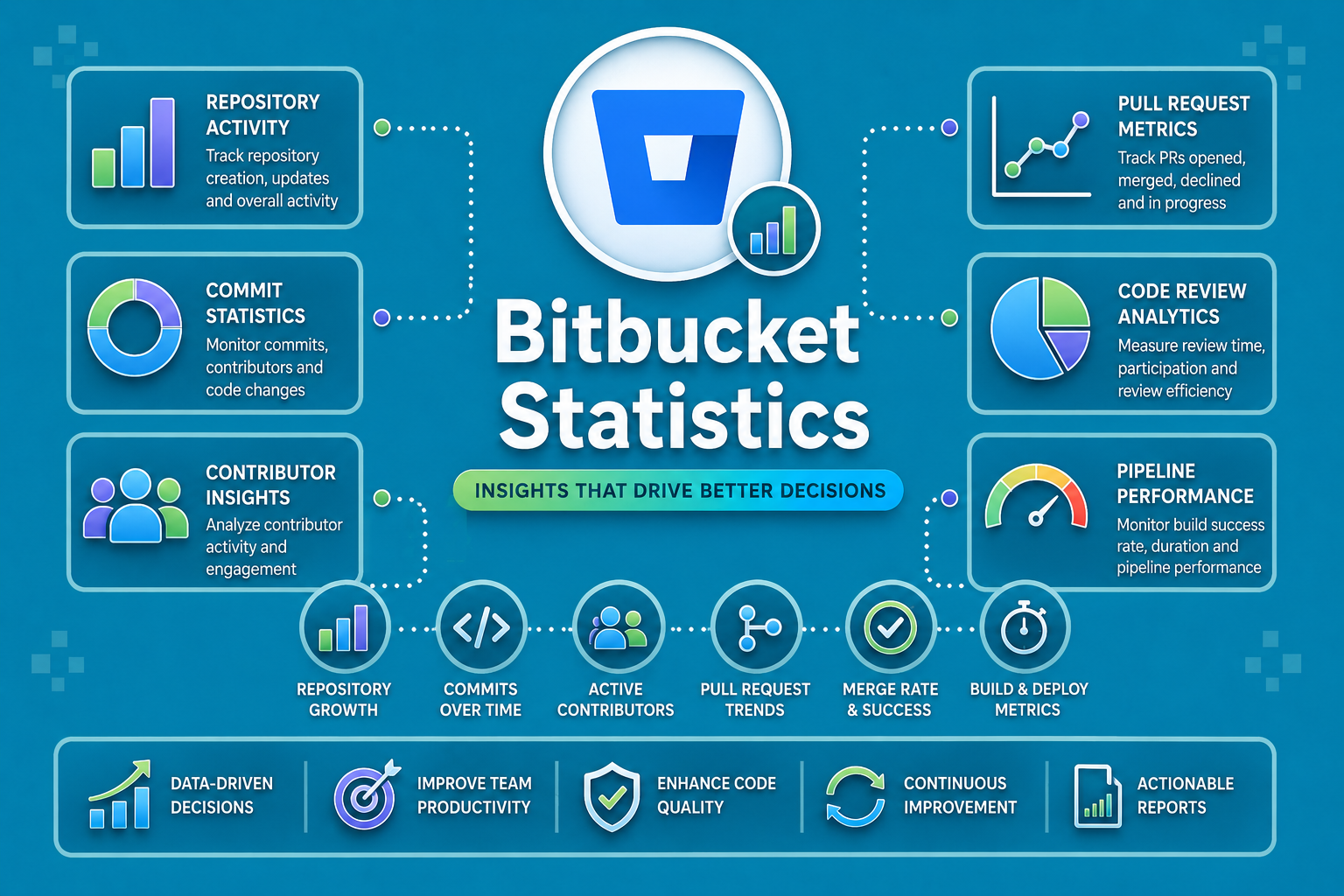

Bitbucket now says 15 million developers build on the platform, and Bitbucket Pipelines runs more than 1 billion build minutes per month.
Atlassian also says its broader customer base has passed 350,000+ customers and that 85%+ of Fortune 500 companies are paying customers as of 12/31/2025.
That makes Bitbucket a meaningful player in the source-control and CI/CD market. This article pulls together the most useful public numbers on Bitbucket users, adoption, pricing, enterprise migration, competitive share, and the market trends shaping its 2026 outlook.
Key Bitbucket Statistics and Takeaways
- 15 million developers build on Bitbucket, according to Atlassian’s late-2025 Bitbucket year-in-review.
- Bitbucket Pipelines now runs more than 1 billion build minutes per month, which is the clearest recent usage signal Atlassian has published.
- Atlassian reported $5.2 billion in FY25 revenue and $1.4 billion in free cash flow, showing the scale behind Bitbucket’s roadmap.
- Atlassian said Premium and Enterprise ARR grew more than 40% year over year in FY25, which is the most relevant recent enterprise-growth signal.
- Bitbucket’s free plan was tightened in 2025 to 1 GB storage, 50 build minutes, and 90-day Pipelines log retention.
- Atlassian’s latest developer experience research found 99% of surveyed developers and managers said AI tools save time, based on a study of 3,500 respondents across 6 countries.
Bitbucket Statistics at a Glance
| Metric | Figure |
| Developers building on Bitbucket | 15 million |
| Bitbucket Pipelines build volume | 1+ billion build minutes per month |
| Public Bitbucket scale signal in 2019 | 10 million registered users |
| Free plan | Up to 5 users |
| Free plan build minutes | 50 build minutes |
| Standard plan price | $3.65 per user/month |
| Premium plan price | $7.25 per user/month |
| Community/academic Pipelines allowance | 500 build minutes |
| Atlassian total customers | 350,000+ |
| Atlassian revenue | $6.2B trailing-twelve-month revenue |
| Bitbucket Data Center support end date | March 28, 2029 |
| Stack Overflow survey Bitbucket professional use | 18.42% |
Bitbucket Statistics 2026: Deep Dive
1. Bitbucket User Statistics
Bitbucket’s public user story is built on two different milestones. In 2019, Atlassian said Bitbucket Cloud had reached 10 million registered users.
By December 2025, Atlassian said 15 million developers built on Bitbucket, while also noting that all 10,000+ Atlassian engineers use it internally. Those are not identical measures, but they show a platform that has continued to scale.
| User metric | Figure | Year |
| Registered users | 10 million | 2019 |
| Developers building on Bitbucket | 15 million | 2025 |
| Internal Atlassian engineering users | 10,000+ | 2025 |
The strongest takeaway is that Bitbucket’s public-scale messaging has moved from a 10 million user milestone to a 15 million developer milestone in six years. Even without a formal yearly user count, that is a large base for a source-code platform that also bundles CI/CD and Jira integrations.
Bitbucket’s plan structure also suggests a product that targets both very small teams and large organizations. The free tier supports up to 5 users, while Bitbucket workspaces can scale to “thousands of users” according to Atlassian’s pricing page.
2. Bitbucket Usage & Adoption Statistics
More than 1 billion build minutes per month happened on Bitbucket. That is a large monthly execution volume and implies sustained CI/CD usage rather than occasional repository hosting alone.
| Usage metric | Figure | What it signals |
| Pipelines build minutes | 1B+ per month | CI/CD activity at scale |
| Free plan build minutes | 50 | Low-friction entry point |
| Community/academic build minutes | 500 | Education/open-source adoption path |
| Free workspace storage | 1 GB | Tightened free-tier limits |
| Pipelines log retention on free plan | 90 days | Lower-cost free usage model |
Atlassian’s 2025 Bitbucket review also says AI-assisted code review cut internal PR cycle times by 45%. That is a notable signal because it ties Bitbucket usage to measurable workflow speed, not just repository storage.
Bitbucket’s usage profile is also more professional than personal. In Stack Overflow’s 2022 survey, 18.42% of respondents reported professional Bitbucket use, versus 10.48% personal use. That gap is typical of a tool positioned for team workflows, not hobby projects.
3. Bitbucket Demographics Statistics
In Stack Overflow’s developer survey, Bitbucket appears as a tool with materially stronger workplace adoption than individual use, which points to a professional audience rather than a consumer one.
| Audience proxy | Bitbucket figure | Comparator |
| Professional use | 18.42% | GitHub 55.93% |
| Personal use | 10.48% | GitHub 87.02% |
| Survey size | 67,035 responses | Broad developer sample |
The professional skew matters. Bitbucket is usually not the first choice for personal portfolios, but it remains a credible enterprise tool because it is embedded in team workflows, especially where Jira, CI/CD governance, and security controls matter.
Atlassian’s own 2025 developer experience survey adds context: it sampled 3,500 developers and managers across six countries, and 99% said AI tools save them time. That does not measure Bitbucket users directly, but it helps explain why Bitbucket’s roadmap now centers on AI-assisted reviews and CI/CD automation.
4. Bitbucket Revenue & Financial Statistics
Atlassian reported $6.2 billion in trailing-twelve-month revenue, 350,000+ customers, and 25% year-over-year trailing-twelve-month revenue growth.
| Financial metric | Figure |
| Trailing-twelve-month revenue | $6.2B |
| FY25 revenue | $5.2B |
| Free cash flow | $1.4B |
| Total customers | 350,000+ |
| Fortune 500 penetration | 85%+ are paying customers |
| Premium/Enterprise ARR growth | 40%+ YoY |
| Cloud NRR | ~120% |
For Bitbucket specifically, the pricing model is the clearest monetization signal. The free plan is capped at 5 users, Standard costs $3.65 per user/month, and Premium costs $7.25 per user/month.
Atlassian also says community and academic subscriptions get 500 build minutes, which expands the top of the funnel for noncommercial adoption.
That pricing structure is consistent with a land-and-expand model: small teams can start free, then move into paid tiers when they need more than 50 build minutes, stronger governance, or premium security controls.
5. Bitbucket Enterprise Adoption Statistics
Bitbucket Data Center is positioned for professional teams of any size, and Atlassian says Data Center support ends on March 28, 2029. That deadline is important because it gives enterprise teams a hard migration horizon.
| Enterprise metric | Figure |
| Data Center support end date | March 28, 2029 |
| Cloud migration trial eligibility | 11+ users |
| Cloud migration trial length | Up to 12 months |
| Cloud migration trial cap | Up to 20,000 users |
| AI-assisted PR cycle time reduction | 45% |
Atlassian is also signaling that enterprise demand is driving product strategy. In Q4 FY25, the company said it signed a record number of >$1 million ACV deals, up more than 2x year over year, and that Data Center-to-Cloud migrations were up 60%+ for the year.
Bitbucket Premium is clearly enterprise-oriented. It includes enforced merge checks, IP allowlisting, deployment permissions, required two-step verification, and smart mirroring, while the free plan only includes 50 build minutes and up to 5 users.
6. Bitbucket Market Share & Competitive Statistics
In recent surveys it was observed that GitHub led version control hosting at 55.93% professional use, GitLab followed at 28.9%, Bitbucket was at 18.42%, Azure Repos at 9.94%, and AWS CodeCommit at 2.7%.
Check out our blogs on Github Statistics and Gitlab Statistics for deeper insight→
| Platform | Personal use | Professional use | Relative position |
| GitHub | 87.02% | 55.93% | #1 |
| GitLab | 20.51% | 28.9% | #2 |
| Bitbucket | 10.48% | 18.42% | #3 |
| Azure Repos | 4.25% | 9.94% | #4 |
| AWS CodeCommit | 1.29% | 2.7% | #5 |
That ranking tells a clear story: Bitbucket is not the market leader, but it remains a substantial professional platform with a stronger enterprise footprint than its consumer presence suggests.
The same survey found that 28.44% of developers use a version-control hosting web GUI and 83.57% still rely on the command line, which reinforces why integrated workflows matter so much in this category.
Bitbucket’s competitive position is strengthened by its Atlassian ecosystem integration.
Atlassian’s product page describes Bitbucket as code and CI/CD powered by AI and tightly connected to Jira, which is one reason the platform stays relevant even in a GitHub-dominant market.
7. Bitbucket Developer / API / Platform Statistics
Atlassian says Bitbucket combines source code collaboration with CI/CD, AI-assisted code review, and Jira-linked workflows, while its Premium tier adds enforced merge checks and organization-level governance.
| Platform metric | Figure |
| Free plan user cap | 5 users |
| Free plan build minutes | 50 |
| Community/academic build minutes | 500 |
| Free workspace storage | 1 GB |
| Free log retention | 90 days |
| PR cycle time reduction from AI code review | 45% |
Atlassian’s 2025 Bitbucket review also shows where the platform is headed: Rovo Chat in Bitbucket, AI-assisted code review, build troubleshooting, and deployment summaries. Those features matter because they reduce friction in the development lifecycle rather than simply adding another repo host.
The practical platform takeaway is that Bitbucket is being shaped around measurable workflow gains. A 45% PR cycle-time reduction, 1 billion monthly build minutes, and free-tier limits like 50 build minutes and 1 GB storage all point toward a product built for active engineering teams, not passive storage.
8. Bitbucket Regional / Geographic Statistics
Atlassian serves 350,000+ customers worldwide, including 85%+ of Fortune 500 companies, while Bitbucket itself is used by 15 million developers globally. Together, these figures show that Bitbucket has broad adoption across both mid-sized organizations and large enterprises around the world.
Atlassian’s latest developer research also underscores its international footprint. The company’s 2025 Developer Experience Report surveyed 3,500 developers and engineering managers across six countries.
Its FY25 shareholder letter noted that more than half of Atlassian’s total revenue comes from customers outside the United States. This suggests that Bitbucket adoption is geographically diversified rather than concentrated in a single market.
| Geographic proxy | Figure |
| Organizations using Atlassian products | 300,000+ |
| Bitbucket developer base | 15 million globally |
| Developer experience survey coverage | 3,500 respondents across 6 countries |
9. Bitbucket Market Trends & Industry Growth
Bitbucket sits inside a DevOps market that continues to expand rapidly. Fortune Business Insights says the global DevOps market is valued at $24.30 billion in 2026 and is projected to reach $125.07 billion by 2034, a 22.73% CAGR.
| Market trend metric | Figure |
| Global DevOps market size | $24.30B in 2026 |
| Forecast market size | $125.07B by 2034 |
| CAGR | 22.73% |
Atlassian’s own developer research supports the same direction. It found that 99% of developers save time with AI tools, 68% save more than 10 hours per week, and 50% still lose 10+ hours per week to non-coding tasks.
That combination explains why Bitbucket is adding AI features across code review and CI/CD rather than treating AI as a side feature.
Atlassian also says developers spend just 16% of their time coding, which is a useful reminder that collaboration, review, planning, and context switching are often bigger bottlenecks than writing code itself. Bitbucket’s current roadmap is aligned with that reality.
Conclusion
Bitbucket’s most important numbers in 2026 are hard to miss: 15 million developers, 1 billion+ Pipelines build minutes per month, and a pricing ladder that starts at $0 for up to 5 users.
Those figures show a platform that remains relevant in professional software delivery even without dominating the market. The broader signal is that Bitbucket is increasingly shaped by enterprise workflow, AI-assisted review, and cloud migration, not just repository hosting.
With Data Center support ending in 2029 and DevOps spending still growing at a 22.73% CAGR, Bitbucket’s next phase will be defined by how well it converts large teams into cloud, premium, and AI-enabled workflows.
FAQ’s
Q: How many developers use Bitbucket?
A: Atlassian says more than 15 million developers use Bitbucket as of late 2025. That is up from the 10 million registered users the company reported in 2019.
Q: How much does Bitbucket cost?
A: Bitbucket offers a Free plan for up to 5 users. Paid tiers include:
- Standard: $3.65 per user/month
- Premium: $7.25 per user/month
Enterprise organizations can also access advanced governance, security, and scaling features through Atlassian’s broader platform ecosystem.
Q: How many build minutes does Bitbucket include?
A: Bitbucket’s Free plan includes 50 build minutes per month. Community and academic subscriptions include 500 build minutes.
Atlassian also says Bitbucket Pipelines processes more than 1 billion build minutes per month across the platform overall.
Q: What is Bitbucket’s market share?
A: In Stack Overflow’s 2022 developer survey:
- Bitbucket recorded 18.42% professional use and 10.48% personal use
- GitHub led with 55.93% professional use
- GitLab followed at 28.9%
Bitbucket remains especially strong among enterprise engineering teams already using Jira and the Atlassian ecosystem.
Q: Who uses Bitbucket the most?
A: Bitbucket is used primarily by professional software teams and enterprise engineering organizations.
Stack Overflow’s survey data showed substantially higher professional usage than personal usage, while Atlassian positions Bitbucket as a tightly integrated solution for:
- Source control
- CI/CD pipelines
- Jira-based project management
- Enterprise DevOps workflows
Q: Is Bitbucket Data Center still supported?
A: Yes — but not indefinitely.
Atlassian says Bitbucket Data Center support ends on March 28, 2029. To help customers transition, Atlassian offers migration trials for eligible organizations with 11+ users for up to 12 months.