

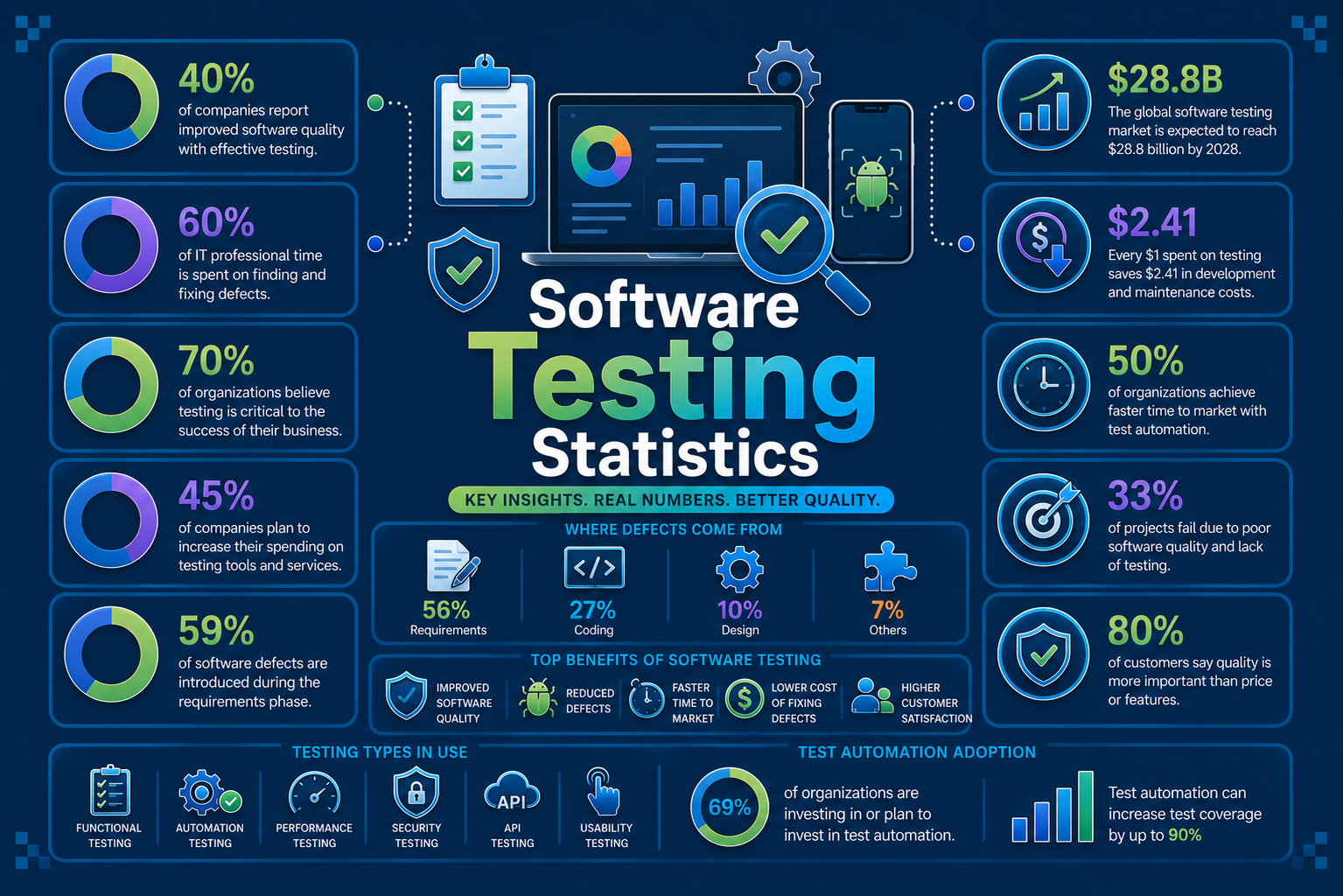

The software testing industry is now a multibillion-dollar market. In 2025 it was valued at $49.4 billion, rising to an estimated $52.7 billion in 2026 and projected to reach $93.2 billion by 2033.
This implies robust growth (CAGR ~8.5% from 2026–2033), reflecting widespread adoption of testing as DevOps and CI/CD practices mature.
In fact, North America alone accounted for ~35% of testing revenues in 2025, while Asia-Pacific leads in growth (13–14% CAGR).
As organizations invest heavily in digital products, testing quality has become critical to user experience and risk management.
Today’s QA is no longer an afterthought – it’s integrated into every sprint. Testing budgets, tools, and strategies dominate engineering plans.
This article digs into the latest data on adoption, tools, budgets, and market trends. We’ll cover key metrics on market size, investment, test automation uptake, enterprise priorities, and industry forecasts, providing a thorough, data-driven view of software testing in 2026.
Software Testing Statistics 2026: Key Insights & Takeaways
- The global software testing market reached $49.4 billion in 2025 and is projected to grow to $52–58 billion in 2026, reflecting continued enterprise investment in software quality.
- North America accounts for approximately 35% of the global software testing market, while Asia-Pacific is the fastest-growing region, with annual growth exceeding 13%.
- 40% of large enterprises allocate more than 25% of their software budgets to testing, and around 10% spend over half of their IT budgets on quality assurance.
- Teams have automated an average of 57% of their software tests, highlighting the growing shift from manual to automated testing.
- Around 65% of organizations continue to use Selenium for test automation, while Playwright has reached approximately 25% adoption, reflecting changing framework preferences.
- 80% of enterprises plan to adopt AI-powered testing tools by 2027, up from about 15% in 2023, demonstrating the rapid adoption of AI in software testing.
Software Testing Statistics 2026: Quick Facts
| Metric | Figure / Value |
| Global testing market (2025) | $49.4 B |
| Estimated market (2026) | $52.7 B – $57.7 B |
| Forecast market (~2030) | ~$93 B (2033); ~$99.9 B (2031) |
| CAGR (2026–2033) | 8.5% |
| CAGR (2026–2031) | 12.9% |
| North America revenue share (2025) | 35.3% |
| Asia-Pacific CAGR (2026–2031) | 13.46% |
| Large enterprises w/ AI in testing | ~42% have deployed AI |
| Enterprises planning AI testing tools | 80% by 2027 |
| Enterprises outsourcing QA | 70% outsource some QA automation |
| Avg. test automation coverage | 57% |
| Shift-left impact | 40% fewer post-release bugs |
| Companies using Selenium (2026) | ~50,000 |
| Selenium market share (testing tools) | ~23–26% of QA tools market |
| Selenium vs Playwright adoption | 65% vs 25% (QA teams) |
| Security testing market (2024–2029) | $14.5B → $43.9B (24.7% CAGR) |
Software Testing Statistics 2026: A Deep Dive
1. Software Testing Statistics 2026: Market Size & Growth
Software testing is a large and rapidly expanding market. Analysts report the global market was roughly $49–54 billion in 2025–26, with forecasts reaching nearly double that by 2030.
For example, Grand View Research values the market at $49.4B (2025) and $52.7B (2026), growing at ~8.5% annual rate through 2033 to about $93B.
Another firm, Mordor Intelligence, projects $54.4B (2026) to $99.9B (2031) (12.9% CAGR).
This growth is fueled by the shift in software development practices: testing is moving from a final check to a built-in part of DevOps/CI-CD pipelines.
Organizations are embedding quality gates throughout development, accelerating release cycles while managing defect risk. Spending on testing tools and services is rising as enterprises recognize the high cost of bugs in production.
Indeed, one study noted fixing defects post-release costs 15–30× more than catching them in development, which motivates upfront investment in QA.
Regional markets
North America is the largest single market, with ~35–37% share in 2025. The U.S. leads globally in absolute spending.
Asia-Pacific is the fastest-growing region (CAGR ~13–14% projected) due to booming IT and digital initiatives in India, China, and ASEAN.
Europe and Latin America also see steady growth as cloud and mobile apps proliferate.
2. Software Testing Statistics 2026: Adoption & Usage
Testing practices are evolving rapidly. Shift-left and agile methodologies are now mainstream: roughly 86% of developers report using Agile at work, and ~83% participate in DevOps-related activities.
Teams with mature DevOps processes deploy code 208× more frequently and with 106× faster lead times than traditional teams, meaning testing must keep up with continuous delivery.
Automation vs manual
A majority of organizations are ramping up test automation. Survey data show QA teams have automated just over half of their test cases on average (57%).
Another source notes 54% of enterprises have adopted agile/DevOps for test automation efforts. The trend is clear: most teams aim to blend manual and automated testing.
For example, one report predicts 73% of firms will target a balanced manual/automation strategy by 2025.
Budget allocation
Testing is taking an increasingly large slice of the IT budget. According to industry research, 40% of large enterprises now allocate over 25% of their software budgets to testing.
Nearly 10% of firms spend more than 50% of their development budget on QA. These figures underline how mission-critical quality has become.
Workforce & skill
The QA/testing workforce is growing. The U.S. Bureau of Labor Statistics reports ~203,040 software QA analysts and testers employed in 2023.
Internationally, Ireland has the highest density of testers (~61 per 100k people), reflecting its tech industry prominence.
Importantly, QA roles are diversifying: one source notes ~38% of testers are female, though data in that area are limited.
3. Software Testing Statistics 2026: Tools & Frameworks Adoption
The choice of testing tools shapes the market. Test automation frameworks remain dominated by long-standing incumbents.
A survey of QA outsourcing firms found Selenium is used by 65% of teams, making it the #1 tool. (Playwright and Cypress have grown quickly, cited at ~25% and 35% respectively by some sources.)
Enterprise usage data confirm Selenium’s wide footprint: independent trackers report 49K+ companies (around one-quarter of all QA tool users) are running Selenium-based tests as of 2026.
However, adoption of newer frameworks is accelerating. For instance, Playwright saw 240% year-over-year growth in npm downloads, becoming the fastest-growing automation tool. Its multi-language, multi-browser capabilities address limitations of earlier tools.
According to LinkedIn data, Playwright was being used by ~4,500 companies by mid-2025, compared to Selenium’s ~50K (in part explaining slower migration).
Check our detailed blog on Playwright MCP For Testing →
Testing spans many layers:
- Unit testing frameworks (JUnit, pytest, etc.) are standard in dev workflows.
- API testing and CI pipelines: ~84% of developers use some form of CI, often including automated tests.
- Codeless/no-code tools are also growing. The codeless test automation market alone is expected to jump from $2.7B (2025) to $11.4B by 2035 (15.6% CAGR), catering to manual testers and citizen developers.
Framework Market Share
One analysis reports Selenium still holds roughly 23–26% of the overall QA automation market share, with Cypress (~30%) and Playwright (~25%) as rising players.
A side-by-side comparison of frameworks shows Selenium’s cross-platform breadth (web, mobile via Appium, desktop via extensions) versus Playwright/Cypress being web-focused, explaining why legacy enterprise teams often stick with Selenium.
| Framework | Primary Focus | Native Mobile | Desktop | Languages |
| Selenium | Web browsers | Via Appium ecosystem | Via Appium + WinAppDriver | Java, Python, C#, JavaScript, Ruby, Kotlin |
| Playwright | Modern web apps | Mobile browser emulation only | No native desktop automation | JavaScript/TypeScript, Python, Java, .NET |
| Cypress | Web applications | No | No | JavaScript/TypeScript |
4. Software Testing Statistics 2026: DevOps & Agile Testing Trends
Continuous delivery and DevOps are reshaping QA. By 2026, DevOps practices are near-universal: surveys find ~83% of developers engage in some DevOps activities.
Organizations practicing DevOps report dramatically higher velocity – a DevOps report noted ~208× deployment frequency and 106× faster lead times for DevOps teams.
In turn, testing has “shifted left” – QA is embedded throughout development.
- Agile usage: ~86% of developers use Agile methodologies. Scrum is the dominant Agile framework (~75% usage).
- Defect reduction: Teams that integrate QA earlier (shift-left) report 40% fewer post-release bugs. Early testing also avoids the 15–30× extra cost of late fixes. Despite this, many QA metrics remain outdated: only ~50% of teams measure defect escape rate (bugs in production) as a key metric.
- CI/CD & QA: Continuous integration pipelines are often configured with tests at each commit. A majority of high-performing teams include security and performance tests in their CI/CD flow. For example, 75% of US/UK security practitioners had adopted AI tools for pentesting by 2024.
Outsourcing and Services
Given the complexity and fast pace, many enterprises outsource QA. About 70% of organizations outsource at least part of their QA automation.
Managed testing services, test-as-a-service (TaaS), and crowdsourced QA are expanding. In 2025, managed testing was the largest service segment.
TaaS models (pay-per-test-cycle) are emerging as well, as organizations seek elasticity in testing capacity.
5. Software Testing Statistics 2026: Automation & AI in Testing
Artificial intelligence is dramatically reshaping testing tools. Adoption has spiked: a 2025 industry survey found 75% of teams with traditional automation frameworks had incorporated AI testing tools (e.g. AI-assisted test generation, self-healing) into their toolchain.
According to Gartner, only 15% of enterprises used AI testing tools in early 2023, but this is expected to jump to 80% by 2027. This trend is driven by generative AI and machine learning enabling:
- Autonomous test generation: AI can create or update tests automatically (codeless recorders with NLP, etc.). Early results suggest significant maintenance reduction. Industry reports claim 35–50% fewer broken tests per release with self-healing automation that uses AI to fix locators.
- Defect prediction and optimization: Nearly 48% of businesses now use machine learning for tasks like defect prediction and test optimization. AI can flag high-risk code areas and prioritize tests accordingly.
- Productivity gains: Over 80% of enterprise developers saw increased productivity from AI agent use, and 70% report faster task completion with AI agents. While not testing-specific, these gains apply to QA as well (e.g. AI-powered test frameworks).
However, industry observers warn of hype: early adopters note that without mature metrics, AI can create many “vanity tests” – e.g. AI-generated tests that pass trivial assertions and miss real edge cases. It remains critical for human teams to guide AI, focusing on coverage and risk areas.
Meanwhile, traditional automation is still effective. Classic metrics – test coverage and pass rates – remain widely used.
Sembi’s QA Pulse reports teams still measure test coverage (%) and automated test counts more than defect escape rates.
But the most modern QA organizations are moving toward outcome metrics (e.g. bugs found vs bugs escaped). As one QA leader put it: “Testing must answer: are we catching the right defects early?”.
6. Software Testing Statistics 2026: Enterprise Adoption & Spending
Large organizations are leading the way in QA investment.
Key statistics:
- Budget commitment: As noted, ~40% of large enterprises spend >25% of their development budget on testing. Roughly 10% of firms dedicate half of their entire product budget to QA. This reflects QA’s strategic priority.
- Shift to TaaS/Cloud testing: Many enterprises are migrating to cloud-based testing platforms and Test-as-a-Service. By 2030, cloud deployments are the norm; in 2025 cloud-based testing already held the largest deployment share. Cloud enables scalable, on-demand testing labs for large firms.
- Compliance & regulated industries: Industries like BFSI (financial services) account for over a quarter of testing demand. Strict regulations (IEC 62304 in healthcare, open-banking in finance) are forcing continuous QA cycles. Healthcare/life sciences testing demand is also growing faster (≈13.6% CAGR through 2031).
- Major tools and vendors: Enterprise QA tool leaders (e.g. IBM Rational, Micro Focus UFT, Micro Focus LoadRunner, Tricentis) continue to earn large deals. For example, in earnings calls, software giants report testing as part of their “DevOps/Quality” segment growth. (Detailed vendor revenues are often private, but testing is integral to broader ALM/DevOps platforms.)
- Professional services: The managed testing services sector is growing; Grand View notes “strong participation from large enterprise customers across industries, creating stable growth opportunities”. Service providers like Cigniti and IBM GBS highlight QA in their portfolios.
7. Software Statistics 2026: Security Trends
Security testing is an increasingly critical subset. Continuous security (DevSecOps) has accelerated: one market report projects the security testing segment expanding at 24–25% CAGR, from ~$10–14B in mid-2020s to ~$40–44B by 2029–31.
Drivers include the explosion of web/mobile apps and API use, which broaden the “attack surface”. Key figures:
- CAGR ~24.7% (2024–29): MarketsandMarkets analysis expects security testing to jump from ~$14.5B in 2024 to ~$43.9B by 2029. An updated forecast pegs 2025 at $10.96B, 2031 at $40.99B (24.6% CAGR).
- Rapid adoption: By 2025, ~75% of US/UK security teams use AI tools (or test automation) for pentesting and threat detection.
- Regulatory push: Compliance mandates (PCI-DSS, GDPR, supply-chain security, SCA requirements) are driving investments in automated vulnerability scanning (SAST/DAST/IAST). These tools are often integrated into the CI pipeline.
- Impact on QA processes: Many QA teams now include security tests (static analysis, dynamic scanning) in regression suites. The average release now includes multiple security test types, whereas five years ago security was often a separate phase.
8. Software Statistics 2026: Regional & Demographic Stats
Geographic distribution of QA capabilities is uneven. The U.S. and India lead in absolute numbers of testers and QA outsourcing centers. According to research data:
- Highest tester density: Ireland has the most testers per capita (61.2 testers per 100,000 people), reflecting its strong tech/QA sector.
- Asia-Pacific growth: Countries like India and China are rapidly expanding their testing industries. For example, the APAC IT services market (of which QA is a component) is projected to reach ~$410B by 2031 (11% CAGR).
- Gender and roles: Within testing teams, available data suggest approximately 38% of testers are female. QA is often staffed by a mix of engineers and specialized QA analysts; however, specific global demographics are not well-tracked in published surveys.
9. Software Testing Statistics 2026: Market Trends
Several broader trends underpin these numbers:
- AI-powered QA: Beyond point tools, the big story is AI-integrated quality. Gartner’s estimate (80% adoption by 2027) underscores how AI is moving from buzzword to standard. Leading QA platforms now emphasize “self-healing” tests, AI-driven coverage analysis, and even AI-based exploratory testing.
- DevSecOps and compliance: QA is merging with security and compliance testing (the rise of “QAOps”). Continuous compliance testing is increasingly demanded by regulations. For instance, by 2026 10% of large enterprises will have mature zero-trust programs, implying pervasive security validation integrated into QA.
- Shift in ROI metrics: Companies are starting to measure QA success not just by test counts but by business impact (e.g. defect escape rate, cycle time). High-performing organizations track how much testing reduces downtime or speeds releases.
- Focus on quality of automation: As one QA thought leader notes, AI can generate many tests quickly, but organizations must ensure those tests cover the right scenarios. The industry is moving toward intelligent test suite management (e.g. prioritizing high-risk tests) rather than blind automation coverage.
- Economic context: In tight markets, QA budgets may be scrutinized, but quality is increasingly seen as non-negotiable. Analyst reports emphasize that spending on testing is countercyclical in a way – cutting QA can end up costing more via defects.
Testing is becoming more integrated, automated, and data-driven. Investments in AI/ML for QA are surging; teams that embrace these tools report faster releases and fewer bottlenecks.
At the same time, emerging areas like API testing, performance/load testing, and security testing are receiving more budget.
Across the board, testing is seen as a strategic enabler of digital products – in numbers: growing market size, rising budget allocations, and near-universal adoption of modern QA practices.
Conclusion
By 2026, software testing has firmly cemented its role as a strategic investment for digital businesses. The biggest numbers – a $52–58 billion market in 2026 and near-doubling to ~$90–100 billion by 2030 – highlight its scale and growth.
Such figures show that companies are dedicating substantial resources to quality: nearly 40% of large firms now devote a quarter of IT budgets to testing, and 70% outsource QA tasks. These numbers mean testing is not a niche concern but a mainstream part of software strategy.
Looking ahead, the trend is clear: automation and AI will drive testing forward. By 2027, 8 out of 10 enterprises are expected to use AI-augmented testing tools, promising faster releases and higher test coverage.
This shift will likely accelerate the market even further. For the software industry, these stats imply that testing is evolving into a sophisticated discipline – one that uses data and automation to ensure quality.
In practical terms, businesses should anticipate ever-increasing QA investment and plan to integrate AI-assisted testing into their workflows, as testing becomes as critical as coding itself.