


Mobile app testing has become non-negotiable for teams shipping quality applications at speed.
Kobiton and BrowserStack dominate the real-device testing landscape, offering cloud-based device access, AI-augmented automation, and seamless CI/CD integration.
Yet their approaches diverge significantly in deployment models, automation philosophy, pricing structure, and advanced features.
This comprehensive comparison breaks down their core strengths, weaknesses, and ideal use cases to help your team make the right choice.
Deep Dive: Kobiton vs. BrowserStack
Real Device Cloud Access and Device Management
Kobiton’s Device Strategy:
- Ultra-low latency device access optimized for rapid parallel testing
- Complete regression cycles in one hour or less
- Hundreds of real iOS and Android devices (curated selection)
- One-hour continuous debugging cycles for faster feedback loops
- Speed differential compounds for teams running 50+ daily test cases
Kobiton provides curated access with emphasis on responsiveness and speed. Direct device optimization eliminates bottlenecks in device queuing and test execution, enabling teams to achieve faster feedback than traditional device farms.
BrowserStack’s Device Coverage:
- 30,000+ real iOS and Android devices globally
- 21 data centers across 13 regions worldwide
- Near-100% availability for rare device combinations
- Day-zero OS support immediately after iOS/Android releases
- Cutting-edge devices provisioned instantly upon release
BrowserStack operates at enterprise scale with immense inventory providing near-100% device availability. Testing on real devices happens on day zero after iOS and Android releases—their team provisions new devices immediately upon OS release.
| Device Access Metric | Kobiton | BrowserStack |
|---|---|---|
| Total Device Count | Hundreds (curated) | 30,000+ devices |
| Global Data Centers | Multiple regions | 21 centers/13 regions |
| Regression Testing Speed | 1-hour cycles | Standard CI/CD integration |
| Day-Zero OS Support | Latest releases | Guaranteed new OS releases |
| Rare Device Coverage | Limited | Near-complete |
Practical implications: Choose Kobiton when rapid iteration matters most. Choose BrowserStack when rare device combinations are essential.
Automation Frameworks and Script Generation
Kobiton’s AI Script Generation:
- Converts manual test sessions directly to open-standard Appium code
- Testers perform natural interactions (tap, swipe, type, navigate)
- AI automatically generates executable scripts without manual coding
- 100% vendor-neutral Appium output (no lock-in)
- Fastest path from manual to automated testing
Kobiton’s AI engine eliminates the bottleneck where QA engineers struggle to translate manual test cases into automation code. After natural interactions are performed on a device, the AI automatically generates executable Appium scripts.
The generated scripts are 100% open-standard Appium, meaning they execute on BrowserStack, Sauce Labs, LambdaTest, or any Appium-compatible platform. This vendor neutrality prevents lock-in and future-proofs your testing infrastructure.
BrowserStack’s Multi-Framework Support:
- Native support for Appium, Espresso, XCUITest, Maestro, Flutter
- Self-healing agents automatically detect broken locators
- Intelligent replacement selector suggestions reduce flaky test maintenance
- Selector-level intelligence for CSS and accessibility attributes
- Accommodates teams invested in specific testing stacks
BrowserStack’s approach accommodates teams already invested in specific testing stacks without forcing framework migrations. Self-healing agents automatically detect broken locators during test execution and suggest intelligent replacement selectors.
The locator detection operates at the selector level. When element IDs change, BrowserStack’s AI intelligently maps to CSS selectors or accessibility attributes, automatically adapting tests to minor UI changes without human intervention.
| Automation Feature | Kobiton | BrowserStack |
|---|---|---|
| Script Generation | AI-powered from manual tests | Manual + self-healing |
| Framework Support | Appium (open-standard) | 5+ frameworks natively |
| Vendor Lock-in | None (open Appium) | Framework-dependent |
| Self-Healing | Integrated capability | Self-healing agents |
| Learning Curve | Minimal (record-based) | Moderate (code expertise) |
Key distinction: Kobiton accelerates the manual-to-automation transition for non-technical QA teams. BrowserStack serves teams already proficient in specific automation frameworks.
Deployment Flexibility and Infrastructure

Kobiton’s Deployment Options:
- Cloud-based public access for instant availability
- Full on-premises installation for compliance-first teams
- Hybrid deployment combining local and cloud devices
- DIY lab management where you connect your own devices
- Device Lab Management (DLM) for centralized command and control
- HIPAA and GDPR compliance for regulated industries
Kobiton offers unprecedented deployment optionality. Organizations like healthcare providers, banks, and government agencies run Kobiton entirely on-premises to satisfy HIPAA, GDPR, and data sovereignty requirements.
The DIY lab approach maximizes return on existing device investments. Your organization’s internal device inventory connects remotely to Kobiton’s platform, accessible by distributed teams worldwide without physical proximity.
BrowserStack’s SaaS Model:
- Pure cloud-based architecture (no on-premises option)
- Eliminates operational overhead and infrastructure management
- Teams focus on testing, not device infrastructure maintenance
- SOC2 Type II compliance included
- IP whitelisting and two-factor authentication
- Managed infrastructure reduces deployment friction
BrowserStack operates exclusively as a pure cloud-based SaaS platform. This architectural choice eliminates operational overhead—your team focuses on testing, not device infrastructure management.
BrowserStack compensates through enterprise security: SOC2 Type II compliance, IP whitelisting, two-factor authentication, and SSO integrations across major identity providers.
Deployment winner: Kobiton for regulated industries (healthcare, finance, government). BrowserStack for operational simplicity.
Pricing Structure and Cost Scaling
Kobiton’s Unlimited User Model:
- Entry plan: $50/month (unlimited users)
- Mid-tier: $200/month (unlimited users)
- Advanced plan: $700/month (unlimited users)
- 20-person QA team pays same as 2-person team per tier
- Perfect for distributed teams spanning QA, Dev, Product
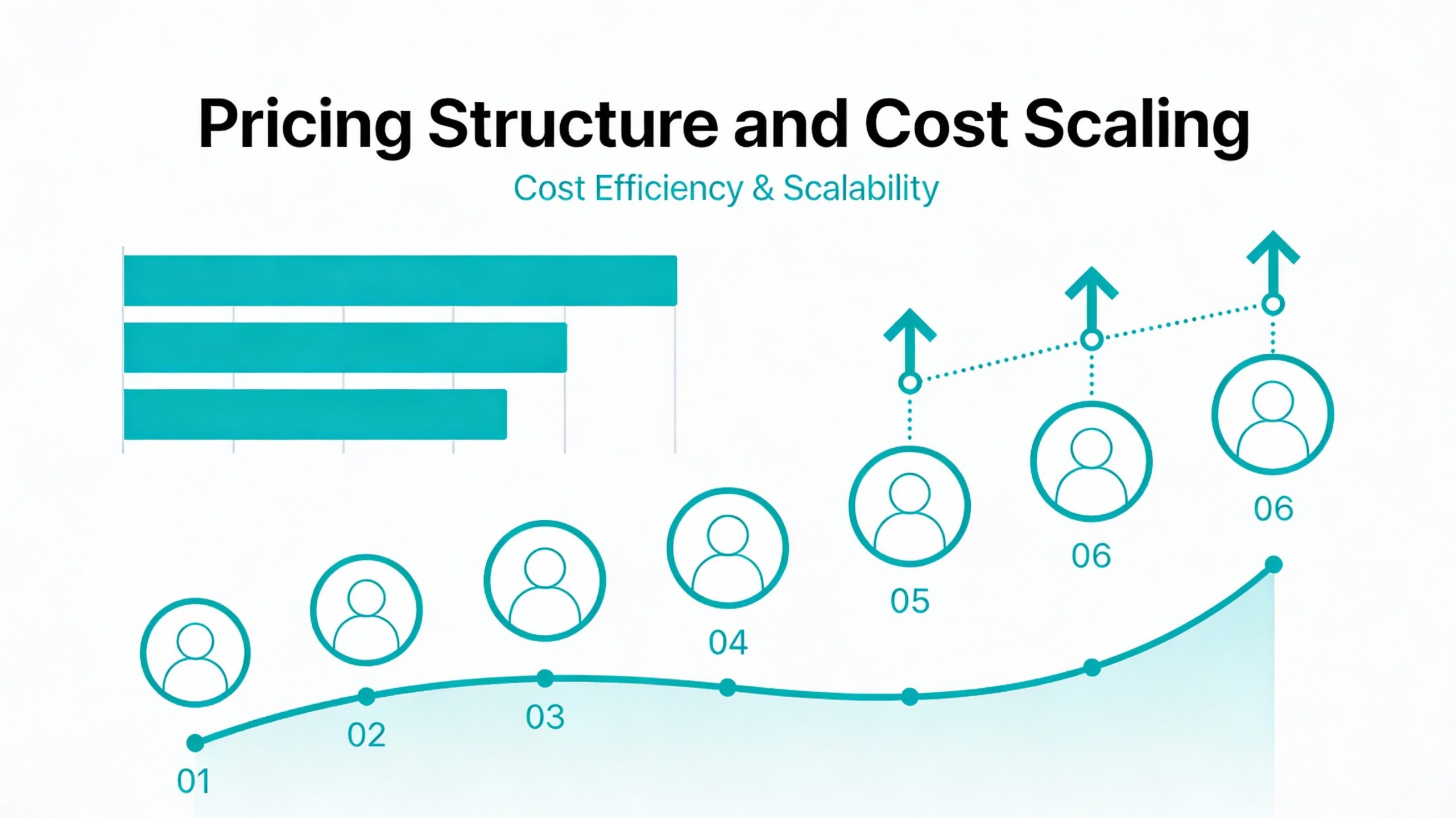
Kobiton’s pricing model offers unlimited user seats across all tiers—a fundamental advantage for large distributed teams. A 20-person QA team pays identical costs to a 2-person team under the same plan tier, providing predictable per-organization pricing.
This unlimited-user approach benefits organizations where QA engineers, developers, and product managers all need device farm access. No per-head licensing eliminates hidden scaling costs.
BrowserStack’s Per-User Seat Pricing:
- Entry plans: $29-49 monthly per user
- Mid-tier: $150 for five users
- Advanced plans: $225 per parallel execution
- Solo freelancer spending $49/month (unlimited minutes)
- 10-person team faces $290-490 monthly costs
BrowserStack uses per-user seat pricing starting at $29-49 monthly per user. A solo freelancer spending $49/month for unlimited testing minutes pays less than Kobiton’s $50 entry plan.
However, a 10-person team faces $290-490 monthly costs—significantly more than Kobiton’s $200 fixed tier.
| Pricing Scenario | Kobiton | BrowserStack | Winner |
|---|---|---|---|
| Solo freelancer | $50/month | $49/month | BrowserStack |
| 3-person team | $50/month | $147-150/month | Kobiton (3x) |
| 10-person team | $200/month | $490-500/month | Kobiton (2.5x) |
| 25-person team | $700/month | $1,225-1,250/month | Kobiton (1.75x) |
Cost implications: Kobiton dominates for teams of 10+. BrowserStack wins for freelancers under five users. The inflection point occurs around 8-10 team members.
Advanced Features and Specialized Capabilities
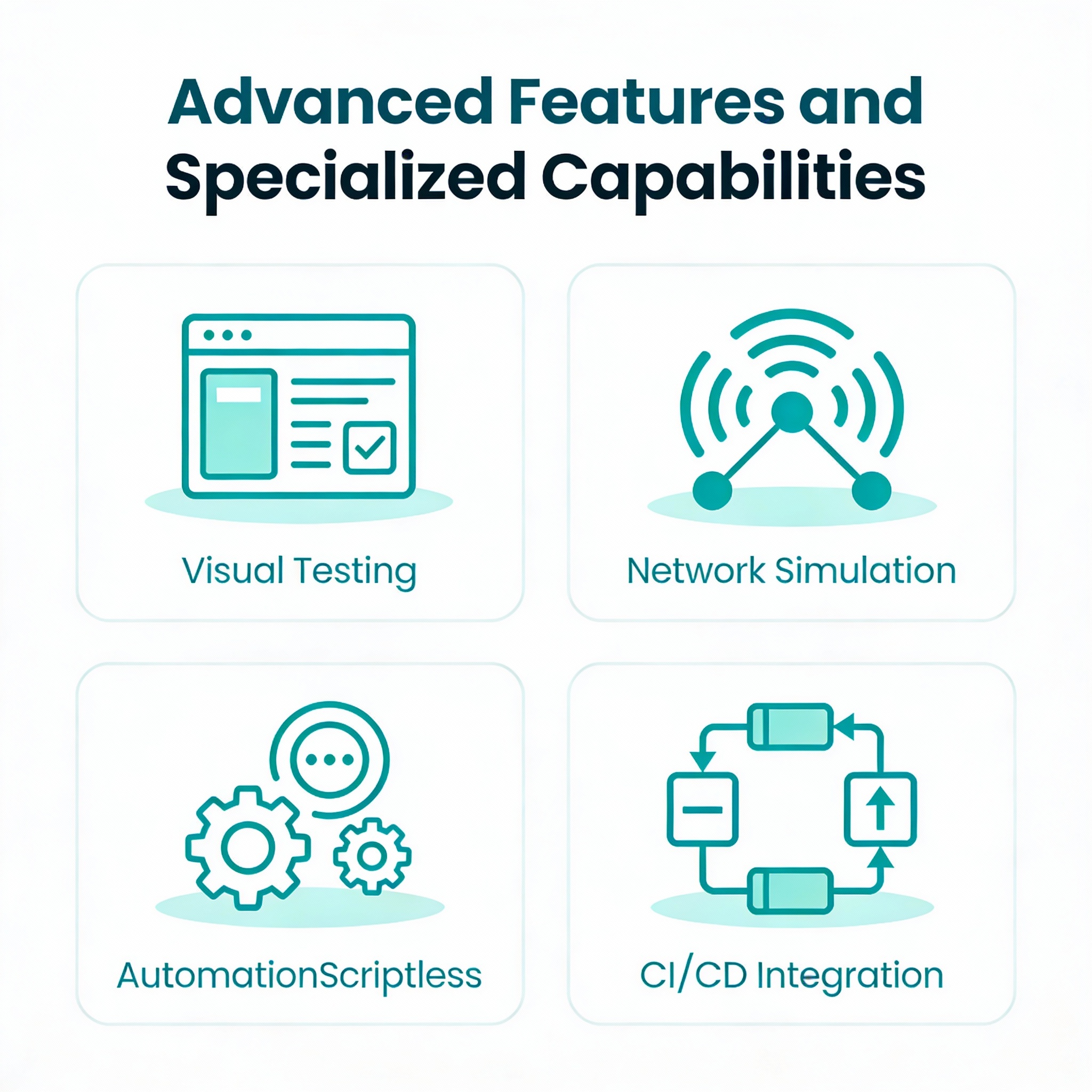
Visual Testing and UI Regression Detection
BrowserStack’s Percy Platform:
- Pixel-perfect screenshot capture across real devices and browsers
- DOM snapshot technology (not traditional screenshots)
- Snapshot stabilization freezes animations and dynamic elements
- Minimizes false-positives from dynamic content changes
- Teams collaboratively approve/reject visual diffs before merges
BrowserStack’s Percy visual testing platform captures pixel-perfect screenshots across real devices and browsers, automatically detecting visual regressions. Percy uses DOM snapshot technology rather than traditional screenshots.
This DOM snapshot approach eliminates false-positives from dynamic content. Teams can confidently compare visual changes without manually ignoring transient UI flicker.
Kobiton’s Visual Testing Capabilities:
- Screenshot capture and regression detection built-in
- Basic screenshot comparison capabilities
- Less mature than dedicated Percy tooling
- Lacks sophisticated DOM snapshotting
- Suitable for basic visual smoke testing
Kobiton includes visual testing and basic screenshot regression detection built into its platform, but lacks the maturity of Percy tooling. The platform captures screenshots for validation but doesn’t provide sophisticated DOM snapshotting.
For basic screenshot comparison, Kobiton suffices. For enterprise visual QA at scale with complex, dynamic UIs, Percy’s advantages become compelling.
Visual testing winner: BrowserStack for complex, dynamic UIs at scale. Kobiton for basic screenshot comparison.
Network Simulation and Performance Testing
BrowserStack’s Network Throttling:
- Preset profiles: 2G, 3G, 4G, 5G, WiFi
- Custom bandwidth and latency configurations
- Real-world network degradation simulation
- Parallel testing across device matrices under identical constraints
- Perfect for mobile banking, ecommerce, streaming apps
BrowserStack enables network throttling simulation through preset profiles and custom bandwidth/latency configurations. Teams test app behavior under poor connectivity, airplane mode, and intermittent network condition.
The platform simulates real-world network degradation, enabling performance debugging under realistic user conditions. Network simulation applies to all devices simultaneously, allowing parallel testing across device matrices.
Kobiton’s Network Capabilities:
- Network simulation integrated into test sessions
- Custom network condition simulation available
- Variable granularity and customization options
- Less documented network profile breadth
Kobiton’s platform includes network simulation integrated into test sessions, though the network profile breadth remains less documented than BrowserStack’s. Teams can simulate network conditions during execution.
Network simulation winner: BrowserStack for rigorous performance testing under degraded networks. Essential for apps targeting global markets.
No-Code and Scriptless Automation
Kobiton’s No-Code Approach:
- Record test session on one device
- Automatically replay across hundreds of devices
- No code writing required from testers
- Intelligently handles device-specific variations
- Different screen sizes automatically adapted
- OTP interruption handling built-in
- Unlocks automation for non-technical QA teams
Kobiton’s no-code automation allows testers to record a test session on one device and automatically replay it across hundreds of devices without writing code. The platform intelligently handles device-specific variations.
Recording manual tests and auto-generating Appium scripts represents the fastest path from manual to automated testing. Teams transition from manual testing in weeks because the barrier to test automation—coding ability—disappears entirely.
BrowserStack’s Low Code Automation:
- Recently launched Low Code Automation feature
- AI-driven recording and playback capabilities
- Maturity lags behind Kobiton’s no-code experience
- BrowserStack’s strength remains multi-framework support
BrowserStack recently launched Low Code Automation with AI-driven recording and playback features. While promising, the maturity lags behind Kobiton’s no-code experience, which has been foundational to Kobiton’s platform DNA for years.
No-code automation winner: Kobiton for non-technical QA teams and rapid automation expansion.
CI/CD Integration and Ecosystem Breadth
BrowserStack’s Integration Breadth:
- 150+ native CI/CD platform integrations
- Jenkins, Azure DevOps, CircleCI, Travis CI, GitHub Actions
- Comprehensive webhook support
- Test Management product suite included
- Test Reporting & Analytics unified dashboards
- Unified test reporting across multiple test types
BrowserStack integrates natively with 150+ CI/CD platforms: Jenkins, Azure DevOps, CircleCI, Travis CI, GitHub Actions, and comprehensive webhook support. This breadth eliminates custom integration work for enterprise tooling ecosystems.
BrowserStack’s Test Management and Test Reporting & Analytics products extend beyond device testing, offering unified dashboards for API tests, unit tests, and cross-platform test observability.
Kobiton’s Integration Approach:
- Clean API-first design for custom integrations
- Supports Jenkins, GitHub Actions, Bitrise, GitLab
- Focus on core testing workflows
- Direct device cloud integration rather than orchestration
Kobiton supports core CI/CD platforms with clean API-first design: Jenkins, GitHub Actions, Bitrise, and GitLab. The focus centers on development workflows rather than test orchestration.
CI/CD integration winner: BrowserStack for enterprises requiring unified test reporting. Kobiton for teams prioritizing direct device integration.
How Panto AI Complements Both Platforms
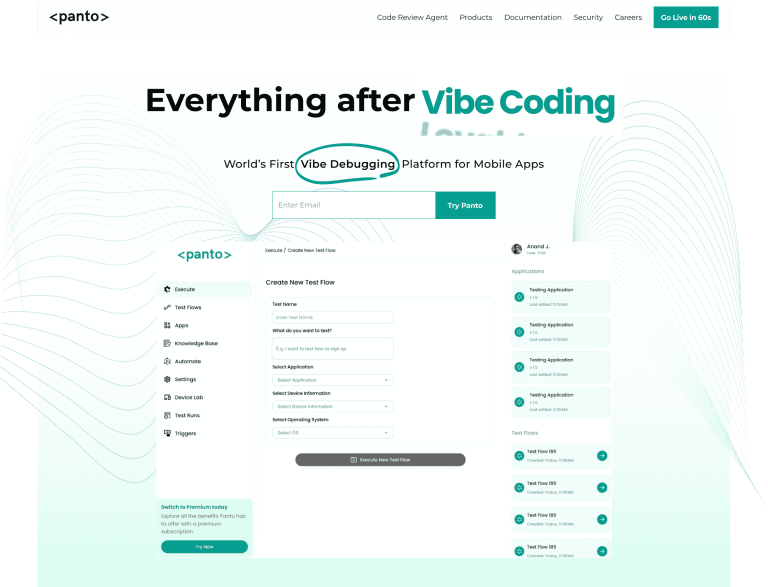
While Kobiton and BrowserStack excel at device-level testing and automation, neither solves the pre-QA problem: ensuring code quality before device testing begins. This gap wastes device farm resources on tests against poorly-reviewed code, extending release cycles unnecessarily.
Panto AI bridges this gap with integrated code review, secret scanning, and deterministic mobile QA test generation.
Panto AI’s Unique Position:
- Integrated code review (not just device testing)
- Security scanning alongside QA automation
- Deterministic mobile QA test generation
- AI agent navigates app from natural language descriptions
- Code context awareness in all operations
- Executes test flows and allows for scripted automation
Teams describe test flows in natural language (“User logs in → searches → adds to cart → checks out”), and Panto’s AI agent navigates the app, executes flows, and generates deterministic Appium or Maestro scripts.
The Deterministic vs Non-Deterministic Problem
- Kobiton & BrowserStack: Non-deterministic AI picks “recent searches” instead of search box. Creates two different test paths and regression detection failures
- Panto: Generates repeatable, CI/CD-native scripts executing identically. Eliminates false positives from AI execution variance
The critical differentiation lies in execution determinism. Non-deterministic AI selection creates false positive, causing two different test paths and regression detection failures.
Panto generates repeatable, CI/CD-native scripts executing identically across hundreds of parallel devices.
Panto Performance Metrics
- Reduces new feature testing from 2 weeks to under 5 minutes
- Automatic test case generation from codebase context
- Self-healing with code context awareness
- Semantic code understanding (not just locator-level fixes)
- Prevents regressions before they reach production
Panto’s unified platform automatically generates test cases from codebase context, self-heals with code awareness, and prevents regressions before reaching production.
| Capability | Kobiton | BrowserStack | Panto AI |
|---|---|---|---|
| Device Testing | ✓ Excellent | ✓ Excellent (30K+) | N/A |
| Code Review | ✗ | ✗ | ✓ Built-in |
| Deterministic Test Gen | ✗ | ✗ | ✓ AI-generated |
| Self-Healing | ✓ Locator-level | ✓ Locator-level | ✓ Code-aware |
| Network Simulation | Limited | ✓ Full-featured | N/A |
| On-Premises | ✓ | ✗ | ✓ |
| Visual Testing | Basic | ✓ Percy | N/A |
Final Recommendation: Choose Your Platform Based on Priorities
Kobiton is the right choice if:
- On-premises deployment required for compliance
- Unlimited user seats critical for team scaling
- Rapid regression cycles (1-hour testing) essential
- AI-powered script generation from manual testing beneficial
- DIY lab management with existing device inventory needed
- Cost predictability per organization important
Choose BrowserStack if:
- 30,000+ device coverage necessary
- Day-zero support for new OS releases required
- Multi-framework flexibility (Appium/Espresso/XCUITest/Maestro/Flutter)
- Percy visual testing at scale needed
- Network simulation and performance testing critical
- SaaS simplicity with managed infrastructure preferred
- Freelancers and 1-5 person teams seeking budget solutions
Select Panto AI if:
- Unified code review + mobile QA integration needed
- Deterministic, CI/CD-native test generation required
- Reduced test maintenance burden critical
- Security scanning pre-deployment important
- Code context awareness in test operations essential
- Natural language test description capability valuable
The optimal approach combines all three: Panto AI for intelligent test creation and code quality gates, deployed on either Kobiton (on-premises/compliance) or BrowserStack (cloud/broad coverage) based on deployment requirements.
This unified stack ensures faster release cycles, higher code quality, reduced test maintenance, and maximum device coverage across your mobile engineering workflow.