
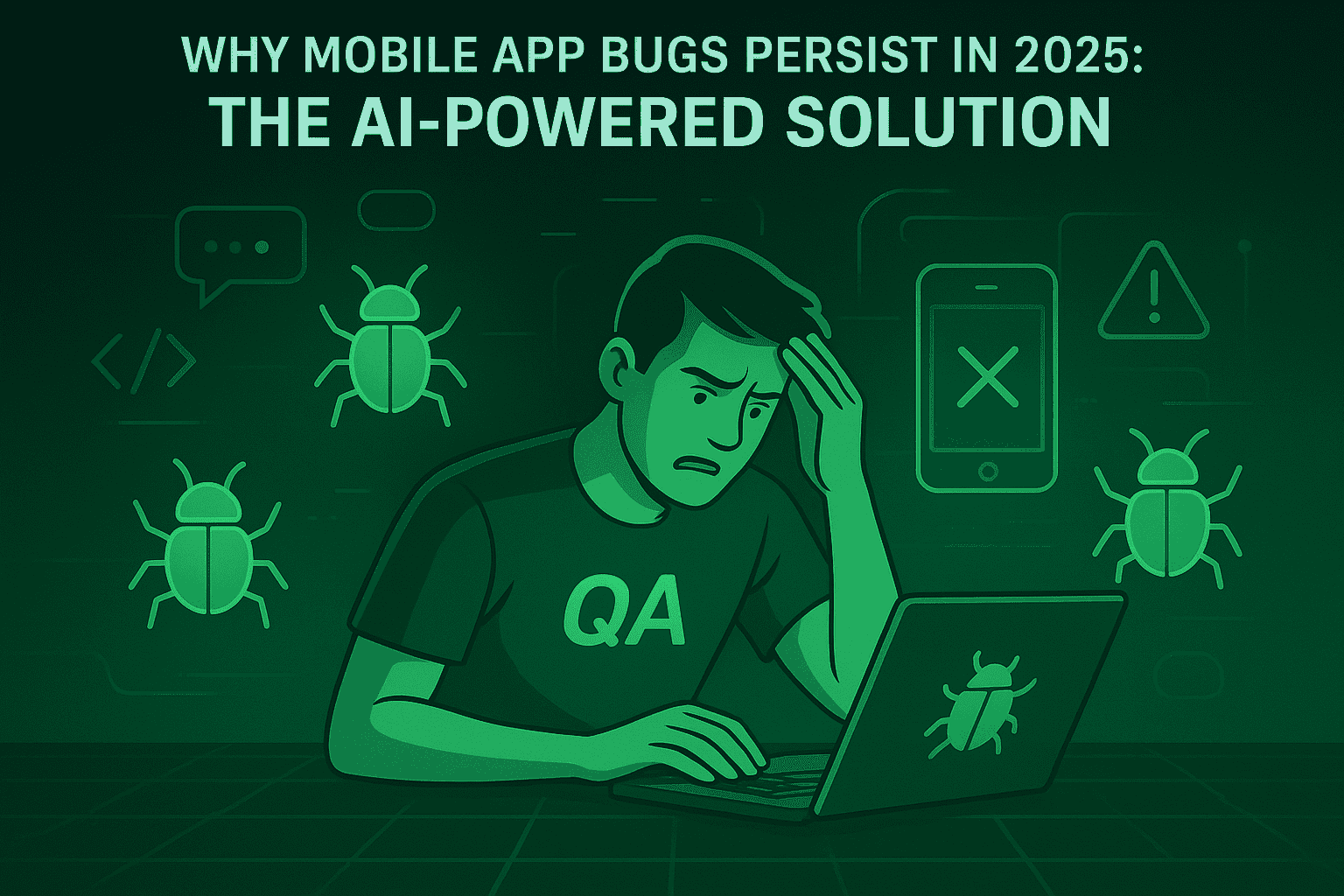
Mobile app development has reached unprecedented complexity in 2026 with thousands of daily launches. With over 5,500 new applications launching daily, the pressure to deliver quality at scale has never been greater. Despite technological advancements, users abandon apps at alarming rates—a staggering 68% churn rate demonstrates lasting damage from mobile app bugs.
The paradox is striking: companies invest heavily in testing infrastructure, yet the same five mobile app bugs continue to resurface across countless releases. This persistent problem reveals a fundamental truth about modern mobile QA: traditional testing methods simply cannot scale with app complexity and feature velocity. AI-powered testing solutions have emerged as the definitive answer, offering unprecedented bug detection and prevention capabilities.
Manual testing approaches lack the speed, coverage, and consistency required for diverse device ecosystems and rapid development cycles. Organizations adopting intelligent testing platforms experience dramatic improvements in app reliability, user retention, and customer satisfaction metrics. Investment in AI-driven quality assurance directly translates to measurable business impact.
Understanding Why These Five Mobile App Bugs Never Disappear
Mobile app bugs remain remarkably consistent across years of development in the industry, defying traditional expectations. Research tracking bug patterns since 2019 shows that the top five critical issues continue to dominate failure reports and support tickets globally.
This consistency stems from fundamental challenges inherent to mobile development environments and infrastructure constraints. Legacy code architectures, diverse device configurations, increasing feature complexity, and accelerated development cycles all contribute to recurring problems.
Developers face mounting pressure from rapid CI/CD cycles that can allow critical issues to slip through undetected. Device fragmentation across iOS, Android, and various hardware configurations complicates comprehensive testing coverage strategies significantly.
Feature complexity grows exponentially with each release cycle, creating exponentially more potential points of failure. Traditional testing approaches struggle to cover all possible scenarios across different device states, user behaviors, and environmental conditions.
Quality assurance teams working with manual processes cannot keep pace with the volume of changes. The gap between development velocity and testing capacity continues to widen, leaving critical bugs undiscovered.
The Top 5 Mobile App Bugs Plaguing Development Teams
1. Broken Links and Navigation Failures
Broken links represent one of the most frustrating user experience failures in modern mobile applications. Dead-end links disrupt app navigation, particularly as developers manage multiple device types, screen sizes, and language localizations simultaneously.
Users encountering broken links often abandon the app immediately without attempting recovery or contacting support. Each navigation failure represents a lost opportunity for engagement and permanent user retention loss.
AI-powered debugging tools now validate thousands of links in minutes, identifying broken navigation flows automatically. Vision-based AI can detect navigation errors that manual testers would miss during standard testing cycles.
This intelligent approach reduces navigation-related errors by up to 35%, directly improving user satisfaction ratings. Automated link validation ensures consistent navigation experiences across all supported devices and international locales.
2. Null Pointer Exception (NPE) Crashes
Null Pointer Exceptions occur when applications attempt to access non-existent objects, triggering crashes immediately. These bugs frequently slip through rapid development cycles where traditional code review tools cannot catch every edge case scenario.
NPE crashes are particularly damaging because they occur unexpectedly, offering users no warning before application failure. Developers spend countless hours diagnosing and fixing NPE issues after crashes occur in production environments.
AI-driven solutions now combine static code analysis with advanced pattern learning to predict and prevent NPEs. This proactive approach reduces diagnosis time from hours to just minutes, minimizing costly production crashes significantly.
Detected crashes are automatically logged in comprehensive dashboards with clear root cause identification and precise location data. Machine learning algorithms learn from previous failures to identify emerging NPE patterns before manifestation in user-facing code.
3. Index Out of Bounds Exceptions
Index out of bounds exceptions plague dynamic user interfaces where array indexing depends on runtime conditions. These errors cause unexpected failures that users cannot anticipate or workaround easily or immediately.
Dynamic content loading, pagination operations, and responsive layouts create multiple scenarios where index errors occur. Traditional debugging approaches struggle to cover all possible index combinations across different device states and configurations.
AI testing engines now simulate thousands of real user journeys, discovering index-related crashes through comprehensive scenario analysis. This approach reduces index-related incidents by approximately 28% compared to conventional testing methods.
Reinforcement learning algorithms identify patterns in how users interact with dynamic interfaces automatically and systematically. Early detection prevents production crashes and maintains application stability effectively across all usage patterns.
4. Out of Memory (OOM) Crashes
Out of memory crashes have become increasingly common as applications incorporate heavy media and AR/VR features. Modern mobile app testing demands sophisticated multimedia handling and graphics processing that strain device memory significantly.
OOM crashes occur without warning and are particularly damaging on older devices with limited RAM capacity. Users experiencing OOM crashes believe the app is poorly optimized, damaging brand perception and customer loyalty permanently.
Automated stress testing on real devices detects OOM bugs twice as effectively as traditional manual approaches. AI-driven development solutions provide real-time analysis of resource usage, helping developers identify memory-heavy operations before crashes occur.
Performance monitoring dashboards track CPU and memory usage trends throughout testing duration comprehensively. Developers gain actionable insights into optimization opportunities that improve app performance and device compatibility directly.
5. Bad Token Exception and Authentication Failures
Bad token exceptions occur when complex authentication flows fail silently, undermining user trust significantly and immediately. Authentication failures prevent users from accessing app functionality entirely, creating frustration and escalating support tickets.
Silent failures leave users confused about why they cannot log in or access protected features and services. Each authentication failure represents both a lost user and a frustrated customer contacting support teams repeatedly.
AI anomaly detection continuously tests authentication flows, catching token-related failures early and preventing cascade effects. This intelligent approach reduces authentication-related support tickets by up to 60% significantly and measurably.
Real-time monitoring of authentication systems enables immediate response to emerging security issues and threats. AI learns from previous authentication failures to identify suspicious patterns before actual exceptions occur.
AI-Powered Mobile Testing: Transforming Quality Assurance
| Bug Type | Traditional Testing | AI-Powered Solution | Impact Reduction |
|---|---|---|---|
| Broken Links | Manual validation, time-consuming | Automated validation in minutes with AI vision | 35% fewer errors |
| Null Pointer Exception | Hours to diagnose root causes | Minutes to identify and locate automatically | Significant reduction |
| Index Out of Bounds | Limited scenario coverage | Thousands of simulated user journeys | 28% fewer incidents |
| Out of Memory | Manual stress testing only | Automated 24/7 real device testing | 2x more effective |
| Bad Token Exception | Post-deployment detection | Continuous pre-deployment monitoring | 60% fewer tickets |
AI-driven testing platforms deliver autonomous app testing for iOS and Android without requiring coding expertise. Organizations detect crashes, force closes, and navigation errors automatically throughout development and pull request cycles.
Root cause analysis identifies precise issue locations, enabling rapid developer response and iteration. Integration with CI/CD pipelines enables continuous testing that catches issues before reaching production.
Real Device Testing and Device Farm Optimization
Real device testing provides incomparable advantages over emulator-based approaches in identifying bugs consistently. Device farms enable testing across multiple OS versions with zero manual setup required.
Unlike emulators, real device testing detects actual hardware-specific issues that only emerge on production devices. Seamless CI/CD integration supports continuous automated testing at scale with instant feedback.
Device farms eliminate the bottleneck of physical device management while maintaining comprehensive hardware coverage. Automated mobile testing runs 24/7 across diverse device configurations, detecting compatibility issues across the spectrum.
Real-time feedback enables developers to iterate quickly and address issues before release cycles. Scalable infrastructure ensures testing capacity grows with application complexity and release requirements.
Environmental variations in real devices reveal bugs that emulators cannot simulate or reproduce. Testing on actual hardware provides confidence that apps will perform reliably in production environments.
Seamless CI/CD Pipeline Integration
Modern development workflows demand testing solutions that integrate seamlessly with existing automation infrastructure. QA automation tools connect directly with major CI/CD systems, providing instant feedback without disruption.
Developers receive actionable bug reports with precise reproduction steps and root cause analysis immediately. Automated test result visualization enables rapid decision-making about release readiness and deployment gates.
Continuous integration of quality assurance prevents the traditional separation between development and QA phases. Teams identify issues early in development cycles when fixes are fastest and cheapest to implement.
Automated gating prevents buggy code from advancing through deployment pipelines to production. Real-time dashboards provide visibility into quality metrics throughout the entire development lifecycle.
Integration eliminates context switching and communication delays between development and testing teams. Developers gain immediate feedback on code quality, enabling faster iteration and deployment.
The Future of Mobile QA
The next generation of mobile testing leverages generative AI to automatically create sophisticated test scenarios and learn from historical bug patterns to predict failure points with accuracy. Explainable AI provides transparent reporting that helps teams understand why issues occur and prevent recurrence, while AI QA automation can now generate test cases automatically, eliminating manual test script creation bottlenecks entirely. Continuous learning from production failures enables testing strategies to evolve and improve over time, giving teams confidence that testing approaches cover genuine risk scenarios.
Panto AI: A New Look into Mobile QA Automation
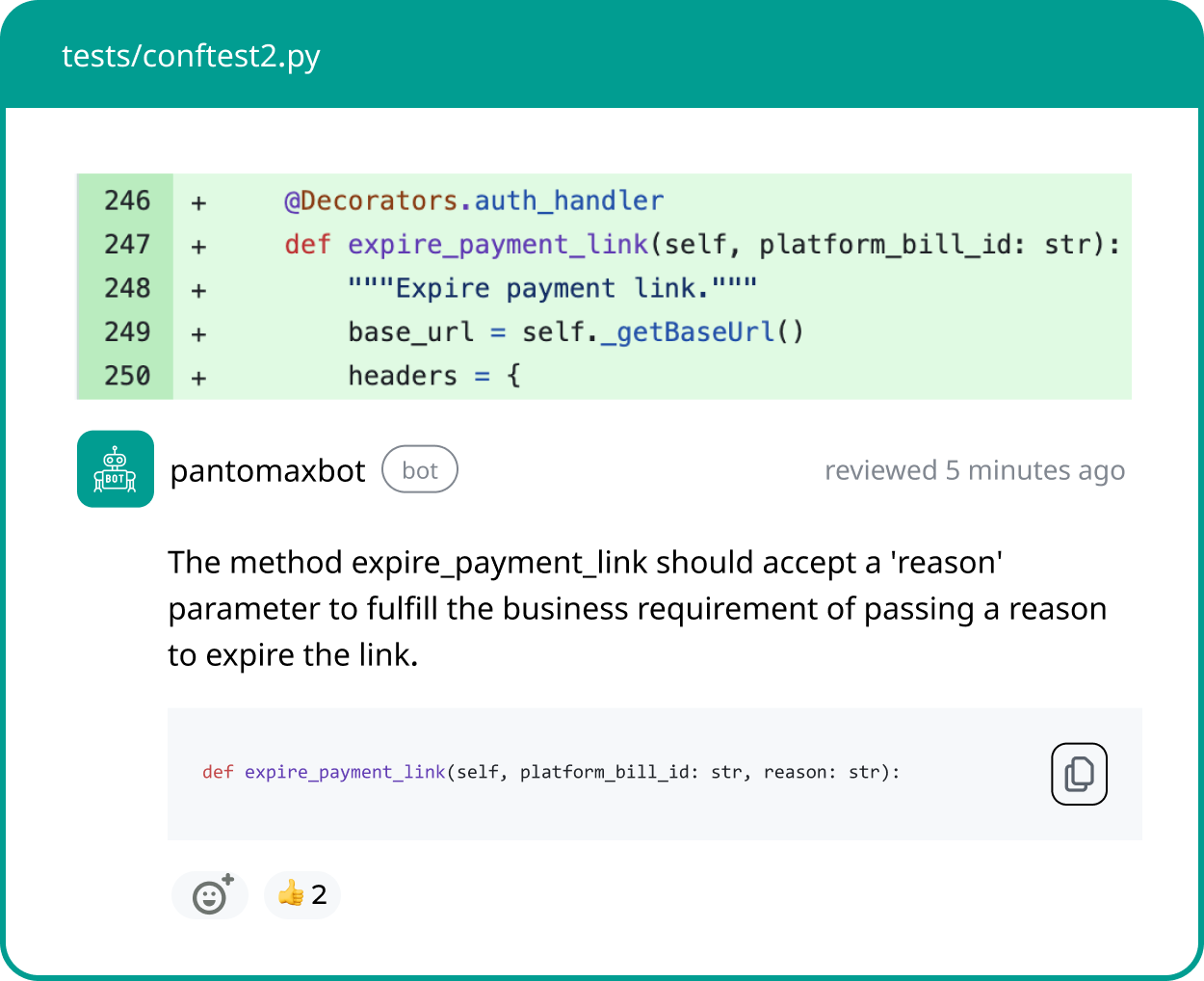
Panto AI introduces a paradigm shift in mobile quality assurance through its innovative end-to-end vibe debugging platform that captures complete application behavior context, unlike traditional debugging approaches that focus on individual bugs in isolation.
The platform uses advanced AI to understand not just what goes wrong, but why it happens and how it affects users, by combining continuous, context-aware code review capabilities with real-time mobile testing insights to eliminate entire bug categories before production deployment. Panto AI’s context-aware vibe debugging engine learns from each bug occurrence, identifying patterns systematically and continuously throughout the application lifecycle.
Teams using Panto AI experience dramatically faster bug resolution cycles and significantly fewer regressions in production, with the integration of mobile-specific debugging and continuous monitoring transforming app reliability metrics permanently and measurably. The platform enables development teams to maintain quality standards while accelerating release velocity significantly, providing AI-powered insights and visibility that traditional tools cannot match or replicate.
Moving Beyond Traditional Mobile App Testing
The persistence of the same five mobile app bugs across years demonstrates fundamental limitations of traditional approaches. Manual testing, emulator-only strategies, and post-deployment bug discovery all fail to meet modern quality standards.
AI-powered testing solutions deliver the speed, consistency, and comprehensiveness required for today’s complex mobile ecosystem. Organizations ready to eliminate recurring bugs and accelerate development cycles should embrace intelligent testing platforms immediately, for intelligent software systems.
Real device testing, codeless test automation, and continuous monitoring create unprecedented visibility into application quality. By investing in intelligent testing infrastructure, development teams gain confidence that apps deliver excellent experiences consistently.
Panto AI is built on the belief that open source drives global innovation. The platform is completely free for open-source projects, offering unlimited pull request reviews to help developers maintain high-quality, reliable code.
Whether it’s a small personal project or a widely used library, Panto AI helps teams deliver bug-free and production-ready code at no cost.