

AI-assisted code review has become essential for teams looking to catch bugs early, improve code quality, and speed up pull request merges. While Cursor Bugbot provides a conversational AI interface for detecting logic errors and security issues.
This guide explores 10 top Cursor Bugbot alternatives, headlined by Panto AI, analyzing features, pros, cons, pricing, and ideal use cases. We’ve included real-world benchmarks, for teams seeking Cursor Bugbot alternatives with broader integrations, deeper security coverage, or context-aware insights.
Why Consider Cursor Bugbot Alternatives?
Cursor Bugbot excels at logic bugs and security via conversational PRs. However, key gaps drive teams to Cursor Bugbot alternatives for scale and depth. Switching yields 40% faster merges.
What Cursor Bugbot Lacks
- Narrow integrations: GitHub-only via Cursor IDE—no GitLab, Bitbucket, or Azure DevOps support.
- Steep pricing: $20–$50/dev/month scales poorly for enterprises; no OSS free tier.
- Limited scope: Ignores team metrics, business context (e.g., Jira tickets), or full-repo analysis.
- No CI/CD depth: Misses pipeline hooks, IaC scanning, or dashboards for engineering insights.
What Modern Cursor Bugbot Alternatives Offer
- Broad integrations: GitHub, GitLab, Bitbucket, Azure, CI/CD, and self-hosting options.
- Full-repo context: Dependency graphs, multi-file bug detection, and business tool links.
- Advanced security: 30,000+ SAST/IaC/SCA checks across 30+ languages with low false positives.
- Team insights: Metrics dashboards, auto-fixes, and quality gates for 50-60% bug reduction.
These upgrades make Cursor Bugbot alternatives ideal for modern teams. Let’s explore the top 10.
10 Best Cursor Bugbot Alternatives
1. Panto AI – The Wall of Defense for Code Quality
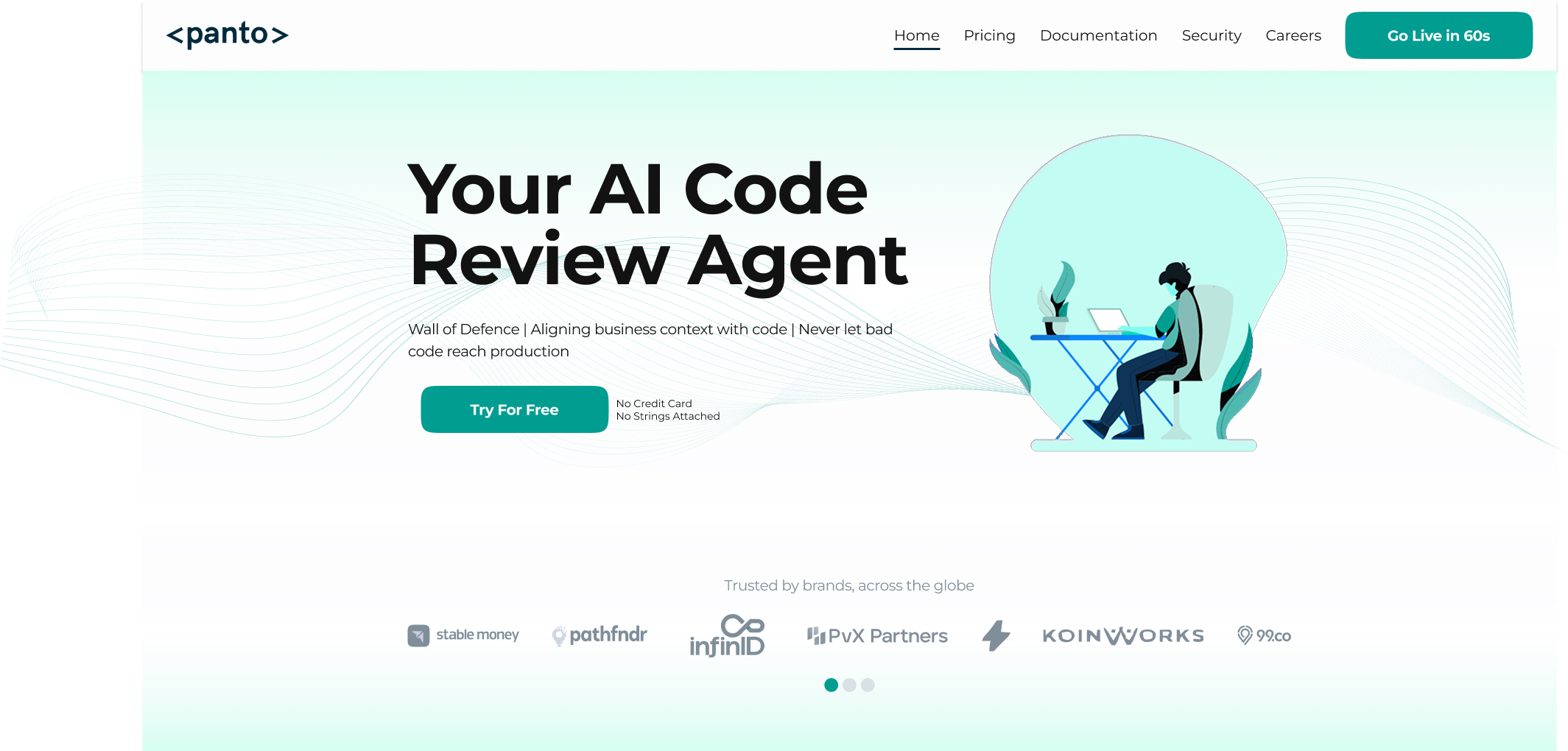
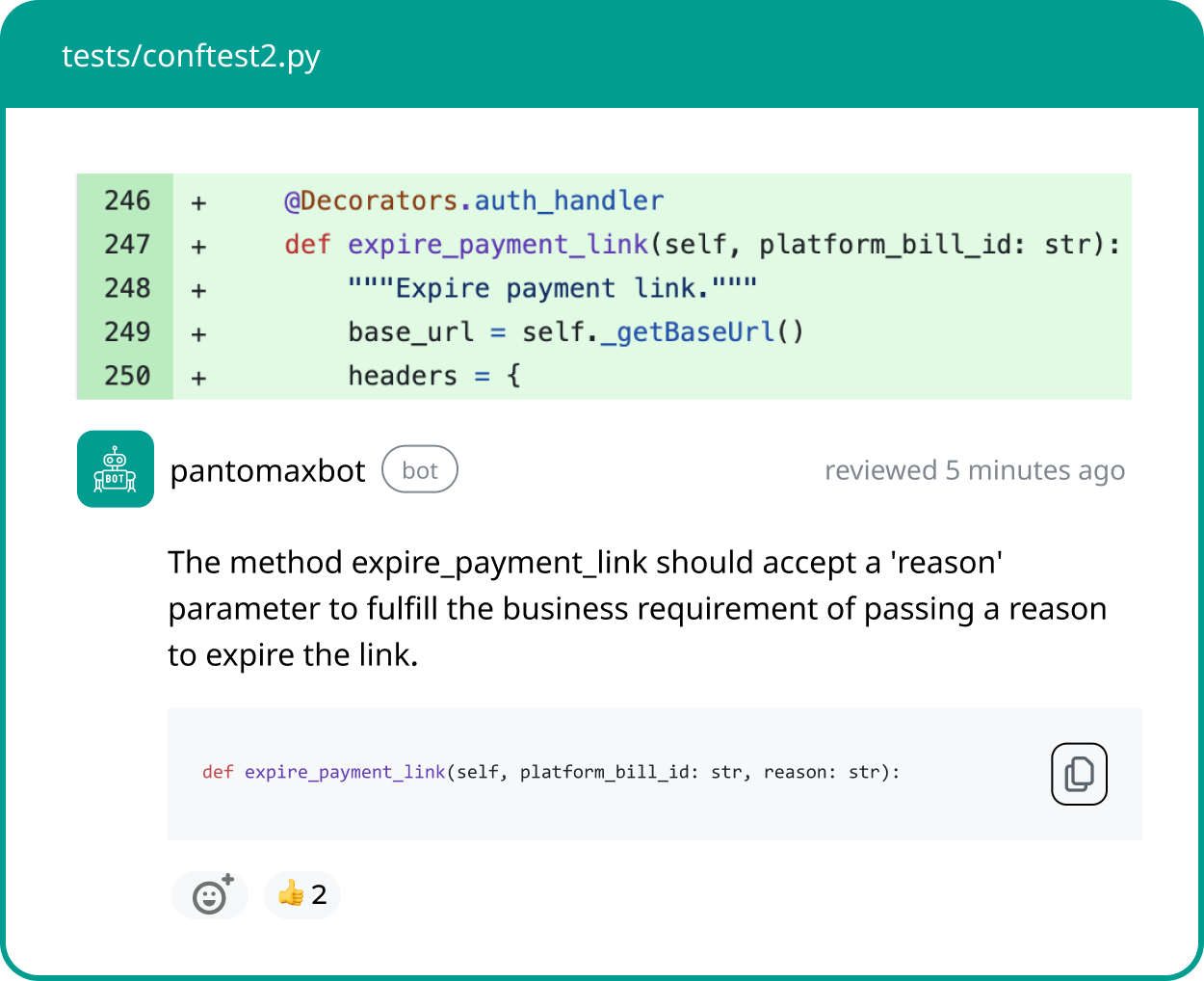
Panto AI blocks bad code with deep context and 30,000+ security checks. Unlike Cursor Bugbot’s IDE limitations, Panto links to Jira/Confluence for business “why” behind changes. Teams report 60% vulnerability reductions in production.
Key features include SAST, IaC scanning, secret detection, SCA/SBOM, and metrics dashboards. PR comments achieve 98% relevance with reinforcement learning.
Integrations span: GitHub, GitLab, Bitbucket, Azure DevOps, CI/CD pipelines, and on-prem deployment.
Pricing: Free for OSS; $15/developer/month enterprise.
Pros: 95%+ accuracy, <2% false positives, CERT-IN compliant, zero code retention.
Cons: Initial config needed; onboarding app evolving.
Fintech teams cut React/Node vulnerabilities by 60%. “Panto reads our Jira epics—total game-changer,” says Ayoconnect VP Engineering. Migrate from Cursor: Install GitHub App, connect Jira, watch accuracy soar.
2. CodeRabbit – Lightweight PR Feedback Tool
CodeRabbit delivers diff-based AI feedback on GitHub/GitLab PRs, catching bugs, style issues, and test gaps. Lightning-fast but lacks Cursor’s partial context or Panto’s repo depth.
Features include linting, refactoring suggestions, chat interface, and auto-test detection across 20+ languages. Bitbucket support exists but Azure DevOps lags.
Pricing: Free for individuals/OSS; Pro at $12–$15/developer/month.
Pros: 5-minute setup, 90% actionable comments, minimal noise.
Cons: Diff-only analysis misses cross-file bugs; limited enterprise features.
Open source projects gain 30% faster PR cycles. “Perfect for solo devs—no fluff,” says maintainer. Choose for tiny teams avoiding setup.
3. Greptile – Full Repo Context Analysis
Greptile builds dependency graphs across entire repos, catching multi-file bugs Cursor Bugbot misses entirely. Conversational PR feedback gets smarter with codebase context.
Core capabilities: Full-repo analysis, inline suggestions, security/logic detection across 25+ languages. Limited to GitHub/GitLab integrations.
Pricing: $30/developer/month—no free tier.
Pros: 85% catch rate in monorepos, excellent for legacy codebases.
Cons: Expensive at scale, complex onboarding, no metrics dashboards.
E-commerce platform fixed 40% hidden cross-service bugs. “Dependency maps reveal everything,” engineering lead notes.
4. Bito AI – Automated Fixes and In-Depth Analysis
Bito AI extends beyond Cursor detection with one-click automated fixes and inline PR suggestions. Handles 20+ languages with light security scanning included.
Key features: AI-generated comments, click-to-fix automation, built-in linters. Supports GitHub, GitLab, Bitbucket but enterprise self-hosting costs extra.
Pricing: Free tier available; Enterprise $15/developer/month.
Pros: Automates 40% of trivial issues, multi-language support.
Cons: Feature-overloaded UI, lacks business context integration.
SaaS startup automated 50% of routine PR reviews. “Click-to-fix saves hours weekly,” senior dev reports.
5. CodeAnt AI – Security-First Code Reviews
CodeAnt AI prioritizes security and compliance with comprehensive PR dashboards and IaC scanning—far beyond Cursor Bugbot’s basic checks.
CodeAnt’s features inline PR comments, secret detection, custom rules enforcement across 25+ languages. Full integrations plus IDE plugins available.
Pricing: $10–$20/developer/month based on features.
Pros: 92% vulnerability accuracy, built-in compliance dashboards.
Cons: Feels lint-like, limited contextual understanding vs Panto.
Banking team achieved regulatory compliance effortlessly. “Dashboards show security trends clearly,” engineering lead confirms.
6. SonarQube – Mature Static Analysis Platform
SonarQube delivers battle-tested static analysis with quality gates blocking bad merges—stable but lacks Cursor’s AI conversations.
Comprehensive static analysis for code smells, duplication, complexity, SAST across 30+ languages. Deep CI/CD and IDE integrations via SonarLint.
Pricing: Free Community edition; paid plans ~$150/year+.
Pros: Industry standard, historical trend analysis, compliance proven.
Cons: 20% false positive noise, no conversational PR feedback.
Enterprise legacy teams depend on quality gates. “Blocks junk code automatically,” DevOps reports.
7. Qodo (Formerly CodiumAI) – Test-Driven Reviews
Qodo generates tests alongside PR reviews, filling Cursor Bugbot’s complete lack of test coverage analysis and suggestions.
AI-powered test generation, bug prediction, refactoring suggestions across 25+ languages. Primarily GitHub/GitLab focused.
Pricing: Free OSS tier; Pro $20/developer/month.
Pros: Boosts test coverage by 50%, developer-friendly automation.
Cons: Test-focused only, thin integration ecosystem.
TDD teams reached 90% coverage targets. “AI writes tests better than juniors,” lead developer shares.
8. Graphite – Dev-Friendly AI Agent

Graphite deploys AI agents that stack, review, and merge PRs—accelerating workflows beyond Cursor Bugbot’s detection-only approach.
Auto-PR stacking, contextual reviews, basic security scanning across 20+ languages. GitHub-centric with limited multi-platform support.
Pricing: $15/developer/month.
Pros: Doubles merge velocity, agentic workflow automation.
Cons: GitHub-only focus, emerging security capabilities.
High-velocity teams cut cycle time in half. “Agents literally own our PR workflow,” engineering manager praises.
9. Snyk Code – Developer-First Security
Snyk Code prioritizes security with PR/IDE vulnerability scanning and automated fixes—pure security focus vs Cursor’s logic emphasis.
Advanced SAST, secrets scanning, SCA across 25+ languages with broad integrations. Developer-first IDE embeds available.
Pricing: Free for developers; $25/developer/month teams.
Pros: 98% vulnerability precision, seamless IDE experience.
Cons: Security silo mentality, lacks engineering metrics.
Security teams caught zero-day vulnerabilities early. “IDE fixes happen instantly,” senior security engineer confirms.
10. Swimm – Documentation-Powered Reviews
Swimm connects PR reviews to living documentation, providing context Cursor Bugbot completely lacks in complex codebases.
Automatic doc generation, PR annotations linked to docs across 20+ languages. GitHub/GitLab integrations primarily.
Pricing: $15/developer/month.
Pros: Reduces misunderstandings by 35%, excellent doc integration.
Cons: Not a core AI reviewer, light security coverage.
Documentation-heavy organizations onboarded 3x faster. “PRs explain themselves through docs,” tech lead notes.
Comparison Table: 10 Cursor Bugbot Alternatives
| Tool | Integrations | Language Coverage | Feedback Accuracy | Security & SAST | Pricing | Ideal Use Case |
|---|---|---|---|---|---|---|
| Panto AI | GitHub, GitLab, Bitbucket, Azure DevOps, CI/CD | 30+ | Very High (95%+) | 30,000+ checks | Free OSS, $15/dev/mo | Full-context + security + metrics |
| CodeRabbit | GitHub, GitLab, Bitbucket | 20+ | Medium | Basic | Free / $12-15/dev/mo | Fast small-team PRs |
| Greptile | GitHub, GitLab | 25+ | High | Moderate | $30/dev/mo | Complex repo context |
| Bito AI | GitHub, GitLab, Bitbucket | 20+ | Medium-High | Limited | Free / $15/dev/mo | Routine fix automation |
| CodeAnt AI | GitHub, GitLab, Bitbucket, Azure | 25+ | Medium | Strong SAST | $10-20/dev/mo | Security/compliance |
| SonarQube | CI/CD, IDEs | 30+ | Medium | Strong static | Free / $150+/yr | Static gates/compliance |
| Qodo | GitHub, GitLab | 25+ | High | Basic | Free OSS / $20/dev/mo | Test-driven quality |
| Graphite | GitHub | 20+ | Medium-High | Basic | $15/dev/mo | PR stacking/velocity |
| Snyk Code | GitHub, GitLab, Bitbucket, Azure | 25+ | High | Advanced SAST/SCA | Free dev / $25/dev/mo | Vuln prioritization |
| Swimm | GitHub, GitLab | 20+ | Medium | Basic | $15/dev/mo | Doc-linked reviews |
How to Choose Between Cursor Bugbot Alternatives
Picking the right tool depends on team size, stack, priorities (speed vs. depth), and budget. Use this guide to match needs:
- Panto AI if you need full-context reviews, 30,000+ security checks, business integrations, and quality metrics dashboards at $15/dev/month—perfect for enterprise scale.
- CodeRabbit if you’re a small/OSS team wanting 5-min setup and lightweight PR feedback under $15/dev/month.
- Greptile if complex monorepos demand repo-wide dependency analysis, despite $30/dev/month cost.
- Bito AI if automating trivial fixes and multi-language support is key, with a free tier option.
- CodeAnt AI if security/compliance dashboards matter most at $10–$20/dev/month.
- SonarQube if static analysis, quality gates, and free Community edition fit compliance development workflows.
- Qodo if test generation and coverage boosts are priorities for TDD teams.
- Graphite if AI agents for PR stacking/velocity on GitHub accelerate your flow.
- Snyk Code if developer-first vulnerability scans with IDE fixes top your security list.
- Swimm if documentation-linked reviews reduce misunderstandings in doc-heavy teams.
Final Thoughts on Cursor Bugbot Alternatives
Other tools like CodeRabbit or Bito AI serve niche needs: fast PR checks or automated fixes, while SonarQube excels at static analysis and compliance. Greptile remains strong for full repo context but comes at a higher cost. Teams should weigh depth vs. speed, AI intelligence vs. static checks, and integration breadth when choosing a Cursor Bugbot alternative.
Panto AI leads Cursor Bugbot alternatives with full-context reviews, 30,000+ checks, and metrics—slashing bugs 60% for enterprise teams. Niche picks like CodeRabbit (speed) or Snyk (vulnerabilities) fit specifics, while SonarQube handles static needs.