

Code review has always been one of the most important quality gates in software development. It is also one of the most strained.
Reviewers are stretched thin, pull request queues grow faster than teams can clear them, and the pressure to ship means thorough review often loses to fast review. The result is inconsistent feedback, missed bugs, and security gaps that only surface after the damage is done.
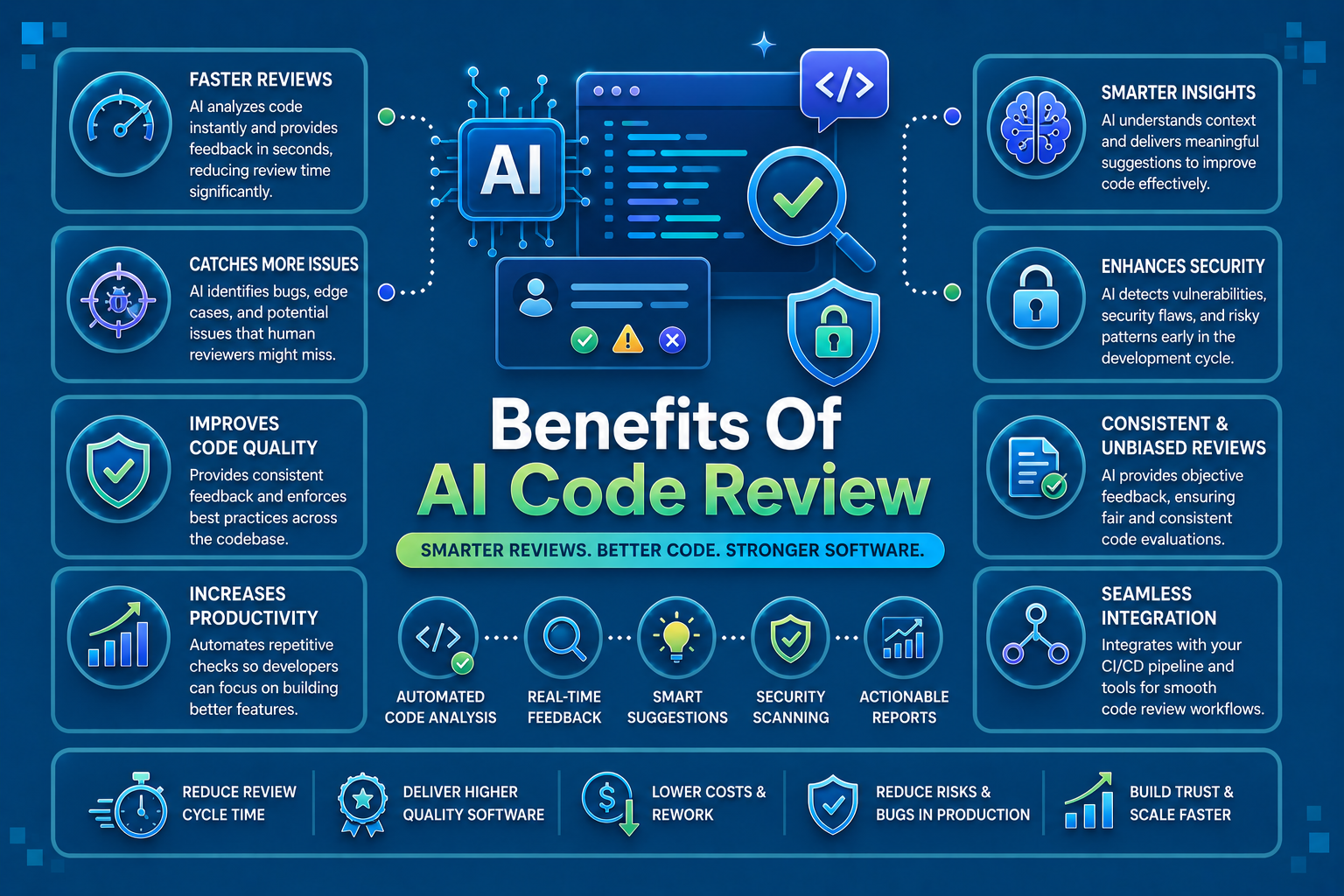
AI code review changes that equation. It does not replace the human judgment that makes review valuable. It removes the friction that makes review slow, inconsistent, and hard to scale.
This guide covers what AI code review actually delivers, how it compares to manual review, the benefits of ai code review, and how engineering teams can adopt it without disrupting the workflows already in place.
Why AI Code Review Has Become A Priority For Engineering Teams
The Traditional Review Model Is Under Pressure
Software teams are shipping faster than ever, and the traditional code review process was not built for this pace.
A SmartBear study found that reviewing 200 to 400 lines of code takes between 60 and 90 minutes and still leaves 10 to 30 percent of defects undetected.
Forty-five percent of developers cite lack of time as their biggest obstacle to thorough review, and 34 percent admit that pressure to ship actively compromises review quality.
These are not symptoms of bad engineering culture. They are symptoms of a process that has not scaled with the demands placed on it.
What AI Code Review Actually Does
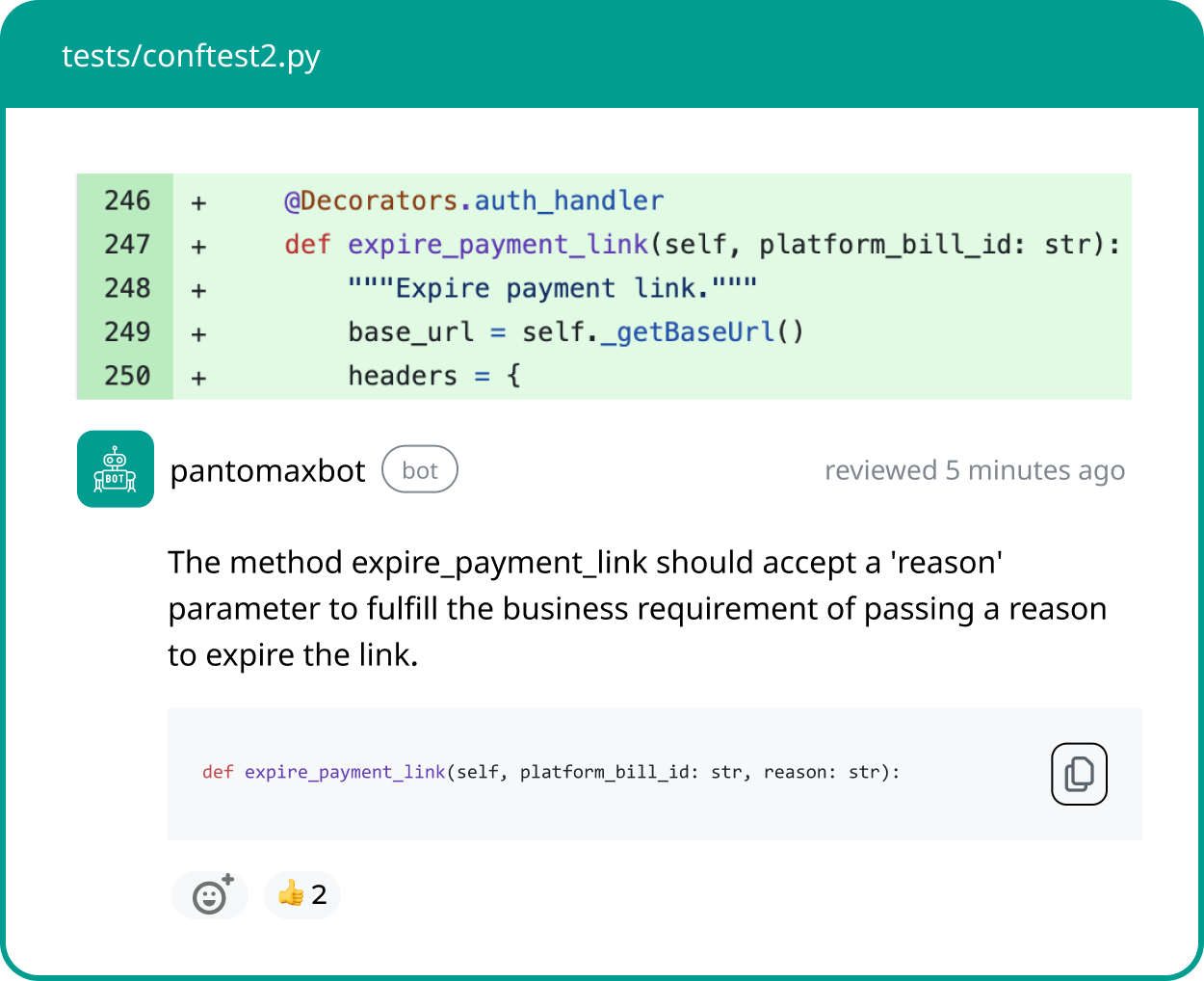
AI code review tools scan every pull request automatically, apply consistent rules across every commit, and surface actionable feedback in seconds. They sit inside pull requests, merge requests, IDEs, and CI/CD pipelines, flagging issues before a human reviewer opens the diff.
The AI code review market is projected to grow from USD 6.7 billion in 2024 to USD 25.7 billion by 2030. The 2025 Stack Overflow Developer Survey reports that 84 percent of developers now use or plan to use AI tools as part of their development process, including code review.
The Shift That Matters
AI review tools do not replace human reviewers. They handle the mechanical first pass so humans can focus on architecture, business logic, and edge cases.
That division of labour is what makes the process faster, more consistent, and more scalable without sacrificing the judgment that experienced engineers bring to a review.
The Core Benefits Of AI Code Review
Faster Feedback Without Waiting On Reviewer Availability
The most immediate benefit teams notice after adopting AI code review is speed.
Tasks that take human reviewers hours, such as scanning for subtle bugs or checking for security anti-patterns, take AI tools seconds to minutes.
Teams that have integrated AI review into their pull request workflows consistently report 10 to 40 percent reductions in PR completion time, with a significant portion of flagged issues resolved before a human reviewer is ever looped in.
That speed shortens the time between a mistake being introduced and a fix being applied, which reduces rework and keeps delivery pipelines moving without unnecessary stalls.
Earlier And More Reliable Bug Detection
AI code review catches issues at the earliest possible stage of the development lifecycle, before they compound into larger problems downstream.
AI tools trained on large codebases can detect syntax errors, logical flaws, performance bottlenecks, and security vulnerabilities with accuracy rates that significantly exceed traditional static and software composition analysis tools.
The earlier a defect is found, the cheaper it is to fix, and bugs caught at the PR stage cost a fraction of what they cost when discovered in staging or production.
This shift-left approach to quality is one of the most measurable improvements teams report after adoption.
Stronger And More Continuous Security Review
Security is one of the highest-value use cases for AI in the code review process.
AI models trained on millions of code samples can recognise injection flaws, hardcoded credentials, insecure dependencies, and OWASP Top-10 vulnerabilities with context-specific remediation guidance that would take a human reviewer significant time to research and document.
Rather than depending on a dedicated security audit at the end of a sprint, AI review makes security checks continuous and repeatable on every single commit.
| Review Approach | Security Check Frequency | Consistency | Time To Detection |
|---|---|---|---|
| Manual only | Depends on reviewer expertise | Varies by reviewer | Hours to days |
| AI-assisted | Every PR, every commit | Standardised | Seconds to minutes |
| AI combined with human review | Every PR with expert validation | Highest | Near-instant with deep validation |
This does not replace a dedicated security function. It significantly reduces the volume of security issues that reach later pipeline stages where they are far more costly to address.
Consistent Coding Standards Across Every Pull Request
One of the most underrated benefits of AI code review is consistency.
Human reviewers get tired, apply different standards at different times, and bring varying levels of domain knowledge to each review.
AI applies the same rules to every commit, every time, regardless of PR size, time of day, or reviewer availability. Every pull request is evaluated under identical coding conventions, security policies, and architectural standards.
This matters most as teams grow. Style drift and uneven review quality increase naturally with team size, and AI provides the stable baseline that keeps standards anchored across the entire codebase.
Less Reviewer Fatigue On Repetitive Work
Manual code review is mentally expensive, and a significant portion of that cost is spent on low-value, repetitive tasks.
AI handling repetitive checks frees developers to focus on solving complex, high-value problems. AI tools can also operate around the clock, providing continuous feedback and summaries across nights, weekends, and time zones without cognitive degradation.
The result is a cleaner division of labour that makes the overall process more efficient for everyone involved.
Here is how that division typically looks in practice:
- AI handles: linting, formatting, basic logic errors, known vulnerability patterns, naming conventions, documentation gaps, and boilerplate checks
- Human reviewers handle: architectural decisions, product logic, business-critical trade-offs, edge cases, final approval, and knowledge transfer
Scalability Across Large And Complex Codebases
Large codebases expose the limits of manual review very quickly.
Quality issues rarely stay inside a single file. A change in one module can introduce a regression in another, and human reviewers working file-by-file frequently miss cross-cutting impact.
AI tools with codebase-level context can reason over system-level relationships and historical patterns, not just the isolated diff in front of them.
For enterprise teams managing millions of lines of code across dozens of repositories, this kind of contextual understanding separates genuinely useful AI review from a sophisticated linter.
Better Signal-To-Noise Ratio
Volume of feedback is not the same as quality of feedback.
A tool that generates hundreds of low-priority comments per PR trains developers to ignore it. Effective AI code review prioritises relevant findings and surfaces fewer, more actionable comments.
Teams that report the highest satisfaction with AI review tools consistently cite high signal-to-noise ratio as the deciding factor in sustained adoption.
The tools that earn long-term trust are the ones that leave developers better informed after reading a review, not overwhelmed by it.
Stronger Support For AI-Generated Code
AI is now writing more code, which makes AI review more important, not less.
Data from 2025 shows that 41 percent of new code in many teams already originates from AI-assisted generation. AI-generated code tends to introduce different patterns of error than human-written code, and review tooling needs to account for that.
If AI is accelerating the rate at which code is written, review must become smarter and faster in proportion. Manual-only review cannot keep pace with AI-assisted development.
Developer Learning And Knowledge Sharing
Code review has always been one of the primary mechanisms through which engineering knowledge spreads across a team. AI makes that learning more accessible and consistent.
Modern AI review tools provide contextual guidance that explains why something is flagged, not just what is wrong, often linking to relevant documentation or best practice references.
For junior engineers, this is the equivalent of a detailed review comment from a senior colleague on every single PR.
Over time, as developers engage with AI feedback, they internalise standards more quickly and require less hand-holding on routine issues.
Manual Review Versus AI-Assisted Review
| Area | Manual-Only Review | AI-Assisted Review |
|---|---|---|
| Feedback speed | Depends on reviewer availability | Near-instant, seconds to minutes per PR |
| Consistency | Varies by reviewer and time of day | Standardised across every commit |
| Security checks | Uneven, dependent on expertise | Continuous and repeatable |
| Bug detection rate | Lower with traditional tools | Significantly higher with AI tools |
| Reviewer fatigue | High on repetitive tasks | Reduced, focused on high-value decisions |
| Scalability | Breaks down at team and codebase scale | Handles multi-repo, large codebases |
| Cost of defects found | Higher if caught in staging or production | Lower when caught at PR stage |
The goal is not to remove human judgment. The goal is to redirect human judgment toward the decisions where it is most valuable.
How To Adopt AI Code Review Without Disrupting Your Team
Use AI For The First Pass, Not The Final Decision
The most effective adoption model positions AI review as the first layer, not the last word.
Let AI catch patterns, surface risks, and flag obvious issues. Let human reviewers make decisions about architecture, product logic, exceptions, and final approval.
That division gives teams the speed of AI without sacrificing the contextual judgment that experienced engineers provide.
A Practical Rollout Checklist
Starting with a pilot on a subset of repositories before rolling out org-wide is almost always the right approach. A disciplined rollout typically involves the following steps:
- Define which categories of issues AI should flag and at what severity level
- Decide which AI comments require human approval before a PR can merge
- Tune the tool to the team’s specific coding standards, style guide, and architecture conventions
- Measure average PR review cycle time before adoption to establish a baseline
- Track defect rates at different pipeline stages before and after adoption
- Collect developer feedback on signal quality and comment relevance after the first two to four weeks
- Iterate on rules, prompts, and configuration based on real usage data
Always keep a human reviewer in the approval loop for high-risk or high-complexity changes. AI coding and review is a force multiplier, not a replacement for engineering judgement on decisions that carry significant consequences.
Track The Right Metrics
AI code review only delivers measurable value if teams track the right indicators from the start.
Key metrics to monitor include average PR review cycle time, number of issues caught by AI versus human reviewers, defect rates post-deployment, developer satisfaction scores, and false positive rate over time.
Teams using automated review report quality improvement rates of 81 percent, compared to 55 percent among equally fast teams without automated review.
That gap compounds over time and translates directly into faster delivery, lower defect remediation costs, and higher developer satisfaction across the team.
The Bottom Line
The biggest benefit of AI code review is not speed alone. It is that the entire review process becomes more scalable, more consistent, and more useful across the full delivery pipeline.
The data is clear, the tooling is mature, and the cost of not adopting is increasingly a competitive disadvantage for teams trying to ship quality software at pace.
AI does not make code review obsolete. It makes code review better, and that is the shift every engineering team should be building toward.
FAQ’s
Q: Does AI code review replace human reviewers?
A: No. AI code review is most effective when it complements human expertise rather than replacing it. AI handles repetitive tasks such as bug detection, security analysis, code quality checks, and style enforcement, while engineers focus on architecture, business logic, product requirements, and long-term maintainability. The strongest review processes combine both.
Q: What is the biggest benefit of AI code review?
A: Faster pull request turnaround is often the first visible benefit, but the bigger long-term advantages are consistent code quality, earlier defect detection, and reduced review bottlenecks. Teams that integrate AI review into their development workflow typically ship code with greater confidence while spending less time on repetitive review tasks.
Q: Is AI code review effective for security?
A: Yes. Modern AI code review tools can identify vulnerability patterns, insecure coding practices, exposed secrets, dependency risks, and known CVEs before code reaches production. While AI is not a replacement for dedicated security testing or security teams, it serves as a valuable early-warning layer that helps reduce risk throughout the development lifecycle.
Q: How long does it take to see results after adopting AI code review?
A: Most engineering teams see measurable improvements in pull request cycle time and review efficiency within the first few weeks. Broader quality metrics—such as lower production defect rates, fewer escaped bugs, and reduced rework—typically become noticeable after one or two quarters of consistent adoption.
Q: How does AI code review handle AI-generated code?
A: AI-generated code often introduces different failure patterns than human-written code, including subtle logic errors, security issues, and incorrect assumptions. AI code review tools are particularly valuable in these environments because they can analyze generated code at scale, identify common model-generated mistakes, and provide an additional validation layer before changes are merged. As AI-assisted development grows, AI-powered review becomes increasingly important for maintaining code quality.