

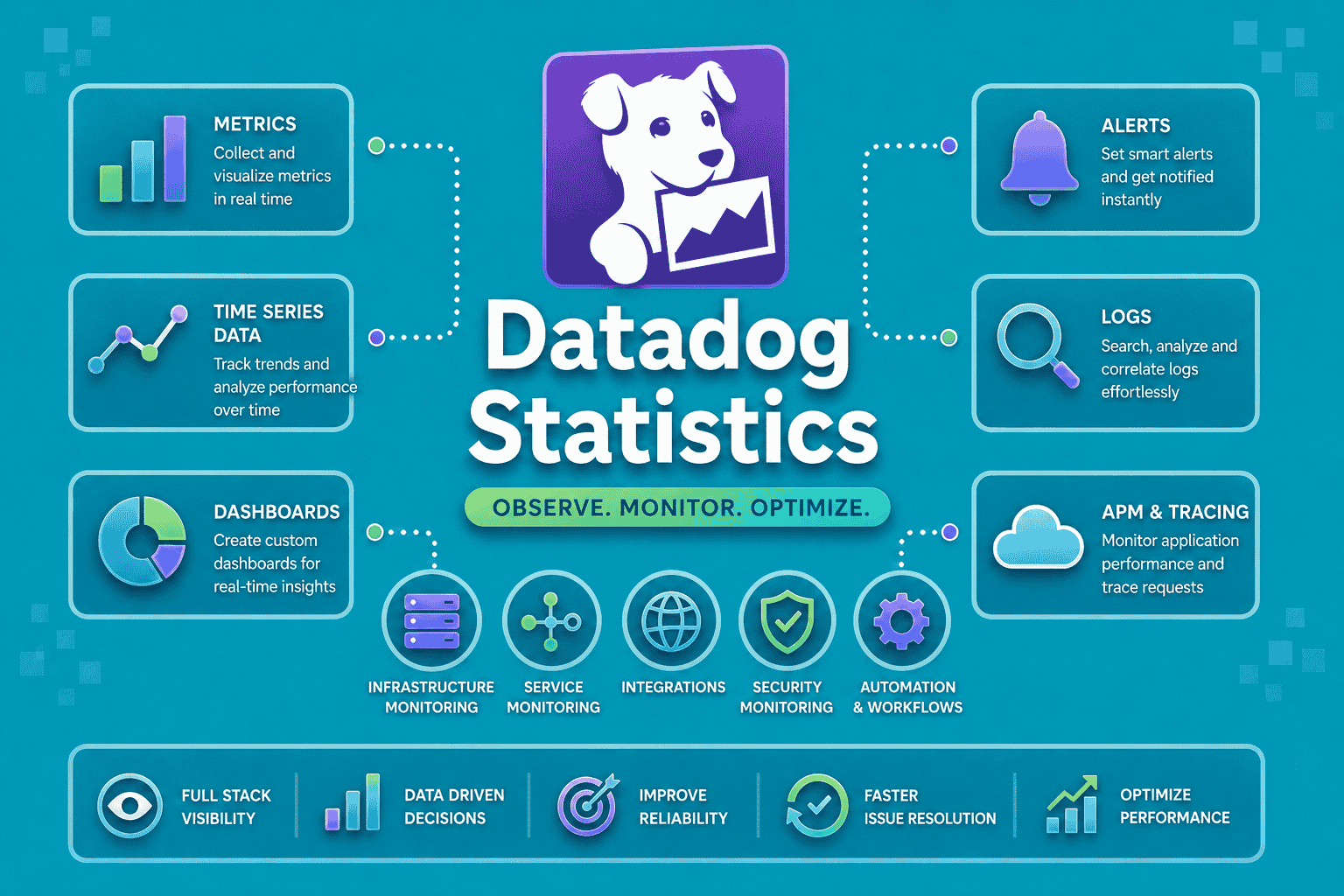

Datadog sits at the center of observability, cloud security, and AI operations spending. Datadog closed FY2025 with $3.43 billion in revenue and 32,700 customers, then started 2026 with $1.006 billion in Q1 revenue, up 32% year over year.
Its enterprise mix also kept deepening: Datadog ended Q1 2026 with about 4,550 customers at $100,000+ ARR and 603 customers at $1 million+ ARR, while cash, cash equivalents, and marketable securities reached $4.8 billion.
This article breaks down Datadog users, adoption, revenue, enterprise scale, competitive positioning, platform activity, geography, and market trends with current 2026 data.
Datadog Statistics 2026: Key Insights & Takeaways
- Datadog reported $3.427 billion in FY2025 revenue, up 28% from $2.684 billion in FY2024.
- The Q1 2026 revenue reached $1.006 billion, rising 32% year over year.
- The customer base grew to 32,700 by December 31, 2025, from 30,000 a year earlier.
- Datadog had about 4,550 customers with $100,000+ ARR in Q1 2026, up from about 3,770 a year earlier.
- Datadog ended FY2025 with 4,310 customers at $100,000+ ARR, and those accounts represented 90% of ARR.
- The $1 million+ ARR customer count reached 603 in FY2025, up from 462 in FY2024.
- Trailing 12-month dollar-based net retention was about 120% at the end of FY2025, versus the high-110% range a year earlier.
- Datadog ended Q1 2026 with $4.8 billion in cash, cash equivalents, and marketable securities.
Datadog Statistics 2026: At a Glance
| Metric | Figure |
| FY2025 revenue | $3.427 billion |
| Q1 2026 revenue | $1.006 billion |
| FY2025 operating cash flow | $1.050 billion |
| FY2025 free cash flow | $914.7 million |
| Q1 2026 cash and marketable securities | $4.8 billion |
| Total customers | 32,700 |
| $100k+ ARR customers | 4,550 |
| $1M+ ARR customers | 603 |
| Dollar-based net retention | About 120% |
| Integrations | 1,000+ |
| Observability market size (2026) | $3.35 billion |
Datadog Statistics : Deep Dive
1. Datadog Statistics 2026: User Statistics
At the end of 2025, Datadog had approximately 32,700 customers, up from 30,000 at the end of 2024.
The company has added customers consistently at scale. Revenue nearly doubled from $2.128 billion in 2023 to $3.427 billion in 2025, while the customer base rose from 27,300 in 2023 to 32,700 in 2025.
That combination signals that Datadog is growing both by adding new accounts and by expanding its footprint inside existing ones.
Datadog user growth over time
| Period | Total customers | $100k+ ARR customers | $1M+ ARR customers |
| Dec. 31, 2024 | 30,000 | 3,610 | 462 |
| Dec. 31, 2025 | 32,700 | 4,310 | 603 |
| Mar. 31, 2026 | N/A | about 4,550 | N/A |
By FY2025, Datadog’s 4,310 customers with $100,000+ ARR represented 90% of ARR, which means a relatively small portion of the customer base generates the vast majority of revenue.
By Q1 2026, that cohort had already climbed to about 4,550, an increase of 780 customers year over year.
2. Datadog Statistics 2026: Usage & Adoption Statistics
Datadog’s usage story is increasingly about platform breadth. The company reached 1,000 integrations in October 2025, and it said the integration footprint spans infrastructure, cloud services, security platforms, SaaS applications, and AI technologies such as NVIDIA and OpenAI. Check out our Open AI Statistics as well →
Datadog also said it had introduced dozens of new AI infrastructure and tooling integrations over the prior year.That breadth matters because observability buyers tend to consolidate around platforms with wide coverage.
Datadog’s pricing page shows how that broadening usage can translate into recurring spend:
- Universal Service Monitoring is priced at $15 per host per month on annual billing
- Continuous Profiler at $19 per profiled host per month
- Logs at $0.10 per ingested GB
- Custom Metrics at $5 per 100 custom metrics per month.
Security and AI usage are also becoming central to the platform. Datadog’s 2025 State of Cloud Security report found that 40% of organizations in its sample used data perimeters, 86% used multi-account within AWS Organizations, and 70% had all accounts in an AWS Organization.
In the same report, 59% of AWS IAM users, 55% of Google Cloud service accounts, and 40% of Microsoft Entra ID applications had access keys older than one year.
Datadog usage and adoption table
| Usage metric | Figure |
| Integrations | 1,000+ |
| New AI-related integrations in the prior year | Dozens |
| Organizations using data perimeters | 40% |
| AWS Organizations adoption | 86% |
| AWS accounts fully included in organization | 70% |
| Stale AWS IAM access keys | 59% |
| Stale Google Cloud access keys | 55% |
| Stale Entra ID access keys | 40% |
3. Datadog Statistics 2026: Audience Segment Statistics
Ramp’s observability data shows Datadog with 30% SMB adoption, 39% mid-market adoption, and 35% enterprise adoption. That means Datadog’s strongest public penetration is in the mid-market, with enterprise adoption close behind.
The same dataset shows Datadog is winning both new and switching customers. It had a 24% first-time adopter share and a 29% competitor switch rate, which suggests the platform is capturing both greenfield budgets and replacement deals.
In practical terms, roughly 1 in 4 first-time buyers in that dataset chose Datadog, and almost 3 in 10 switchers moved to Datadog from another observability vendor.
Datadog audience segment table
| Segment | Figure |
| SMB adoption | 30% |
| Mid-market adoption | 39% |
| Enterprise adoption | 35% |
| First-time adopter share | 24% |
| Competitor switch rate | 29% |
4. Datadog Statistics 2026: Revenue & Financial Statistics
Datadog’s financial profile remains unusually strong for an infrastructure software company. FY2025 revenue hit $3.427 billion, compared with $2.684 billion in FY2024 and $2.128 billion in FY2023. Operating cash flow rose to $1.050 billion in FY2025, and free cash flow reached $914.7 million.
Q1 2026 kept that momentum intact. Revenue was $1.006 billion, operating cash flow was $335 million, and free cash flow was $289 million.
Datadog also reported 1% GAAP operating margin and 22% non-GAAP operating margin in the quarter, which shows the business is still scaling into profitability while preserving high growth.
Datadog said its trailing 12-month dollar-based net retention rate was about 120% at year-end 2025, meaning the same customer cohort generated roughly 20% more ARR than a year earlier before counting new customers. That is a strong indicator of expansion inside existing accounts.
Datadog revenue and cash flow table
| Period | Revenue | Operating cash flow | Free cash flow | Notes |
| FY2023 | $2.128B | $660M | $598M | Revenue up 27% |
| FY2024 | $2.684B | $871M | $775M | Revenue up 26% |
| FY2025 | $3.427B | $1.050B | $914.7M | Revenue up 28% |
| Q1 2026 | $1.006B | $335M | $289M | Revenue up 32% |
Datadog also has clear pricing leverage across its product set. Logs cost $0.10 per ingested GB, Workload Protection is $15 per host per month on annual billing, and Cloud SIEM is priced at $5 per 1 million analyzed events per month.
Those usage-linked prices help explain why revenue can rise quickly once customers expand from monitoring into logs, security, and developer tooling.
5. Datadog Statistics 2026: Enterprise Adoption Statistics
Enterprise customers are doing most of the revenue work. Datadog ended FY2025 with 4,310 customers at $100,000+ ARR, and those customers made up 90% of ARR.
In other words, enterprise and upper mid-market accounts are not just an important segment; they are the revenue backbone.
The $1 million+ cohort is becoming more important each year. Datadog had 603 customers at $1 million+ ARR in FY2025, up from 462 in FY2024 and 396 in FY2023.
That is a jump of 31% year over year from 2024 to 2025, a pace that suggests large customers continue to standardize on more Datadog products over time.
The latest quarter adds another layer. Q1 2026 brought the $100k+ cohort to about 4,550 customers, which is 780 more than a year earlier. That shows the enterprise funnel is still healthy even as Datadog’s customer base becomes larger and more mature.
Datadog enterprise adoption over time
| Year | $100k+ ARR customers | Share of ARR | $1M+ ARR customers |
| 2023 | 3,190 | 86% | 396 |
| 2024 | 3,610 | 88% | 462 |
| 2025 | 4,310 | 90% | 603 |
| Q1 2026 | about 4,550 | Not disclosed | N/A |
6. Datadog Statistics 2026: Market Share & Competitive Statistics
In Ramp’s spend data, Datadog showed 33% adoption, compared with 10% for New Relic and 8% for Grafana Labs. It also posted 35% enterprise adoption, ahead of New Relic’s 16% and Grafana Labs’ 13% in the same dataset.
Switching behavior also favors Datadog. Ramp reported a 29% competitor switch rate for Datadog, which was second only to Sentry’s 39% in that category view.
That matters because switch rate is a useful sign of whether buyers are replacing incumbents with Datadog rather than simply testing it.
On the revenue side, Datadog remains larger than close public peer Dynatrace. Datadog reported $3.427 billion in FY2025 revenue, while Dynatrace reported $1.699 billion in FY2025 revenue and $1.734 billion in ARR.
Datadog’s larger top line does not translate directly into market share, but it does show the scale gap between the two public vendors.
Datadog also has strong analyst validation. The company said Gartner named it a Leader in the 2025 Magic Quadrant for Observability Platforms for the fifth consecutive year, reinforcing its position at the high end of the category.
Datadog vs. observability competitors
| Vendor | Public adoption / scale metric | Revenue / ARR metric | Position signal |
| Datadog | 33% adoption; 35% enterprise adoption | $3.427B FY2025 revenue | Gartner Leader for 5th straight year |
| Dynatrace | Not shown in Ramp adoption table here | $1.699B FY2025 revenue; $1.734B ARR | Gartner Leader |
| New Relic | 10% adoption | Not public here | Lower observed adoption than Datadog |
| Grafana Labs | 8% adoption | Not public here | Lower observed adoption than Datadog |
7. Datadog Statistics 2026: Developer / API / Platform Statistics
Datadog’s developer-facing story in 2026 is tied closely to AI operations. In its State of AI Engineering report, the company said it analyzed telemetry from customer LLM agent traces and found OpenAI held 63% share.
This is while Google Gemini and Anthropic Claude gained 20 and 23 percentage points, respectively, over the prior year.
The same report shows how quickly AI stacks are becoming more operationally complex. Framework adoption rose from more than 9% in early 2025 to almost 18% by early 2026, while 69% of input tokens were system prompts and only 28% of spans used cached-read tokens.
Those numbers suggest AI teams are now spending a large share of their effort on orchestration, prompt design, and cost control rather than model selection alone.
Reliability remains a major pain point. Datadog found that 5% of LLM call spans errored in February 2026, with 60% of those errors caused by exceeding rate limits.
In March 2026, 2% of spans errored and rate-limit failures accounted for nearly 8.4 million errors. Datadog’s Q1 2026 release also showed the platform broadening into adjacent developer and AI tools. The company launched MCP Server, Bits AI Security Analyst, GPU Monitoring, and Experiments for general availability.
They also released a State of DevSecOps report that found 87% of organizations were running software with known, exploitable vulnerabilities.
Datadog developer and AI telemetry table
| Metric | Figure |
| OpenAI share in sample | 63% |
| Gemini share change | +20 percentage points |
| Claude share change | +23 percentage points |
| Framework adoption | >9% to almost 18% |
| System prompts as input tokens | 69% |
| Cached-read token usage | 28% |
| LLM span error rate, Feb. 2026 | 5% |
| LLM span error rate, Mar. 2026 | 2% |
| March 2026 rate-limit errors | Nearly 8.4 million |
| Known exploitable vulnerabilities in software | 87% |
8. Datadog Statistics 2026: Regional / Geographic Statistics
Datadog’s revenue is still concentrated in North America, but international operations are significant. In FY2025, North America revenue was $2.433 billion, or about 71.0% of total revenue, while international revenue was $994.1 million, or about 29.0%. Revenue by location is based on customer billing address.
The company’s workforce is also globally distributed. Datadog said it had about 8,100 employees across 35 countries as of December 31, 2025, with about 44% located outside the United States and 34% of those outside-U.S. employees based in France.
Datadog geography table
| Geography metric | Figure |
| North America revenue, FY2025 | $2.433B |
| North America revenue share | 70.99% |
| International revenue, FY2025 | $994.1M |
| International revenue share | 29.01% |
| Employees across countries | 8,100 across 35 countries |
| Employees outside the U.S. | 44% |
| Non-U.S. employees in France | 34% of non-U.S. staff |
9. Datadog Statistics 2026: Market Trends & Industry Growth
Mordor Intelligence estimated the observability market at $3.35 billion in 2026, up from $2.9 billion in 2025, and projected it to reach $6.93 billion by 2031 at a 15.62% CAGR. That forecast aligns with Datadog’s own growth in customers, ARR concentration, and AI-focused platform expansion.
The broader demand drivers are increasingly AI and cloud complexity. Datadog’s own research says operational complexity, not model intelligence, is now the main barrier to reliable AI at scale.
The company’s platform updates in Q1 2026, especially GPU Monitoring, MCP Server, and Bits AI Security Analyst—show how observability vendors are repositioning around AI-era operational needs.
Datadog market trend snapshot
| Market metric | Figure |
| Observability market size, 2025 | $2.9B |
| Observability market size, 2026 | $3.35B |
| Observability market forecast, 2031 | $6.93B |
| Observability CAGR | 15.62% |
Conclusion
Datadog’s most important 2026 numbers are still moving in the same direction: $3.427 billion in FY2025 revenue, $1.006 billion in Q1 2026 revenue, and 4,550 customers above $100,000 ARR.
Add in 603 customers above $1 million ARR and 120% net retention, and the picture is of a platform that keeps expanding inside large accounts rather than relying only on new-logo growth.
The broader market signal is equally clear. Observability is still projected to grow at 15.62% CAGR through 2031, and Datadog is positioning itself for that expansion with 1,000+ integrations, AI-focused platform launches, and stronger enterprise penetration.
FAQ’s
Q: How many customers does Datadog have in 2026?
A: Datadog reported 32,700 customers at the end of FY2025. In Q1 2026, the company also disclosed approximately 4,550 customers generating more than $100,000 in annual recurring revenue (ARR).
Q: What is Datadog’s revenue in 2026?
A: Datadog reported $1.006 billion in Q1 2026 revenue after finishing FY2025 with $3.427 billion in annual revenue.
Q: How fast is Datadog growing?
A: Datadog’s revenue grew 28% in FY2025 and 32% year over year in Q1 2026. Its customer base also expanded from 30,000 to 32,700 customers over the same period.
Q: What are Datadog’s biggest enterprise statistics?
A: Datadog ended FY2025 with 4,310 customers generating $100,000+ ARR and 603 customers generating $1 million+ ARR. The $100k+ customer segment represented approximately 90% of total ARR.
Q: How many integrations does Datadog have?
A: Datadog surpassed 1,000 integrations in 2025, covering cloud infrastructure, SaaS platforms, security tooling, databases, developer workflows, and AI technologies.
Q: What is Datadog’s market share?
A: Ramp’s spend data estimated Datadog at 33% adoption overall and 35% enterprise adoption within observability tooling. While this reflects procurement penetration rather than total industry market share, it indicates strong enterprise adoption.
Q: Who uses Datadog most?
A: According to Ramp’s data, Datadog’s strongest adoption segment is mid-market companies at 39%, followed by enterprise organizations at 35% and SMBs at 30%.